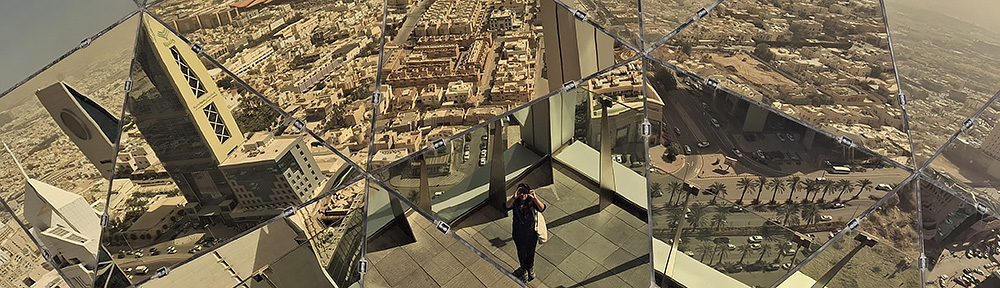
Coast, Hope, Moscow 400, Semipalatinsk-21, Station Terminal.
No, these are not names of multiple places. Instead, they are the multiple names of one single place, now known as Kurchatov, which for over four decades was not to be found on any public map. Located in present-day north-east Kazakhstan, the names were a trap to maintain its secret whereabouts and mislead potential spies at a time when the region was still part of the USSR.
As if this were not enough, those brought here through stringent checkpoints were routed via Moscow. The city’s residents, mainly nuclear scientists, truly believed they were still somewhere near the Soviet Union capital, even though their new homes lay 3,400 kilometres away.
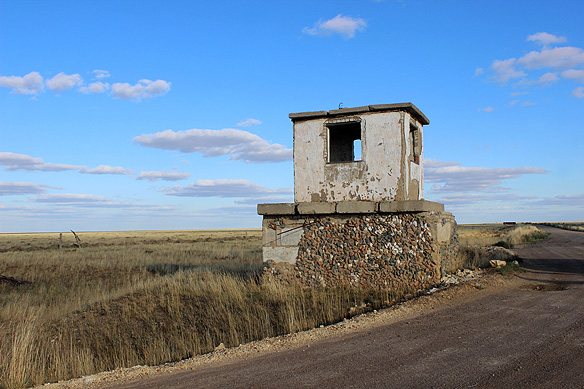
One of the many, now abandoned, checkpoints that once controlled access to Kurchatov and the adjoining nuclear test site.
Kurchatov: One of USSR’s most secretive and restricted cities
It was extremely difficult to enter Kurchatov, with family and friends of the scientists often having to wait for months to get permission to visit. It was not that easy to leave the city either. Life, however, within the cordoned off 16 sq. kms was comfortable to say the least, with the very best of amenities.
Founded in 1947, two years after World War II and in the aftermath of the Hiroshima and Nagasaki bombings, Kurchatov had a clear mandate from the outset. It was to be the secret centre of operations for the adjoining Semipalatinsk Nuclear Test Site popularly known as Polygon, a Russian term meaning ‘specialised land.’
![Hammer and sickle communist symbol on the facade of the former KGB office [Komitet Gosudarstvennoy Bezopasnosti, USSR’s Committee for State Security] in Kurchatov.](https://ramaarya.blog/wp-content/uploads/2024/09/rama-arya-polygon-17-1.jpg)
Hammer and sickle communist symbol on the facade of the former KGB office [Komitet Gosudarstvennoy Bezopasnosti, USSR’s Committee for State Security] in Kurchatov.
Russian spies had already informed Joseph Stalin that the US had nuclear powers. The 1945 bombings in Japan merely confirmed it. Determined not to be overpowered by the US, Stalin ordered Kurchatov to produce an atomic bomb by 1948.
Igor Kurchatov, the city’s namesake and father of the ‘Red Bomb’
Igor Kurchatov had not been Stalin’s first choice for this gigantic task. He was only 40 years old when hired, a naval engineer, and self-taught nuclear physicist. But it was Igor Kurchatov who turned the USSR into the world’s second nuclear power, and match the US in nuclear strength.
Seventy-five years ago, on 29 August 1949, USSR detonated its first atomic bomb in the Semipalatinsk Nuclear Test Site next to Kurchatov. Christened RDS-1/ First Lightning, it was a plutonium implosion bomb uncannily similar to Robert Oppenheimer’s Trinity bomb in the US. Both, its chemical make-up and design, were aided by feedback from Russian spies in America.
Determined to achieve the targets entrusted to him by Stalin, Igor Kurchatov had sworn not to cut his beard till the program succeeded. When RDS-1’s explosion echoed for miles across the barren steppes, he is said to have heaved a sigh of relief, but decided to keep the quirky beard, earning him the moniker ‘The Beard.’ Perhaps he felt the beard had brought him luck. Perhaps he thought it helped him be taken more seriously.
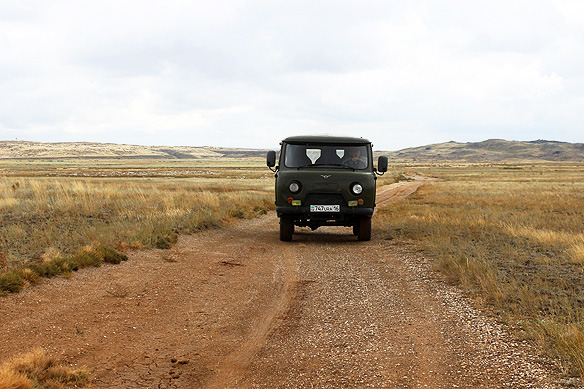
Soviet remnants: Kazakh guards at the Polygon in a UAZ-452. The four-wheel off-road van was originally designed for USSR’s military.

Polygon’s eerie landscape, stretching over 18,500 sq. kms of steppes, has witnessed 456 atomic bomb detonations amounting to an explosion yield 250 times larger than the Hiroshima bomb.
For the next forty years, 456 nuclear devices were exploded across the 18,500 sq. kms of steppes, coating its golden blades of grass with radioactive elements and impacting the health of those associated with the site.
Including that of Igor Kurchatov who died aged 57 of a blood clot which many believe was the result of a radiation leak at Ozyorsk in Russia.
The city which carried out his scientific instructions was later renamed in his honour. In more recent years, a red marble statue of his likeness was put up in the main square decked with blobs of flowers.
Polygon, the ‘specialised land’ which turned USSR into a nuclear superpower
Sixty kilometres away from Kurchatov, on a bumpy bedraggled road winding its way through the endless steppes, is the actual nuclear test site where the 456 bombs were built, refined, and exploded. Tests included their effects on buildings and people. Of these, 340 were underground and 116 atmospheric, meaning they were either dropped from planes or exploded directly on the ground.
The road to the site was not always this run-down. At one time, every single part of the site’s infrastructure was top-notch. Neither were all the tests carried out destructive and dark, aimed to destroy the earth and humanity. Some nuclear tests were carried out for civil engineering purposes as well.
One such was the Chagan Test on 15 January, 1965, aimed at enhancing irrigation. Since tests were constrained to subterranean levels after the 1963 Partial Test Ban Treaty, the 140-kiloton bomb at Chagan was placed deep in the bowels of the earth.
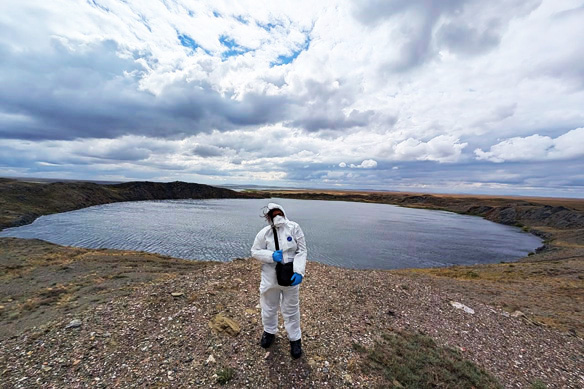
The explosion was so powerful it burst through the earth’s surface creating a 38-metre-high caldera around a 400-metre-wide and 100-metre-deep hollow lined with nonporous melted rock. This soon filled up with water from the nearby river and rainwater to form Chagan or Balapan Lake. Also referred to simply as the Atomic Lake.
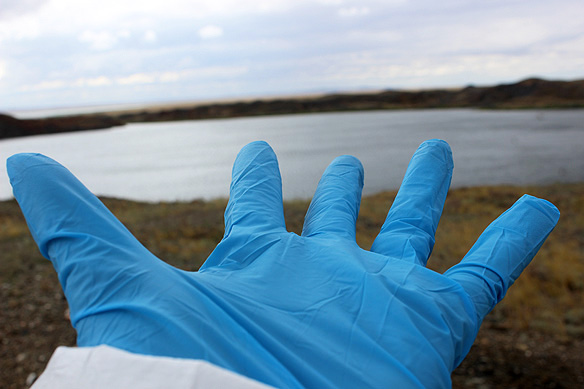
Bucket list. Polygon. Check. 🙂
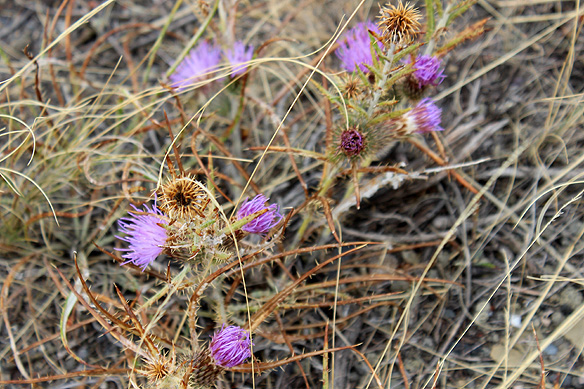
Flowers in Polygon’s arid wasteland. As if seeming to say, “Hope will bloom, wherever it can.”
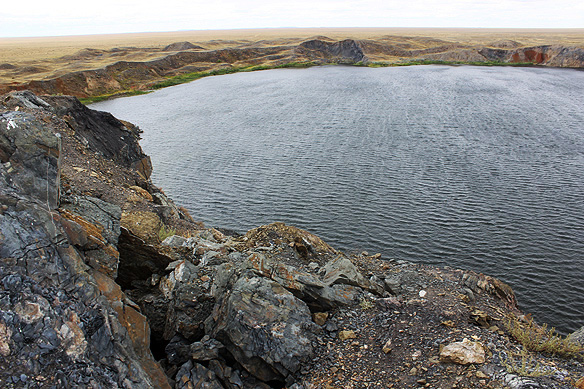
Atomic Lake, one of Polygon’s most unsafe areas was the result of an underground bomb that smashed through the earth’s surface. Ironically, it was created to test how nuclear power could be used for enhanced irrigation.
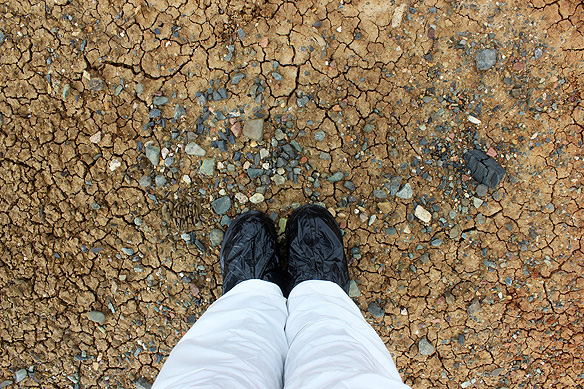
Radiation kills off everything as is illustrated on Atomic Lake’s shores.
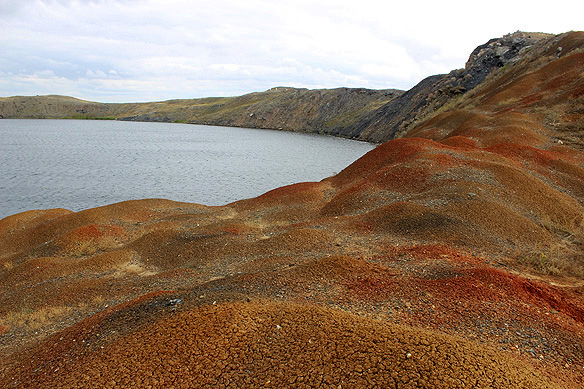
Walking along the lunar-like Atomic Lake on a two-hour hike over a 38-metre-high caldera flung out of the bowels of the earth. Except that this was no natural phenomenon.
Atomic Lake is also one of the areas at the nuclear test site where radiation levels are still at the highest, though within safety levels.
Concentration of beta particles at the lake is about 30 percent of safe level whilst gamma emission is within safe level, close to its maximum value. These numbers spike at the shores. In several spots it is triple of safety standard, but still far lower than in the case of atmospheric tests which are at 0.6 to 3.6 mcSv per hour. In comparison, at the test fields, gamma emission goes up to 24 mcSv per hour.
To put things in context, level 0.5 to 1.2 is considered as safe. Excess is acceptable for short periods, as radiation effects are cumulative. The longer one is exposed to it, even in a safe area, the more harm it can cause.
Dressed in PPE outfits, gum boots, FFP2 masks, and surgical gloves, the hike around the lunar-like Atomic Lake is surreal and grim, and comes with strict instructions. I was not allowed to touch the ground or raise any dust whilst walking. Though the radiation levels at the lake will not kill anybody on a 2-hour hike, it is still an experience that gets etched in one’s mind. Forever. The silence, emptiness, and bellowing winds seem to question human actions.
Other key sites within the Polygon are the Command Centre which was connected to Polygon’s eight test districts, and remains of both Inter-Continental Ballistic Missile (ICBM) launchers and enormous underground laboratories.
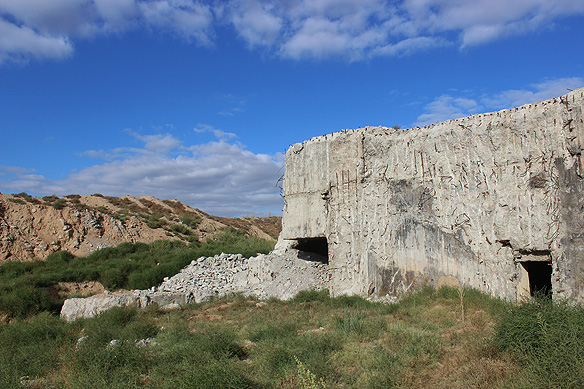
Semipalatinsk Nuclear Test Site’s Command Centre coordinated the activities of all eight test districts. When the site was disbanded in 1991, its closure included blasting of its buildings. What was left was scavenged by looters in the subsequent years.
![A notice on the wall inside the Command Centre [above the door] reads, "Pass to the security before leaving."](https://ramaarya.blog/wp-content/uploads/2024/09/rama-arya-polygon-10-1.jpg)
A notice on the wall inside the Command Centre [above the door] reads, “Pass to the security before leaving.”
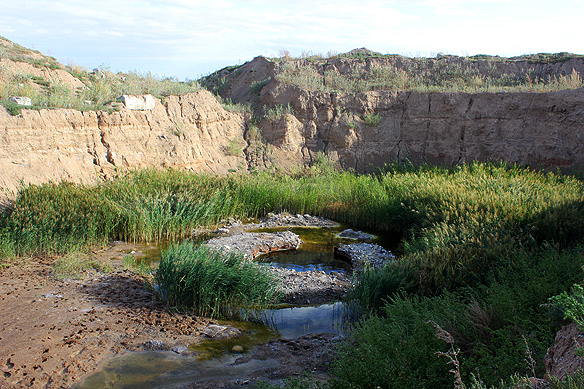
Inter-Continental Ballistic Missile (ICBM) launchers formed part of Polygon’s experiments. The ones in this image were used to check their effectiveness if ever surrounded by explosions in a real war scenario.
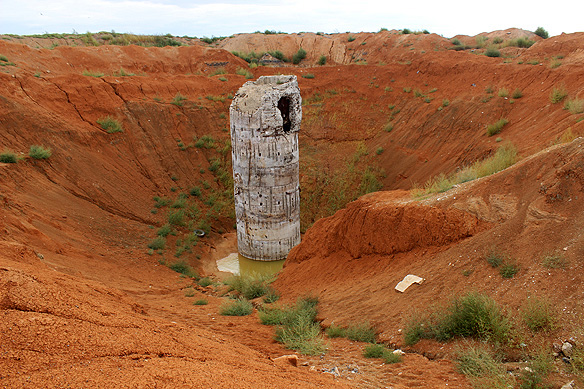
Underground laboratory to test subterranean explosions. The scalloped hollow around the monumental concrete edifice was created by looters looking for treasures. Nope, there was no gold to be found for all the effort! But instead, they did get their hands on lots of copper wires.
Chagan airbase, to take Polygon’s bombs to their targets if required
Somewhere between Kurchatov and Semey is an often-overlooked echo of this period in modern world history: remnants of the Chagan airbase. An operating air force base with its own mission, the garrison patrolled the Chinese border and extreme North. It was intentionally built near the Polygon as a test of resilience and to be able to draw on nuclear stock if the need were to arise.
Consisting of a 4-kilometre-long runway which could double up as an emergency landing for a Soviet space shuttle if necessary, bomb shelters hidden under mounds of earth, and fuelling depots—the airbase was kept on 24/7 high alert for four decades in case of a World War III. Next to it is a derelict ghost town which once housed the large garrison and their families.
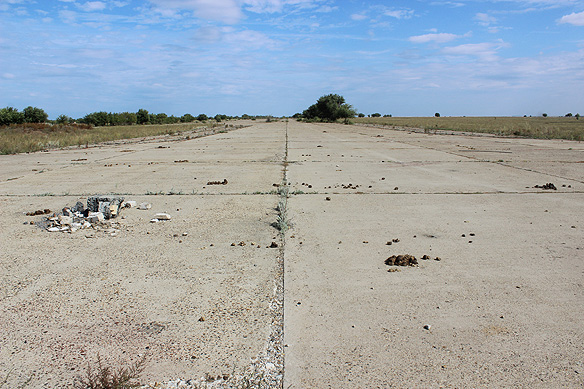
The 4-kilometre-long runway at Chagan airbase.
![Enormous concrete pits [17 in total] at the Chagan airbase served as refuelling tanks.](https://ramaarya.blog/wp-content/uploads/2024/09/rama-arya-polygon-18-1.jpg)
Enormous concrete pits [17 in total] at the Chagan airbase served as refuelling tanks.
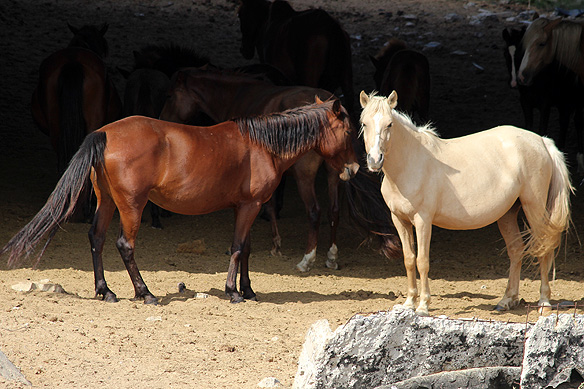
Where once bombs were sheltered, now wild horses take shelter.
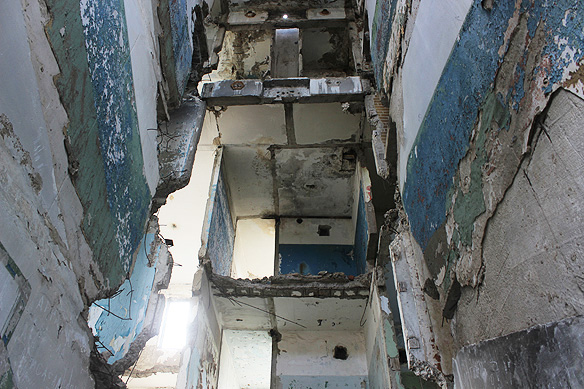
Homes of the Chagan airbase garrison with collapsed staircases were stripped bare after they were abandoned in 1994. Just 30 years ago, there were families and children living here.
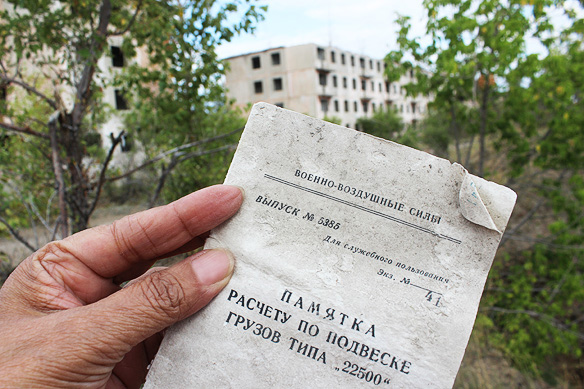
Look what showed up at the Chagan airbase’s housing blocks: A crew manual on attaching type 22500 load for airborne missiles or bombs.
Beginning of the end
Within 14 years from the first fateful explosion on 29 August, 1949 in the Polygon, world politics had changed to a new, more chillingly dangerous footing. The Cold War [which lasted from 1947 to 1991] was now in full swing.
Despite US’ huge dominance over the USSR in terms of the former’s combined number of nuclear weapons, the USSR had found a way to counter the threat. It started to increase the capacity of each device, culminating in the Tsar Bomba in 1961, the world’s most powerful nuclear bomb ever created. 3,800 times the size of the Hiroshima bomb, it was tested in the Barents Sea, Arctic Ocean, at the Novaya Zemlya Test Site. By 1963, the USSR had also become capable of planting atomic bombs in space given its leadership in the space industry.
These two developments prompted the US to negotiate, though it still was ahead in the nuclear arms race. In August 1963, the USSR, USA and United Kingdom signed a treaty in Moscow on the prohibition of testing nuclear weapons in atmosphere, outer space, and underwater. In addition, the USSR committed to not place nuclear weapons in space either.
Even so, the treaty neither stopped the production of nuclear devices nor their testing. It simply constrained it to the underground across the world, battering the earth, henceforth, from below.
In tandem with the USSR’s later fall, the Polygon ceased to operate by 1989. On 29 August, 1991, Kazakhstan’s first President Nursultan Nazarbayev signed the decree to officially close the site and proposed that 29 August be earmarked as the International Day Against Nuclear Tests.
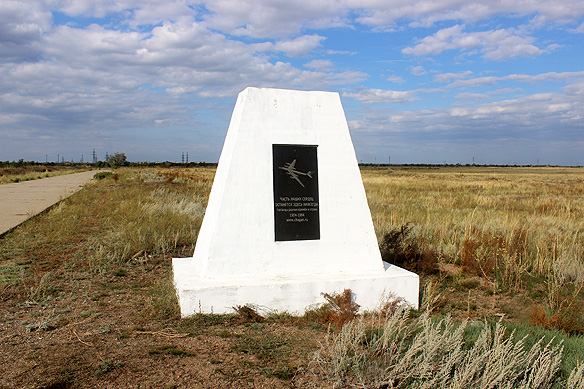
“Part of our hearts remain here forever.” The Chagan airbase memorial was put up by its residents who came from different parts of the world and called this neck of the woods their home for forty years.
Following close in its heels, the Chagan airbase was abandoned too, leading to an exodus of both the scientists and pilots. The latter left behind a memorial outside their airbase that reads:
“Part of our hearts remain here forever. People of Chagan of different times and countries. 1954 – 1994.”
The aftermath, today, 75 years later
A walk around Kurchatov today reveals abandoned looted USSR buildings, the square with the city’s namesake, and atomic research offices in which scientists continue to study nuclear reactions.
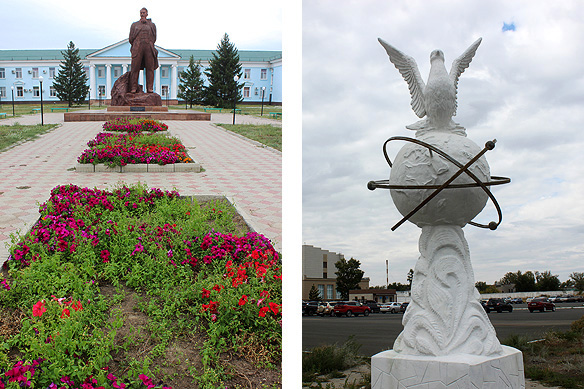
Left: Statue of the city’s namesake Igor Kurchatov, ‘Father of the Soviet Bomb,’ with the former headquarters of the Semipalatinsk Nuclear Test Site in the background; Right: Peaceful Atom Monument in Kurchatov honouring atomic energy for peace.
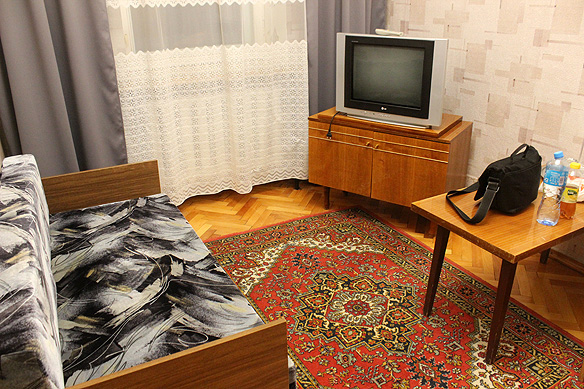
Lounge area of my suite at Hotel Mayak—straight out of the 1970s. Apparently, the idea was put across during COVID to refurbish and update the hotel’s décor. But the plan was rejected. Instead, the management decided to freeze an era in time.
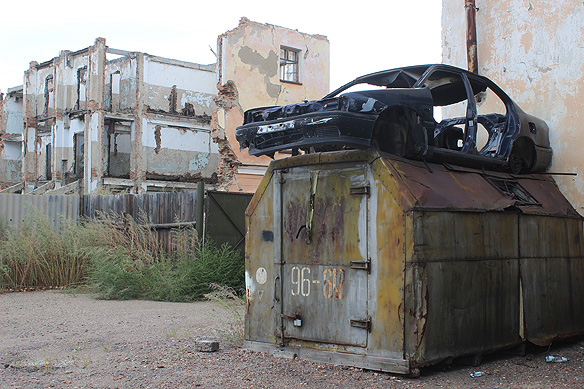
I did not know what to make of this. Like, how did that car land up on the roof of the shed. And why??
![The Gostinitsa [meaning guesthouse] for scientists dates to 1953.](https://ramaarya.blog/wp-content/uploads/2024/09/rama-arya-polygon-15-1.jpg)
The Gostinitsa [meaning guesthouse] for scientists dates to 1953.
Meanwhile, the Polygon and Chagan airbase lie in ruins, repeatedly scavenged for their metal components since their closure in the 1990s. A solitary shoe, a section of a Rubik’s Cube, an instruction manual for a missile bomb peep through the rubble as one wanders past and through the endless shells of poker-faced apartment blocks in Chagan. Horses take shelter in the airbase’s bomb shelters, and gales beat vehemently around the Atomic Lake.
Post the country’s independence in 1991, the Kazakhstan Institute of Atomic Energy manages Kurchatov’s nuclear facilities. Research is presently focussed on how to reclaim the large swathes of wasteland for agriculture and mining use, with the most dangerous parts sealed off.
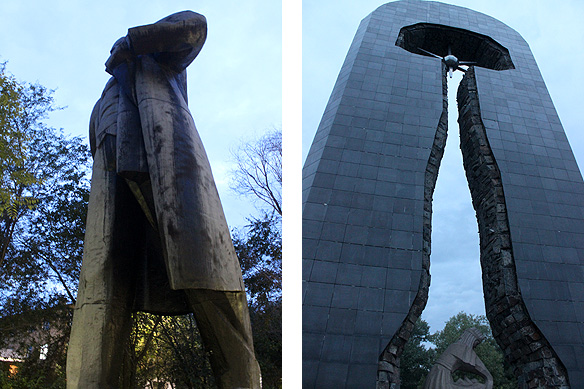
Kazakhstan’s tallest Lenin monument and the ‘Stronger Than Death’ atomic mushroom monument in Semey.
Back in Russianised Semey, 140 kilometres away and containing the nearest airport and railhead, two monuments sum up the area’s raison d’etre. Kazakhstan’s tallest statue of Vladimir Lenin and the ‘Stronger Than Death’ atomic mushroom monument.
It took one man’s ideology, namely Lenin’s, to shake the world, dividing it into two major power blocs for the foreseeable future. Kurchatov and the Semipalatinsk Nuclear Test Site are the tangible extent to which the subsequently created ‘I’ versus ‘We’ and ‘Capitalism’ versus ‘Communism’ beliefs can culminate in.
Polygon, because not all travels are about beautiful places. Some are about world politics, groupism, and war games too.
– – –
This post has been written with inputs from my local guide Yerlan Shegenov [WhatsApp No. +7 701 788 3579; Email: Shegenov@gmail.com], and by referring to multiple sources as listed below and those linked to in the text.
Recommended reading:
Igor Kurchatov, Nuclear Physicist, Russia [Atomic Heritage Foundation]
Radiation Levels at Atomic Lake on 2 September 2024
Semipalatinsk Test Site [Nuclear Threat Initiative]
The Semipalatinsk Legacy
UN NEWS SPECIAL REPORT: ‘Ground Zero’ at the Former Semipalatinsk Nuclear Test Site in Kazakhstan
www.dark-tourism.com
Note: Special permits via registered tour companies are needed to visit the Polygon. It cannot be done independently. I explored this leg of my 14-day Kazakhstan travels with a 4-day tour run by Young Pioneer Tours.
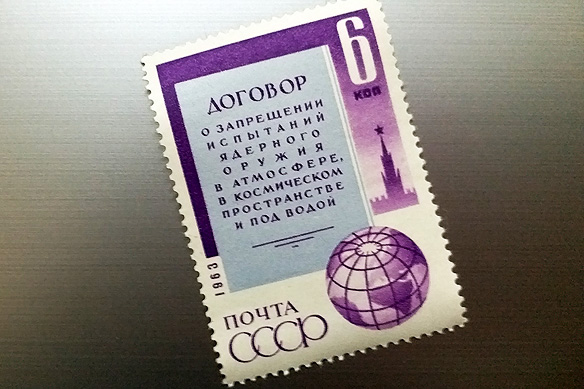
Polygon souvenirs. This 1963 Soviet Union stamp, gifted to me by my guide Yerlan, commemorates the 1963 Partial Test Ban Treaty.
 rama toshi arya's blog
Grim, but fascinating!
LikeLiked by 1 person
Well said. It was the first time I was visiting a site such as this and the enormity of what happens behind the scenes and ordinary everyday life was a reality check.
LikeLiked by 1 person
I would never have imagined any of these places would be open to visit.
LikeLiked by 1 person
Lots of permits needed. 🙂
LikeLiked by 1 person
I can well imagine.
LikeLike
It looks like an eerie place to visit with such a horrific history. And yet flowers grow and horses run wild. Maggie
LikeLiked by 1 person
Yes, and that is what comforted me too … That the positive always finds a way to shine through.
LikeLiked by 1 person
Stunning piece, backed so evidently by meticulous research. Fantastic longform piece that mingles travel blogging with a history writing almost. Brilliant.
LikeLiked by 2 people
Thank you so much! It’s a sensitive subject and a political one as well. Thus wanted to ensure it was a factual post. A task made easier by a fantastic guide who helped me understand a topic I had very little exposure to before visiting the Polygon.
LikeLiked by 1 person
Honestly Rama ji, I think it’s one of your best works till date.. Brilliantly articulated and accentuated with beautiful frames. A photo exhibition of your work would perhaps do justice to the effort. 👏🏻👏🏻
LikeLiked by 4 people
Thank you so much! I don’t know about the photo exhibition, but do appreciate the compliment. 🙂 You must visit the Polygon if you get a chance. I think you would find it particularly interesting.
LikeLiked by 1 person
Wow! This is like a Cold War period novel married to a science fiction fantasy! It’s fascinating but I’m tickled that this was on your bucket list!
LikeLiked by 4 people
Hehe. My bucket list is one eclectic mixed bag. 😁 Am happy you enjoyed the post. 💕
LikeLiked by 2 people
Pingback: travel guide: the six untold treasures of kazakhstan’s silk road heritage | rama toshi arya's blog
Pingback: travel guide to the american war | rama toshi arya's blog