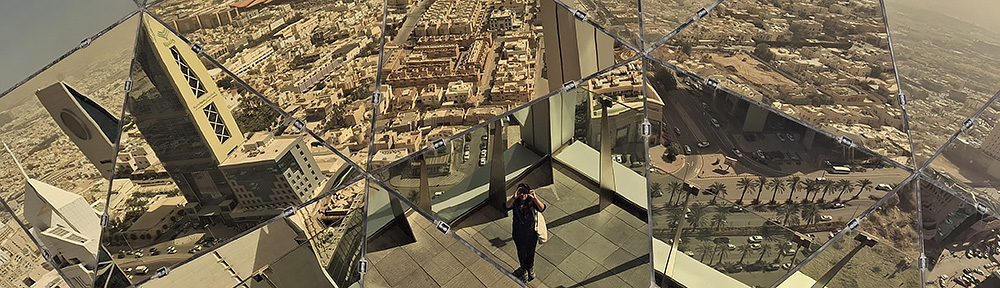
Nizwa, Oman’s 17th Century capital
I found myself blinking hard. And then blinking again. A little dazed. Bewildered is perhaps a better word. Was this for real? Was it indeed the 20th of December, 2024, or had I by some unexplained miracle time-travelled a good few centuries back?
Around me was a scene pulled right out of a medieval Arabian livestock souq. Sellers in pastel dishdashas were running around a ring. First with their goats, and then their cows, in tow. On either side of this parade were buyers in crisper, whiter dishdashas calling out if a particular animal caught their interest.
What followed next was a thorough examination of the selected livestock’s teeth, gums and hooves, and some hard-core bargaining. At times the seller won, at times the buyer, and the mute creature swapped masters. Often nothing materialised till another early Friday morning, when a display would again be put on show.
There were a handful of foreigners in the periphery, looking on, as amazed as me. Just like maybe a Marco Polo or Ibn Battuta did when witnessing a similar scene.
The business on hand was, however, completely unaffected by the cameras or gasps. There were more important things to focus on for these gentlemen. Would that goat be an asset? Would he be able to resell that cow for a profit? It’s a stock market in its most basic form wherein livestock are sold and resold every week.
In a couple of hours, the hullabaloo simmered down. The sellers and buyers dispersed. Showtime was over.
Did the end of the spectacle bring me back to the present? Not exactly. For next to the Friday traditional livestock souq were the 17th Century Nizwa Fort and Castle, the latter predating the fort by a few decades. Both built by the Ya’rubid dynasty, rulers of Oman from 1624 to 1742 who had made Nizwa, a historical city built over a stream and trade crossroads, their capital.

Nizwa Fort dates to the middle of the 17th Century. Built on the orders of Imam Sultan bin Saif Al Ya’rubi, the enormous earth-filled stone tower took 12 years to complete.
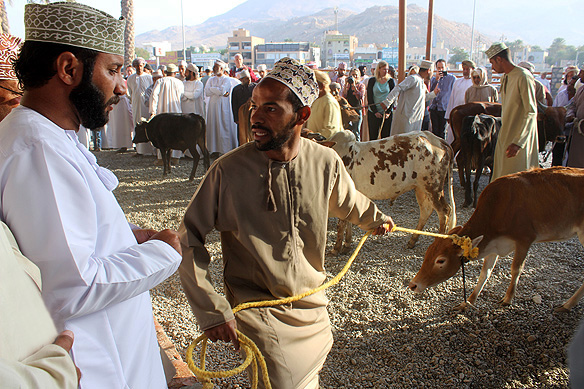
Hard selling in Nizwa’s Friday traditional livestock market where goats and cattle are traded much as they have been done for hundreds of years.
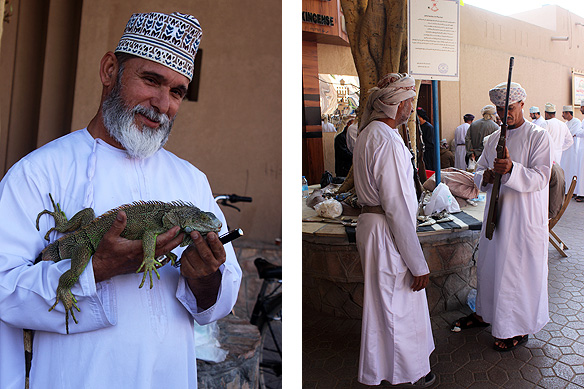
Left: Not for sale. A shopkeeper and his pet iguana selling Rolex watch knockoffs; Right: The guns and daggers makeshift stall in Nizwa Souq.
This was not the first time for Nizwa—it had been the capital of Oman earlier as well, fostering trade and scholarship in the 6th and 7th Centuries. It was also on these soils that Islam was first introduced into Oman. Most of its populace have since then been Ibadi Muslims; a separate sect founded in 692 AD which is neither Sunni nor Shia.
Nizwa Fort is often considered to be Oman’s most impressive, with an enormous mud-filled stone circular tower 45 metres in diameter rising 34 metres into the air, built on foundations 30 metres deep into the earth. A dark narrow zig-zag staircase winds its way up with concealed trap-doors and overhead openings through which burning hot oil was poured on enemies. If the enemy could still get past all these attempts on their life, there was no escaping the large garrison and armoury stationed on the fort’s rooftop.
Though the trap-doors are now shielded with thick glass, I still leapt over them. In fear that should the glass break, I would be plunged into darkness.
I wonder how many did do in the distant past …
Nizwa Castle is more homely with some 62 furnished rooms spread over two storeys for the Imam and his family’s personal and official use. Devout supporters of learning, there was even a section for visiting Islamic scholars to board and discuss theology, science, and the mysteries of the universe aided by a well-stocked library.
Huddled around the fort and castle is a renovated souq where I felt I was finally back in the present amidst carefully packaged Omani goodies. But on walking past a sign that read East Souq, I was again flung back in time into the oldest part of the market where heady fragrances of frankincense and halwa wafted through the air and white kummas with intricate embroideries lined the walls.
I noticed a familiar face amongst a group of men haggling over guns and daggers in a makeshift stall under a tree. I had met its owner in the Sinaw Souq. I tried to catch his eye, and once I succeeded, made a quick wave, whispering “Sinaw.” He broke into a grin and nodded.
For one wonderfully, warm fuzzy moment, I transitioned from a traveller to being part of the fabric of the city. Hey, I even knew the travelling tradesmen doing the rounds of weekly markets!
[Click on any image below to enlarge it and start a slideshow. Use the arrow keys to navigate through the set and read the captions.]

![A meeting room [majlis] in the Nizwa Castle.](https://i0.wp.com/ramaarya.blog/wp-content/uploads/2025/01/nizwa-2.jpg?w=190&h=190&crop=1&ssl=1)


Muscat, Sultan Qaboos’ capital
Dynasties rise and fall, and when new dynasties take their place, they invariably chalk out their own capitals. The Ya’rubid dynasty who had Nizwa as their capital fell in 1742, and in its place came the Al Said dynasty who jumped between the trio of Muscat, Rustaq, and Zanzibar. Till eventually Muscat won. For keeps. But it was in 1970 that Muscat’s destiny really jumpstarted.
Oil had been discovered recently and the coffers were full. Local Omanis tell me, with deep reverence in their voices, that when their Sultan Qaboos bin Said Al Said came to power, he told his people progress would be step by step. There were to be no overnight transformations. No ditching of old traditional Omani ways for homogenous steel, glass, and glitz. Health, education, and welfare were to be the priorities.
This ideology applied to the country at large, whose name he changed from Sultanate of Muscat and Oman to simply Sultanate of Oman. And more so to the capital Muscat, the 2,000-year-old port city mentioned by both the ancient Greeks and Romans, and hemmed in by the Hajar Mountains and Sea of Oman.
Muscat is different from other Middle Eastern capitals. In a palpable way. Courtesy of late Sultan Qaboos’ rules which became its blueprint during his reign from 1970 to 2020: no high rises and all edifices to be painted in sparkling white or creamy ivory. The rationale being it would keep the city cooler and airier under the harsh yearlong sun. It is a practice that is still stringently followed by the current Sultan Haitham bin Tariq.
The city is equally quick to point out that though it may be taking it slow, it is not without its grand show-stoppers, namely, the Sultan Qaboos Grand Mosque and Royal Opera House Muscat.
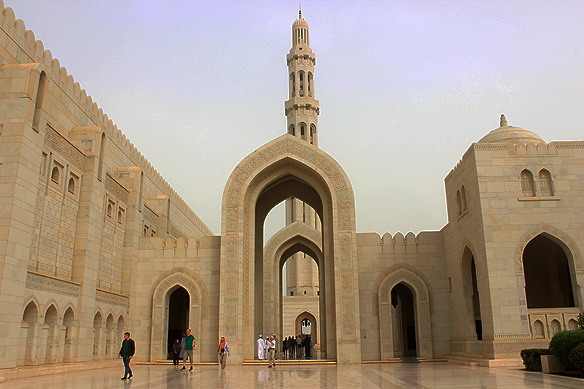
Sultan Qaboos Grand Mosque’s staggering statistics: 416,000 sq. metres, 20,000 worshippers, five minarets, and a Persian carpet with 1,700 million knots.
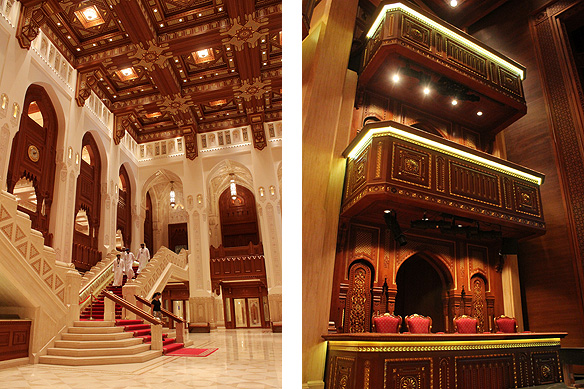
State-of-the-art Royal Opera House Muscat, with a seating capacity of 1,100 people, was late Sultan Qaboos’ gift to the city, along with the Grand Mosque.
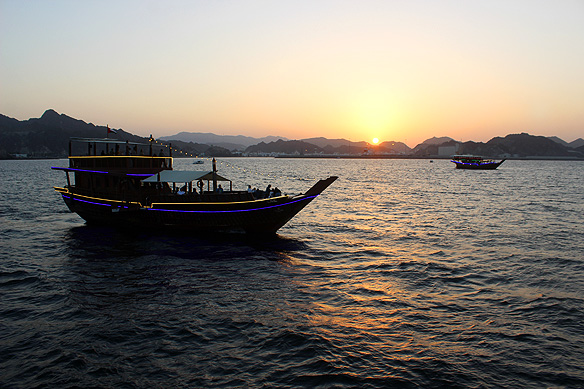
Dhows from Muttrah plough the waters of the Sea of Oman at sunset: a mandatory Muscat experience.
Let the numbers do the talking here. Oman’s largest mosque with five soaring minarets opened its doors in 2001 after six years in the making. The design, selected through a competition, encompasses 416,000 sq. metres and seats 20,000 worshippers. Its main prayer hall is the show-stopper’s show-stopper with gigantic chandeliers and a single-piece Persian carpet made of 1,700 million knots. The Royal Opera House Muscat, meanwhile, is about striking red velvet elegance for an audience of 1,100, wrapped in white marble that shimmers like glass. Especially at night.
How much did they cost? No one knows and no one tells. “They are a gift from the late Sultan to us!” is all that is said with a grateful smile.
After much gawking in awe at these monumental structures, I had begun to think I’d figured out Muscat. I could not be more wrong. Time travel was intrinsic to Oman.
Muttrah, Muscat’s port by the sea is frozen in the 1970s and 80s, filled with museums housing Omani artefacts and royal palaces. I looked a little closer and there were even older sections. One of the Arabian Peninsula’s earliest souqs next to the corniche and a 16th Century Portuguese fort perched atop a low hill.
It did not take me long to explore Muttrah. From poking around Bait Al-Zubair, a museum dedicated to Omani heritage and culture to a pit-stop outside the bright blue and gold Al-Alam Palace where the late Sultan Qaboos resided when in Muttrah, and is now a ceremonial palace for welcoming foreign dignitaries. On to getting lost in the souq’s ancient labyrinth selling all kinds of wares and finding my way again on the 2-kilometre-long corniche flanked by medieval homes, ocean-themed sculptures, and a photogenic mosque.
I was feeling peckish by the end. Oman’s 42 percent expatriate community of which a big chunk is from the Indian subcontinent, has its perks for the Indian traveller. It seemed the most natural thing to get myself a karak chai and some onion bhajia [fritters], and then plonk myself on the corniche overlooking the ultramarine blue waters of the Sea of Oman.
Step by step. The late Sultan Qaboos had obviously got it right. 😊
[Click on any image below to enlarge it and start a slideshow. Use the arrow keys to navigate through the set and read the captions.]


![Qasr Al-Alam Palace [1972], late Sultan Qaboos' royal residence in Muttrah.](https://i0.wp.com/ramaarya.blog/wp-content/uploads/2025/01/muscat-3.jpg?w=190&h=190&crop=1&ssl=1)


![Mohammed Al-Ameen Mosque [2014], one of Muscat’s largest mosques.](https://i0.wp.com/ramaarya.blog/wp-content/uploads/2025/01/muscat-11.jpg?w=190&h=190&crop=1&ssl=1)

– – –
[This blog post is part of a series from my 12-day travels across Oman in December, 2024. To read more posts in my Oman series, click here.]
 rama toshi arya's blog
Interesting information on the old capitals and souqs. I believe there’s a lot of natural aquatic and scenic beauty as well for travellers to enjoy there.
LikeLiked by 2 people
Yes, yes, absolutely. Oman is very scenic! My previous two posts are about it. You might find them interesting too. 🙂
LikeLiked by 1 person
Your Oman blogs have been fantastic! I would love to visit this part of the world some day!
LikeLiked by 1 person
Thank you, Anna. Oman is very authentic. Whether it is the people, the history or the landscapes. I hope you get to experience it for yourself in person some day. 🙂
LikeLiked by 1 person
Oman has been one of those countries I’m very intrigued about because despite being a GCC member, it sounds so different from the rest. It’s good to know how the current sultan still retains the previous sultan’s policies, especially concerning the integrity of Omani’s traditional architecture set against the country’s natural setting.
LikeLiked by 1 person
It is definitely different! I will be honest I did not know what to expect when I went. I was not sure if all those who had told me Oman was different were right, and if they were, whether it was still “different” keeping in mind the rapid pace countries and cities tend to change nowadays under the guise of development. But Oman was easily one of my most authentic travel experiences to date. Thanks to the vision of both its Sultans and very hospitable Omanis. 🙂
LikeLiked by 1 person
Fascinating post! Especially loved the slide show pics. The livestock market description is detailed and vivid. Enjoyed reading the post very much!
LikeLiked by 1 person
Thank you! The livestock market was a highlight of my travels to Oman, somewhere on the top of the list. What made it extra special was its timelessness and that it was so untouristy. But then Oman is still very untouristy. I hope it stays that way. 🙂
LikeLike
Great read and beautiful captures! Really interesting to explore Oman through your post! 😍
LikeLiked by 1 person
Thank you, Jyothi. Oman was lovely. Easily one of my favourite places I have travelled to. 🙂
LikeLiked by 1 person
thank you for these captured moments, streetphotography at its finest!
LikeLiked by 1 person
Thank you so very much for your kind words. Really appreciate it. 🙏
LikeLike
considering a trip to Oman myself—think you may have sold me. Wonderful photos.
LikeLiked by 2 people
Thank you! Oman is beautuful. When planning, try and include a few days in Salalah. It is completely worth travelling across the country for. 🙂
LikeLike