Not far from Moscow lies a ring of UNESCO-listed historical towns where the Russian nation, religion, arts, and architecture first took shape a thousand years ago under the rule of the Rurik dynasty. Frozen in time, these towns are a far cry from the enormity of Moscow. But their legacy has survived a millennium, through the cold-blooded Mongol onslaught and despite Soviet industrial atheism, forming the blueprint of what is intrinsically ‘Russia.’
Here are the finest of those towns. Achingly beautiful, and steeped in history and traditions, no visit to Russia is truly complete without them. And it is not just me who thinks so. The locals will vouch for it too. ❤️
1. SERGIEV POSAD, HOME TO RUSSIA’S MOST SACRED LAVRA
One of only two lavras in Russia, the highest title granted by its Tsars to a monastery, the Trinity Lavra of St. Sergius in Sergiev Posad is the country’s penultimate spiritual centre. Streams of pilgrims and tourists alike pass through its fortress-like 3.5-metre-thick walls everyday which contains within its folds 700 years of Russian history and some of the finest gems in Russian architecture.
Its beginnings were humbler though. When founded in 1337 by the monk Sergius of Radonezh, it was a simple wooden church deep in the woods. In 1380, his disciple the Great Prince of Moscow Dmitri Donskoi came to ask of him his blessings for the upcoming battle to drive away the Mongols. Dmitri won the battle, and Sergiev’s prestige multiplied manifold.
Over the centuries, Russia’s Tsars built some 50 structures in the complex, adding further to its sanctity and stature. Ivan the Terrible commissioned the Cathedral of the Assumption in 1559 to celebrate his victory over Kazan, whilst Peter the Great funded the ornate refectory in 1686. Sergius himself, canonised in 1422, lies in a silver shrine inside Trinity Cathedral, the ensemble’s first limestone building.
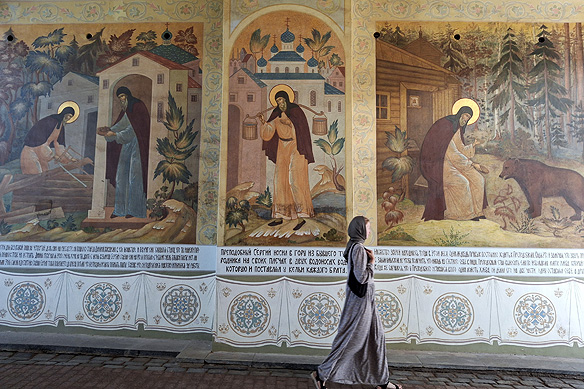
A series of frescoes illustrate the legend of St. Sergius of Radonezh. Russia’s patron saint and founder of the Trinity Lavra of St. Sergius, he is credited with uniting the Russian princes to overthrow the Mongols in 1380.
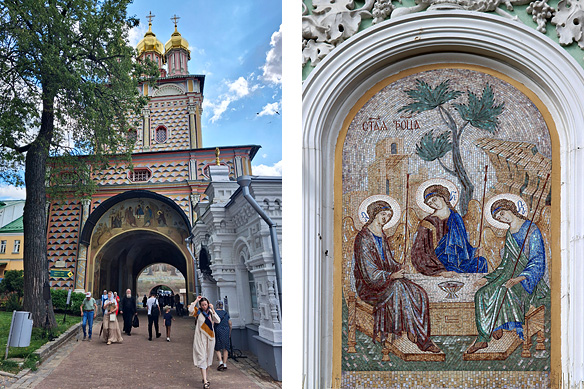
Left: Gate Church dedicated to Nativity of St. John the Baptist [1693-99] built by the Stroganoff family; Right: Mosaic of Andrei Rublev’s masterpiece ‘The Trinity’ on the main entrance. The original 15th Century icon is in Trinity Cathedral’s iconostasis.
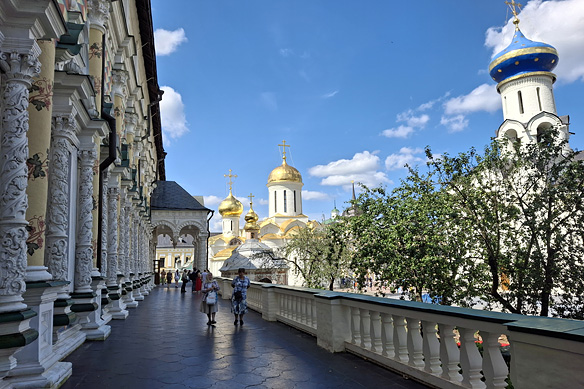
Peter the Great funded the monks’ refectory as a token of gratitude for the refuge given to him during the Streltsy Revolt. At its eastern end is the gold-leafed Church of St. Sergius.
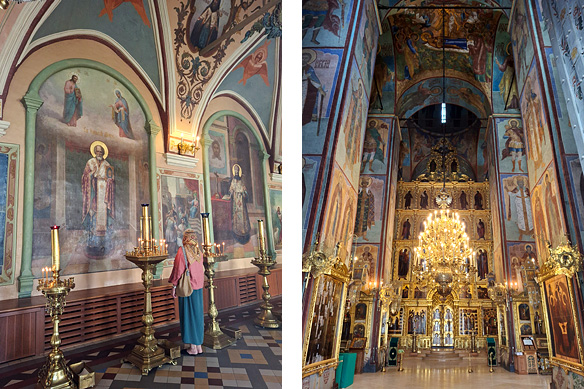
Left: Inside Peter the Great’s monks’ refectory; Right: Inside Ivan the Terrible’s Cathedral of the Assumption.
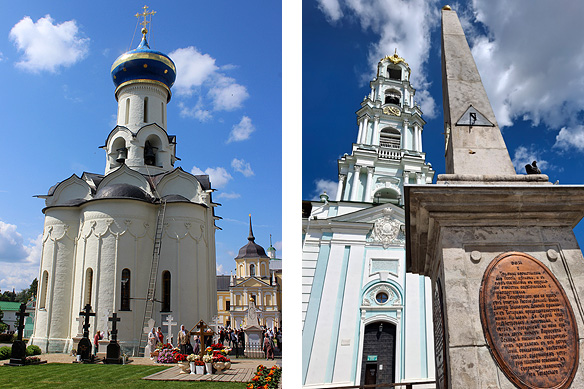
Left: Holy Spirit Church [1476]; Right: Peter the Great’s daughter Empress Elizabeth’s baroque 88-metre-high ice-blue bell-tower [1740-70] with a 1792 obelisk in the foreground.
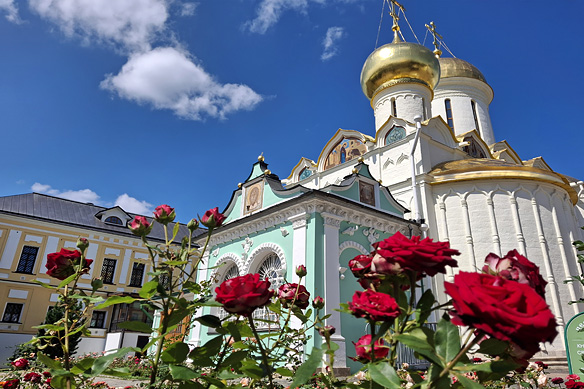
Trinity Cathedral [1422], the monastery’s oldest stone building and centrepiece, contains the relics of St. Sergius.
2. SUZDAL, CROWNING GLORY OF RUSSIA’S GOLDEN RING
When a town’s name teeters between the Russian word for ‘wolf’ [because wolves roamed the area in medieval times] and ‘song of a young girl’ [because the girls working in its fields sang with the most lilting voices], expect the unusual. Suzdal is picture-perfect pretty.
The air is so clean, its thirty 17th-18th Century limestone churches glitter in luminous white and a patchwork of reds and oranges, surrounded by deep green meadows under a piercing blue sky. If the colours are not enough to stop you in your tracks, its 1,001-year-old history and UNESCO-listed sites will. An open-air museum, Suzdal is the crowning glory of Russia’s Golden Ring, a group of historic cities north-east of Moscow.
Founded in 1024, the 15 sq. kms settlement has resolutely stayed within its city gates, frozen in space and time. In addition to the picturesque churches are strings of low wooden log-houses, five splendid fortified monasteries and convents, a 12th Century Kremlin by Prince Yuri Dolgorukiy which predates the one he built in Moscow, with a magnificent Cathedral of the Nativity in its centre. Icing on the cake? A Museum of Wooden Architecture with traditional buildings brought in from across the region, including fairy-tale churches, furnished log-houses, and soaring wind-mills.
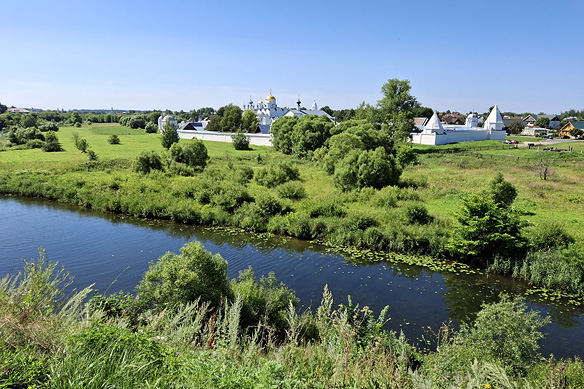
Convent of the Intercession as seen from the Monastery of the Saviour and St. Euphemius [1352]. Peter the Great, and before him multiple other Tsars, had their better halves incarcerated at this convent.
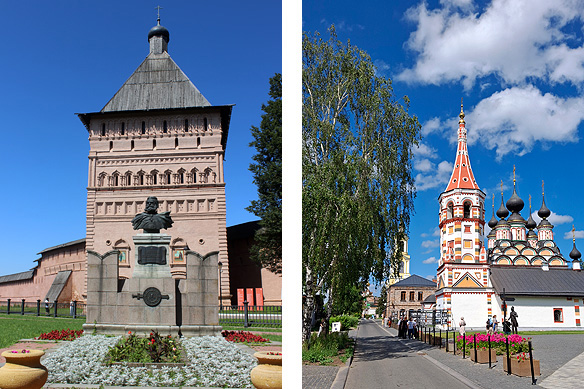
Left: Monastery of the Saviour and St. Euphemius was once the richest monastery in the area; Right: St. Antipus and St. Lazarus Churches. Numerous 17th-18th Century churches sponsored by local merchants dot the entire town.
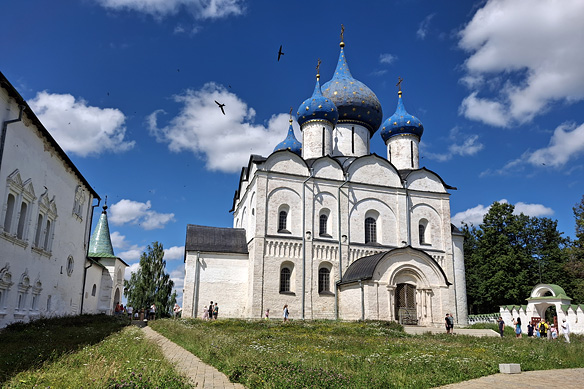
13th Century Cathedral of the Nativity with its five star-spangled domes in Suzdal’s 12th Century Kremlin.
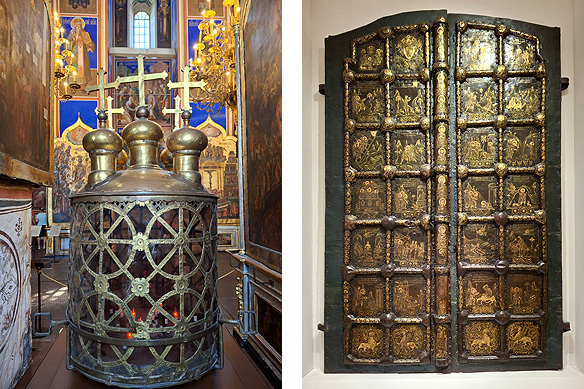
Treasures of the Cathedral of the Nativity. Left: 17th Century portable copper lantern shaped as a 5-domed church; Right: Gilded copper ‘Golden Doors’ etched with Biblical scenes in the museum housed in the Archbishop’s Palace next door.
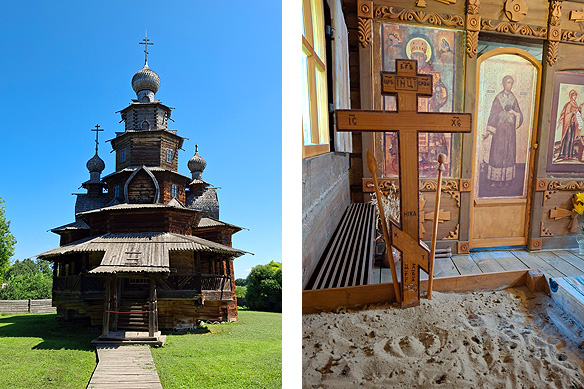
In Russia, before stone, there was wood, and even after stone, there was wood. The 1756 Church of the Transfiguration [left] and inside the 1776 boat-shaped Church of the Resurrection in Suzdal’s Museum of Wooden Architecture.
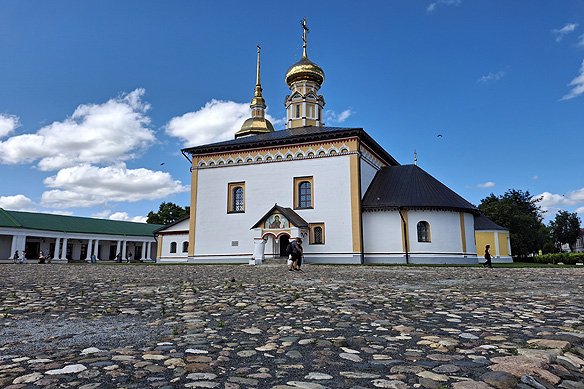
Wrapped in a time-warp: The 800-year-old Market Square aka Trading Square with the Church of the Resurrection.
3. VLADIMIR, RUSSIA’S HISTORICAL CAPITAL
A popular Russian name meaning ‘master of the world,’ three Vladimirs are often credited as the cornerstones of the country. Vladimir the Great, the country’s Christian Orthodoxy baptiser; Vladimir Lenin who transformed the world’s largest kingdom into the world’s largest communist nation; and Vladimir Putin, modern Russia’s Head of State since 2000. The latter two, in all likelihood, were named after the first Vladimir.
Vladimir the Great was a Grand Prince of Kievan-Rus [as Russia was known till the Mongol invasions] who in 988, after converting to Christian Orthodoxy, baptized the entire nation en masse. Russia never looked back after that. Based in Kiev, Vladimir also founded a military outpost and named it after himself.
His descendent Andrei Bogolyubskiy [r. 1157 – 1174] moved the capital to Vladimir, setting in motion the city’s path to greatness. Up came the UNESCO-listed monumental limestone gold-capped Cathedral of the Assumption and lacelike Cathedral of St. Demetrius, and a Golden Gate evocative of Jerusalem’s. For a brief 29 years, the Nativity of the Virgin Monastery he founded even served as the centre of Russian Christian Orthodoxy. Had the Mongols not devastated the city in 1238, Vladimir may perhaps have been Russia’s capital today.
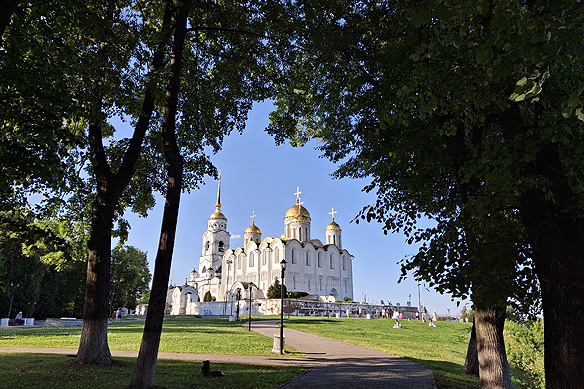
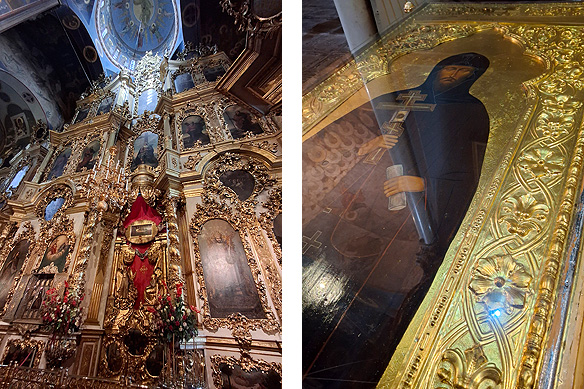
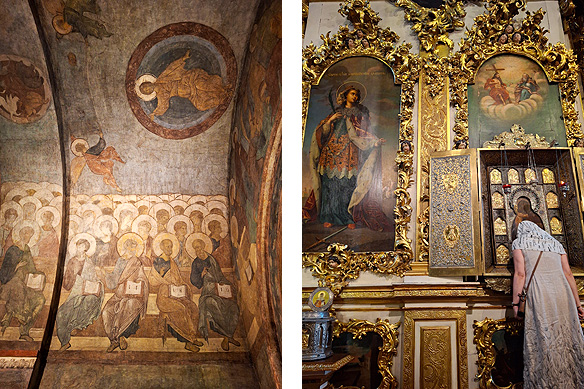
Built by Prince Andrei Bogolyubskiy between 1158 and 1160, and thereafter added to, restored, and rebuilt over the centuries, the towering cathedral is an eclectic mix of styles interspersed with royal tombs. The exuberant baroque iconostasis is Empress Catherine’s gift in 1774. Look closely and you may well see her likeness in the icon of St. Catherine. In stark contrast is Andrei Rublev’s 1408 masterpiece: The Last Judgement fresco.
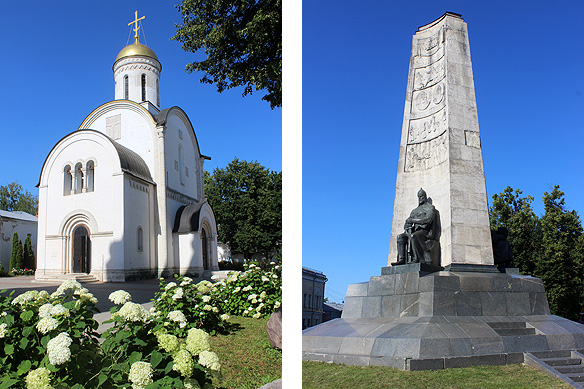
Left: St. Alexander Nevsky, a military leader, was interred at the Nativity of the Virgin Monastery in 1263, before being shifted to St. Petersburg in 1723 by Peter the Great who saw him as his predecessor; Right: ‘Monument to Vladimir 850 Years’ in the Cathedral Square depicts a warrior, architect, and worker [1960].
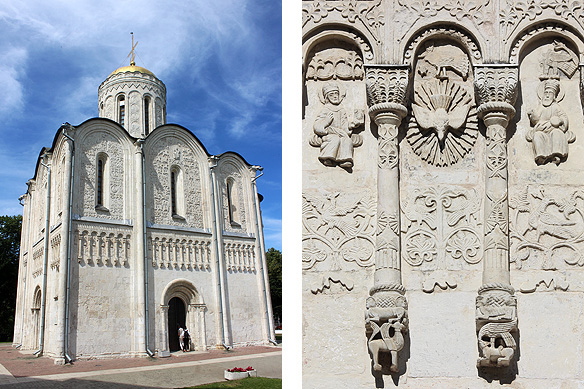
Meant for the personal use of Prince Vsevolod the Big Nest, the Cathedral of St. Demetrius built in the 1190s is covered with over a thousand limestone carvings. The royal cubic church is a perfect blend of harmony, beauty, mythology, and craftsmanship.
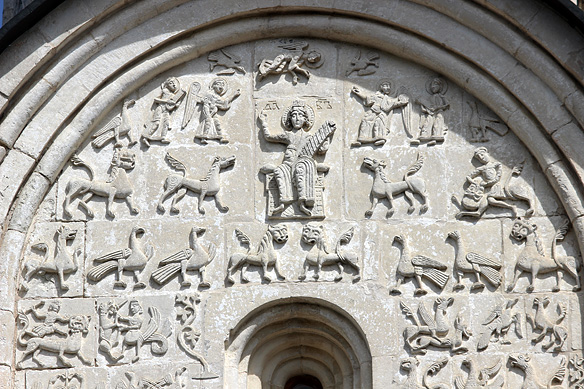
King David, the central figure on three facades of the Cathedral of St. Demetrius, is seen surrounded by lions, centaurs, snow leopards, and mythical creatures. Meanwhile Alexander the Great, the Labours of Hercules, and an enthroned Vsevolod with his sons make guest appearances.
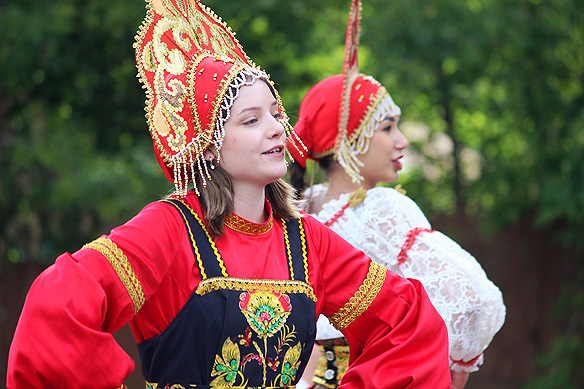
Folk dancers at the Vladimir Cherry Festival that was taking place during my visit.
4. VELIKY NOVGOROD, BIRTHPLACE OF RUSSIA
What happens when a 12th Century principality decides to adopt democracy? It elects or ousts its prince as deemed necessary, putting him up in a palace on the outskirts of the city, and a citizens’ assembly formed of local nobles starts to run the show. It was a natural progression for Veliky Novgorod, birthplace of Russia on the banks of Volkhov river, established in 859 AD.
It was here in Veliky Novgorod that Rurik, a Viking, was invited three years later to lead the local Slavs, paving the way for 736 years of Rurik dynastic rule. It was also here that the prototypes of Russian secular and religious art and architecture took birth in the form of the first Kremlin, and first stone church [St. Sophia’s Cathedral]. One of the few Russian cities to escape the Mongol strikes, 37 sites in and around Veliky Novgorod are presently included in UNESCO’s World Heritage List.
At its height, the independent city-state spread from the border of present-day Estonia in the west to the Ural Mountains in the east. Its membership of the Hanseatic League between the 12th and 15th Centuries, a trade alliance with western Europe, brought incredible wealth to its citizen merchants who decorated the city with numerous churches at Yaroslav’s Court. Unfortunately, Moscow’s Ivan the Terrible, who saw Veliky Novgorod as a rival, razed the city and its citizens in 1570. Veliky Novgorod never regained its past glory after the massacre.
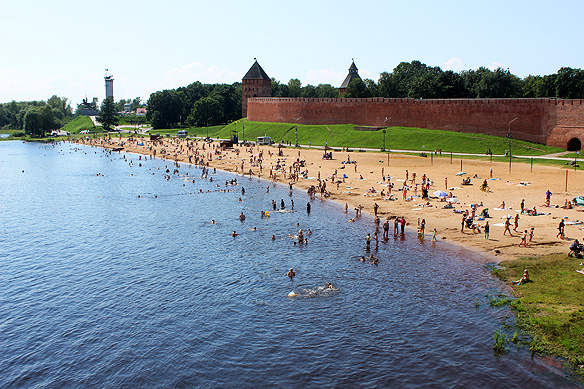
Sun, sand, and a river beach with Russia’s very first Kremlin in the background. The current fortifications belong to the 15th Century.
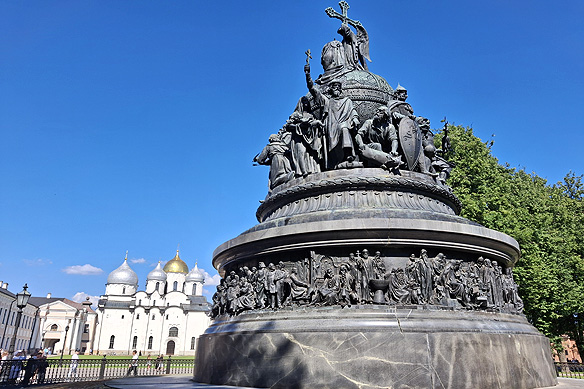
The Millennium Monument was installed in 1862 to celebrate Veliky Novgorod’s 1,000th anniversary. Decorated with key figures and events from Russia’s past, it is a crash course in the country’s rich history.
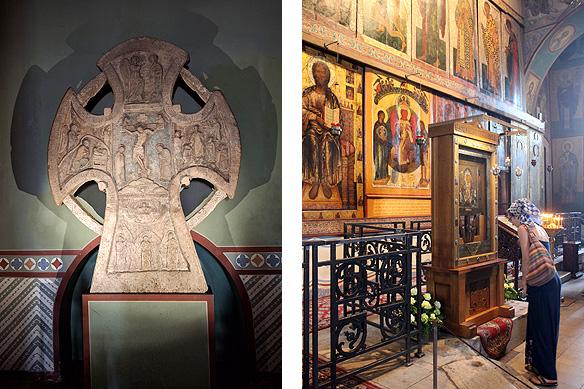
Cathedral of St. Sophia inside the Kremlin dates to 1045. Nearby is the Museum of History, Architecture, and Art with a fabulous collection of icons and medieval letters written on birch bark; the latter pointing to a literate society.
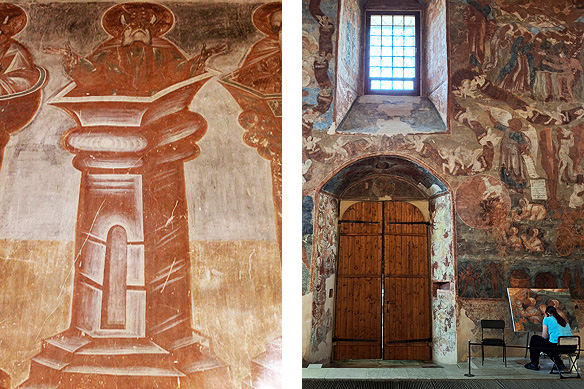
Art abounds in Veliky Novgorod’s churches. Left: Theophanes the Greek’s Old Testament Trinity painted in 1378 in the Church of the Transfiguration [1374]; Right: An art student at work in the Znamensky Cathedral/ Cathedral of the Icon of Our Lady of the Sign [1682].
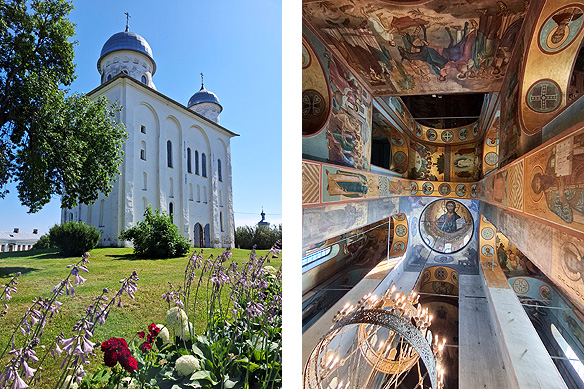
Yuriev [St. Gerorge’s] Monastery is Russia’s oldest monastery, founded in 1030. Its stone church, St. George’s Cathedral, dates to 1119.
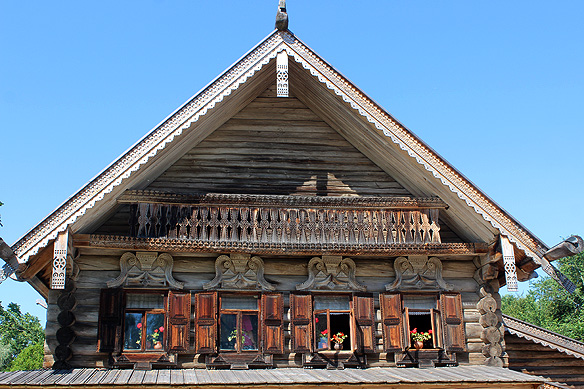
Veliky Novgorod’s open-air Vitoslavlitsy Museum of Wooden Architecture showcases traditional folk architecture from Russia’s north. Made without nails, all these structures can be pulled apart and reassembled, which is what was done when shifting them here for posterity.
5. BOGOLYUBOVO, A PRINCE’S GIFT IN HONOUR OF OUR LADY
Amongst all of Russia’s ethereal historical cities, Bogolyubovo’s rise and fall stands out for being inexorably tied to just one gentleman: Prince Andrei Bogolyubskiy of Vladimir. According to legend, one night as the prince rested at this very same spot in 1158, he had a vision of Mary, the mother of God. In this dream, she instructed him to set up a settlement, monastery, and church in memory of his son Izyaslav who was killed fighting against the Bulgars.
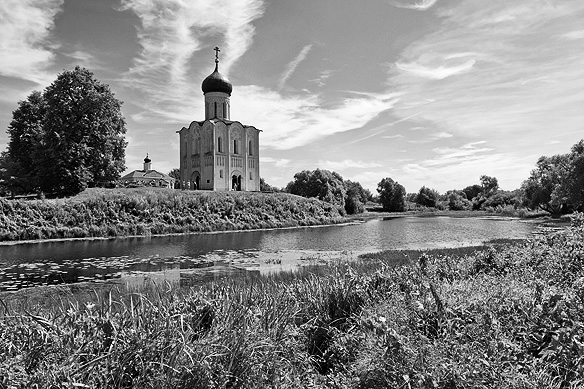
Up came Russia’s architectural jewels—one of Russia’s earliest limestone churches, the Church of the Intercession on the Nerl river’s floodplain and a grand Palace in the hinterland in which the prince himself lived. But Bogolyubovo fell apart after the prince was murdered by conspirators on the palace staircase in 1174, and died out completely post the Mongolian raid in 1238. By some miracle, the UNESCO World Heritage Sites of the 12th Century Church of the Intercession and parts of the palace have survived to this day. Almost as if Our Lady herself had decided to protect what she had asked to be built.
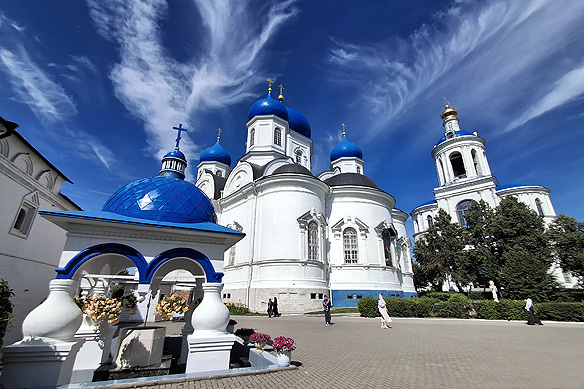
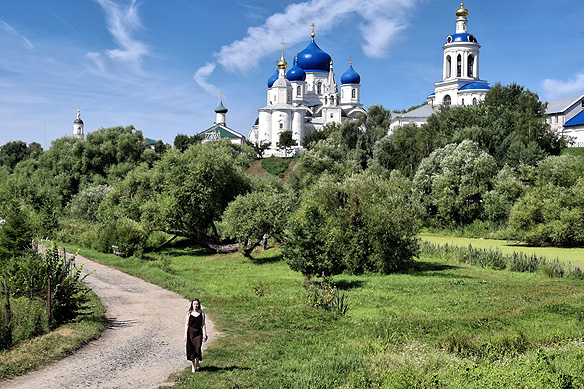
The blue-domed shrine to the left is believed to be the site where Prince Andrei Bogolyubskiy had his vision of the Virgin Mary. Behind it is Our Lady of Bogolyubovo Cathedral [1855].
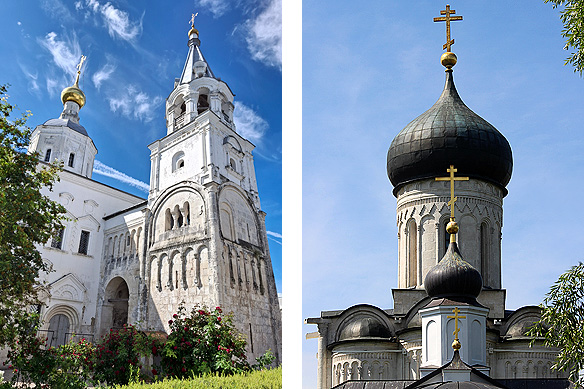
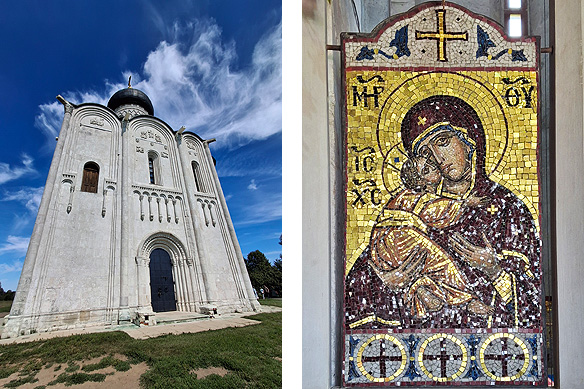
Just over a kilometre away from the monastery and the prince’s palace is the Church of the Intercession. Located on the mouth of the Nerl river, it served as the gateway to Vladimir. Middle left: Surviving section of the palace where Prince Andrei Bogolyubskiy was murdered in 1174.
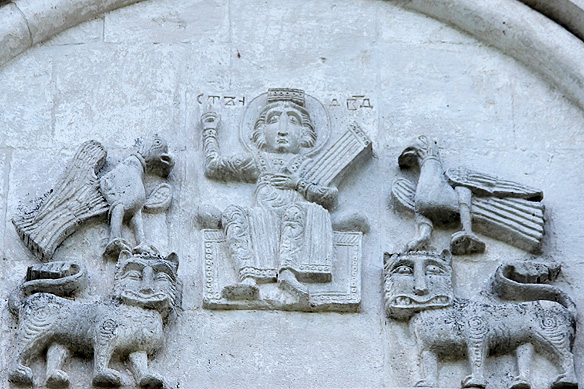
Bas-reliefs of King David surrounded with mythical creatures on the Church of the Intercession’s limestone facade.

When it rains, the Nerl river floods and the Church of the Intercession [then closed to visitors] appears to float on the water.
I hope you enjoyed this post. Coming up next week is Travel Shorts: Jewelled Eggs and Quirky Surprises Fit for a Tsarina. 🙂
– – –
Travel tips:
- Sergiev Posad: I visited it en-route to Vladimir from Moscow. My guide was an official monastery guide.
- Vladimir: I stayed at the Vladimir Hotel. My guide for Suzdal, Vladimir, and Bogolyubovo was Klestova Elena, +8(910)1884931, helenproud@mail.ru.
- Veliky Novgorod: I stayed at the Volkhov Hotel. My guide Marina was an official city museum guide.
[I travelled solo across Russia in July-August, 2025 for 30 days. Due to sanctions, international cards do not work in Russia and western travel portals do not list services for Russia. My central hotels, seamless transfers, and private tours with some of the best guides I have ever had, were all arranged by Go Russia. Highly recommended!]
 rama toshi arya's blog
Wow, what beautiful photographs taken in perfect weather of such magnificent buildings and art works. Its remarkable how they have survived the troubles of Russian history and obviously been lovingly restored. I never got to see these towns on my visits to Russia and my plans to do so will never now be fulfilled but its great to see and hear your experience of them. Thanks Rama
LikeLiked by 5 people
Am glad you liked it. Russia is one of the most beautiful countries I have travelled to. So much incredible art and architecture, and the people so warm and kind. Thank you for reading the post. 🙏
LikeLiked by 2 people