It is evening and I am watching the news. Missiles are tearing through Western Asia in a war that is well into its 23rd day. Feels strange it was only a few weeks ago I was exploring the Kingdom of Saudi Arabia.
Never had I felt safer than in the futuristic cities of Riyadh and Jeddah. Or discovering the mysteries of UNESCO-listed Hegra and Jubbah. Or clambering over the butter smooth gigantic rocks of Shada Mountain and locking eyes with hundreds of camels at Buraidah, the world’s largest camel market, with a pit stop at the ancient port city of Yanbu on the Red Sea thrown in to add some blue into the desert mix.
All these were incredible parts of the Kingdom, but what’s Saudi Arabia without Mecca and Medina. And so, it was for me.
As a non-Muslim I did not have access to the former; Medina was the closest I could get to the heart of the Islamic world that encompasses 2 billion people, with every fourth person in 2026 being a Muslim. In spite of not being a part of the Hajj pilgrimage or its lesser sibling, the Umrah, any journey to Mecca is deemed incomplete without a visit to Medina. Even the names of the two holy cities are often taken in one breath!
When the Prophet Muhammad was forced to leave Mecca in 622, he migrated [the Hijra] to Medina, then known as Yathrib, to become its political, military, and spiritual ruler on its tribal leaders’ request. Medina became the world’s first Muslim state, its residents, the first Muslims in the world and the year 622, the beginning of the Islamic era and Islamic calendar [Hijri]. It was from Medina that Islam eventually spread across the world with the conversion of Mecca taking place in 630.
Irrevocably tied to the Prophet Muhammad, even the name Medina, literally meaning ‘the city’ was bestowed on it by him.
Mosques and sites associated with the events from the 7th Century still dot the city. Grander, newer, but their significance no lesser.
I made my way to Archers’ Hill where one of the key battles with Mecca [Battle of Uhud] was fought in 625, flanked by Masjid Sayed Al Shouhada and the Martyrs’ Cemetery. Then it was on to Masjid Quba, Islam’s first mosque built by the Prophet in 622 soon after his arrival in Medina. According to Islamic tradition, praying here is the equivalent of an Umrah in Mecca.
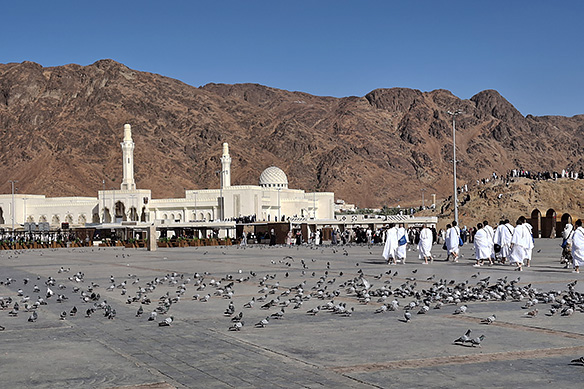
Mount Uhud with Archers’ Hill to the right was the site of a key battle with Mecca in 625, before the latter converted to Islam in 630.
![Signboards in multiple languages [French, Bangla, and Hindi in this image] outline guidelines for visiting the Martyrs' Cemetery as per Wahabism.](https://ramaarya.blog/wp-content/uploads/2026/03/saudi-arabia-medina-2.jpg)
Signboards in multiple languages [French, Bangla, and Hindi in this image] outline guidelines for visiting the Martyrs’ Cemetery as per Wahabism.
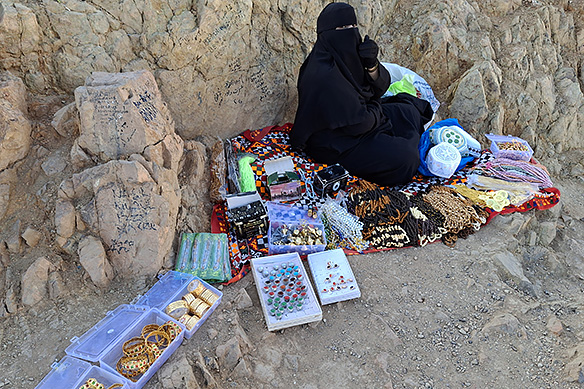
Hawker selling talismans on Archers’ Hill.
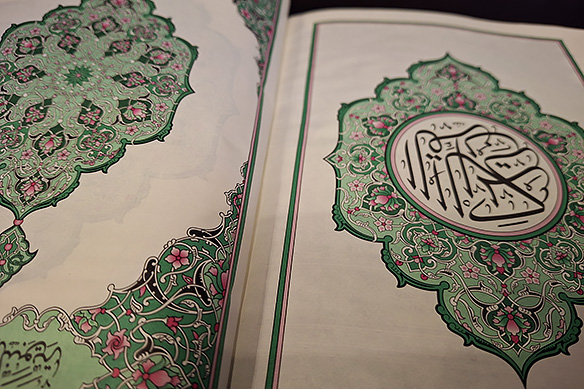
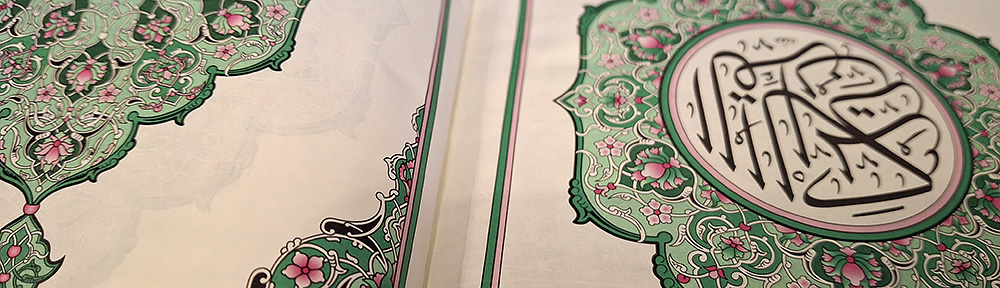
Qur’ans printed in Medina have green design motifs. Those from Mecca are embellished in blue.
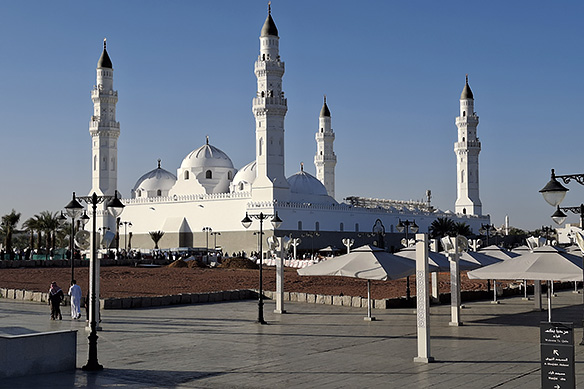
Masjid Quba, the world’s first mosque, has been renovated multiple times over the centuries. The current version dates to 1986.
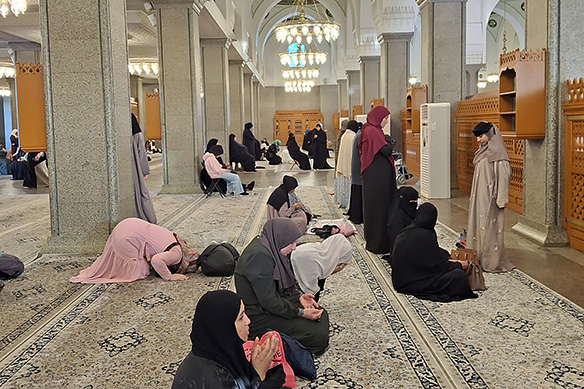
Inside Masjid Quba’s ladies’ section.
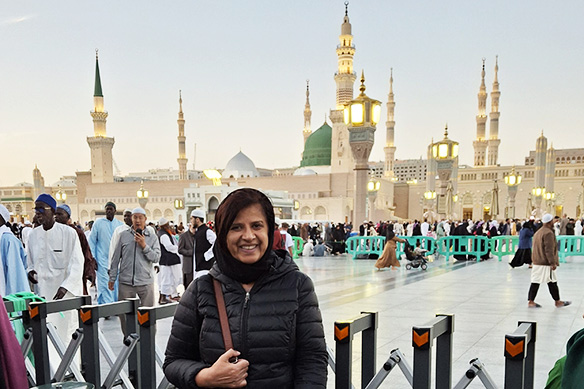
And finally, as dusk fell, along with tens of thousands, I proceeded to the world’s second largest mosque, the green-domed Prophet’s Mosque, where the Prophet has lain buried since his death in 632.
It is an incredible sight, hard to put in words, of standing amidst Muslims from all corners of the world, across the racial spectrum and vagaries of class – tied by just one thread. Their faith.
![Maghrib [sunset prayer] at the Prophet's Mosque, ladies' section. The mosque can accommodate up to 1.5 million worshippers at a given time.](https://ramaarya.blog/wp-content/uploads/2026/03/saudi-arabia-medina-7.jpg)
Maghrib [sunset prayer] at the Prophet’s Mosque, ladies’ section. The mosque can accommodate up to 1.5 million worshippers at a given time.
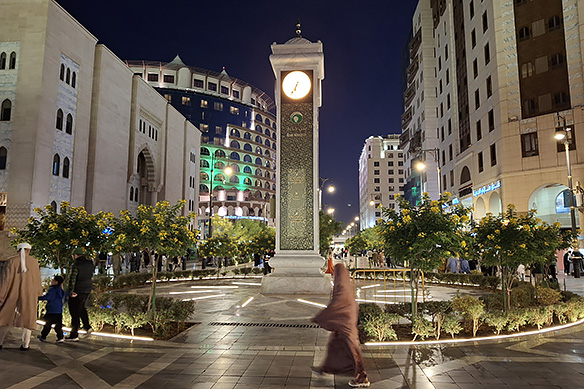
Medina’s city-centre is filled with hotels for visiting pilgrims. The city’s 1.5 million population sees around 21 million visitors annually.
Islam itself has had its fair share of evolutions in its birthplace, Saudi Arabia. From the version compiled by the Prophet to Wahabism, a fundamentalist sect from 1744 which destroyed shrines and women’s rights, to a more liberal version under its current ruler Mohammed bin Salman Al Saud, popularly known by his nickname MbS.
Whilst Muslims from across the world throng Medina’s streets, devouring the sacred air, wrapped in dense abayas, the locals are, in an ironical contrast more matter-of-fact about their city’s sanctity. The middle-class live in fancy condos, their Americanized children with heavy American accents go to international schools where the Qur’an is taught once a month. Unabashedly confident ladies wear tank-tops, hip-hugging jeans, and fashion makeup beneath their sedate black robes. There is a Starbucks, McDonalds, and Tim Hortons at every turn.
Saudi Arabia is rapidly changing under MbS. In leaps and bounds ever since he marginalised Wahabism influence after taking up office in 2017, moving from a religious to nationalist identity for the Kingdom. And the change seemed to me, loudest, in Medina because of the sheer difference between the subdued overwhelmed visitors and its chilled-out pragmatic citizens.
Welcome to my Saudi Arabia series based on my 17 days of travel across the Kingdom earlier this year. Next week, it is Lawrence of Arabia’s home in Yanbu. Wishing you safe, happy travels. Always. ❤️
Travel tips:
- Staying in Medina: I stayed at the Season Star Hotel.
- Getting into Medina and around: I used ABCT-KSA. My driver Iqbal Rahim was fantastic – incredibly professional and helpful.
- Non-Muslims are not allowed to go inside the Prophet’s Mosque.
 rama toshi arya's blog
You must be logged in to post a comment.