

“The blood of the infidels flowed so copiously that the stream was discoloured, and people were unable to drink it.”
~ Al-Utbi, Tarikh Yamini [Mahmud of Ghazni’s court historian]
Al-Utbi’s lines describe the carnage Sultan Mahmud of Ghazni, a city in eastern Afghanistan, inflicted on the wealthy temple cities of medieval India. From 1001 to 1026, Mahmud attacked northwest India 17 times, revelling in the destruction of the Hindu idols, and stripping the cities of its gold, silver, and wealth.
Mahmud was not interested in permanently owning the sub-continent. The resistance by the likes of Rajput King Vidyadhara Chandela was at times way too stiff, so alliances were made instead when required. His strategy was simple: attack, loot, return. Every year. It was a vow he had made to himself.
Bereft of any other major source of income, the Indian booty helped finance Mahmud’s empire, its capital Ghazni, and army. Under Mahmud’s rule [998 – 1030], the Ghaznavid empire founded by his father, reached its zenith stretching from Iran to Punjab in northwest India.
Mahmud was also an ace diplomat. He was the first ruler to use the title ‘Sultan,’ meaning authority, while at the same time acknowledging the authority of the Abbasid Caliphs. An early-14th Century miniature painting shows him receiving a robe of honour from the Caliph, signifying the two were partners when it came to Muslim ideology.
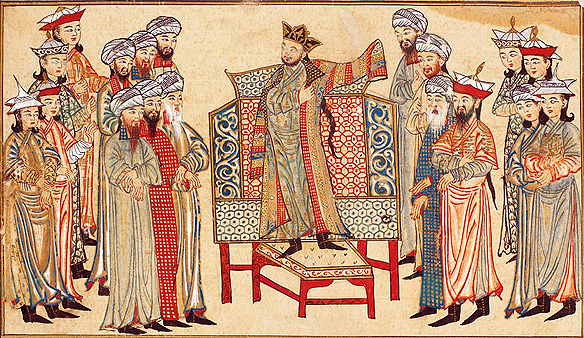
Mahmud of Ghazni [center] receiving a robe of honour from Caliph Al-Qadir in 1000 AD. Painting by Rashid al-Din Hamadani, Edinburgh University Library.
It was sheer willpower and an indomitable spirit that kept the Ghaznavid dynasty, Turkic in ethnicity and Persian culturally, in power for over two centuries [977 – 1186]. Over these years, 18 rulers across eight generations sat on its throne, of which three stand out the most.
One, for his persistent raids across the borders into northwest India to fill his coffers and extend his empire, changing the course of India’s cultural and political landscape for good with the introduction of Islam into the subcontinent. Two, for being the ones whose legacy survives through magnificent structures in its capital, Ghazni, almost a thousand years on.
History is subjective and one person’s villain is often another’s hero. Mahmud, whose very name is shunned in India, is the hero in Afghanistan. Seen as a true believer who held the Islam banner high, his personality takes on a multi-dimensional form on home ground. That of a poet, artist, and lover.
[Click on an image below to enlarge it and read the caption. Use the arrow keys to navigate through the set.]


![The Afghan-Russian war [1979 to 1989] ended with Russia's defeat.](https://i0.wp.com/ramaarya.blog/wp-content/uploads/2023/12/ghazni-monuments-russian-tank.jpg?w=190&h=190&crop=1&ssl=1)


Armed with the immeasurable wealth from his raids, Mahmud transformed his capital Ghazni into a centre of learning, arts, and culture, second only to Baghdad back then. He filled the city with beautiful gardens, mosques, madrasas, libraries, palaces, and caravanserais, and patronized the finest scholars and poets.
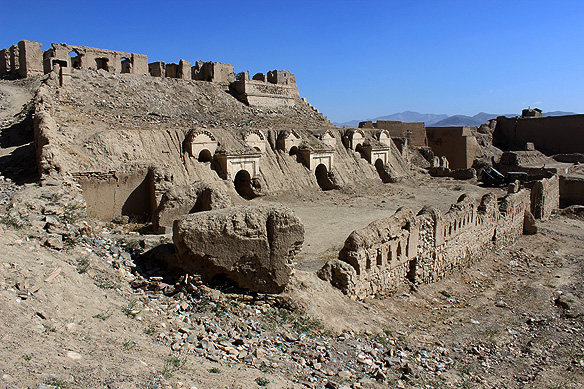
Ruins of Ghazni’s 1,000-year-old citadel.
Firdausi wrote the inimitable Shahnama [Book of Kings] in 1010 under his patronage while Al-Biruni, who accompanied Mahmud on his Indian expeditions in 1017 compiled Tarikh Al-Hind, a veritable encyclopaedia on 11th Century Indian history and culture.
In Malik Ayaz, a Georgian slave, Mahmud found companionship and according to Persian sources a lover, and Afghan sources simply a loyal commander. Whatever be the case, Ayaz eventually became the ruler of Ghaznavid Lahore.
The only remaining traces of Mahmud in his city Ghazni, a thousand years after his death, is his grave in a simple mausoleum which barely reflects his power, legacy, reputation, or deeds, and a citadel’s construction he initiated.
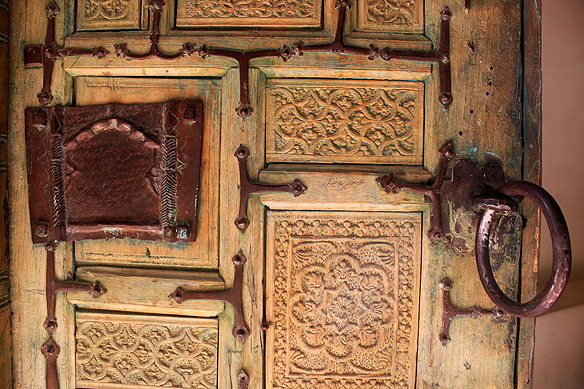
The above doors at Mahmud of Ghazni’s tomb are a later addition. It is believed the original sandalwood doors were from the Temple of Somnath. To appease its Indian subjects, the British army removed the doors in 1843 and placed them at the Agra Fort.
Sultans Masud III [r. 1099 – 1115] and his son Bahram Shah, the last Sultan of Ghazni [r. 1118 – 1157], were not so colourful in comparison. Their fame is more of a tangible kind: A pair of stunning star-shaped minarets which tower over the dusty plains of Ghazni, a palace, and the fortifications of the cascading citadel perched on a rocky outcrop.
Whether the two minarets, six hundred metres apart, were intended to be victory towers or attachments to mosques, is uncertain. What is known, however, is they were both initially a lot taller—44 metres. Then an earthquake in 1902 destroyed the top cylindrical halves, bringing them down to their current 20 metres height.
Made of fired mud brick and decorated with Quranic verses and geometric patterns on square panels, Sultan Masud III’s minaret is stylistically complex and intricate. Sultan Bahram Shah’s, perhaps reflecting his tenacious, albeit intermittent, rule spanning 35 years is on the bland side. He was most likely too busy trying to just hold on to his sovereignty.
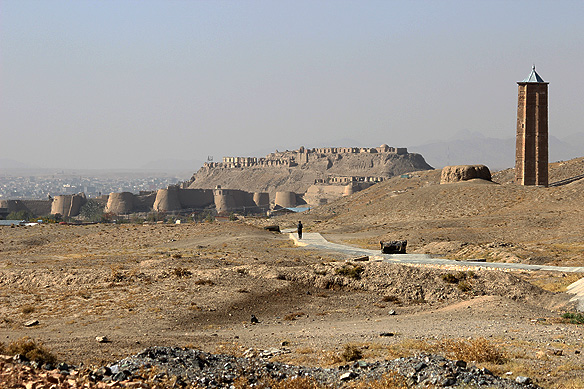
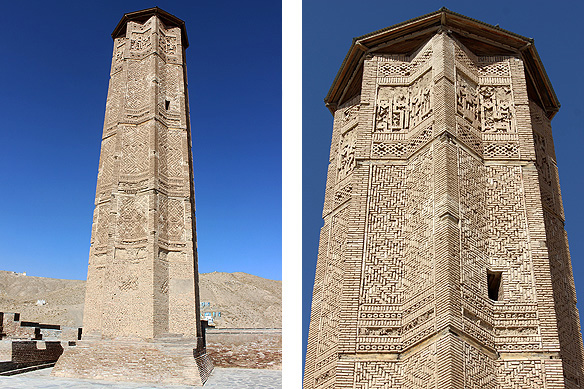
Old Ghazni’s 1,000-year-old skyline with the citadel in the distance and Bahram Shah’s minaret on the right; Above: Closeup of Bahram Shah’s minaret. The conical metal roofs on top of the two minarets are a 1960s contraption to avoid rain-water from filling up the hollow minarets and causing further damage.
Overlooking the two is Bala Hisar, a 45-metre-high citadel atop a rocky outcrop, built by the Ghaznavids to protect their city. With 36 towers, of which two-thirds have collapsed, it offered a bird’s eye view of Old Ghazni and the surrounds, just like it does even today.
Since its construction a thousand years ago, the fort has seen it all. From the raging violence of the Mongols in the 13th Century, to being the site of the Battle of Ghazni during the Anglo-Afghan war in 1839. From the attacks by the Soviet in the 1980s to becoming a US base after 2001.
But it still stands, along with the minarets and the simple grave. Just like the indomitable spirit of the Sultans of Ghazni. 😊
– – –
In 2013, the Islamic Educational, Scientific and Cultural Organization (ISESCO) declared Ghazni the Asian capital of Islamic culture for the year.
Travel tips:
- I stopped at Ghazni and stayed overnight in Uranos Hotel on my way to Kandahar from Kabul.
- WhatsApp contact details of my local tour operator: Obaid [+93 77 842 6816] and Tamim [+93 70 804 5886].
[Note: This blog post is part of a series from my solo travel to Afghanistan for 18 days in October 2023. To read more posts in my Afghanistan series, click here.]


Astonishing. Great post.
LikeLiked by 2 people
Thank you! I was just talking to a friend this morning about how history, and even current political scenarios, are so very subjective. It all depends on who is narrating it. And the truth maybe is both sides, neither or something in-between. It was interesting to see how someone we consider a barbaric invader in India was seen as a cultured hero in Afghanistan. That is why I am of the firm opinion that we need to travel, and that too with an open mind. Not that everyone agrees to my version of travel. 😀
LikeLike
Absolutely
LikeLiked by 1 person
Happy New Year! May 2024 bring much happiness to you and yours. 🙏
LikeLike
Such an interesting and well-written post. All of the raiding in India done by Mahmud in the 11th century reminds me about the early history of Cambodia in the 11th and 12th centuries. Where Hinduism once existed, a Khmer prince who became king also adopted Mahayana Buddhism and transformed the Hindu carvings and sculptures at Angkor Wat into Buddhist pieces. Later, according to the guide I had at Angkor Wat, the Hindus came and cut the Buddhist heads off. Religion has certainly played a big part in the history of all nations.
It was interesting reading about Ghazni, and a shame to find there is so little left of its early vibrant history.
LikeLiked by 1 person
Thank you, June. Yes, I remember learning about Angkor Wat’s religious one-upmanship when I was there. It’s ironical how many wars are fought in the name of religion, when the very idea of religion is supposed to be peace. 🙂 The minarets in Ghazni are quite a beauty. They must have been splendid in their hey-day. Happy New Year to you. May this year be a fabulous one for you and yours!
LikeLike
The minarets fascinate me – this must have been spectacular before the earthquake – like a mini Qutub Minar. Was it possible to ascend it and the one in Jam or are they blocked/too damaged or simply off limits?
LikeLiked by 1 person
I was told all the minarets in Afghanistan had spiralling staircases inside to get to the top, much like the Qutub Minar. However, all of them, including the Minaret of Jam are off limits. The structures are very old and have not had any significant conservation carried out on them. Some scholars are of the opinion that it won’t be long before the Minaret of Jam collapses. Maybe in a few decades at the most. It’s tilt is increasing by the day. It was one of the reasons I was so adamant that I go to Afghanistan now and take the road trip to the Minaret. I was scared it might otherwise be too late. 😦
LikeLike
The history surrounding these historical Sultans (and other leaders) is always harsh. I guess they didn’t amass a large empire with marauding your neighnours. They did make at least one lovely minaret though. Happy New Year Rama!
LikeLike
True. ‘Conquerors’ have often veered to the extreme when amassing land whether it be in Asia or South America or whereever. Guess it is part of the accepted rule book. By the way, not one but two lovely minarets for all their efforts. 🙂 The two look similar but are different in their detailing. Happy New Year to you and Richard too!
LikeLiked by 1 person
Those minarets are absolutely beautiful! I love the detailed carvings adorning their facades. I also love the look of Ghazni’s old citadel. It’s been truly great to travel vicariously to Afghanistan through your evocative blog posts, Rama.
LikeLiked by 1 person
Thank you, Bama. What little is left of Ghazni is truly lovely. I especially liked the minarets because of their unusual star-shaped design. The exquisite brickwork made them even more stunning. I am well aware it will take some time before people feel comfortable going to Afghanistan, but I am glad I went now and had these wonderful sites and warm people all to myself. 🙂
Thank you for coming along with me virtually on this journey. 🙏
LikeLiked by 1 person
Stunning! X
LikeLiked by 1 person
Thanks, Anna. 💕 Happy New Year to you and yours!
LikeLike
Happy new year to you! All the best for the year ahead! X
LikeLiked by 1 person
Pingback: taliban afghanistan, a solo indian woman traveller, and help from unexpected quarters | rama toshi arya's blog
Pingback: a guide to solo travel in afghanistan for the indian traveller | rama toshi arya's blog
Pingback: travel diaries: from bamyan to herat via the minaret of jam | rama toshi arya's blog
At first glance, the minaret reminds me of the Qutb Minar in Delhi, albeit smaller in scale. But look closely, the geographic patterns and the turquoise roofs are similar to those of Seljuk. Are these dynasties somehow related? The citadel also looks great even in its current condition.
LikeLiked by 2 people
The Ghaznavids and Seljuks were ruling around the same time, albeit from different cities — Ghazni and Merv respectively. Their shifting empire borders must have seen a natural absorption of certain elements of each other’s cultures into their own. Plus, both were key players in the Great Silk Road, where in addition to trade, cultural ideas were exchanged as well.
Originally, the Ghaznavid minarets were twice the current size, the top parts having collapsed during the 1902 earthquake. The pointed roof is actually made of metal and was placed in the 1960s to prevent rainwater from seeping into the hollow pyramids, and further weakening them.
LikeLiked by 1 person
Now I understand why these two dynasties (and rivals) have so many things in common. Thanks for the comprehensible explanations, Rama! 🙂
LikeLiked by 1 person
I am a student of the world, just like you. 🙂 Constantly learning and trying to connect the dots. It was very astute of you to notice the similarities.
LikeLiked by 1 person