Welcome to my travel guide on Sri Lanka’s Cultural Triangle told a bit differently—through short photo-essay chapters on the country’s ancient and medieval history.
Of the six UNESCO-listed cultural world heritage sites in Sri Lanka, five lie within the Cultural Triangle in the heart of the country. It is a region rooted in 2,500 years of history and heritage, both sacred and secular, from timeless Theravada Buddhist sites to splendid Sinhalese royal capitals. All surrounded in lush tropical jungles.
Before I write any further, I would like to briefly explain two terms used in this guide which are part of the warp and woof of the country. Theravada Buddhism and ‘Sinhalese.’ Theravada Buddhism is the oldest school of Buddhism and a direct offshoot of Buddha’s teachings. There are five countries in the world which have Theravada Buddhism as their official religion, and Sri Lanka is one of them. Sinhalese refers to the Indo-Aryan ethnic race native to Sri Lanka.
Whilst this guide covers the five UNESCO-listed sites, it also includes some gems scattered in-between. I hope you find it useful and it helps put the country’s Cultural Triangle as a seamless whole with all the dots connected. ❤
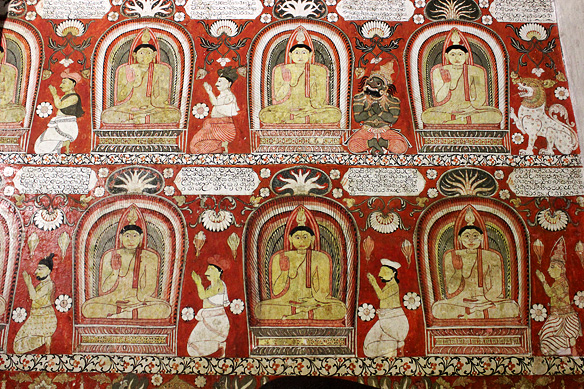
[Title photo: 18th Century Mural at Lankatilaka Vihara, Kandy.]
Table of Contents:
- Chapter 1: Anuradhapura, Sri Lanka’s first capital
- Chapter 2: Sigiriya, the 5th Century rock fortress
- Chapter 3: Polonnaruwa, Sri Lanka’s second capital
- Chapter 4: Kandy, Sri Lanka’s last royal capital
- Chapter 5: Dambulla, a Kandyan sacred art masterpiece
- Additional Sites
- Mihintale, birthplace of Sri Lankan Buddhism
- Avukana, ancient Sri Lanka’s finest standing statue of Buddha
- Yapahuva, the 13th Century citadel of a lost city
- Ritigala, a 2,300-year-old Buddhist monastery
- Nalanda Gedige, Sri Lanka’s central point
CHAPTER 1: ANURADHAPURA, SRI LANKA’S FIRST CAPITAL
This is where it all started. UNESCO-listed Anuradhapura, wrapped in sacred chants and colossal stupas, has been the island’s spiritual heart from the day Buddhism was introduced to its shores. Here, traditions and rituals play out, unhindered and unadulterated, just as they were conceived 2,300 years ago.
One of the world’s oldest continuously inhabited cities, Anuradhapura was founded 3,000 years ago. For half of this period, from 5th Century BC to 10 Century AD, it served as the capital of Sri Lanka, and from the 3rd Century BC onward its sacred core. Following King Devanampiyatissa’s conversion to Buddhism, Anuradhapura became the site of the country’s first Buddhist temple and bodhi tree [from a sapling of the original in Bodhgaya, India]. After him, powerful rulers continued the tradition of upping the city’s sanctity by sponsoring gigantic stupas and monasteries.
Of these, the most significant are: Thuparamaya stupa [3rd Century BC], the first Buddhist stupa built in Sri Lanka; Isurumuniya Vihara [3rd Century BC] built by King Devanampiyatissa; Ruwanwelisaya stupa [2nd Century BC] containing 1/8th of Buddha’s relics; Ruins of Lovamahapaya or Brazen Palace [2nd Century BC], a 9-storeyed building for congregational use; Abhayagiri Vihara, a prominent monastic centre, and Lankarama stupa [both 1st Century BC] built by King Valagamba; and Jetavanarama stupa [3rd Century AD], the world’s tallest stupa at 122 metres high when built.
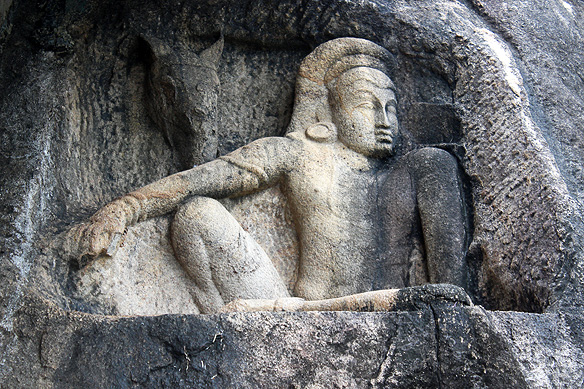
A masterpiece from across the millennia: ‘Man and the Horse Head’ carving in Isurumuniya Vihara [3rd Century BC].
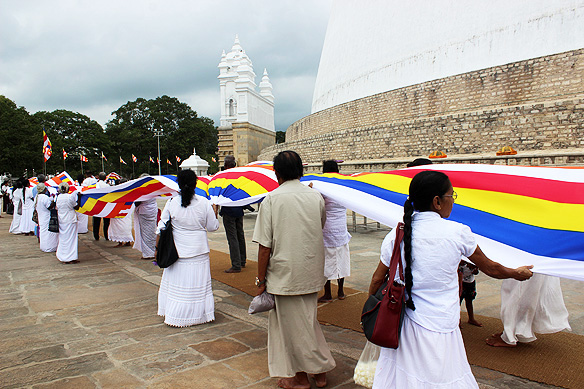
Sacred timeless rituals at Ruwanwelisaya stupa, Anuradhapura’s holiest site.
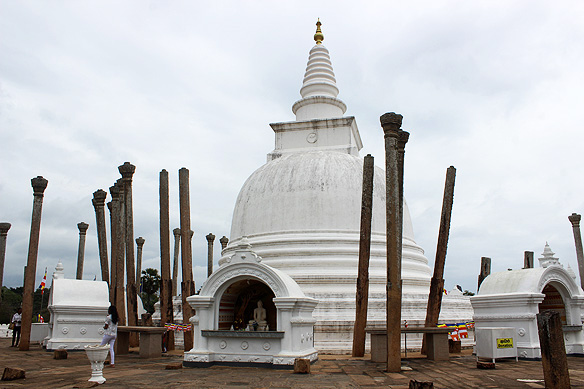
Thuparamaya is Sri Lanka’s first Buddhist stupa.
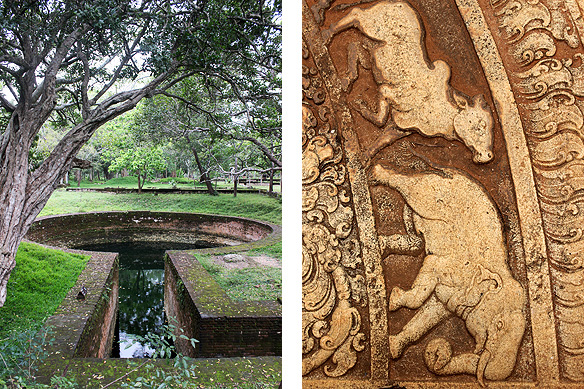
Left: Keyhole pond in an ancient monastery [2nd Century AD]; Right: Moonstone detail. Considered one of the finest moonstones in the country, the above, sculpted in the 7th to 8th Centuries AD is in the Abhayagiri monastic complex and represents the journey through samsara towards enlightenment.

Abhayagiri stupa was once part of the Abhayagiri monastic centre established in the 1st Century BC. When Buddha’s tooth relic first arrived in Sri Lanka from Kalinga, India in the 4th Century AD, it was housed in this monastery.
Anuradhapura travel tips:
- Recommended number of days: Three days, two nights.
- Recommended stay: I stayed at Amsterdam Tourist Rest, Anuradhapura.
CHAPTER 2: SIGIRIYA, THE 5TH CENTURY ROCK FORTRESS
Although Anuradhapura was the political and spiritual capital of the Sinhalese kings since the 5th Century BC, for a brief period a thousand years later, it moved to a place called Sigiriya. Seventy-five kilometres south, the site was marked by a towering 180-meter-high volcanic rock pillar. The ruling monarch had its facade painted with frescoes of 500 beautiful women and its summit topped with a palace. Sounds fantastical. But it is true—along with a story of greed, ambition, and possible redemption that is equally incredible.
It was the year 477 AD. In Anuradhapura, Prince Kassapa I had killed his father and ousted his half-brother, the legal heir, to become the new ruler. But his subjects and the Buddhist sangha did not take too kindly to it. Forced to leave Anuradhapura, Kassapa I set up a new capital city in Sigiriya and decorated the rock fortress with landscaped gardens and ponds using an advanced system of hydraulic engineering, and a sumptuous palace on the summit entered through huge stone lion paws. In 495 AD his ousted brother returned. Kassapa I killed himself in battle when defeat seemed imminent, and the capital was moved back to Anuradhapura.
Today, Sigiriya is a UNESCO World Heritage Site celebrating both an architectural marvel, and the tale of human frailty behind it.
NOTE:
You may also like to read The Sigiriya Frescoes: King Kassapa I and his 500 Damsels
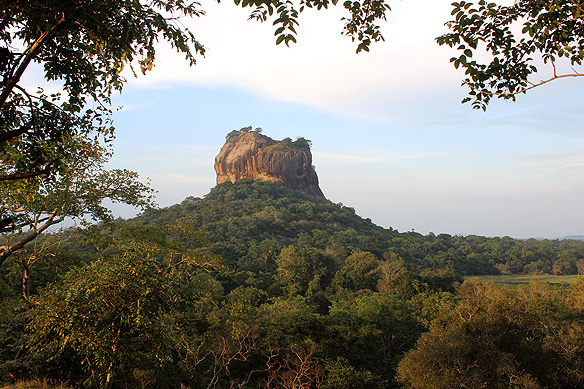
Sigiriya’s rock fortress: King Kassapa I’s haven, home, and place of hiding.
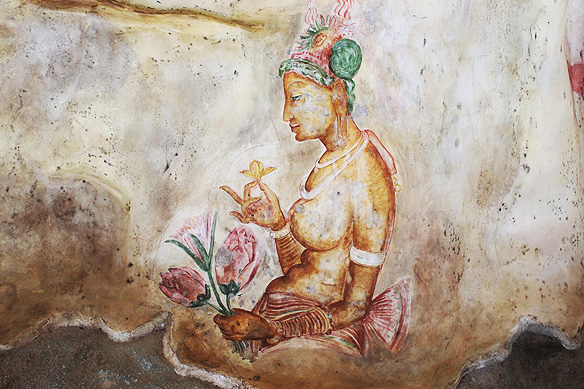
Of the 500 life-sized Sigiriya damsels painted 1,500 years ago, this, together with another 17 are all that remain on the monolith’s facade. Who they were and why they were painted are questions whose answers are still shrouded in mystery.
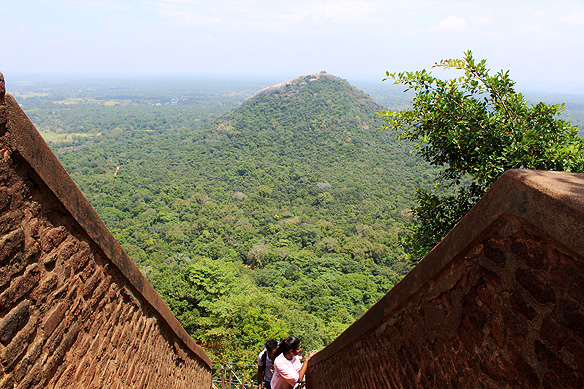
Stairs going up the 180-metre-high monolith are a 21st Century addition. When the fortress was originally built, a pulley-lift system was used to go up and down.
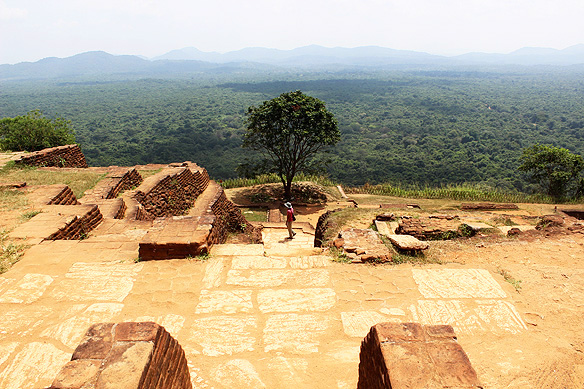
Ruins of King Kassapa I’s 5th Century palace atop the Sigiriya rock fortress.
Sigiriya travel tips:
- Recommended number of days: One full day.
- Recommended stay: I stayed at Ekho Sigiriya.
CHAPTER 3: POLONNARUWA, SRI LANKA’S SECOND CAPITAL
Anuradhapura fell to the Tamil kings Rajaraja Chola I and his son Rajendra Chola I’s expansionist policies in the 10th Century. And with it, the Anuradhapura kingdom also came to an end. Determined to bring ‘Lanka’ back under Sinhalese control, King Vijayabahu I defeated the invading Cholas in 1070 and moved his capital further inwards to Polonnaruwa, in the hope it would be safer.
Over the next two hundred years and under the aegis of two additional rulers, Parakramabahu the Great and Nissanka Malla, Polonnaruwa blossomed. Exquisite temples, grand public buildings, and water reservoirs turned Polonnaruwa into the island’s most lovely city. The fine craftsmanship is still impressive even after 800 years. Of special importance are the Sacred Quadrangle with the Atadage, Hatadage, Vatadage, Satmahal Prasada, Nissankalata Mandapa, and Gal Pota; Gal Vihara with its granite-streaked Buddhas; Alahana Parivena Monastery with Kiri Vihara and Lankatilaka; Parakrama Samudra Lake which made the kingdom self-sufficient; the seven-storeyed Royal Palace and Council Chamber; Jetavanarama Image House; and Potgul Vihara, a Buddhist temple containing ancient Sri Lanka’s largest library.
However, it wasn’t long before other Indian rulers renewed attacks. Sri Lanka’s second capital fell in 1212, this time to the Pandyan kings who razed Anuradhapura and Polonnaruwa, paving the way for a new Tamil kingdom with its capital in Jaffna. Polonnaruwa was abandoned, and unlike Anuradhapura, also forgotten.
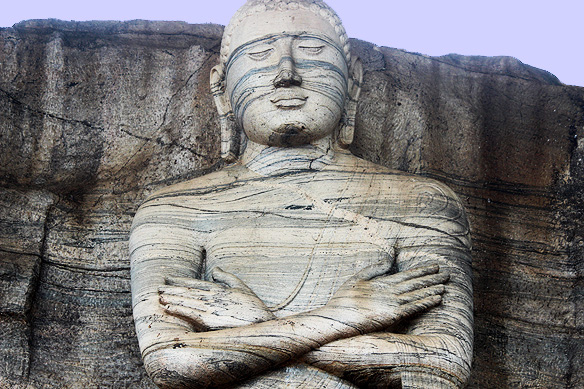
One of the most unusual depictions of Buddha: the cross-armed standing Buddha at Gal Vihara.
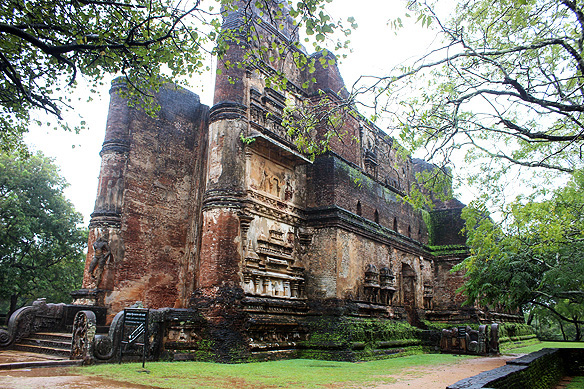
Lankatilaka Image House in Alahana Parivena encloses a towering standing Buddha statue inside.
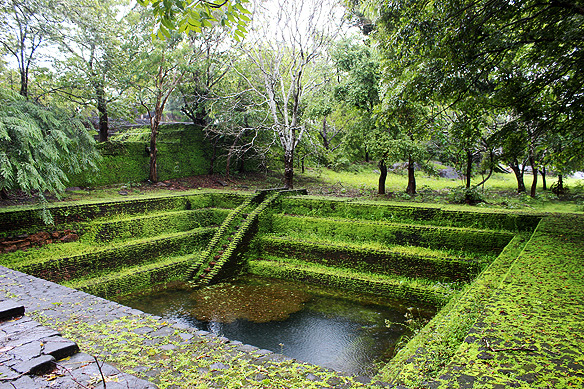
Established by King Parakramabahu the Great [1153 – 1186], Alahana Parivena is the largest monastery complex in Polonnaruwa. It is filled with ponds, stupas, monks’ residential cells, and a monastic hospital.
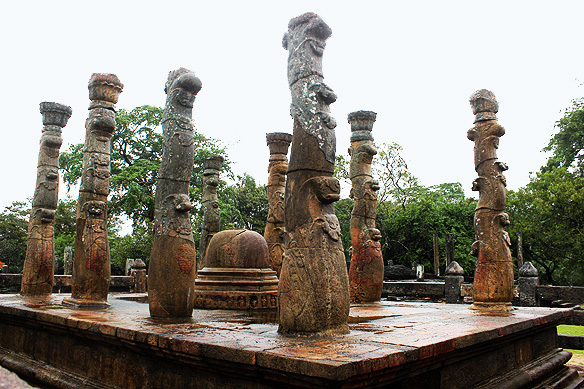
Nissankalata Mandapa in the Sacred Quadrangle is the handiwork of King Nissanka Malla [1187 – 1196]. An inscription states he used to sit here when listening to recitals of the Buddhist scriptures.
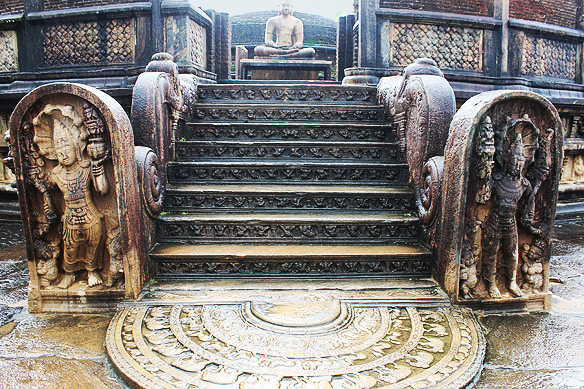
Each of Polonnaruwa’s three great kings had a Temple of the Tooth Relic built in the Sacred Quadrangle. King Vijayabahu I built the Atadage, King Nissanka Malla built the Hatadage, and King Parakramabahu the Great built the ethereal Vatadage [above image].
Polonnaruwa travel tips:
- Recommended number of days: One full day.
- Recommended stay: I stayed at Habarana Village by Cinnamon.
CHAPTER 4: KANDY, SRI LANKA’S LAST ROYAL CAPITAL
Spread around a placid lake flanked by the snow-white Sri Dalada Maligawa, Kandy was the last seat of the Sinhalese kings and final home of the tooth relic. From the day of its arrival in the 4th Century AD, it was believed whosoever had possession of the tooth relic also got to rule the country. As kingdoms and their capitals changed, the relic moved as well. First from Anuradhapura to Polonnaruwa, on to India for short periods, but always brought back, and finally to Kandy where it has stayed.
Though the Jaffna kingdom was flourishing in the north after the collapse of Polonnaruwa, the Sinhalese never gave up on self-rule, despite it being a difficult task. Founded in 1469, their Kandyan kingdom faced new ‘invaders’ now—the Portuguese and Dutch—which it somehow manipulated its way through using diplomacy and military tactics. And it did succeed till 1815, but eventually had to succumb to the British. Right up to its independence in 1948, Sri Lanka remained a British colony.
A UNESCO World Heritage Site since 1988, Kandy’s main attraction is undeniably the Temple of the Sacred Tooth Relic [Sri Dalada Maligawa] with its elaborate rituals enveloped in incense smoke and beating drums. In addition, there is the colonial-era Royal Botanic Gardens Peradeniya; the three 14th Century Gampola-era Western Temples of Embekka Devalaya, Lankatilaka Vihara, and Gadaladeniya Vihara; and the exquisitely painted Degaldoruwa Cave Temple. Come evening, a cultural show replete with music, dance, and fire-eaters offers a perfect grand finale to one’s stay.
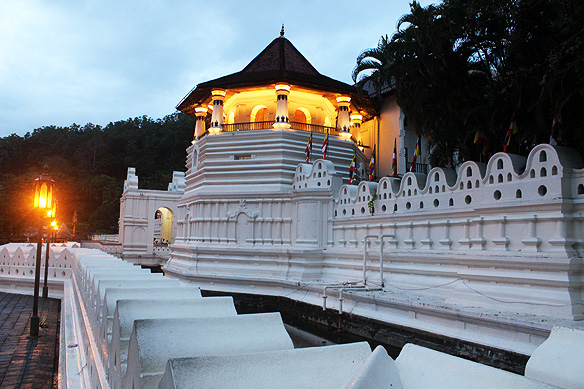
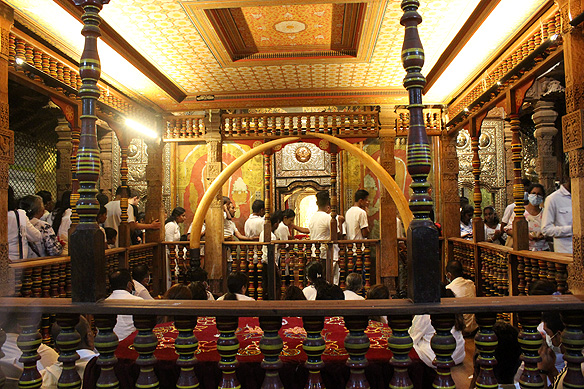
Kandy’s most hallowed site: Sri Dalada Maligawa, better known as Temple of the Sacred Tooth Relic; Above: Evening prayer ceremony inside the temple.

Grand finale of the fabulous cultural show at the Kandyan Cultural Centre.
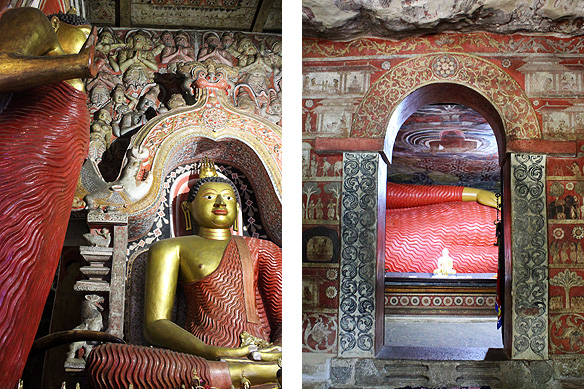
Left: 14th Century Lankatilaka Vihara decorated with 18th Century Kandyan-era murals and sculptures; Right: Degaldoruwa Cave Temple, the ‘Second Dambulla,’ is a treasure trove of Jataka stories in the Kandyan style.
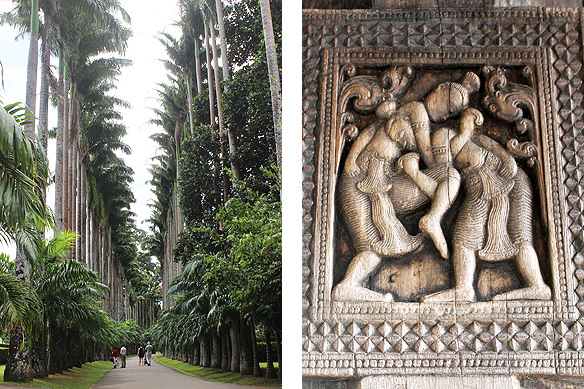
Left: Royal Botanic Gardens Peradeniya [1821] has over 4,000 species of plants across 147 acres; Right: Two Angampora martial art fighters wrestle it out on a 14th Century wood-carving in the Embekka Devalaya dedicated to the Hindu god Kartikeya.
Kandy travel tips:
- Recommended number of days: Two full days.
- Recommended stay: I stayed at Mount Blue Kandy.
CHAPTER 5: DAMBULLA, A KANDYAN SACRED ART MASTERPIECE
When Anuradhapura had taken on its iconic mantle of a Buddhist sacred city in the 3rd Century BC, another Buddhist tradition also mushroomed across the island—that of forest-dwelling monks using natural rock caves for meditation and congregation. One such was the Rangiri Dambulla Cave Complex, Sri Lanka’s largest and best-preserved cave temple.
The complex may well have ended up as just one of the many others dotted across the hills were it not for the generous royal patronage it continuously received. Its first royal contribution came in the 1st Century BC after King Valagamba took refuge in the caves for 15 years when political usurpers seized Anuradhapura. In 1190, King Nissanka Malla of Polonnaruwa gilded the caves and gave the site additional Buddha statues. The patronage reached a high point in the mid-18th Century under the Kandyan kingdom who sponsored intricate murals on Buddha’s life across the walls and ceilings, covering an area of 2,100 square metres.
Together with 157 polychrome effigies of Buddha, Bodhisattvas, and royal sponsors made of stucco, clay or carved out of living rock, the UNESCO-listed five-cave complex is a stunning visual treat. Even with the crowds of tourists. A treat that is magnified even further through offerings by pilgrims at its altars in a ritual that has stayed unchanged for two millennia.
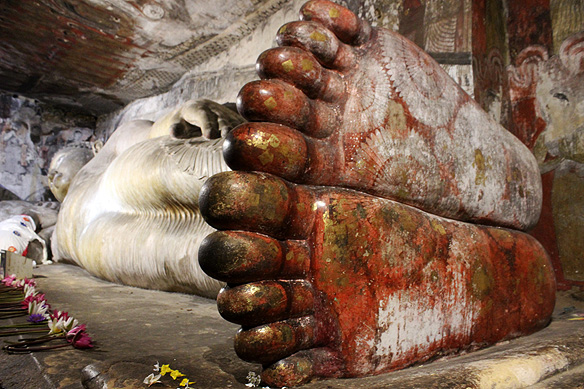
Nirvana Buddha in the Devaraja Lena or Cave of the Divine King [Cave No. 1] is the oldest effigy in the complex.
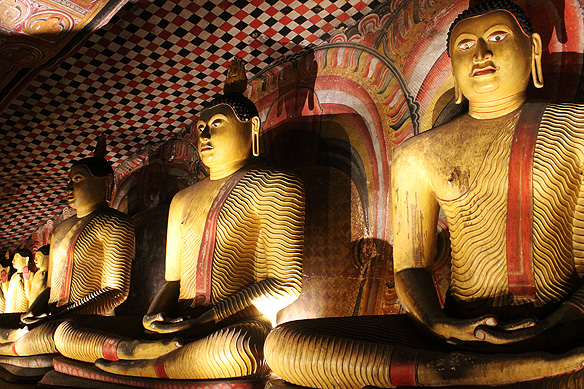
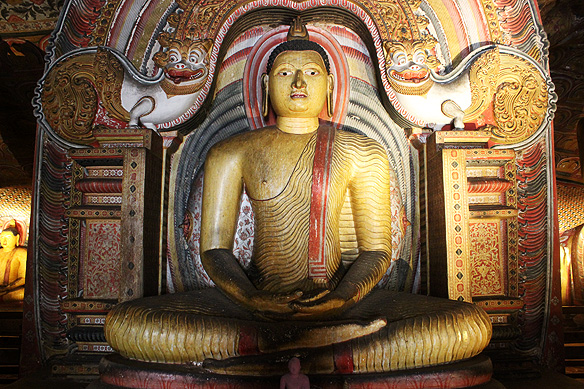
Row of seated Buddhas and the Altar in the Great New Monastery [Cave No. 3].
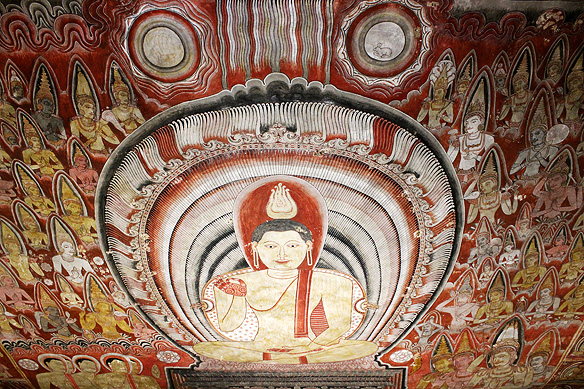
18th Century mural of a scene from Buddha’s life on the Cave of the Great Kings’ ceiling [Cave No. 2].
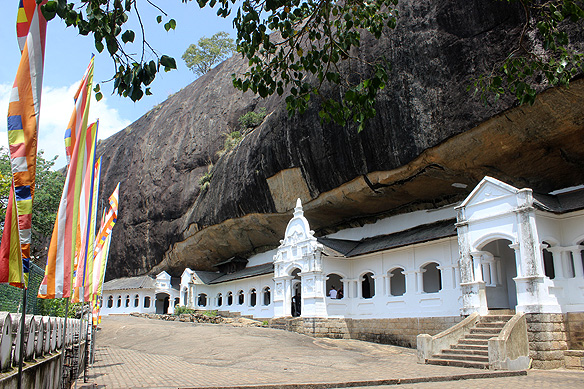
The whitewashed columns and gables in front of the cave entrances were added by the British colonial rulers in 1915.
Dambulla travel tips:
- Recommended number of days: Half a day.
- Recommended stay: I stayed at Habarana Village by Cinnamon.
ADDITIONAL SITES
In addition to the five UNESCO-listed world heritage sites in Sri Lanka’s Cultural Triangle described above, the area also contains a string of lesser-known gems. Rarely visited by tourists, they comprise both royal and holy sites sheathed in lush wilderness and are worth exploring. These are Mihintale, Avukana, Yapahuva, Ritigala, and Nalanda Gedige.
Mihintale, birthplace of Sri Lankan Buddhism
Some 13 kilometres east of Anuradhapura is Mihintale, a 3rd Century BC pilgrimage site associated with the exact moment Buddhism came to Sri Lanka. Emperor Ashoka in India had recently converted to Buddhism. Keen to spread the word of peace, he sent his son Mahinda, a monk, to neighbouring Lanka which was then ruled by his friend King Devanampiyatissa. On a plateau, up above a hill, Mahinda preached the doctrine to the king, and a country’s spiritual fate was sealed. Mihintale literally means ‘the plateau of Mihindu’ [Mahinda in the local Sinhala dialect]. The monk’s relics were later enshrined in Ambasthala Dagoba to mark the spot.
Next to the plateau is Aradhana Gala, a rocky outcrop, where Mahinda is believed to have landed after flying across the skies from India. Apart from these two key sites, Mihintale is scattered with ancient Brahmi inscriptions, ponds guarded with Nagas [snake deities] and lions, hospital ruins, stupas, and a massive statue of Buddha.
[Nearest town: Anuradhapura. It is recommended you use one of the local guides at Mihintale’s entrance for an in-depth exploration of the site.]
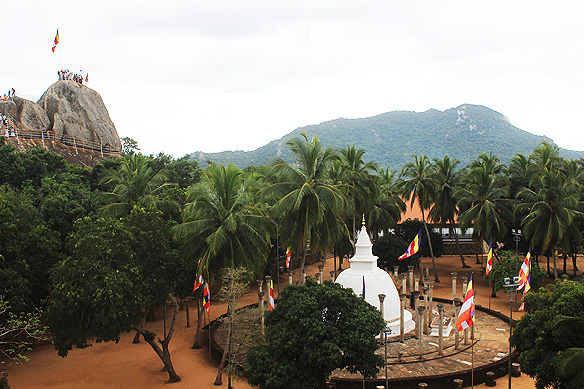
Aradhana Gala [rocky outcrop on left] and Ambasthala Dagoba [stupa on right] in Mihintale are associated with the arrival of Buddhism in Sri Lanka.
Avukana, ancient Sri Lanka’s finest standing statue of Buddha
Towering above the intrepid traveller in Avukana village is a 14-metre-high standing statue of Buddha. One of the very few to have survived from Sri Lanka’s ancient annals, its hands are raised in a variation of the abhaya mudra protecting those who seek him. Whilst some historians date it to the 5th Century and King Dhatusena, father of King Kassapa I of Sigiriya fortress fame, others believe it was made in the 8th Century. There is also a legend that the statue was the result of a competition held between a stone-sculpting guru called Barana and his pupil. Avukana’s Buddha was the guru’s creation.
Either way, the granite east-facing Buddha in a tight-fitting meticulously-pleated robe is a masterpiece. Designed using a combination of two styles—Gandhara [from Afghanistan] and Amaravati [from South India]—the colossal effigy would have once stood inside an image house of a temple complex.
[Nearest town: Anuradhapura.]
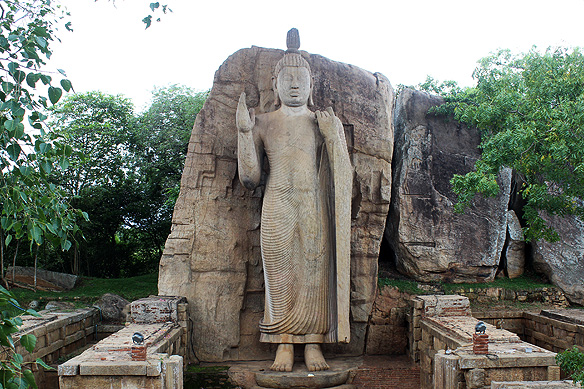
Avukana’s 14-metre-high standing Buddha is believed to have been carved out of living rock on King Dhatusena’s orders 1,500 years ago.
Yapahuva, the 13th Century citadel of a lost city
Halfway up a 90-metre-high rock boulder in Yapahuva is a royal complex reached by steep ornamental stone steps snaking their way to it. For 12 years the magnificent citadel, one of Sri Lanka’s most evocative ruins, served as the capital of a 13th Century Sinhalese king called Bhuvanekabahu I. When the Pandyan rulers of South India attacked Polonnaruwa in 1272, Bhuvanekabahu I fled to Yapahuva bringing with him Sri Lanka’s most prized possession: Buddha’s tooth relic [now housed in Kandy].
Here, deep in the jungle, his predecessors had already built a fortress for defensive purposes. Bhuvanekabahu I fortified it even further, and built a temple for the relic in the royal residence. But both his rule and resplendent city were short-lived. In 1284, the Pandyans succeeded in defeating him, as well as taking the relic away. And Yapahuva got entangled in the surrounding forest and was blotted out, except by the monks who came here to meditate.
[Nearest town: Anuradhapura.]
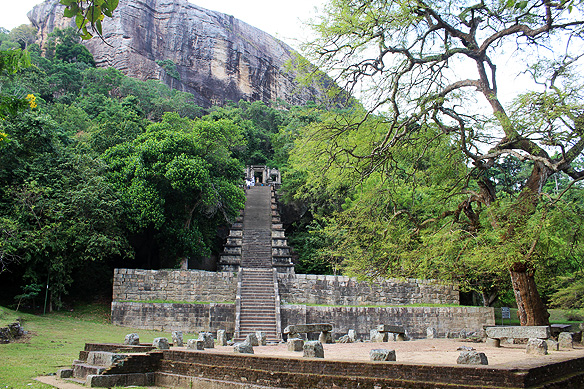
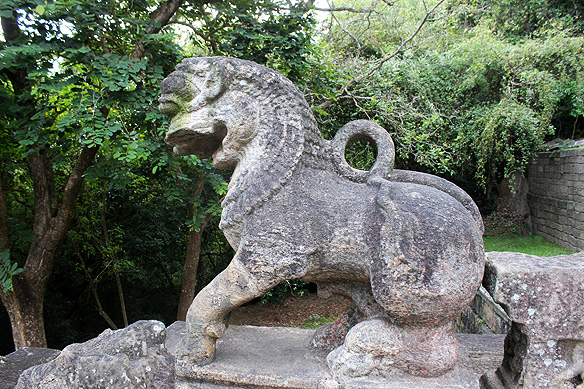
13th Century citadel of Yapahuva with the lion sculpture which used to appear on the country’s former 10 Rupee note.
Ritigala, a 2,300-year-old Buddhist monastery
Wrapped around Ritigala, the highest mountain in northern Sri Lanka, is a Buddhist monastery that goes back to the 3rd Century BC. Legends abound here, from those of royals who took up an ascetic life to Hanuman, the monkey-god in the Hindu epic Ramayana dropping a portion of the herb-rich chunk of the Himalayas on its summit by mistake.
The current version of the hermitage dates to the late-Anuradhapura period [7th – 11th Century] and comprises of a pilgrim route starting at a 2,500-year-old enormous water tank, up stone steps to platforms for meditation and congregation, bridges, resting areas and an Ayurvedic hospital. Bereft of stupas, bodhi trees, effigies or iconography, its monks were famed for practicing severe asceticism—they wore strips of old cloth and peed on embellished urinals. The latter, it is said, served as an expression of disdain for the material world!
[Nearest town: Sigiriya.]
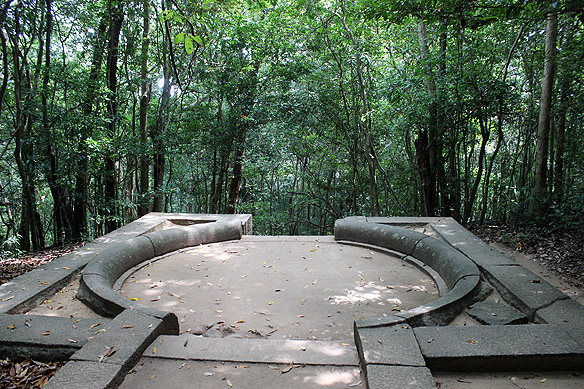
Ancient resting area for monks inside Ritigala monastery.
Nalanda Gedige, Sri Lanka’s central point
Nalanda Gedige is believed to be located at the geographical centre of Sri Lanka. Somewhere between the 8th and 10th Centuries, this momentous location was celebrated with the construction of a stupa, Buddhist image house [in the South Indian Pallava architectural style], and bodhi tree. Many claim to experience a heightened magnetic pull in the quadrangle. Others, an acute sense of serenity.
Usually deserted except for a few local pilgrims, the temple contains some fascinating detailing. These include carvings of gajalakshmi [goddess Lakshmi flanked with two elephants] on the front portal, and a human trio indulging in erotic sex and ganas [dwarfs] on the plinth. In keeping with Sri Lanka Post’s mandate of putting up a letterbox in the island’s cardinal points, a bright red letterbox greets visitors at the site entrance.
[Nearest town: Sigiriya.]
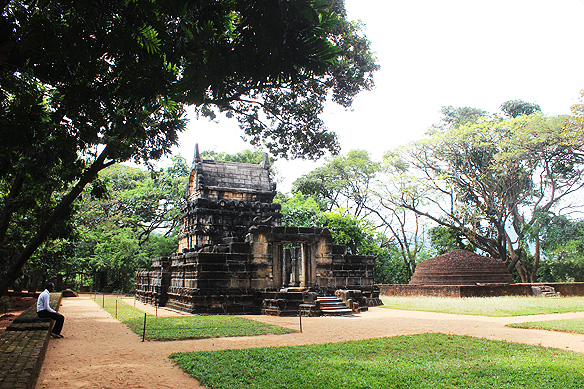
A Hindu temple-styled image house and Buddhist stupa make the thousand-year-old Nalanda Gedige a unique architectural amalgamation.
– – –
With this, I come to the end of the post and the end of my Sri Lanka series. Wishing you happy travels, always. 🙂
Note: I used Visit in Lanka for my transport arrangements.
[This blog post is part of a series from my solo independent travels to Sri Lanka. To read more posts in my Sri Lanka series, click here.]
 rama toshi arya's blog
Great, all-encompassing blog of the jewels of Sri Lanka. I visited all the places in 1978, but I didn’t see all the sites you did. My most enduring memory was the Youth Hostel at Anuradhapura which was in a swamp. The toilets were outside and without light. Needing to use the facilities at night was unnerving, as you had to take a torch and use stepping stones. I will use Amsterdam Tourist Rest next time I visit!
LikeLiked by 1 person
Am glad you liked the post. For a small island, Sri Lanka has enough sites to warrant multiple revisits. I covered the above over two trips. Am sure there are still more off-the-tourist-trail, off-the-radar ones. 🙂 Amsterdam Tourist Rest was fab. It is a homestay — the owners stay on the ground floor and the upper bedrooms are for tourists. It is spotless with really nice breakfasts. Also very pretty.
LikeLike
Wow Rama, what a post! It must have taken you ages to create! I am way too lazy for such in depth posts. lol. Sri Lanka definitely looks like a must see destination!
LikeLiked by 1 person
It took me 10 days to write this travel guide. Not sure if that would be classified as ages. 🙂 My regular posts take three days each. I enjoyed writing this one. These in-depth posts also help me to connect the dots — the linkages between sites, historical figures, recurrent themes… I hope you do make it to Sri Lanka some day. It is lovely. One of my favourites, for sure.
LikeLike
Ten days! That’s ages! I whip up mine in 10 minutes! lol. But mine aren’t very factual. I just don’t have the time to put in the effort, and any spare time I prefer to read and learn from blogs!
LikeLiked by 1 person
Hehehe. I think I am just slow! 😀 In 10 minutes, I only manage to write an intro.
LikeLiked by 1 person
Great recap on these wonderful sites in Sri Lanka. Maggie
LikeLiked by 1 person
Many thanks, Maggie! Hope it brought back lots of great memories for you.
LikeLiked by 1 person
It definitely did 🙂
LikeLike
This is a fantastic travelogue Ramya!! Thank you for taking the time and effort to make it so easy to understand and refer!!
LikeLike
Thank you so very much! Am glad you found the guide useful. 💕
LikeLike
Thanks Rama for taking us around so many magnificent sites – many of which I have been lucky enough to visit. Strangely enough though my most vivid memory of the trip is the deafening sound of the dawn chorus of birds in the trees outside the Temple of the Tooth in Kandy.
LikeLiked by 3 people
Am happy you liked the post. 🙂 True, it is interesting that oftentimes it is not the sites, but sounds that stay with us. My most vivid memory of Bodh Gaya, for instance, is not the UNESCO-listed temple, but a chanting session by a large group of Chinese Buddhist pilgrims. It was so beautiful, it had brought tears to my eyes. I can still hear them, when I close my eyes.
LikeLike
Avukana, Yapahuva, and Nalanda Gedige are the ancient sites in Sri Lanka that recently came to my attention. It’s really cool that you also visited these places during your latest trip to this country. Thanks for yet another fascinating series, Rama!
LikeLiked by 2 people
I loved Yapahuva. It is not a very big site but so atmospheric. Indiana Jones types. 🙂 Am happy you enjoyed the series. I enjoyed writing it.
LikeLiked by 1 person
That sounds like the Yapahuva I’ve been imagining. Hope to see it in person one day!
LikeLiked by 1 person
Thanks for the sharing this comprehensive guide, Rama! Otherwise, the history would be too complex to understand 🙂
LikeLiked by 2 people
Am glad I could simplify it somewhat. 🙂 On a personal level, I have always enjoyed a place more when I could connect the dots. Within a country, and also between the country and other nations. I have discovered everything is in some way interconnected. There are no silos. Neither in time nor distance.
LikeLiked by 1 person
Totally agree with you. Humans are social beings, so civilizations are always connected, one way or another. Even those living on islands 🙂
LikeLiked by 1 person
Pingback: Gadaladeniya Temple - Sri Lanka 800