Think of the United Arab Emirates [UAE] and the one city that invariably pops up in our minds is Dubai—the city of steel, glass, and gold. But Dubai is not the only emirate. Notice the plural in the country’s name? There are six others, each with its own ruler, and of these, two are steadily vying with Dubai for a space in global tourism. For a reason: The incredible treasures they both hold which not many know about. They are Abu Dhabi and Sharjah.
Abu Dhabi is the richest emirate in the grouping and its city by the same name, Abu Dhabi, is the country’s capital. 96 percent of the UAE’s 100 billion barrels of proven oil reserves are within its borders, ranking it at number six worldwide. Abu Dhabi’s ruler is also the President of the UAE. Sharjah, on the other hand, is in a time-warp. It is older, more traditional, and regarded as the UAE’s cultural capital.
It was in 1958 when the UAE first discovered it had oil, and that too loads of it. Four years later, in 1962, Abu Dhabi, then a small fishing village on the edge of a desert, exported its first cargo of crude oil, and the country changed forever.
Supplying 4 percent of the world’s oil requirements with a production of 3.2 million barrels per day, the UAE has spiralled its way through progress at an astonishing speed. However, there is another side to the country that was formed on 2nd December, 1971. Its pre-oil era, swathed in a heritage that is beyond its oil. There is also a whole country that is beyond Dubai.
With ancient desert roots and a vision of unity through globalisation, here are some of UAE’s most spectacular treasures in its two lesser visited cities Abu Dhabi and Sharjah. For often the most beautiful sites are on the road less trodden. ❤
1. Sheikh Zayed Grand Mosque, uniting the world through architecture
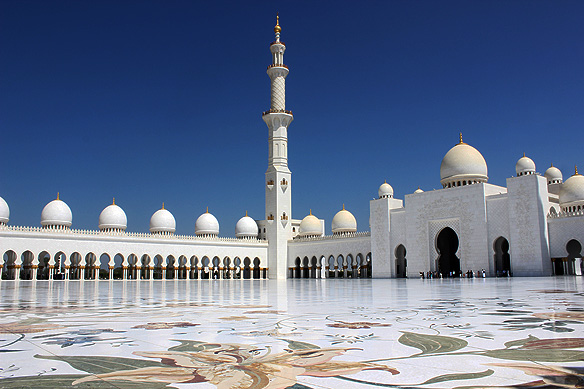
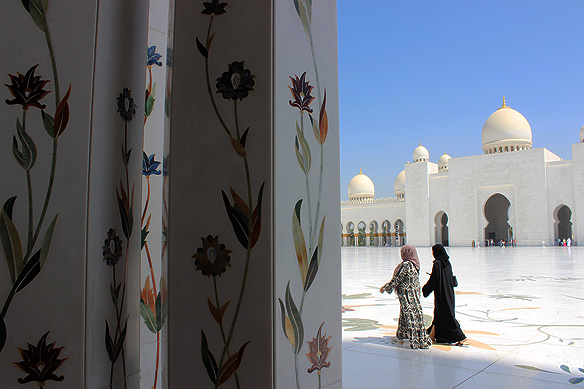
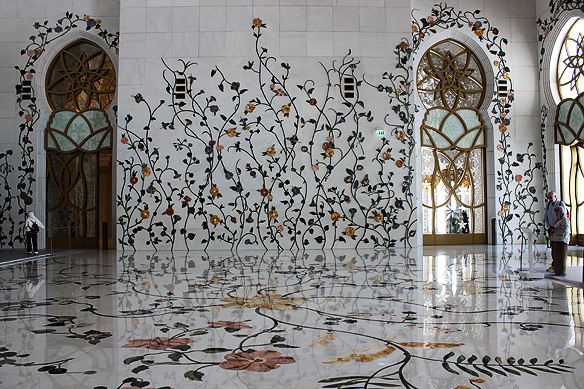
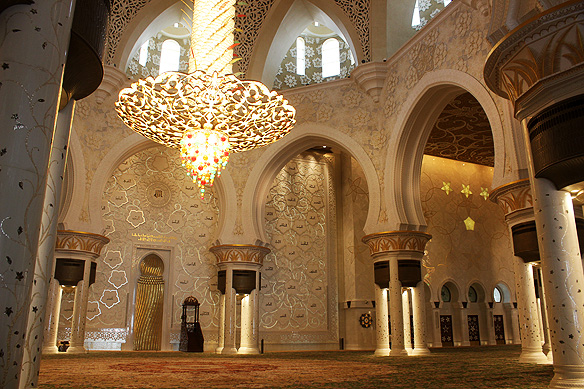
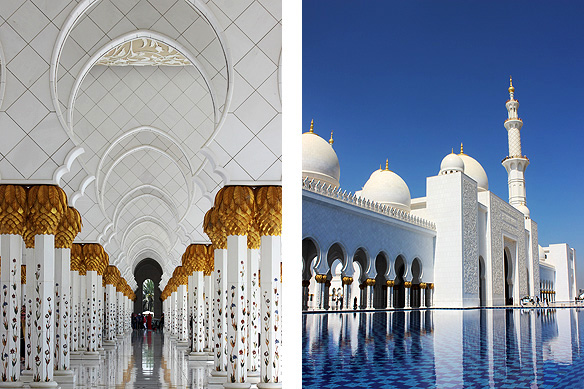
Grand in design, scale, and vision, Abu Dhabi’s Sheikh Zayed Grand Mosque is the country’s largest mosque. Covering an area of 555,000 square meters and with a capacity of 55,000 worshippers, the mosque opened its doors to the public on Eid Al Adha in 2007. It is pure poetry in pure white marble, uniting multiple nations and cultures from across the globe. Wondering how that is possible? Read on.
Named after the founding father of the UAE, Sheikh Zayed bin Sultan Al Nahyan, it took 11 years, over 3,000 workers, and 38 construction companies to build. Craftsmen and material from China, Germany, Greece, India, Italy, Morocco, New Zealand, Turkey, United Kingdom, and the UAE [to name but a few] are all part of its story.
Whether it is its 82 domes, 107-metre-high minarets, courtyard with mosaics of flowers from various countries, 1,096 six-sided marble columns decorated with pietra dura, lunar illumination, the world’s largest hand-knotted carpet, or its qibla wall with the 99 names of Allah—everything has been thought out to the minutest detail in this masterpiece which aims to unite the world. Through architecture.
Travel tips: 1) Women need to wear a hijab and burqa when inside. 2) Complimentary 45-minute guided tours are available.
2. Emirates Palace Hotel, plated in pure gold
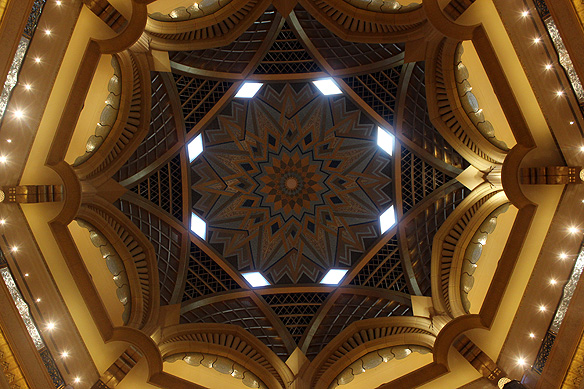
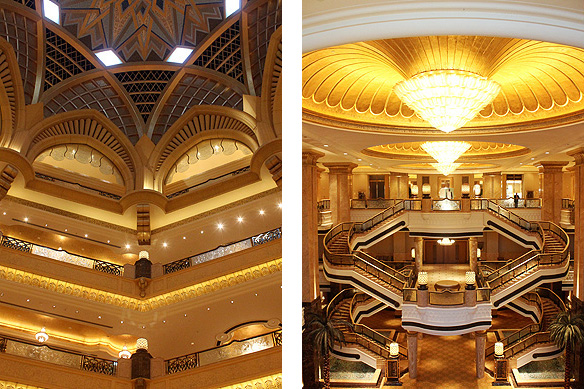
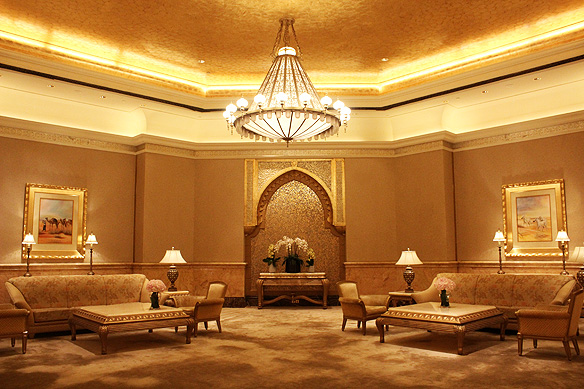
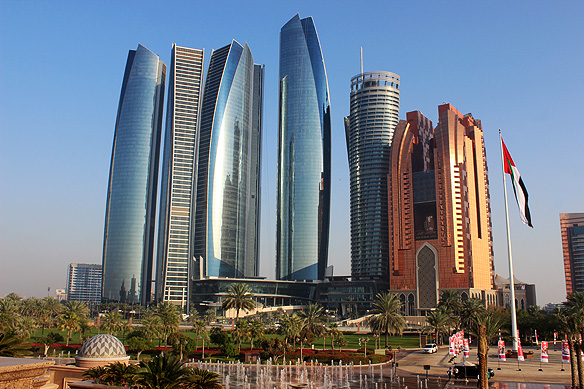
Now why would I put a hotel here, you may well ask. Because this is no ordinary hotel. Located on Abu Dhabi’s corniche facing the Etihad Towers, Emirates Palace’s main building is a kilometre long from one wing to the other. Its manicured gardens are spread over a hundred hectares and it has its own private 1.3-kilometre-long beach, marina, and natural bay.
Larger than the Buckingham Palace, the eight-storeyed hotel is draped in 6,000 sq. metres of 22 karat gold leaf. The building has 114 domes, with the world’s largest dome in the foyer rising to a height of 72.6 metres. This dome is embellished with pure gold, mother of pearl, and crystals. There are also 1,002 chandeliers inside; the largest weighs 2.5 tons.
You do not have to stay here to see all this fabulous ostentatiousness. Visitors have access to select areas for free which are enough to make one gawk.
Oh, there is also 24 karat gold facials at its spa, 24 karat gold flakes in the in-house cafe’s cappuccinos, and a solid gold ATM in the foyer!
3. Sharjah Museum of Islamic Civilization, mapping the journey of Islam
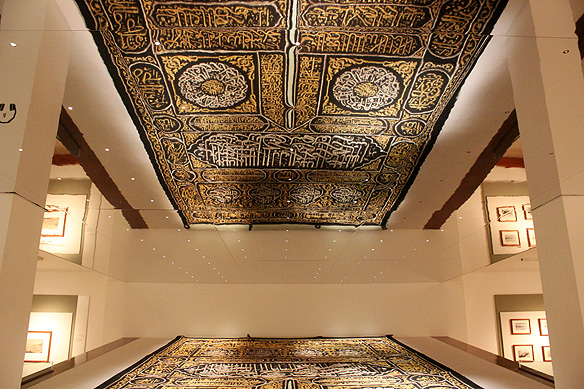
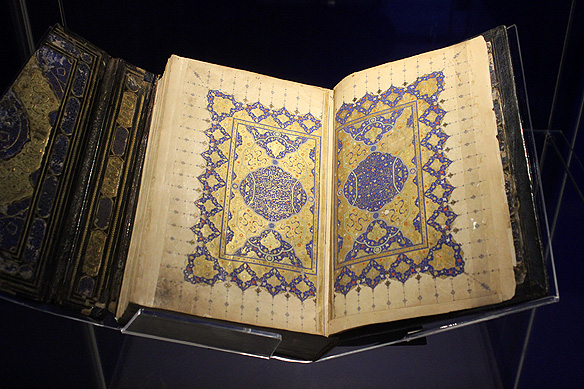
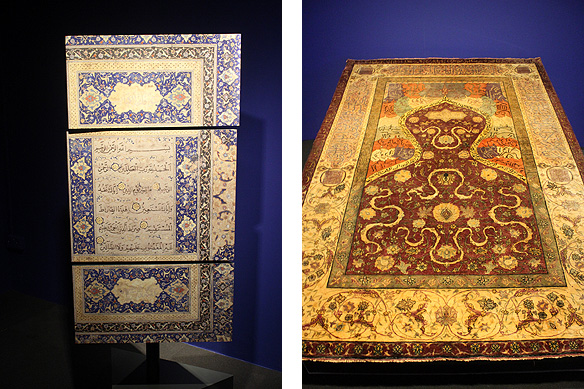
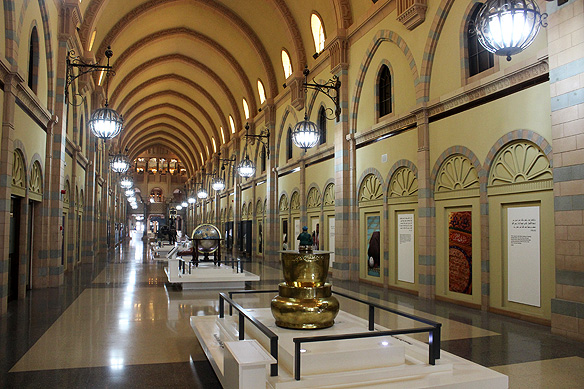
In the heart of Sharjah, along the city’s Al-Majarrah Waterfront is the state-of-the-art Sharjah Museum of Islamic Civilization. First of its kind in the UAE, the over 5,000 artefacts from across the world trace Islam’s journey from its birth in the 7th Century to modern-day 20th Century. These artefacts are divided into distinct themes such as the principles of Islam, Islamic achievements by Muslim scholars, artworks, and coins.
Highlights to watch out for are parts of the Ka’aba and its covering, the Kiswah, and a copy of the third Caliph’s 7th Century Quran. There are also models of mosques from different parts of the world illustrating how local traditions have shaped Islamic aesthetics. The science and technology gallery has impressive displays on Islamic astronomy, mathematics, and medicine whilst the art galleries comprise works of calligraphy and miniature paintings from the Ottoman, Safavid, and Mughal empires.
Take your time exploring the museum’s unique treasures. None of these have any copies elsewhere. And yes, do not forget to look up at the museum’s dome when inside. It is decorated with a mosaic of zodiac constellations.
4. King Faisal Mosque, Sharjah’s modernist mosque
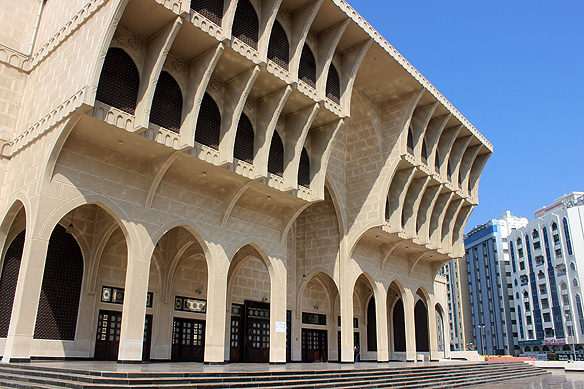

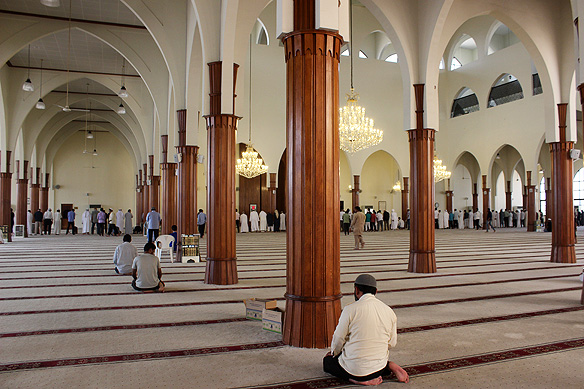
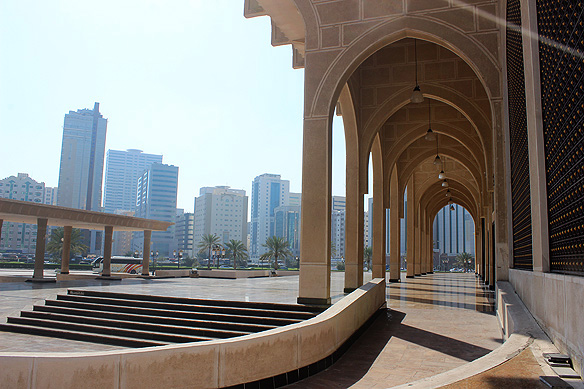
Named after the former Saudi king, Faisal bin Abdulaziz Al Saud, King Faisal Mosque was Sharjah’s biggest mosque when it opened in 1987 with a capacity of 16,670 worshippers. Women pray in the basement, men on the ground floor, and upstairs is a library with around 7,000 books on Islamic history and thought. Though the ‘largest mosque’ accolade has since been overtaken, it still stands out for its distinctive architecture. It looks nothing like the typical mosque design one has learnt to recognize.
The angular arcaded jutting facade of the minimalist modernist structure is flanked by 70-metre-high minarets on either side. Its architect Al Junaidi, a descendent of the Prophet and a Saudi architect born in Mecca in 1937, specifically kept the mosque free of embellishments and ensured there were lots of pillars.
In his own words, the lack of ornamentation was so as not to distract the worshippers and that they could do their duty to God, and the pillars were to ensure they did this duty in neat lines as mandated in Islam.
5. Abu Dhabi Heritage Village, a window into pre-oil UAE


The UAE has progressed so rapidly in recent years, it can be hard to believe that a few decades ago its shiny global metropolises were sun-baked mud villages in the desert. Which is where Abu Dhabi’s Heritage Village come in. As a reminder to tourists and local Emiratis alike, about the country’s pre-oil era—its roots and desert lifestyle.
Since most traditional villages have more-or-less been wiped out in the race towards modernization, the recreated village offers a welcome window to indigenous mud-houses, water-wells and irrigation, the village mosque, a Bedouin camp, fishing village, and souqs [markets].
There are also traditional handicrafts with curated collections of handmade tribal jewellery, exquisite khanjars [daggers], pistols, and models of sailing boats, with a camel thrown in for effect. Promise, after this, you will forever see the country’s glittering skylines a bit differently and perhaps understand the Emiratis a little better too. 🙂

 rama toshi arya's blog
Impressive photos and interesting text about somewhere I’ve not visited! HaHa. But while I get a thrill out of modern secular architecture – like that in Dubai and what you saw in Ashgabat – modern mosques/temples/churches leave me unmoved. I find them soulless. This is an aesthetic response – not religious. That a place has been used by worshippers for hundreds even thousands of years and shows the evidence of their footsteps, devotions and reconstructions because of war or disasters warms my heart – but modern religious buildings leave me cold. Do you have the same response?
LikeLiked by 1 person
To be honest, I find beauty in everything. 🙂 In the modern, as well as the old, well-worn. I find every place heartwarming, am attracted to all styles of architectures and from all periods of history, and connect with all kinds of people, cultures, and faiths. Hehe. Guess I am not very selective. 😀
LikeLiked by 1 person
And that’s a good thing! I feel the same with people, cultures, and faiths – I guess I must work on it with religious architecture …
LikeLiked by 2 people
We all see our world differently and that’s perfectly ok. 🙂
LikeLike
It’s highly unusual to see a swanky hotel in your blog post. But I can see why you include it here — all that gold just goes to show how much money this country has. I have to say if I ever make it to the UAE, I’m more interested in visiting Abu Dhabi (for its museums) and Sharjah (for its role as the country’s cultural capital).
LikeLiked by 1 person
True, I am really not the swanky hotel types and especially not one who writes about them. 🙂 But this place was something else! I was very pleasantly surprised by these two cities. Overlooked by travellers, they have so much to offer.
LikeLiked by 1 person
Among the ones you have listed, I will pick heritage village. When I visited UAE, I skipped Abu Dhabi. Among the list of places I could not visit, Fujairah ranks very high.
LikeLiked by 2 people
After you mentioned it here, I read up about Fujairah. The place definitely looks worth visiting! Maybe on my next visit to the UAE. 🙂
LikeLiked by 1 person
Dubai has been in the limelight lately but the essence of UAE is Fujairah, Ras Al Khaimah, Ajman, to name a few. As you have mentioned, you find beauty in everything, I’m drawn more towards culture and heritage. I’m not undermining modern beauty; buildings like Future Museum and Palm Jumeriah are beautiful. But these can be built anywhere, but culture and heritage are unique to certain geography.
LikeLiked by 2 people
Thank you for the extra tips for my next UAE trip! Truly appreciated. Since you like history and heritage, you might enjoy my latest post in which I write about Azerbaijan’s two heritage cities–Shamakhi and UNESCO-listed Sheki. 🙂
LikeLiked by 1 person
Sure, will check it out Rama. Thanks.
LikeLiked by 1 person
We visited Abu Dhabi in the beginning of July. They were intensive 2 days and not only because of the heat and humidity; the plus point being almost no tourists anywhere 😀 I must say it was quite interesting experience. They cannot build on the history much, but with the money they have now they can do a lot with the modern architecture, which we found quite intriguing.
Unfortunately, we did not manage the Heritage village, but we managed to visit the oldest building in the city, the fort Qasr Al Hosn, which is now the museum on the history of the city and the royal family. Behind it (and included in the ticket) is the House of Artisans. Another must is the Louvre. They are intensively building around more museums, I’m sure they will be grandeous as well.
I can also recommend the Abrahamic Family House. I was really charmed by the place, but I must say I like this type of architecture (not exclusively, like you, I find the charm everywhere).
For eating we enjoyed the fish market and for some fun the National Aquarium, which is near the Grand Mosque. They concentrate a lot on saving the turtles (did you know that if the turtles are not around, the population of jellyfish will not be under control?)
We did not manage everything, what we wanted to see and maybe it is not the destination for the first choice, but I think we will return once, there might be still much to explore.
LikeLiked by 1 person
Thank you for all these wonderful tips! It is interesting how there is always, always so much more to explore in every place.
LikeLike
For me everything has beauty in it. Never really visited Dubai, had just a stop over on its nice airport on our way to Rome. Thanks for sharing this post. Hope to visit it one day.
LikeLiked by 2 people
Dubai is nice. A cosmopolitan world city at every level, and that too a very welcoming one. In fact all of UAE is welcoming. That is why, I guess, it has been able to attract people from all over the world, both for work or simply to visit. I hope you get to explore its charms some day. 🙂
LikeLike