This is the tale of two cities in the land of fire, oil, and gas: Shamakhi where Azerbaijan’s rich medieval heritage took birth. And Sheki, which witnessed this same heritage’s closing chapter before the country was enveloped, first into the Russian empire and soon after, into the Soviet Union.
One specific dynasty’s rule had dominated Azerbaijan’s windswept plains and highlands in the Middle Ages. They were the Shirvan Shahs who ruled the Shirvan region, and whose capital Shamakhi was a trading post on the famed Silk Road.
Such was the glory and power of the Shirvan Shahs that their capital Shamakhi flourished for seven hundred years, from the 9th to 15th Centuries. When it did end its role as their capital, it was only because of nature’s unpredictable jostles. Shamakhi was prone to earthquakes. In the 15th Century, after one of the worst earthquakes the city had seen till then, its rulers felt it was wiser to move their capital lock-stock-and-barrel to Baku.
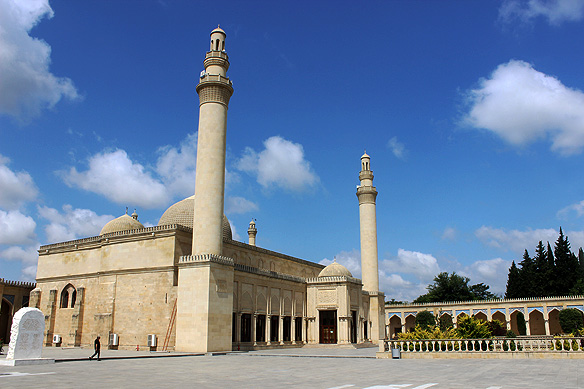
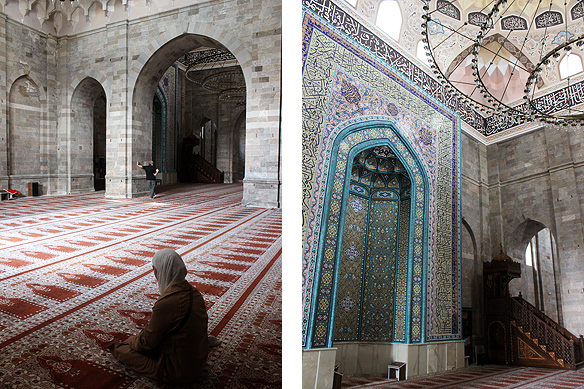
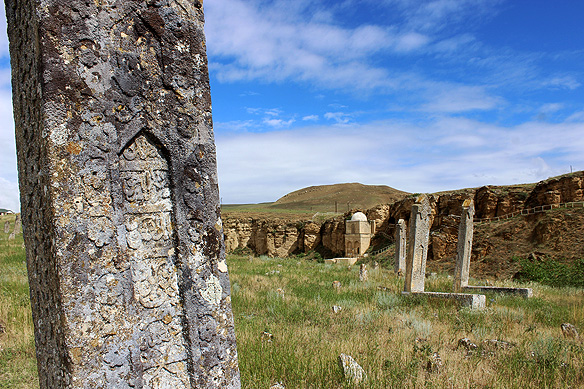
Most of Shamakhi was razed to the ground in this earthquake. Except for Juma Mosque, Caucasus’ second oldest mosque dating to 743. Juma or Friday Mosque has consistently, and lovingly, always been restored over the centuries. Its most recent face-lift was in 2013.
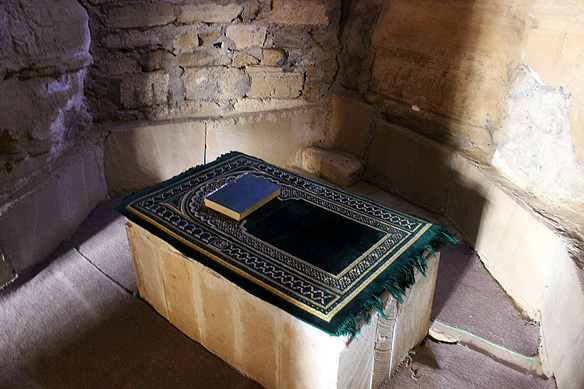
Thirty-five kilometres south-east of Shamakhi is another of Azerbaijan’s gems. Its very own Petra in fact—the Diri Baba Mausoleum built in 1402 during the reign of Shirvan Shah Sheykh Ibrahim I. Scalloped out of the towering cliff, it houses the tomb of the mystic Diri Baba. According to legend, Diri Baba’s body did not decompose upon his death, resulting in an instant bestowal of great spiritual powers upon the gentleman and a barrage of faithful pilgrims visiting the site over the next six hundred years.
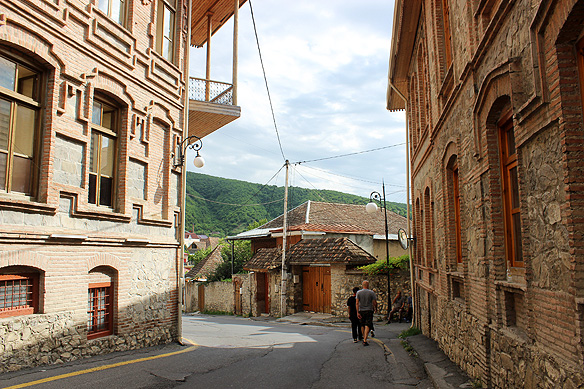
Historic Sheki in north-west Azerbaijan, meanwhile, dates to 1772 and was centred around silkworm breeding, as well as trade along the Silk Road. Set against the slopes of the Greater Caucasus Mountains, it is often considered to be Azerbaijan’s most beautiful city and was the capital of the Sheki Khanate till 1805, after which it was absorbed into the Russian empire.
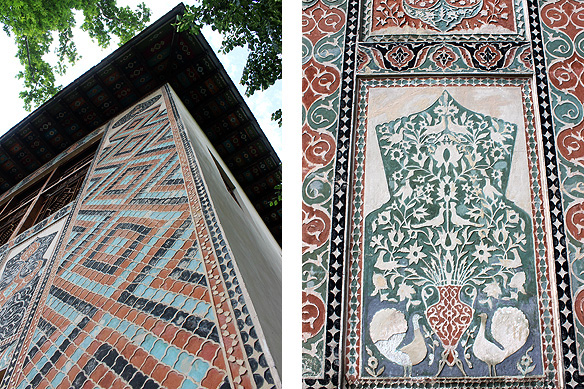
Golden stone edifices, including high gabled merchant houses and airy caravanserais line its winding streets. The city’s most spectacular structure is the UNESCO-listed Sheki Khan Palace in the royal complex. Built over 10 years, two years for the structure and eight years for its embellishment, its colourful murals on the walls and ceilings are loaded with symbolism. These range from how a ‘good’ woman can completely change a man’s fortune for the better, to battle-scenes with hundreds of life-like faces, all painted purely from imagination.
Sheki Khan Palace’s most prized and unique decoration is, however, its ‘Shebeke’ windows in which jewel-coloured pieces of glasses are held together with interlocking pieces of wood. Sans any nails or glue, these windows can be completely dismantled and reassembled, and were a trademark craft of the Sheki region.
Two cities spanning a millennium, Shamakhi and Sheki are a rare insight into the country’s indigenous culture. Yes, Azerbaijan is about oil and gas propelling it headlong into a European-styled global future. But it is just as much about medieval Islamic Shamakhi and Sheki. 😊
– – –
[This blog post is part of a series from my solo independent travels to Azerbaijan in June, 2024. To read more posts in my Azerbaijan series, click here.]
 rama toshi arya's blog
I didn’t really know about these places, but they surely sound and look like they’re worth the trip. Now you got me interested in the Shebeke windows!
LikeLiked by 1 person
Not many tourists go beyond Baku and Gabala which is a pity because the rest of the country has so much to offer. The shebeke windows are fascinating. After the palace tour, the official English guide gave a demo of how the windows were dismantled and assembled. Pure creativity!
LikeLiked by 1 person
Azerbaijan has fascinated me for years, it looks like such a unique and beautiful place. I look forward to more posts from you!
LikeLiked by 1 person
It is a beautiful country. I really enjoyed exploring it. Though small, it is packed with so much variety in terms of landscapes, timespan, and quirky unique places. 🙂
LikeLiked by 1 person
Thanks again Rama for bringing back more memories – of Sheki – a very atmospheric town. As usual I remember odd things – not so much the intricacies of the Sheki Khan Palace – but the man outside in a fur hat with a stuffed wolf as his attraction for earning a few notes and also the run-down Soviet era flats with collapsing balconies. And then the rough walk up to the ruins of the fortress of Galarson-Gorasen through the woods on a mountain top outside the city when the guide kept asking “do you really want to climb up to the top?” It means ‘will come-will see’ which is what the Sheki Khan apparently said to the Shah of Iran when he tried and failed to capture it after he had turned down an offer to surrender. So great to visit such places.
LikeLiked by 1 person
Which year did you go, and was it with Explore? I never went up to the fort. Apparently not much of it is left. I like the ‘will come-will see’ story. 🙂
LikeLike
It was 2012 with Explore and we visited Armenia, Georgia & Azerbaijan for 3 weeks. Interesting to note the dynamics between each of the countries. Anything recognisable as being from Armenia would have prevented entry to Azerbaijan so I hid my fridge magnet in the dirty washing! There’s not much to see of the ruined fort but the ascent was an experience – just two of us with a reluctant guide!
LikeLiked by 1 person
Not much has changed since 2012. The fort (or what remains of a gate and its adjoining wall) is still at the top of a wooded hill that is surprisingly steep and gives the careless hiker plenty of opportunities to twist an ankle or break a leg.
I came to know of the fort and its fascinating story from a tourist brochure not long after arriving at Baku last year but did not seriously think of traveling there. It was only after I stayed two nights at Seki and took a minibus to the village of Kis that I began to entertain the idea of a hike. To that end I was quite unprepared and had merely a bit of water, some stale biscuits and a notebook, all in my trusty Trader Joe’s cloth bag. The distances involved were more than I anticipated. Crossing the dry river bed on foot (a benefit of Autumn), I walked several kilometres of paved road passing two resorts, re-crossing the rivulet upstream (I could had simply walked the bed if I had the courage) and an abandoned Gorasan theme park before hitting the woods and finding sketchy arrows towards the fortress. Once off the main road I met not a soul save for three young border guards who warned me that the Russian border was not far (though they did not stop my hike). Getting to the top sapped a lot of strength in the humid air and it was all an anti-climax at the end with the sight of some beer cans and other assorted rubbish being my reward for the climb. Getting back down in the fading light was tricky and I slipped twice, narrowly escaping injury. Walking back as the shadows lengthened I was lucky to see a minibus waiting to start from the first resort (about 3-4 km from the fortress). A tiny adventure that made my equally tiny stay in Seki memorable!
LikeLiked by 1 person
Truly memorable, Kumar. It’s these detours and stories which stay with us for years. Thank you for sharing your experience here. I really enjoyed reading it. 🙂
LikeLike
While we continue to look at countries in the current context, the fact is, these have evolved over a period of time and borders have always kept changing. That’s why it is important to see places in context of its history and region. A lot in Azerbaijan is similar to Iran, in the same context!
LikeLiked by 3 people
Well said. However, the Azeris are not Persians, but are in fact Turkic. They belong to the same ethnic group as the people of Turkmenistan and Turkiye. 🙂
LikeLiked by 1 person
True. This explains why Turkey and Azerbaijan go along so well. Ethnicity and shared history are a few factors. This was also was a major factor for Turkey helping them in the recent Nagorno Karabakh conflict.
LikeLiked by 1 person
Yes, absolutely! When travelling through Azerbaijan, I often saw the two country flags next to each other, and the phrase “1 nation, 2 states” used to describe the relationship they have with Turkiye. Their relationship with Iran, on the other hand, is complicated because of different ideologies, especially recent ideologies. 🙂
LikeLiked by 1 person
Yes, it is complicated. In fact, the entire ME is complicated in a political context; ideology, religion, and interests, dictate relationships with each other. Azerbaijan and Iran also have land disputes, Azerbaijan and Israel maintain good relations even though Turkey and Israel are not really good friends. It is one of the most complex regions of the world.
LikeLiked by 1 person
And the most interesting. Especially for a traveller, and a traveller like me. 🙂
LikeLiked by 1 person
Great 👍
LikeLike
Pingback: the road less travelled: azerbaijan’s unusual villages | rama toshi arya's blog
Pingback: 72 hours in baku | rama toshi arya's blog