Sandwiched in the Caucasus, between the Caspian and Black Seas, Azerbaijan is a bit of a latecomer to global tourism. But catching up fast.
Unusual on multiple counts, four features and their unique mix set the country even further apart from the ordinary: Mud, petroglyphs, oil, and fire. Where else can one find such a cocktail! To add to its appeal, they come candy-wrapped in picturesque settings at a short distance from the capital Baku in the surrounding Absheron Peninsula.
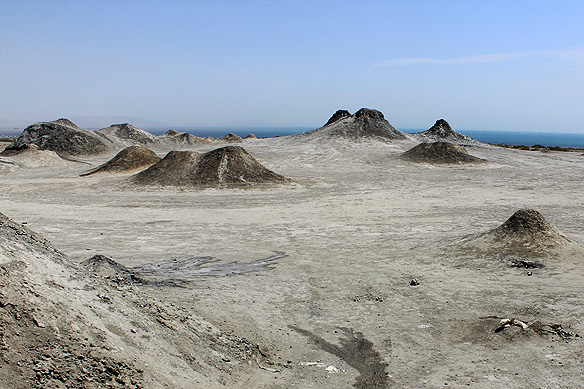
Of the 700 mud volcanoes found around our planet, 40 percent lie in Azerbaijan. They bubble away on barren stretches courtesy of methane gas trapped under the earth’s crust. When the pressurized gas encounters groundwater, and together they find an opening in a fault line, they ooze out in the form of mud, cool to the touch.
Ranging from 1 to 700 metres high, and a few centimetres to a few kilometres wide, they function similarly to regular volcanoes. When they erupt, they can spew flames and mud from the bowels of the earth. Kinezadagh [397 metres high] and Turaghay [400 metres high] are the largest mud volcanoes in the country.
Azerbaijan is also among the oldest inhabited regions in the world, going back to the Stone Age. The Gobustan Rock Art Cultural Landscape Reserve, a UNESCO-listed World Heritage Site, contains an exceptionally large collection of petroglyphs. Etched into rock with sharp stone tools, and with the advent of the Bronze and Iron Ages, with metal, the earliest of the lot is 40,000 years old.
Subjects range from dancing figures, shamans, boats with oarsmen, and battle and hunting scenes; the latter replete with bison, gazelles, horses, and goats. Some of these were ‘drawn’ even before the region’s ancient men and women shifted to farming and husbandry as a source of food.
![Simulation of how petroglyphs were perhaps used by Stone Age men to hone their hunting skills. [Gobustan National Park Museum]](https://ramaarya.blog/wp-content/uploads/2024/08/absheron-title-photo-2.jpg)
Simulation of how petroglyphs were perhaps used by Stone Age men to hone their hunting skills. [Gobustan National Park Museum]
![The Reserve's 6,000 petroglyphs depict a large variety of animals from goats and birds, to wild boars. [Gobustan National Park Museum]](https://ramaarya.blog/wp-content/uploads/2024/08/absheron-title-photo.jpg)
The Reserve’s 6,000 petroglyphs depict a large variety of animals from goats and birds, to wild boars. [Gobustan National Park Museum]
Under the country’s terrain and adjacent Caspian Sea are 7 billion barrels of oil reserves and 2.5 trillion cubic metres of proven natural gas reserves. The oil is often just a few hundred metres below. A mere crack on the earth’s surface is sufficient to ‘see’ the gas with the help of a lit matchstick.
Is it any wonder then that the world’s first industrial oil rig was raised in Azerbaijan, in 1846. Thirty-two years later, the Swedish Noble brothers decided to capitalise on this and set up Branobel in Baku. It was one of the largest oil companies controlling Russian oil output. Does the name sound familiar? It should. The Noble brothers included Alfred Noble, founder of the Noble Prize. Part of the wealth funding the prestigious prize came from Azerbaijan’s oil rigs in which he was a partner.
Local Azeris were quick to join in the treasure hunt leading to a flurry of diggings in the Absheron Peninsula where the reserves lay. In the 19th Century, whosoever owned the land which sputtered the black gold, also owned the riches it garnered, leading to overnight Azeri billionaires with a soft spot for European architecture. With the help of Polish architects, a mini-Europe was created around the medieval heart of Baku.
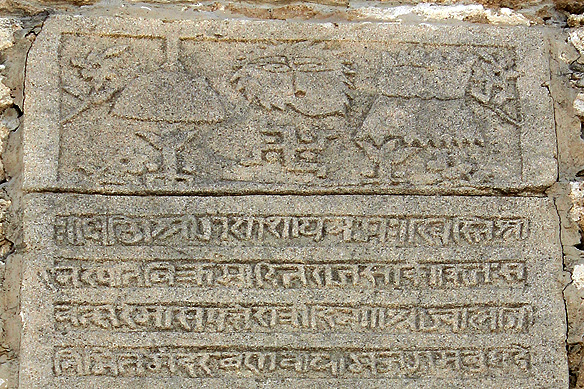
Sanskrit scriptures at the 17th Century Ateshgah Fire Temple rebuilt by Zoroastrians; a gentle reminder of their Indian connection.
Unlike the initial tepid reception received by the greasy oil, the region’s methane gas reserves have long been revered. To the extent they even had a spiritual connotation.
Before the introduction of Islam in this part of the Caucasus, its inhabitants followed Zoroastrianism, a monotheistic fire-worshipping religion with Ahura Mazda as its supreme deity. By the 8th Century this ancient religion was wiped out in the region, except for a brief resurgence a thousand years later as a result of trade routes and the Zoroastrians in India.
Fascinated by the ‘eternal flames’ which licked out of the ground at the site of a 3rd Century Zoroastrian temple, the 17th Century traders decided to rebuild the temple and revive its sanctity. For the next two hundred years the Ateshgah [fire temple] attracted Zoroastrian pilgrims from far and wide, until it died a second death in the 19th Century.
Certain Zoroastrian traditions and customs still survive in Secular Muslim Azerbaijan and are followed with much gusto. One such is the Navroz or New Year festival, marking the beginning of spring. Another, is the third lease of life to the Ateshgah, wherein the sacred fire continues to burn, albeit this time with a gas pipe and the temple’s conversion into a museum.
Mud volcanoes, stone age drawings, oil rigs, and fire temples. What an eclectic unusual assortment. But who said Azerbaijan was just another country? 🙂
[Click on any image below to enlarge it and start a slideshow. Use the arrow keys to navigate through the set and read the captions.]


![Neolithic [10000 BC – 2200 BC] stone with lion petroglyph.](https://i0.wp.com/ramaarya.blog/wp-content/uploads/2024/08/absheron-4.jpg?w=190&h=190&crop=1&ssl=1)
![Bronze Age [3300 BC – 1200 BC] necklace.](https://i0.wp.com/ramaarya.blog/wp-content/uploads/2024/08/absheron-5.jpg?w=190&h=190&crop=1&ssl=1)
![Bronze Age [3300 BC – 1200 BC] stone with hunters petroglyph.](https://i0.wp.com/ramaarya.blog/wp-content/uploads/2024/08/absheron-6.jpg?w=190&h=190&crop=1&ssl=1)
![Mesolithic [10000 BC] scrapers.](https://i0.wp.com/ramaarya.blog/wp-content/uploads/2024/08/absheron-7.jpg?w=190&h=190&crop=1&ssl=1)


![Two bulls carved during the Upper Paleolithic Period [50000 – 10000 BC].](https://i0.wp.com/ramaarya.blog/wp-content/uploads/2024/08/absheron-13.jpg?w=190&h=190&crop=1&ssl=1)


– – –
[This blog post is part of a series from my solo independent travels to Azerbaijan in June, 2024. To read more posts in my Azerbaijan series, click here.]
 rama toshi arya's blog
I remember seeing visuals from this region in YouTube video of Itchy boots. A Dutch woman traveling from India to Holland. A very unique and interesting terrain especially the gate of hell.
LikeLiked by 1 person
A very interesting terrain indeed. The Gates of Hell are in Turkmenistan, on the other side of the Caspian Sea from Azerbaijan. It is, thus, doubly fascinating how both land and sea in the region have oil and gas bubbling under their surfaces!
LikeLike
It’s interesting to learn about the connection the Noble brothers had with Azerbaijan. Fire is often associated with destruction, but Azerbaijan seems to embrace it proudly, so much so they call themselves the land of fire. Fascinating!
LikeLiked by 1 person
Oh yes, they are very proud of Azerbaijan’s fire aspect. More so, I learnt whilst travelling, it is because the Azeris were Zoroastrians before converting to Islam, and a number of Zoroastrian traditions and ideas have survived through the millennia. One key Zoroastrian value, of course, being that fire is sacred.
LikeLiked by 1 person
Such an interesting and fascinating place, thanks for sharing with us!
LikeLiked by 3 people
Thank YOU for reading the post and dropping a comment! I just got back from two weeks in Kazakhstan — another fascinating country.
LikeLiked by 1 person
Oh how exciting! A place i want to see! I am going to uzbekistan this sunday! May we long have happy travels! X
LikeLiked by 1 person
Am so very happy for you. Uzbekistan is an incredible country. Stunning at every level. Enjoy!
LikeLiked by 1 person
Thank you Rama! Xxx
LikeLike