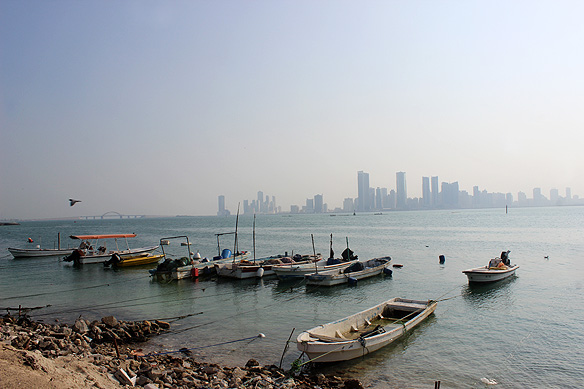
Fishing boats in historical Al-Muharraq overlooking modern Manama.
Bahrain, meaning ‘Two Seas’ in Arabic, is one of those delicious treats one encounters as a traveller. I do not mean that from a food perspective. Do not get me wrong. The food is fantastic here. What I mean is that it is a visual and historical treat. Layered, nuanced, and whole.
Middle East’s smallest country, the Kingdom of Bahrain is located a mere 25 kilometres off the north-east coast of Saudi Arabia. Ruled by the Al-Khalifa family, it is an archipelago of 33 islands with Bahrain Island the largest [51 kilometres long and 18 kilometres wide] and Manama as its capital. Though mainly barren desert, its freshwater underground springs and marine waters have given the country a remarkable gift: the finest Pinctada radiata oyster beds in the world, of which one in every 20 contains an iridescent natural pearl.
Since their discovery over four thousand years ago by the Dilmun civilization, these oyster beds have sustained empires who made Bahrain their home, and provided them with immense wealth. Pearl-diving, however, was no mean feat across these millennia. It was dangerous and physically demanding.
The divers, known as ghawwas, would plunge some 30 metres into the depths of the sea, armed with rudimentary nose clips and finger protectors, to collect the oysters. After gathering as many as they could with their breaths held tight, they would rush back to the surface, gasping for air. The oysters would be slit open, the pearls graded, and the wheeling and dealing begun with buyers from Europe and India. Once the prices were fixed, these little gems of nature left Bahrain’s shores to grace a crown, a robe, or a neck.
Everyone in the island was directly or indirectly involved in the business of pearls which peaked from 1810 to 1923 in Al-Muharraq, the second largest island in Bahrain. The result was a single product economy which made it to the UNESCO World Heritage list in 2012.
Any surprises then that Bahrain is often referred to by its moniker ‘Pearl of the Gulf?’
But what starts, ends. And though the oyster beds are still there, the pearling trade collapsed with the advent of the Japanese cultured pearl in the 1920s—a simpler, cheaper, and easier alternative—and the discovery of oil in Bahrain in 1932.
An Islamic nation based on Sharia Law, Bahrain’s maritime trade and exposure to multiple cultures for over four millennia has made it forward-thinking and tolerant. It is hard to distinguish between the Bahraini and 55 percent expatriate community at times. There is an easy comradery that cuts across race, class, and creed, peppered with some of the warmest, friendliest smiles around.
Here are 15 memorable things to do in Bahrain. Because, this little island kingdom is, well, different. ❤
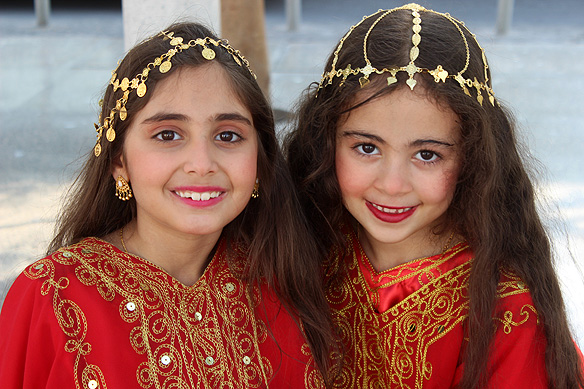
Children dressed up for Bahrain’s national day, 16th December, which celebrates the late Emir Isa bin Salman Al-Kalifa’s ascension to power in 1961.
1. Take a crash course in Bahrain’s 4,300-year-old history
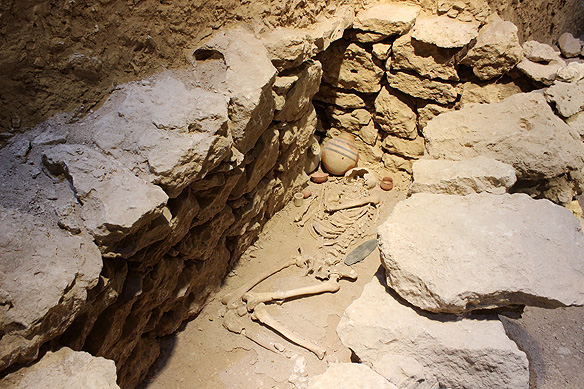
Relocated UNESCO-listed Late Type Dilmun Burial Mound built between 2050 and 1750 BC.
![The 'Dilmun burial jars,' a cultural marker for Dilmun, were used throughout Dilmun, as well as exported [2000 – 1800 BC].](https://ramaarya.blog/wp-content/uploads/2025/02/bahrain-national-museum-2.jpg)
The ‘Dilmun burial jars,’ a cultural marker for Dilmun, were used throughout Dilmun, as well as exported [2000 – 1800 BC].
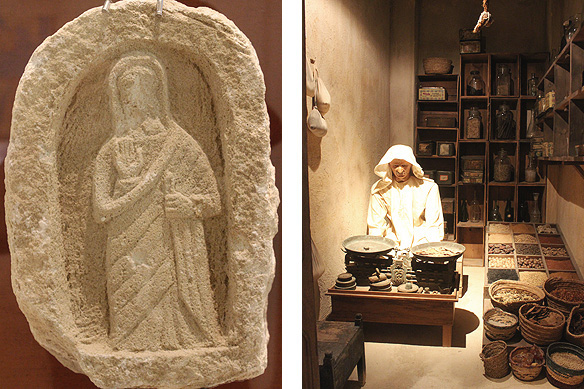
Left: Grave portrait, dated around 150 AD. Hellenistic in style, the raised right hand was unique to Tylos—it was a Parthian gesture of greeting in reverence to the gods. Right: Grocery store in the recreated traditional Bahraini souq.
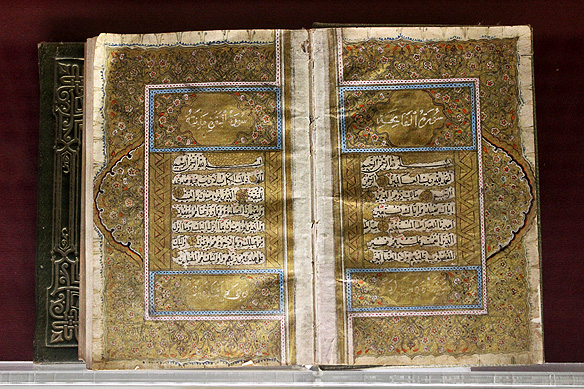
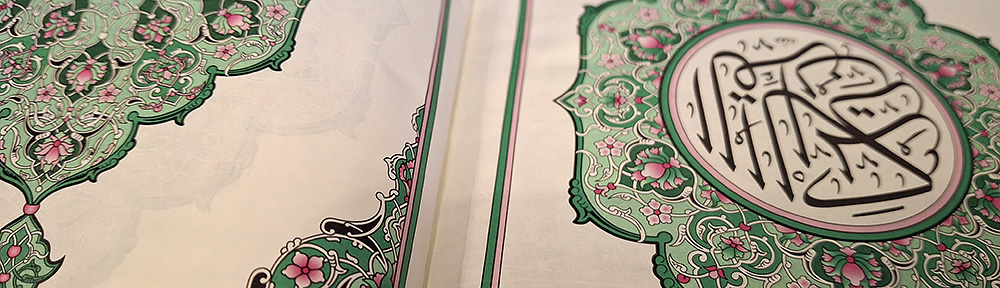
Holy Quran. This copy was made by Darwish Mohammed bin Ahmed Afandi in 1756.
What better way could there be to start learning about a country, so as to understand and enjoy it better, than by paying a visit to its national museum. Luckily, Bahrain’s tops on this count. Beautifully curated and easy to navigate, the region’s first modern museum traces the island nation’s rich history through fabulous relocated structures, life-sized models, succinct explanations, and a compact layout.
Start off at the museum’s prized attraction: the Bronze Age UNESCO-listed Dilmun burial mounds along with the treasures found within them and at other Dilmun sites [2300 – 400 BC]. Then wind your way upstairs to the next chapter in Bahrain’s history when it was known as Tylos [330 BC – 622 AD] during Hellenistic and Roman times, followed by the entry of Islam in the 7th Century and the ruling Al-Khalifa family [since 1783]. The halls celebrating indigenous heritage come replete with a traditional Bahraini souq and wedding scenes, and a section on the country’s pre-oil pearling economy. For a final wrap, browse through the museum’s art collection showcasing works of modern and contemporary local artists.
2. Get bedazzled at the Pearl Museum
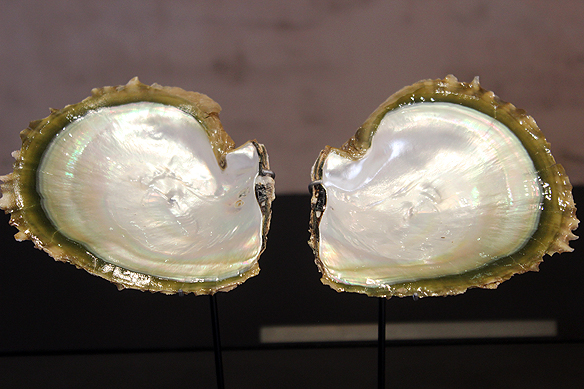
Oyster shells: Home of the natural pearl.
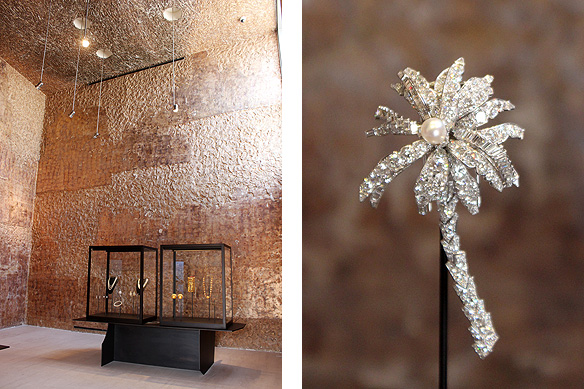
Left: Pearl Museum’s main hall lined in patinated silver leaf; Right: Diamond and pearl brooch designed by Cartier in 1950.
If there is one more museum that needs to be added to your Bahrain bucket list, it is the Pearl Museum. Housed in Al-Muharraq’s 19th Century Siyadi Complex which once belonged to a wealthy pearl merchant family, and designed by Dutch architect Anne Holtrop, it is a shimmering jewellery box. Literally.
Inside the rough-hewn angular textured rooms and the main hall’s patinated silver-leafed walls is Bahrain’s pearling story complete with some of the most exquisite pieces of pearl jewellery ever produced. There are Bronze Age Dilmun and Roman Tylos ornaments, Cartier’s masterpieces including the palm-shaped diamond and pearl brooch he designed in 1950, and Jaipur’s Maharani Gayatri Devi’s necklace of 37 graduated pearls. The Bahraini pearl, which in fact is an anomaly of nature created to protect the mollusc from an irritant, made an unrivalled place for itself. Both in a country’s economy and the world of luxe design.
3. Relive Bahrain’s pearling history on the Pearling Path
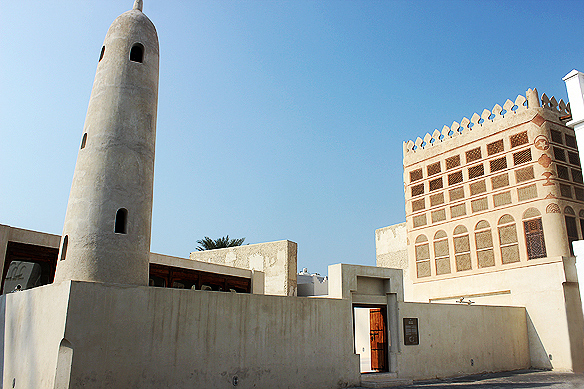
Built in 1865 and renovated in 1910, the Siyadi Mosque is a single-storey courtyard mosque and Al-Muharraq’s oldest functioning mosque.
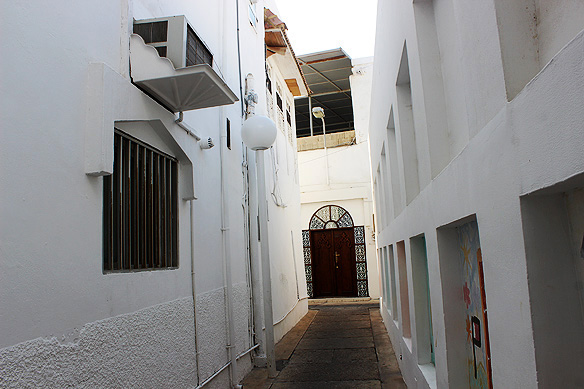
Pearl-shaped streetlamps chalk out the route in the Pearling Path. But be warned, it is easy to get lost. And that is half the fun.
Bahrain’s historical pearling economy was centred on an island in the north. Known as Al-Muharraq, its narrow lanes and squares were once packed with shops, ancillary businesses, grand mansions of pearl merchants, and humble homes of pearl-divers. The coastline around it, meanwhile, was home to the finest oyster beds right from antiquity. This area [comprising 20 sites] was listed as ‘Pearling, Testimony of an Island Economy’ UNESCO World Heritage Site in 2012 and resuscitated through a 3.5-kilometre-long trail aptly named the ‘Pearling Path.’
At one end of the path is Qal’at Bu Mahir [1840] which protected Bahrain’s pearling fleet from pirates and its freshwater supply. At the other end is the Siyadi Complex, a set of three grand 19th Century edifices that belonged to one of Bahrain’s wealthiest pearl merchants. They encompass a mosque they gifted to the city and two houses with the Pearl Museum and a jewelled majlis in one. In-between are a plethora of art galleries, studios, and cafes in restored historical homes and shops.
4. Learn about the Ahmed Al-Fateh Grand Mosque on a free guided tour
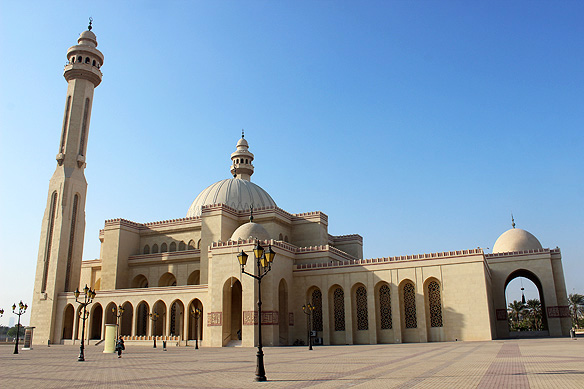
Bahrain’s largest mosque was built in 1988 by the late Sheikh Isa Bin Salman Al-Khalifa.
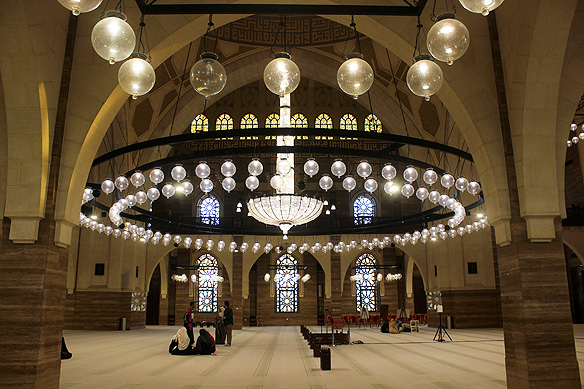
Inside the Ahmed Al-Fateh Grand Mosque: the lights an ode to the kingdom’s pearling history.
Bahrain’s principal mosque named after Ahmed Al-Fateh, the founder of the ruling Al-Khalifa dynasty, is grand in both size and ideology. The latter being ‘global harmony.’ One of the largest mosques in the world with a capacity of 7,000 worshippers, it is embellished with sparkling crystal chandeliers from Austria, silk-smooth marble from Italy, and the finest teakwood from India.
In keeping with its vision of tolerance, multilingual tours are held throughout the day, from 9 AM to 4 PM, except Fridays. There are even Filipino and Russian tours. These guided walk-throughs point out the edifice’s architectural highlights such as its biggest fiberglass dome in the world and the exquisite Kufic calligraphy on the walls. But it does not stop there. The tours also introduce Islam and provide insights aimed at demystifying its practice through visual presentations.
5. Pay homage to the Virgin Mary, Lady of Arabia
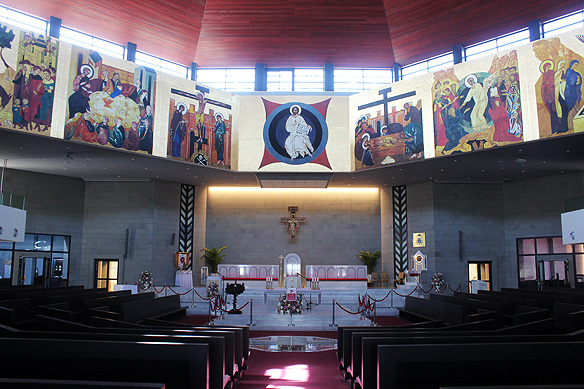
Bahrain’s Roman Catholic cathedral is dedicated to the Virgin Mary.
In keeping with Bahrain’s tolerant outlook towards religious diversity, it is understandable that it has a monumental Roman Catholic Cathedral of our Lady of Arabia. The biggest in the Arabian Peninsula. And that Pope Francis made an official visit to the cathedral on 4 November, 2022.
Located on 9,000 sq. metres of donated land in Awali, the conical-roofed extravaganza is decorated with bright colourful murals by Spanish artist Kiko Arguello, and an effigy of the crowned Virgin Mary holding a rosary and child Jesus in one of the chapels. In Bahrain and Kuwait, Roman Catholics refer to the Virgin Mary as ‘Lady of Arabia.’ It is a title decreed by the Vatican. Masses are held in Arabic, English, Filipino, Konkani, and Malayalam when close to 15,000 expatriates cram into the 2,300-capacity hall.
6. Wander through Qal’at Al-Bahrain, the Portuguese fort atop ancient Dilmun
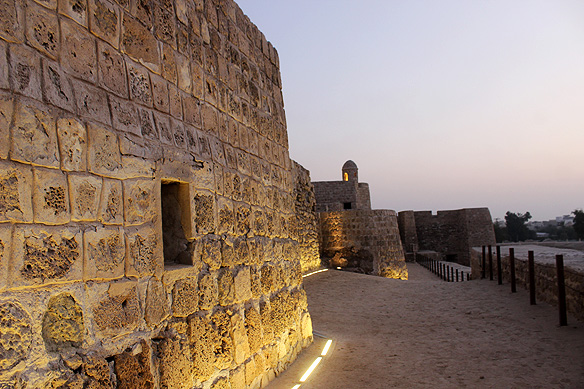
Open from 8:00 AM to 8:00 PM, Qal’at Al-Bahrain on top of an archaeological tell is best visited at sunset.
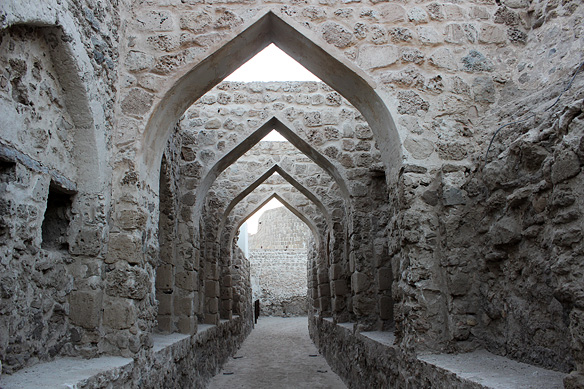
Grand archways inside Qal’at Al-Bahrain. The fort was built by the Portuguese who ruled Bahrain from 1521 to 1602.
Qal’at Al-Bahrain, perched on an atmospheric 12-metre-high tell on the northern coast of Bahrain Island, is its first UNESCO-listed site [the country has three]. It is an impressive 16th century fort with massive ramparts and towers built by the Portuguese who ruled Bahrain from 1521 to 1602. What sets it apart, however, is what lies under it.
The tell below contains remains of settlements stacked on top of each other, starting with 2300 BC when this specific part of Bahrain became the capital of the ancient Dilmun civilization. Then came Hellenistic and Roman Tylos, and thereafter, the medieval Islamic period, culminating in the 16th Century European fort. Archaeologists have unearthed not just countless artefacts from the site, but also defensive and urban structures, illustrating the site’s uninterrupted significance over the millennia. There was one constant thread through all this. That of being a trading port.
It was from here that Bahrain traded as ‘Dilmun’ with Mesopotamia and the Indus Valley from the 3rd to 1st millennium BC. And, thereafter, did business with the Mediterranean and China as part of the Great Silk Route.
7. Explore the Bronze Age Dilmun burial mounds
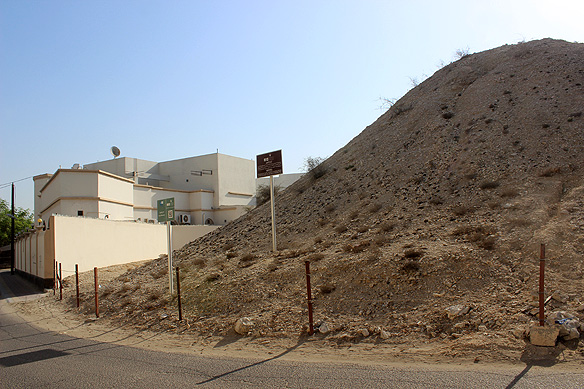
Royal mound in A’ali village. Often up to 50 metres wide and 12 metres high, it is a miracle the mounds have survived 4,000 years.
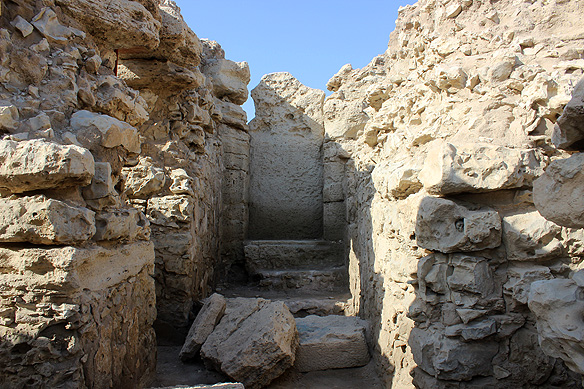
Of the 17 royal mounds, No. 8 stands out for being the only fully excavated royal mound and its asymmetrical layout. Ri’ Mum, one of the last Dilmun kings, was buried here.
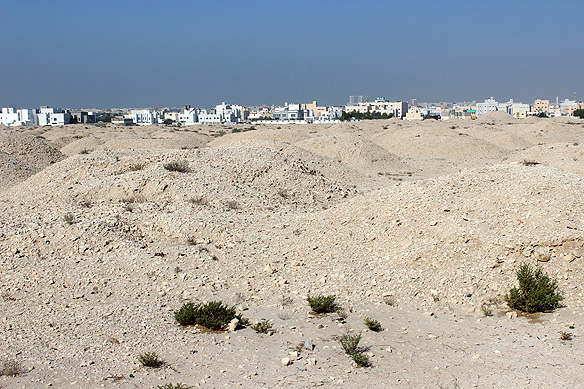
A’ali East Burial Mound Field.
This one is for the history aficionados. One does not often get the opportunity to explore Bronze Age burial mounds. Not even in Bahrain. Of the 11,774 UNESCO-listed Dilmun burial mounds in Bahrain, originally low cylindrical towers, only a small percentage have been excavated. And of these, only one of the 17 royal mounds: No. 8. The rest still lie under heaps of sand and rubble, swathed across miles in Bahrain Island’s north-west, or sandwiched between its concrete 21st Century homes. Long pillaged of their burial paraphernalia, they still reveal much about prevailing hierarchies in society and philosophies on afterlife from 2200 BC – 1750 BC, the high point of Dilmun civilization.
Contemporary to and a trading partner of the Sumerians and Indus Valley civilization, the Dilmun civilization controlled eastern Arabia from its capital in Bahrain. Newly prosperous with copper mining, pearling, and control of the Persian Gulf’s maritime routes, everyone in Dilmun society could afford a decent burial during these 550 years, and did so. The commoners were buried in the fields. The royals in 17 two-storey sepulchral towers furnished with alcoves in present day A’ali village.
8. Shop for Bahraini pottery, a 4,000-year-old Dilmun-era craft
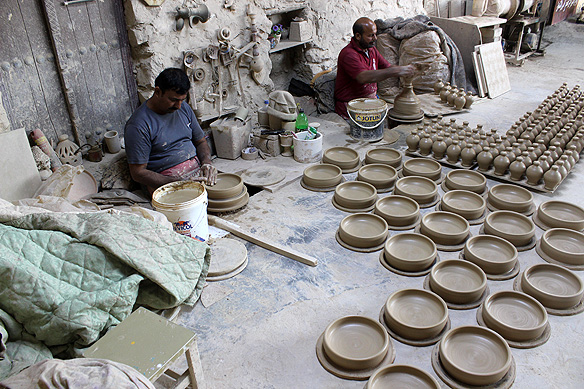
Jaffer Mohd. Al-Shughul Pottery Workshop in A’ali village produces pottery using millennia-old techniques.
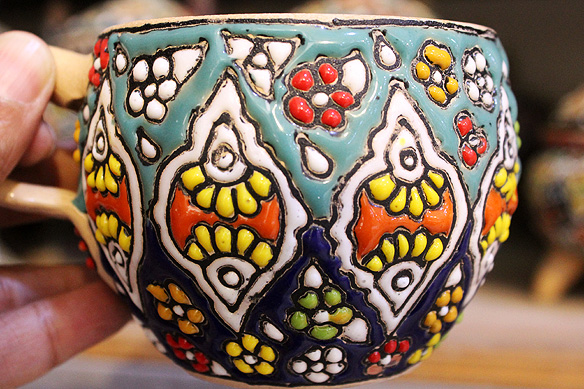
For that perfect cup of coffee back home.
There is more to A’ali village than the Dilmun royal mounds. Interspersed between the Late Type Dilmun [2050 BC to 1750 BC] necropolis are pottery workshops creating wares for as long as the mounds have been around. The same material [one-part yellow clay mixed with three-parts red clay], the same foot-operated wheels and techniques passed down from one generation to the next, and the same type of kilns to bake them into hardened permanence. These kilns often dug into the adjacent burial mounds itself.
Fifty years ago, two-thirds of the villagers were potters. Now, there are only seven families in the pottery business, of which the biggest family-run workshop is Jaffer Mohd. Al-Shughul Pottery Workshop. Bahraini pottery comes with a bit of Dilmun’s soul, and some dust from the mounds too. The perfect souvenir in every respect.
9. Admire the tenacity of ‘The Tree of Life’
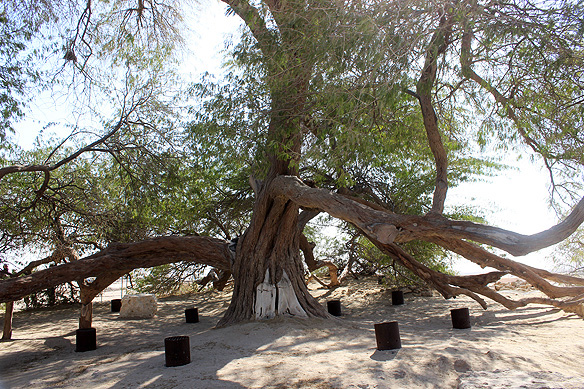
400-year-old lone ghaf tree in Bahrain’s Arabian Desert.
As you make your way deep into Bahrain’s interiors, there is nothing for miles and miles. Just the arid Arabian Desert with no traces of ground or surface water. Yet, amidst this arid barren landscape which receives no rainfall, is a sole tree spreading its gnarled 400-year-old branches laden with lush foliage. Planted in 1582, the ghaf [Prosopis cineraria] tree rises nearly 10 metres tall and has roots 50 metres deep.
It is a popular tourist attraction, drawing some 65,000 visitors annually. After all, there is much to learn about tenacity against all odds from this stubborn being that’s popularly called ‘the tree of life.’
10. Visit the Persian Gulf’s first oil well: Well Number 1
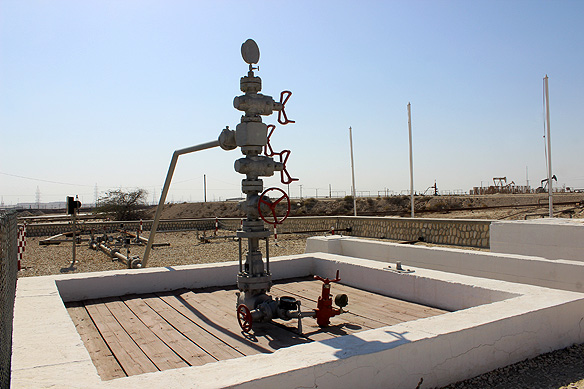
Well Number 1: the game changer in Bahrain and the Persian Gulf.
When Kokichi Mikimoto’s invention of cultured pearls brought Bahrain’s 4,000-year-old pearling economy to a standstill in the 1920s, it seemed all was lost. But nature had other plans. Under the barren limestone and sand landscape were oil reserves that helped catapult the kingdom back into the driving seat.
The year was 1931. Oil had sputtered out from Well Number 1 in the desert below Jebel Al-Dukhan for the first time in the Persian Gulf. One year later, on 1 June 1932, the well blew out oil at 400 barrels per hour, and eventually settled to a flow of 1,460 barrels per hour. There was no looking back for Bahrain anymore. Bahrain has since moved on to more oil wells, refining, and gas, whilst Well Number 1 continues to blow out oil at a steady, albeit reduced rate. Its work was done. It had changed Arabian and world economics and politics. For good.
11. Pet some camels in a Royal Camel Farm
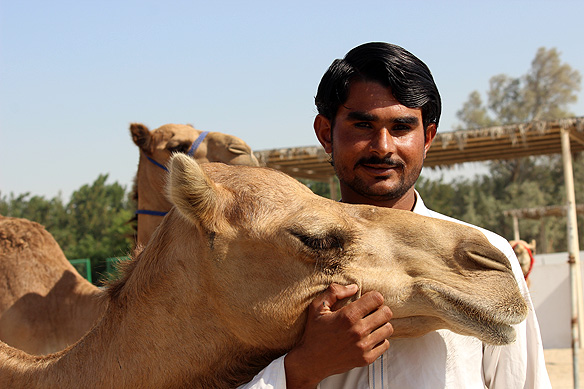
Caretaker with the royal family’s pet camels at the Royal Camel Farm.
Can a trip to the Persian Gulf be without camels! Since they do not prance across the countryside in Bahrain as they do in Oman or Saudi Arabia, the next best place to see them here is in a camel farm. In Bahrain, it translates to a Royal Camel Farm. Not only do you get to pet them, but note these are also royal pets in a way.
These camels have been gathered purely to serve as a personal collection. They are not for sale, or to breed, or to eat. The farm was founded by the uncle of the current ruler of Bahrain, late Sheikh Mohammed bin Salman Al-Khalifa.
12. Feast on traditional Bahraini fare in a traditional restaurant
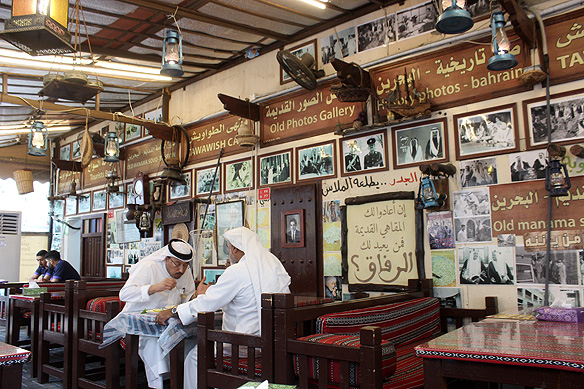
Traditional Bahraini restaurant in Bab Al-Bahrain Souq.
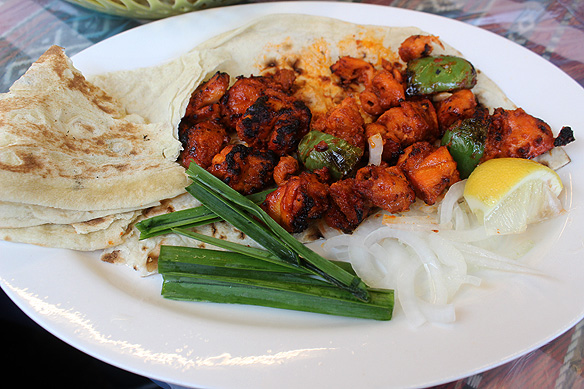
Chicken tikka kebabs, Bahraini bread, green onions, and a sliver of lime.
Although machboos, a spiced basmati rice dish cooked with meat or fish is Bahrain’s national food, nothing quite beats a plate of succulent chicken tikka kebabs and soft Bahraini bread. To enjoy it to the fullest, ensure you have it in a local street-side eatery. Built bang upon the side-walks in Bab Al-Bahrain Souq’s winding alleys, they provide an authentic experience difficult to emulate.
Wrap up your meal with steaming hot Arabic qahwa or a cup of karak chai sweetened with condensed milk. Bahrain’s Indian community, amounting to 30 percent of the 1.6 million population, have given the country its most popular drink. Were you to tell a Bahraini that it is in fact an Indian beverage, you will get a sheepish grin in response. “But we are the ones who drink it all the time, so it is Bahraini!”
13. Indulge in a sensory assault at the Bab Al-Bahrain Souq
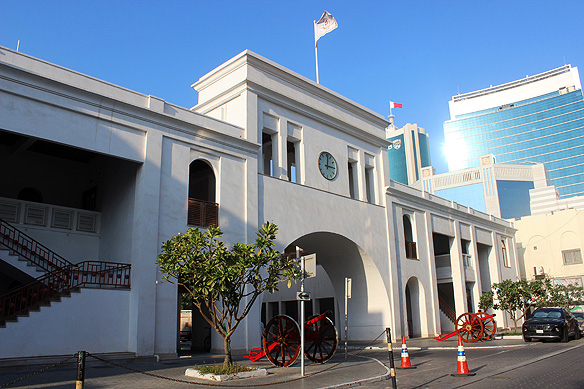
Bab Al-Bahrain, meaning Gate of Bahrain, was built in 1949.
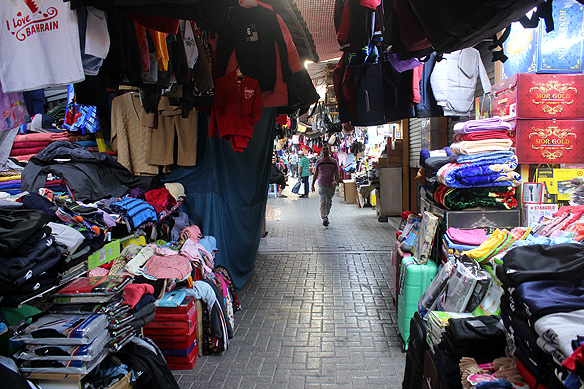
Shopping lane inside the Bab Al-Bahrain Souq aka Old Manama Souq.
Bab Al-Bahrain, dating to 1949, literally means Gate of Bahrain. At one time the sea came right up to the gate and the Bab housed government offices. Since then, considerable land has been reclaimed, pushing the coastline further out, and the Bab given a fresh new crisp mantle with the tourist office stationed in it.
Right opposite is Old Manama Souq, also known as the Bab Al-Bahrain Souq, because it faces Bab Al-Bahrain. It is a maze of narrow lanes filled with shops bursting at their seams, wrapped in a sensory assault from the exotic to the mundane. From clothes to spices, plasticware to perfumes. You name it, and in most likelihood, it would be available. Punctuated at regular intervals are traditional coffee shops and eateries dishing out aromatic fare from different parts of the world that cater to both locals and Bahrain’s large expatriate community alike.
14. Get up close and personal with the Bahrain International Circuit
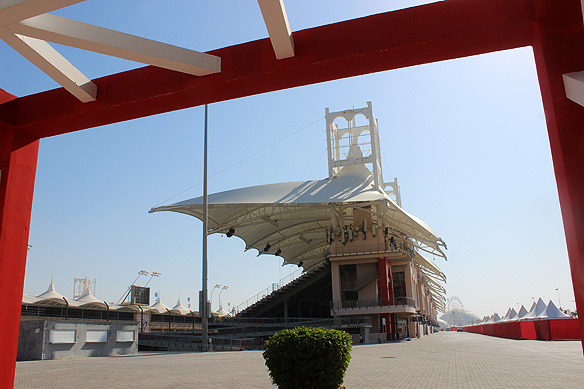
Bahrain International Circuit has hosted 19 Grand Prix since its opening in April, 2004.
You do not have to be a motor-racing enthusiast to appreciate the ultramodern Bahrain International Circuit laid out in the Sakhir Desert. A forerunner in motor sports in the Gulf region, it is meant to impress. Since visiting it when a race is on will most likely cost a small fortune and entail huge queues, the second-best option is to check it out in-between events. Okay, the adrenalin rush will be missing, but you can get up close and personal to the best stands for a fraction of the price.
The 5.412-kilometre-long circuit was designed by German architect Hermann Tilke. It was made in a record 496 days from groundbreaking to handover of the keys, and was inaugurated in April 2004 with the FIA Formula One World Championship. Nineteen grand prix have been held on its tracks to date. There is an interesting gift shop near the entrance selling Formula 1 souvenirs: toy cars, T-shirts and hoodies, caps, mugs, key chains, and even mohawk wigs.
15. Marvel at Bahrain’s innovative modern architecture
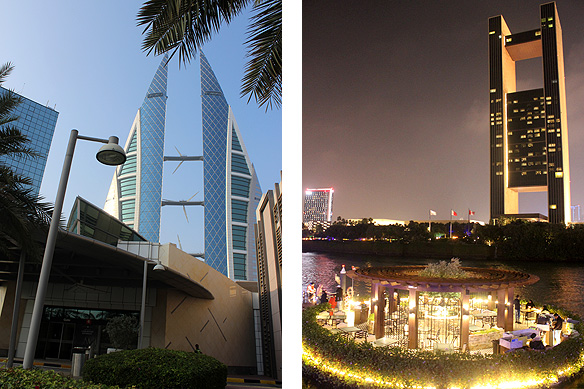
Left: Bahrain World Trade Centre; Right: Four Seasons Hotel with a fine-dining restaurant in the foreground, Bahrain Bay.
Not to be left behind when it comes to skylines, Bahrain has built its own set of amazing high-rises which defy gravity. These centre around Bahrain Bay in Manama, a waterfront mixed-use development built over reclaimed land. Manama has been the capital of Bahrain since 1971. Prior to this, the country was a British protectorate [1861 to 1971] and the old capital was Al-Muharraq.
Buildings to look out for are the Four Seasons Hotel, United Tower, and the Bahrain World Trade Centre. The last edifice is a 240-metre-high 50-floor twin tower with wind turbines which provide 15 percent of its power requirements. They are all at their glittering best at night, when the Bay comes alive with fine-dining restaurants floating on the waters, cafes selling street food under bright colourful lights, and residents strolling leisurely along the walkways.
The perfect wrap for one’s Bahrain travels. 🙂
Travel tips:
- Staying there: I stayed at the ibis Styles Manama Diplomatic Area. Close to the city centre, it has numerous cafes and restaurants at walking distance.
- How many days: I stayed for 3 full days.
- I explored Bahrain Island through a fabulous full day tour run by Maher, a professor in a previous avatar. Cell: +973 3988 4063. Very highly recommended. For the museums and Pearling Path in Al-Muharraq, I walked/ took an Uber.
[I travelled solo and independently across Bahrain for three days in December, 2024.]
– – –
If you enjoyed this post, you may also like to read these from my ‘Top 15 memorable things to do’ collection:
Top 15 memorable things to do in Kabul, Afghanistan’s capital
Top 15 memorable things to do in Jerusalem, capital of the holy land
Top 15 memorable things to do in Fes, Morocco’s cultural and spiritual capital
Top 15 memorable things to do in Bukhara, Silk Road’s legendary trading post
 rama toshi arya's blog
It’s nice to read about a country rarely written about, at least in the blogging world. I read somewhere that compared to the other GCC countries, Bahrain is considered liberal. But with Dubai and even Saudi Arabia seemingly moving toward the same direction, it’s interesting to see how this region will be decades from now.
LikeLiked by 1 person
It is indeed liberal. There is freedom of religion and freedom of conversion, both supported by the constitution, as well as citizenship through naturalization. Yes, the region is changing. Look at Saudi Arabia!
LikeLiked by 1 person
Very nice post! 🙂
LikeLiked by 3 people
Thank you so much! 🙂
LikeLiked by 2 people
Great work as always Rama!
LikeLiked by 1 person
Thank you, Anna, for your kind words. Bahrain is very much worth a stop when travelling. Similar to its moniker, it is a little pearl. 🙂
LikeLike
You took so much of effort to write about places you visited. Well done.
LikeLiked by 2 people
Thank you! 🙂 We live in a very beautiful and interesting world. I genuinely enjoy learning about its wonders, and sharing what I learn with others.
LikeLiked by 1 person
What a beautiful way to wrap up a Bahrain trip. The skyline around Bahrain Bay really is stunning at night, especially the World Trade Centre with its wind turbines — it’s both iconic and unique. Your practical tips are super helpful too, especially the hotel recommendation and realistic timeframe. A full-day guided tour sounds like a great way to see the island, while walking and using Uber in Muharraq is a smart choice. This makes Bahrain feel very approachable and well worth the visit.
LikeLiked by 1 person