[Note: Click on the play button or arrows to start the slide show.]
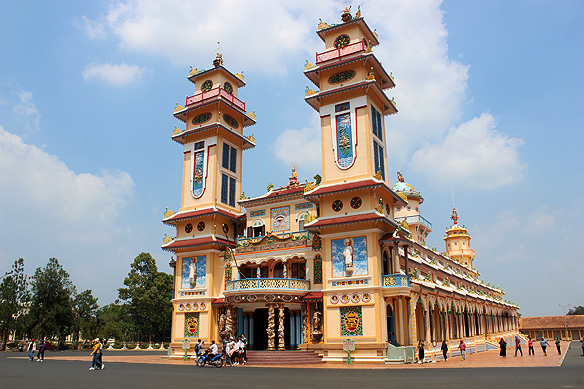
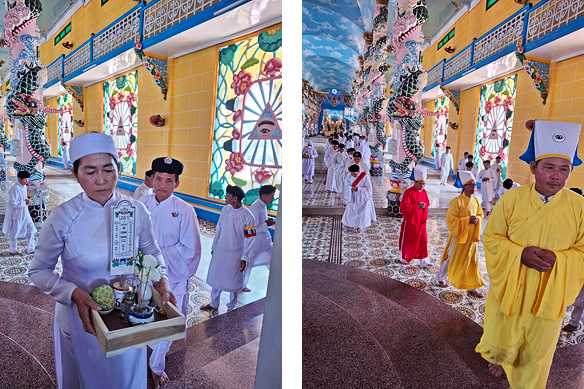
It is mid-day, somewhere in southern Vietnam, 80-odd kilometres from Ho Chi Minh City in Tay Ninh province. I am seated cross-legged inside a cavernous colourful ‘cathedral,’ on the fringes of a 99-year-old hypnotic performance of chants and rituals carried out by hundreds of solemn, serene-faced white-robed disciples.
Teal dragons, in contrast, wrap around soaring pink columns. Their candy red and white tongues stuck out mid-air. Above me, a ceiling recreates the heavens, punctuated with coiled snakes and flowers. Triangles with rays emanating from eyes adorn the windows and facades.
Rich in symbolism, every form and colour in the Cao Dai Holy See represents a belief or value mandated by divinity. Nothing is redundant here.
After all, there is enough inspiration. Vietnam’s very own monotheistic syncretic religion fuses together Buddhism, Confucianism, Taoism, Roman Catholicism, and ancestor worship, with a generous douse of seance [talking to spirits of the dead] into an eclectic mix guided by principles of harmony and simply doing good.
Overlooking this fantasyland are effigies of the first group of Cao Dai spirit mediums who ‘God’ identified himself to on Christmas eve in 1925. On the other end is the Bat Quai Dai altar. The most sacred part of the cathedral, it comprises a large sphere with a left ‘Divine’ eye painted on it, surrounded with religious paraphernalia. The eye represents the all-seeing supreme god Duc Cao Dai who is the universe which lives in all creation.
Not to be construed as an offshoot of any of the religions in its mix, Caodaism, born out of nationalism, was recognized as an independent religion on 7 October 1926 by Vietnam’s French colonial rulers. Officially known as The Great Faith for the Third Universal Redemption, the Holy See in Tay Ninh is its largest place of worship.
But because of its anti-colonial stance, Caodaism was soon repressed by the French and later by South Vietnam President Dinh Diem, and thereafter by Vietnam’s communist party for its anti-communist ideology. When Saigon fell in 30 April 1975, the new government officially banned Caodaism. Covert practice, nonetheless, continued till 1997 when it received legal recognition once again. There has been no looking back since then for this visually vibrant faith rooted in universal peace.
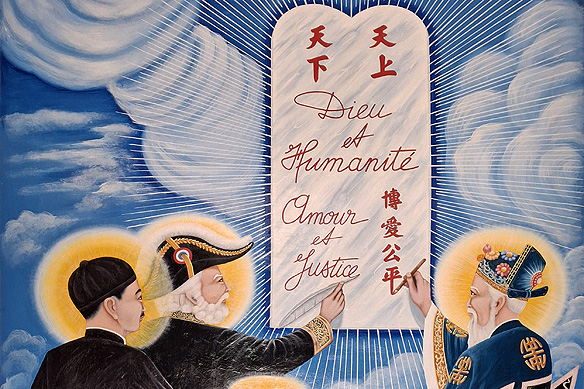
One of the quirkiest imageries in all Cao Dai places of worship has got to be the mural at the entrance in which the French author Victor Hugo, together with a Chinese political leader and Vietnamese poet, is seen writing the covenant “God and Humanity for Love and Justice” in French and Chinese.
You may well ask what is he doing here! Forty-two years after his death, Victor Hugo was ordained a saint in Caodaism. The common link being seances and anti-imperialism. Visits by Victor Hugo’s spirit in which he encouraged resistance against the French and reiterated the arrival of the next world religion were a common occurrence in the early Caodaists’ seances.
Though Victor Hugo is long gone, and seances banned since 1975, Caodaism’s tenets of plurality, peace, and unity touch a deep chord in six million Vietnamese followers today, both in the country and its diaspora. Kitsch yes, but it is a bit hard to find fault with harmony and kindness. 🙂

– – –
Recommended reading:
On Victor Hugo’s Posthumous Career As A Religious Prophet
Cao Dai Temple In Tay Ninh
I visited the Cao Dai Holy See through a private tour organised by Asiana Link Travel.
[Note: This blog post is part of a series from my travels to Vietnam for three weeks in March 2025. To read more posts in my Vietnam series, click here.]
 rama toshi arya's blog
What a fascinating look at Caodaism! The blend of different spiritual traditions and the vibrant imagery of the Cao Dai Holy See is truly unique. I love how the faith promotes peace, unity, and resilience. Victor Hugo as a saint adds such an unexpected twist to the story. Thanks for sharing this incredible insight!
LikeLiked by 2 people
True. It was too incredible a story to miss. 🙂 I loved the whole quirky mix. It also reiterated why we travel — to learn and discover new experiences so as to connect with both the bigger picture and ourselves. Am glad you enjoyed the post. Thank you for stopping by!
LikeLiked by 1 person
Absolutely, traveling opens up so many doors to learning and personal growth! The unique mix of traditions in Caodaism really is a testament to how cultures and beliefs can come together in surprising ways. It’s always inspiring to discover something that challenges our thinking and broadens our worldview. Glad we could connect over this — and thank you for sharing such an interesting piece!
LikeLiked by 1 person
I have never heard of Caodaism before. Thanks for sharing this information. In fact, travelers who have been to Vietnam I have met also never mentioned it. Chances are that they are also not aware of the same.
LikeLiked by 1 person
Most tourists visit ‘popular’ places and unfortunately don’t delve enough into local culture and practices. 🙂 To top it, the Holy See is also a bit out of the way. I had to do a private tour to visit it. I had read about Caodaism before. But the real thing was way more fascinating, for sure. Glad you liked the post!
LikeLiked by 1 person
I guess that’s because of people travel like tourists rather than explorer!
LikeLiked by 1 person
Never heard of this! Thanks for the info – fascinating how humans can make anything an article of faith!
LikeLiked by 2 people
Who understands that better, than us Indians. 🙂 Hehe. Glad you liked the read. So good to hear from you again!
LikeLiked by 1 person
Wow. Brings back memories. Lucky enough to see it in 1994 and I can still remember the hypnotic sound of the chants and the other world / ‘Star Trek’ design of the Temple. Unlike anything else. I seem to remember that the windows did not have glass and that it was very airy – is that right.
LikeLiked by 3 people
You are right, there was no glass. I just checked my photos again. 🙂 The windows did have wooden shutters which were open during the ceremony. It was airy, but not so much. It was hot anyways and they had placed pedestal fans for the devotees. It was all such a surreal experience. Never had seen anything like it before.
LikeLike