
What is the connection between apples and Almaty?
Gotcha!
The answer is: Almaty, the capital of Kazakhstan until 1997, is the birthplace of the apple. 🙂
Though Kazakhstan’s largest city has grown, both figuratively and literally, beyond its apples, its name still carries this legacy with elan. ‘Alma’ means apples and ‘ata’ means father or origin.
Surrounded by the Trans-Ili Alatau Mountains in south-east Kazakhstan, the city has had its fair share of history and avatars. From a prehistoric Saka settlement to a trading centre on the Silk Road, and in more recent years from being Verny, a Russian colonial outpost to Alma-Ata, capital of Kazakh SSR [Soviet Socialist Republic] within the Soviet Union.
In its last set of avatars, Almaty served as the capital of independent Kazakhstan from 1991 to 1997 and, thereafter, has stayed as the country’s vibrant commercial and cultural hub.
Of all of Kazakhstan’s cities, Almaty feels the most European with its wide leafy boulevards edged with open-air cafes, plenty of restful green urban spaces dotted with over 120 sparkling fountains, and a happening scene supported by numerous theatres, art galleries, and concert halls.
Though most travellers use Almaty mainly as a base to explore south-east Kazakhstan’s stunning national parks, the city does warrant a gentle exploration of its charms as well. 36 hours should do the trick in the sprawling metropolis that has earned the moniker ‘Southern Capital.’ Here are those 36 hours. ❤️
Day 1: Early Morning: Explore Zenkov Cathedral and Panfilov Park without the crowds

Zenkov Cathedral, named after its architect A.P. Zenkov, is believed to be the second tallest wooden church in the world. The tallest is in Sapanta, Romania.
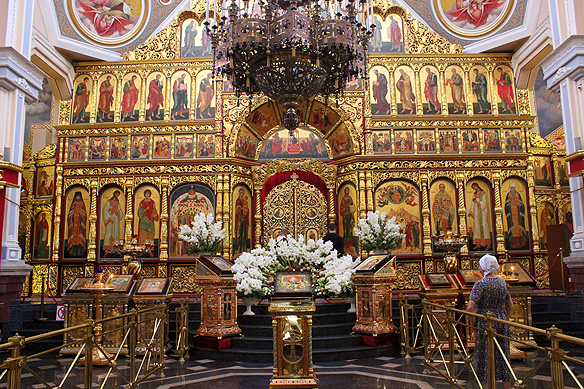
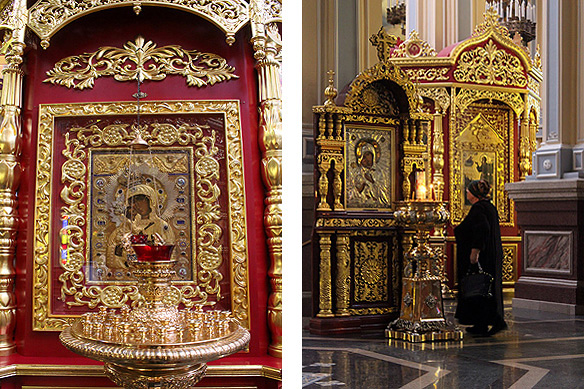
All that glitters is gold here. The splendid iconostasis was handmade by Nikolai Khludov, a Russian artist-cum-teacher who made Almaty his home in 1877.
A good place to start exploring Almaty is at its centrepiece—the buttercup yellow Russian Orthodox Zenkov Cathedral [also known as Ascension Cathedral] hidden behind Panfilov Park’s towering pines and firs. But do start early, before the tourist groups arrive. Inside the 56-metre-tall wooden church built in 1907 is a glittering world of gold iconography and poetic murals made by craftsmen from Moscow and Kiev.
When most of Almaty came crashing down in the 1911 earthquake, the Cathedral continued to stand tall. Some say it was because the edifice was built without any nails. Some claim it was divine intervention. Either way, its resilience led to its use, first as a museum and then as government offices replete with radio transmitters through the atheist Soviet era. In 1997 the church once again regained its halo.
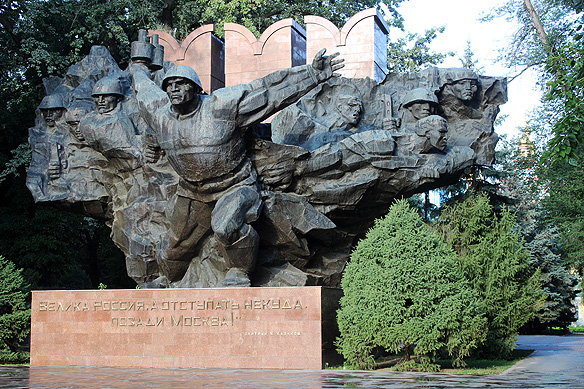
‘The Feat,’ part of the Memorial of Glory triptych, celebrates Soviet victory in the Great Patriotic War [the conflict between the Soviet Union and Nazi Germany, 1941 – 1945].
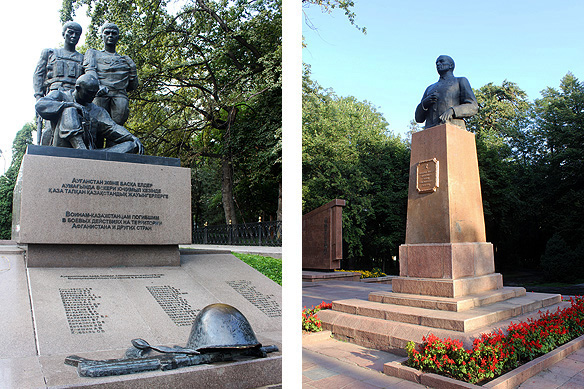
Left: Monument to the 69 Almaty citizens who died in the Afghanistan-Soviet War [1979 – 1989]; Right: Bust of General Ivan Panfilov.
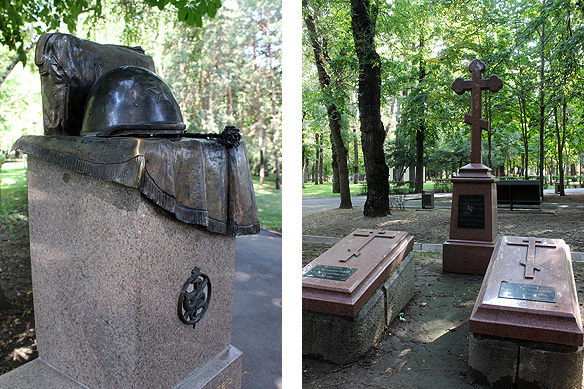
Left: Monument to Medical Veterans with a banner, helmet, and medical soldier’s bag; Right: Remnants of the village cemetery that once stood at the site.
28 Panfilov Guardsmen Park, or Panfilov Park as it is more commonly known, is dedicated to Ivan Panfilov’s 28 soldiers from Almaty’s infantry unit who died defending Moscow in November 1941, World War II. Ivan Panfilov was a Soviet General. Before becoming a park, this expanse in Almaty’s city-centre used to be a 19th Century village cemetery. All that remains, however, of its earlier occupants are a couple of graves.
A favourite with locals for their morning walks, the 18-hectare lawns with paved winding pathways under a dense canopy of trees is peppered with war monuments. Look out for the impressive Memorial of Glory, poignant Monument to Afghan Warriors, and Monument to Ivan Panfilov, the General the park is named after.
Day 1: Morning: Meat, pickles, and dry fruits the Kazakh way at Green Bazaar, followed by the Almaty Central Mosque


Sights, sounds, and smells of Green Bazaar.
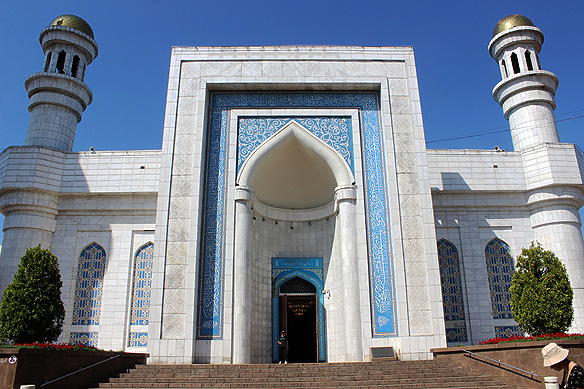
The marble and gold Almaty Central Mosque.
For a peek into local life, cross Gogol Street and walk down two blocks to Green Bazaar, a public market that’s been around since 1875. The best time to visit is in the mornings when fresh meat and produce are piled up high on the long tables. Immaculately dressed ladies slice apart horsemeat and arrange pickles into neat little pyramids, while rows of dried fruits and cheeses call out with free tastings. Green Bazaar is also the perfect place to stock up for a picnic lunch later in the day.
Further ahead is the monumental marble and gold Almaty Central Mosque. Though a recent structure [1999], it was built on the site of a 19th Century mosque which burnt down in 1987. Inside, children roll around on the carpeted floors as their mothers indulge in some daily gossip in the wings.
Day 1: Noon: Unravel the mysteries of Kazakh music at the Museum of Folk Musical Instruments
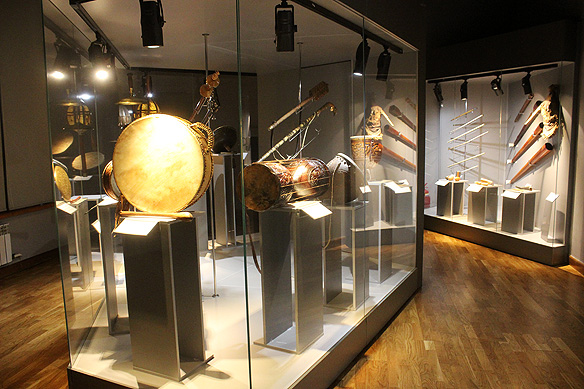

Come back to Panfilov Park and make your way to one of Almaty’s most charming museums: Museum of Folk Musical Instruments. Kazakhs take their traditional music very seriously, and nowhere is it more apparent than in this meticulously curated collection which includes instruments once owned by famous Kazakh singers and composers.
Of equal interest is the building in which the museum is housed. Designed by Zenkov [the same architect who worked on the Cathedral], it dates to 1908 and is a rare remnant of when Almaty was Verny, a Russian colonial town. Don’t miss the museum’s many variations of the two-stringed Dombra and bow-stringed Kobyz. You will be hearing their melodious notes throughout your stay in the country.
Day 1: Lunch: Enjoy a picnic at Panfilov Park with your Green Bazaar goodies
Day 1: Afternoon: Take a stroll through Republic Square and a history lesson at the Almaty Museum
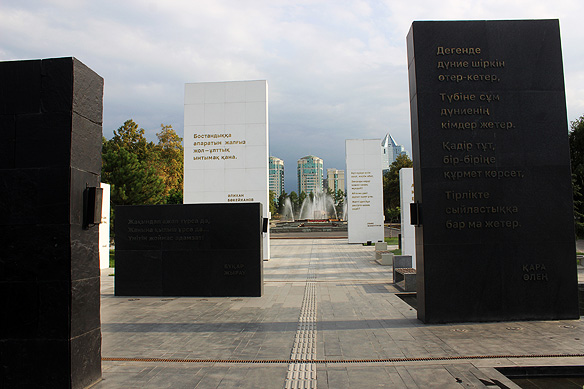
Tagzym Memorial in Republic Square is dedicated to the victims of 2022’s Bloody January protests.
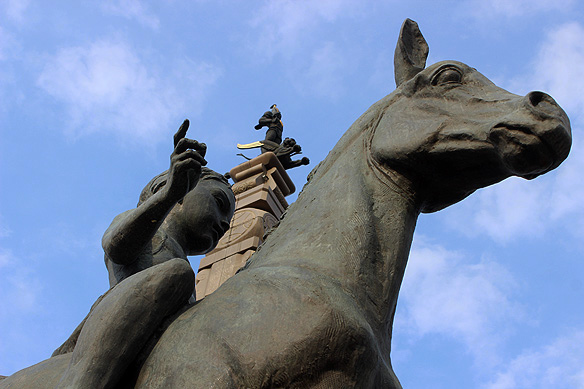
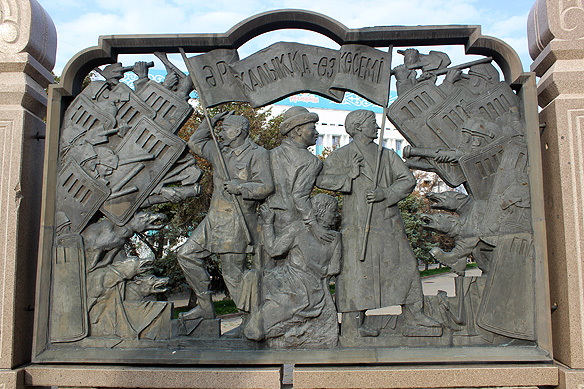
Past, future, and everything in-between at the Independence Monument: The Golden Warrior, a symbol of Kazakh identity, with a child rider representing youth and the future; one of the ten castings recounting key historical events.
No visit to Almaty can be deemed complete without a leisurely stroll in Republic Square and around the towering Independence Monument. The square has been the site of festivals, protests, parades, and rallies since 1980—the most notable being the week-long Bloody January unrest in 2022 in response to a sudden sharp increase in LPG prices. 227 civilians were killed that week.
Tagzym Memorial, a series of rectangular blocks in black, grey, and white stone with gilded lettering, describes the 2022 incident and victims. Across the road is the Independence Monument aka Golden Warrior Monument, a 91-feet-tall column topped with a Bronze Age Saka warrior and the mythical barys, surrounded with 10 castings of scenes from Kazakh history.

Almaty Museum is located in what was once the Vernensky Children’s Orphanage.


Clockwise from top left: Entrance to Almaty Museum’s galleries; traditional silver Kazakh jewellery; a room straight out of when Almaty was Alma-Ata.
Small and compact, the Almaty Museum narrates Almaty’s story through 11 eras across the millennia. Time travel as soon as you walk through the entrance, appropriately framed by an apple tree, starting with the ‘Ancient History of Almaty’ and ending with ‘Model of Peace and Harmony.’ The museum building is just as captivating. Dating to 1892, the single-story wooden log edifice with fairytale eaves has worn multiple mantles. It started off as the Vernensky Children’s Orphanage, then became a government office, hospital, medical school, and finally a city museum.
Day 2: Morning: Savour the finest in Kazakh art at the A. Kasteyev State Museum of Arts
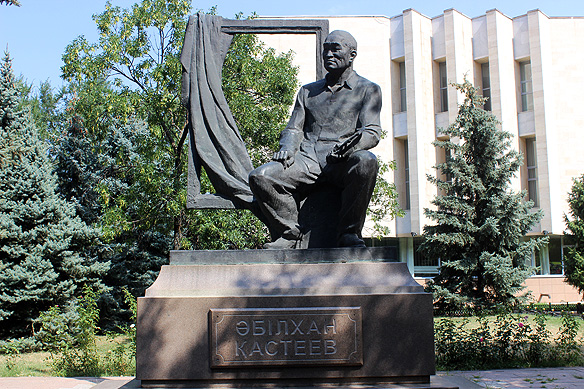
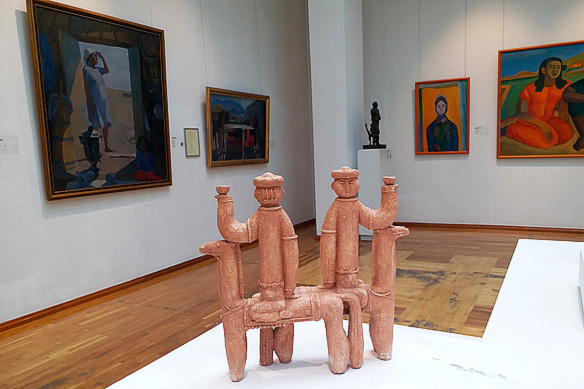
You do not need to be an art buff to appreciate the A. Kasteyev State Museum of Arts, Kazakhstan’s largest art museum. Go for sure if you love art. But also go if you don’t. The extensive collection comprises of Kasteyev’s [1904 – 1973] masterpieces along with works by other Kazakh greats. Together, these offer a fascinating insight into the Kazakh psyche and personality through the country’s modern history. Coupled with traditional Kazakh decorative and applied arts, the museum is all things aesthetic in Kazakh culture. Oh, there is also some European, Russian, and Oriental art thrown in to complete the mix.
Day 2: Afternoon: Learn about Kazakh history at the Central State Museum
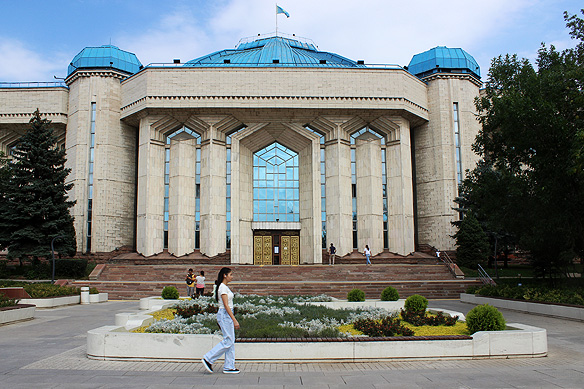
Second in stature only to Astana’s National Museum, Almaty’s Central State Museum was meant to impress when built in 1985 with its cavernous halls and an imposing facade topped with blue domes. Before shifting into their new premises, the collection used to be on display in Zenkov Cathedral [since 1931]. Six halls present Kazakhstan’s story from its paleontological past, across the Bronze Age to medieval, modern, and contemporary periods with a focus on history and culture. It makes for a good old-fashioned introduction to Kazakhstan, sans any tech-savviness.
Day 2: Early Evening: Ride a cable-car over Almaty to Kok Tobe Hill for a final view of the city
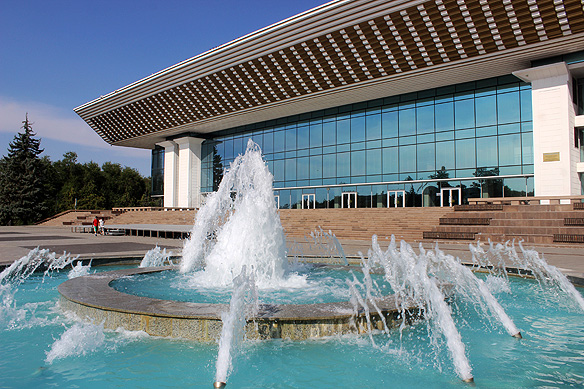
Kok Tobe Hill’s cable-car station is next to Republic Palace, a 1970 concert hall.
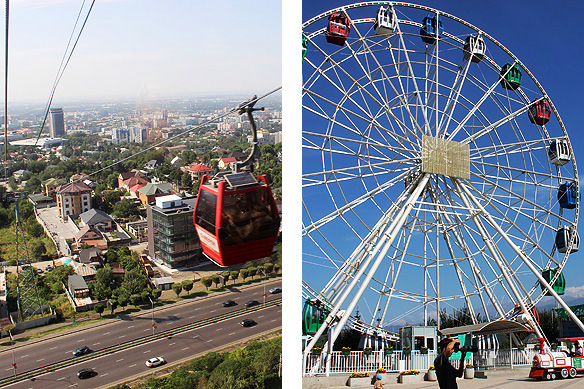
The journey and the destination.
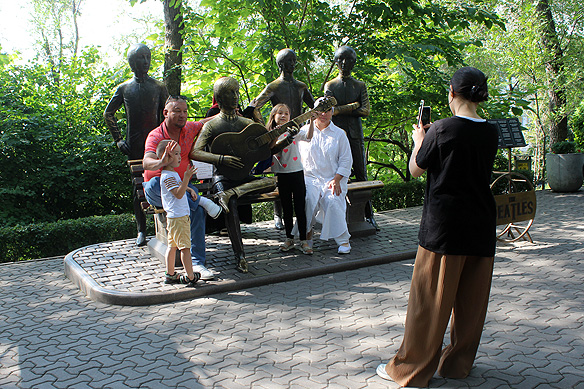
Posing with the Beatles.
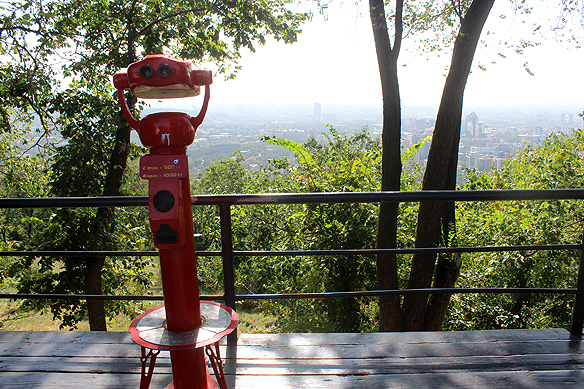
Good-bye Almaty, till we meet again.
While most cable-cars take their eager passengers over deep valleys and mountain slopes swathed in pine, Almaty’s gondola whizzes over downtown apartment blocks and highways. Its destination is the nearby 1,100-metre-high Kok Tobe Hill which houses an amusement park replete with a Ferris wheel, Soviet-era TV tower and food stalls. Popular with both tourists and locals alike, its real draw, however, are the views over Almaty. Time your visit from the late afternoon onward to see the city below slowly wrap itself in thousands of twinkling lights. Makes for the perfect last memory.
– – –
Travel tips:
- Staying there: I stayed at Hotel Kazakhstan in the city centre, a short walk from Panfilov Park. Their breakfast spreads are one of the grandest I have come across. Ask for a room on the higher floors.
- Getting around: I walked or took a Yandex taxi [reasonably priced]. You may need a local SIM [readily available from supermarkets] for the app.
[This blog post is part of a series from my 14-day solo independent travels across Kazakhstan in August–September, 2024. To read more posts in my Kazakhstan series, click here.]

Left: Hotel Kazakhstan, a city icon with ‘Monument’ status built in 1977, is Almaty’s third tallest building. It can withstand a 9.0 Richter scale earthquake. Right: Just another pavement on an Almaty downtown tree-lined street.
 rama toshi arya's blog
I learned that apple in Turkish is elma, and it’s olma in Uzbek. I didn’t realize that it’s alma in Kazakh, and how fascinating that Almaty actually means the origin of apple! Historical tidbits like this always make exploring a new place even more interesting.
LikeLiked by 1 person
Indeed they do. 🙂 Interesting how similar Elma, Olma, and Alma are as well, pointing to all three words stemming, most likely, from the same root language.
LikeLiked by 1 person
Visited Almaty in 2018 – slightly dazed after a 17 hour train trip from Tashkent – not in a sleeper. But I still remember the magnificent and colourful Zenkov Cathedral and the memorials in Panfilov Park (proper sculpture) speaking as a sculpture graduate! And the magnificent State Museum where I seem to remember the clothing exhibits. Have the buildings in Republic Square been fully restored after the riots in 2022? Such an amazing country of which I have seen just a tiny fraction and thankful for it …
LikeLiked by 4 people
Kazakhstan is one of the most underrated countries I have been to. It is an incredible place and though I spent 14 days in it, and traveled pretty extensively through those 14 days, I would love to revisit. It felt like ‘Home’. So warm and welcoming. To your question, Yes, the square has been fully restored. 🙂
LikeLike
Pingback: travel guide: the six untold treasures of kazakhstan’s silk road heritage | rama toshi arya's blog