It is still dark. The sun, groggy-eyed as it squints through the heavens punctuated by a sole star.
I am on my way from Hoi An to My Son Sanctuary—the temple ruins of an ancient Hindu kingdom which called this part of Vietnam home for 1,600 years. You may ask, but why so early? Because some places are best seen at sunrise. When it is just them, you, and the centuries of silence in-between. This silence then starts talking, regaling stories. Some voraciously. Some hinted at with a smile. Don’t you agree? 😊
An hour later, walking through the site’s lush green meadows, I pass scores of my country-folks. Perplexed, I am about to stop one of them and ask the reason, when a large placard explains their presence. They are archaeologists from the Archaeological Survey of India carrying out restoration work in association with the Vietnamese government. It makes sense. Who else could understand the remnants of a millennia-old Hindu kingdom better, even if it wore a different mantle on a foreign ground.
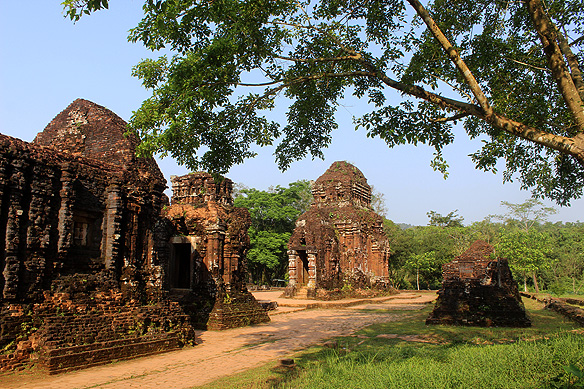
My Son Sanctuary, a UNESCO-listed World Heritage Site, is one of the most important ancient religious sites in south-east Asia.
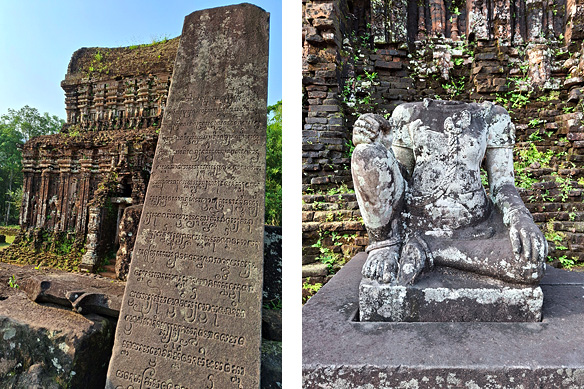
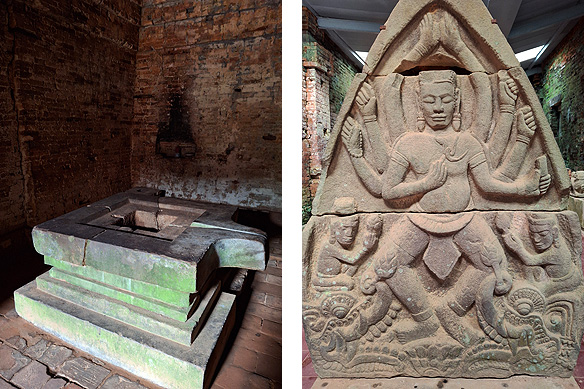
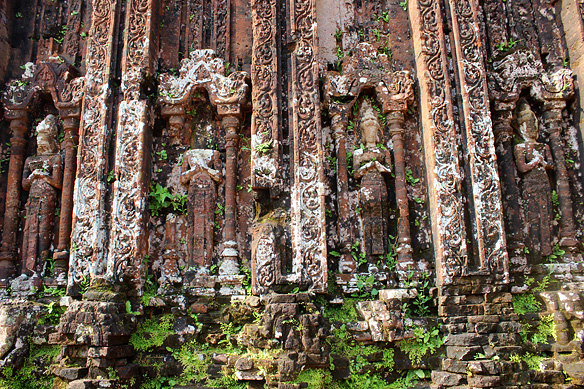
Scattered across the My Son Sanctuary are remnants of sculptures which once decorated the temples. A royal proclamation, Shiva, a yoni, an exquisite facade.
Distinct from the Vietnamese in both ethnicity and religion, the Champa maritime kingdom was established in the year 182 across coastal central and southern Vietnam. In 1471, the kingdom was conquered by the Vietnamese who lived to its north. It became a Vietnamese vassal state in 1697, and was completely dissolved in 1832.
Though Hinduism was its predominant religion from its inception until the end, for a brief period Champa tried its hand at Buddhism as well. An elaborate Buddhist complex dedicated to Avalokitesvara and housing a colossal Buddha was put up in Dong Duong in 875. The latter, scholars claim was perhaps because of King Indravarman II’s desire to align with the prevailing political powers’ faiths. China and India’s.
Most of Champa’s red brick cities and Hindu temple complexes, which once dotted the entire realm, have now crumbled to dust courtesy the American/ Vietnam War. Yet, a few have resolutely stood their ground. The most famous being the My Son Sanctuary, the UNESCO-listed Hindu temple complex near Hoi An.
Built between the 4th and 13th Centuries by the Champa rulers, the temples, with towers reminiscent of Mount Meru, served as their spiritual capital through most of the kingdom’s existence.
Eight groups of 71 monuments, surrounded with a ring of mountains and the Thu Bon river cutting through it, make up the site. The Cham believed the place was blessed by the gods whose likenesses they carved onto sandstone friezes on lintels, pedestals, and temple facades, and had their effigies placed in the inner sanctums.
Though the Champa kingdom is long gone, the descendants of the artisans who carved these vibrant sacred Hindu sculptures in the local style, and laid the fired bricks of their places of worship, continue to live on as one of Vietnam’s 54 ethnic tribes.
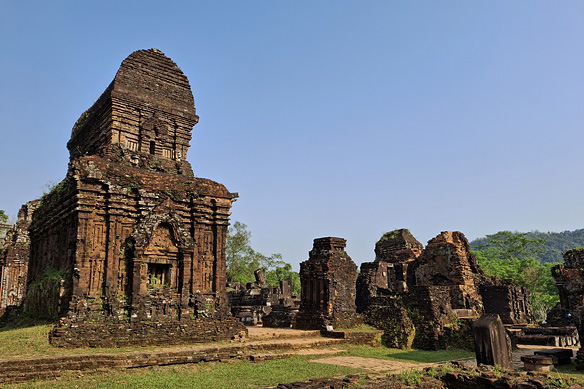
My Son Sanctuary’s most impressive ruins are in Temple Group B, C, and D.
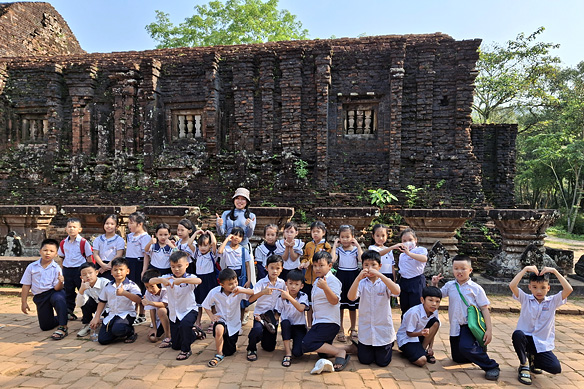
Children on a school-trip posing for my camera.
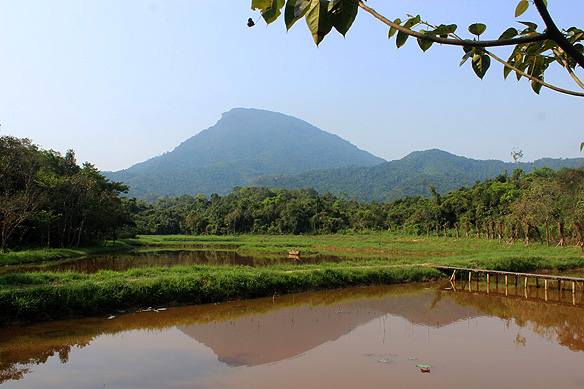
Sacred ground—My Son’s ‘chosen’ location in the shadow of Mhadravata [Cat Tooth] Mountain.
Satiated, I am ready to leave after a few hours. The sun too is out by now, bathing the site in hot humid light, and crowds. Tourists taking selfies. School children on a field trip. The stories the ruins had whispered into my ears had made me greedy to know more. I knew I had to peel away a few more layers of My Son’s stories.
Next day, I make my way to the Da Nang Museum of Cham Sculpture established in 1919. It is the world’s largest exhibition of Champa cultural artifacts. Around 300 sculptures dated between the 7th and 15th Centuries from multiple Champa kingdom sites were brought here before the war. And, hence, survived.
I have hardly crossed the foyer that a bevy of sandstone gods, goddesses, fairies, and mortals rush out to envelop me. Almost as if they were waiting. Curly-haired, thick-lipped, wide-nosed, with oversized hands and feet. I quickly recognize the deities by their appurtenances.
There’s Shiva with his trident, Vishnu with his conch, Brahma with his three faces—one frontal and two profiles. Along with his fourth face [behind his head and, therefore, not visible] he is said to be able to see all four directions. There are also polo players astride galloping horses [a Persian cultural import via China’s Tang dynasty] and dancers swaying to musical notes only they can hear. An ascetic studies the Vedas huddled under a carved doorway, whilst Prince Siddhartha is seen escaping from his palace to start his journey as Buddha, the enlightened one.
Giddy with the visual onslaught, I wander through the museum’s two levels brimming with sculptures in the round and high relief, many of which possess ‘National Treasure’ status. In My Son Sanctuary, I saw their temples. In Da Nang’s Museum of Cham Sculpture, I get to meet the temple residents in person.
Come, let me introduce you to ancient Champa’s mute stone torchbearers. Some divine. Some mortal. And some betwixt. And the stories of a world they hold in their bosoms, and have etched across their brows. ❤
The Hindu trinity: Brahma the creator, Vishnu the preserver, Shiva the destroyer.
![Brahma's four heads [one hidden behind] looking out at the four directions of the universe, 12th – 13th Century, Sandstone, Phu Hung.](https://ramaarya.blog/wp-content/uploads/2025/05/museum-of-cham-sculpture-1.jpg)
Brahma’s four heads [one hidden behind] looking out at the four directions of the universe, 12th – 13th Century, Sandstone, Phu Hung.
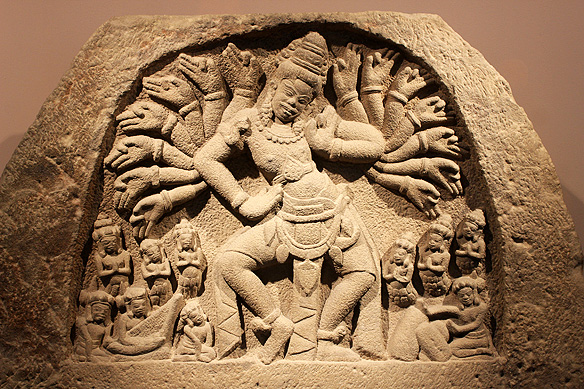
Dancing Shiva symbolizing the cyclical nature of the universe—creation, preservation, and destruction, 10th Century, Sandstone, Phong Le.
![Birth of Brahma from a lotus flower which emerged from Vishnu's naval, 7th – 8th Century, Sandstone, My Son E1. [National Treasure]](https://ramaarya.blog/wp-content/uploads/2025/05/museum-of-cham-sculpture-3.jpg)
Birth of Brahma from a lotus flower which emerged from Vishnu’s naval, 7th – 8th Century, Sandstone, My Son E1. [National Treasure]
![Shiva [left] and Brahma seated on a swan [right], 11th Century, Sandstone, Thap Mam.](https://ramaarya.blog/wp-content/uploads/2025/05/museum-of-cham-sculpture-4.jpg)
Shiva [left] and Brahma seated on a swan [right], 11th Century, Sandstone, Thap Mam.
![Left: Shiva with a moustache and beard in the Late Cham Style, 15th Century, Sandstone, Yang Mum; Right: Shiva's elephant-headed younger son Ganesha, 7th – 8th Century, Sandstone, My Son E5. [National Treasure]](https://ramaarya.blog/wp-content/uploads/2025/05/museum-of-cham-sculpture-5-1.jpg)
Left: Shiva with a moustache and beard in the Late Cham Style, 15th Century, Sandstone, Yang Mum; Right: Shiva’s elephant-headed younger son Ganesha, 7th – 8th Century, Sandstone, My Son E5. [National Treasure]
![Left: Garuda, Vishnu's vahana [mount], 12th Century, Sandstone, Thap Mam; Right: Linga, the aniconic representation of Shiva, 10th Century, Sandstone, Phong Le.](https://ramaarya.blog/wp-content/uploads/2025/05/museum-of-cham-sculpture-6.jpg)
Left: Garuda, Vishnu’s vahana [mount], 12th Century, Sandstone, Thap Mam; Right: Linga, the aniconic representation of Shiva, 10th Century, Sandstone, Phong Le.
![Dvarapala, the temple guardian, with a Garuda devouring a Naga [snake] in the background, 12th Century, Sandstone, Thap Mam.](https://ramaarya.blog/wp-content/uploads/2025/05/museum-of-cham-sculpture-7.jpg)
Dvarapala, the temple guardian, with a Garuda devouring a Naga [snake] in the background, 12th Century, Sandstone, Thap Mam.
![Left: Gajasimha, a mythical half-lion and half-elephant hybrid animal, 12th Century, Sandstone, Thap Mam. [National Treasure]; Lakshmi, goddess of wealth and consort of Vishnu, 11th – 12th Century, Sandstone, Chien Dan.](https://ramaarya.blog/wp-content/uploads/2025/05/museum-of-cham-sculpture-8.jpg)
Left: Gajasimha, a mythical half-lion and half-elephant hybrid animal, 12th Century, Sandstone, Thap Mam. [National Treasure]; Lakshmi, goddess of wealth and consort of Vishnu, 11th – 12th Century, Sandstone, Chien Dan.
![Left: Buddha [the largest Cham statue discovered to date], 9th Century, Sandstone, Dong Duong Buddhist Complex; Right: Bodhisattva Tara, 9th Century, Bronze, Dong Duong Buddhist Complex. [National Treasure]](https://ramaarya.blog/wp-content/uploads/2025/05/museum-of-cham-sculpture-9-1.jpg)
Left: Buddha [the largest Cham statue discovered to date], 9th Century, Sandstone, Dong Duong Buddhist Complex; Right: Bodhisattva Tara, 9th Century, Bronze, Dong Duong Buddhist Complex. [National Treasure]
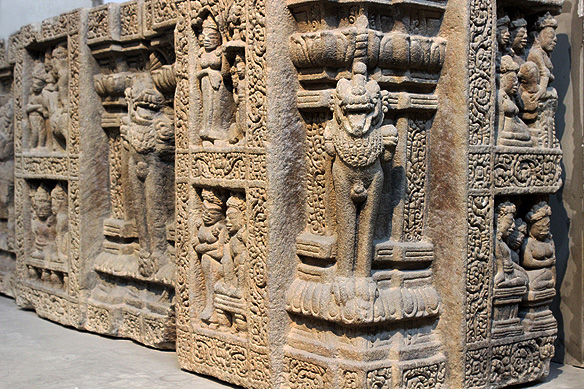
Altar pedestal with scenes from Buddha’s life and large standing lions, 9th Century, Sandstone, Dong Duong Buddhist Complex.
And lastly, a celebration of the secular, fairies, and heroes.
![Relief of Tra Kieu Apsara, 10th Century, Sandstone, Tra Kieu. [National Treasure]](https://ramaarya.blog/wp-content/uploads/2025/05/museum-of-cham-sculpture-11.jpg)
Relief of Tra Kieu Apsara, 10th Century, Sandstone, Tra Kieu. [National Treasure]
![Prince Rama trying to bend the sacred Rudra bow in the epic Ramayana, Tra Kieu Pedestal, 10th Century, Sandstone, Tra Kieu. [National Treasure]](https://ramaarya.blog/wp-content/uploads/2025/05/museum-of-cham-sculpture-16.jpg)
Prince Rama trying to bend the sacred Rudra bow in the epic Ramayana, Tra Kieu Pedestal, 10th Century, Sandstone, Tra Kieu. [National Treasure]
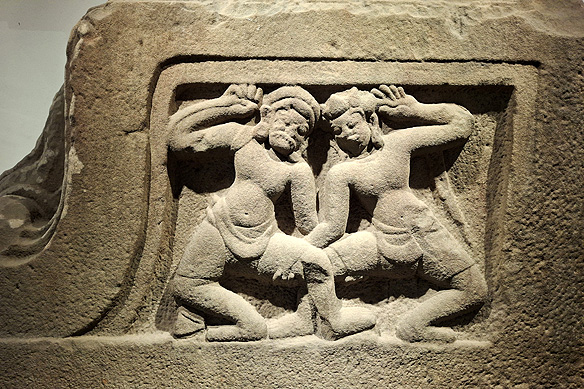
Battle between Prince Rama and the demon-king Ravana in the epic Ramayana, Temple staircase, 10th Century, Sandstone, Khuong My.
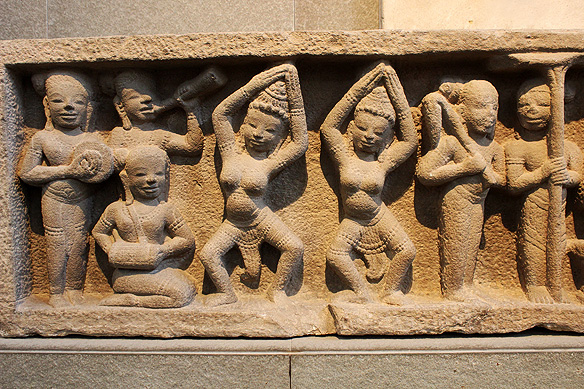
Dance and music in the royal courts, 11th Century, Sandstone, My Son E4.
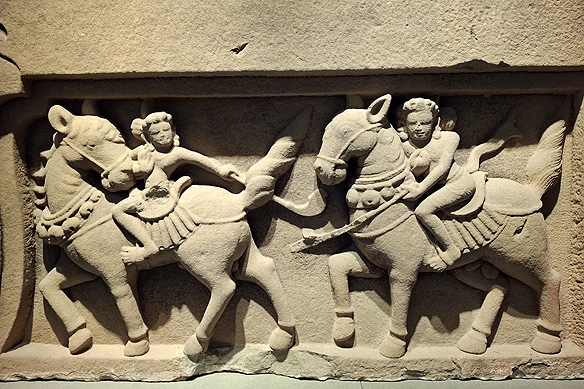
Polo players, a Persian sport brought into Vietnam through the Chinese Tang dynasty, 10th Century, Sandstone, Thach An.
![Ascetic reading a manuscript, Pedestal, 7th – 8th Century, Sandstone, My Son E1. [National Treasure]](https://ramaarya.blog/wp-content/uploads/2025/05/museum-of-cham-sculpture-15.jpg)
Ascetic reading a manuscript, Pedestal, 7th – 8th Century, Sandstone, My Son E1. [National Treasure]
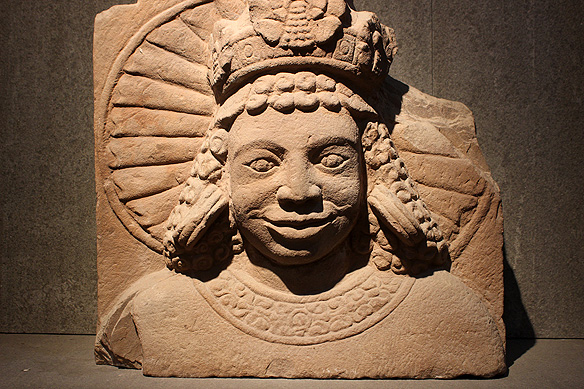
Male deity in the Early Cham Style influenced by India’s post-Gupta aesthetic traditions, 6th Century, Sandstone, An My.
With this, I reach the end of my post and search for Champa, Vietnam’s ancient Hindu kingdom. See you again, next week!
– – –
[Note: This blog post is part of a series from my travels to Vietnam for three weeks in March 2025. To read more posts in my Vietnam series, click here.]
 rama toshi arya's blog
I didn’t get to My Son in 1994 more’s the pity but I did see the magnificent Cham Sculpture Museum in Danang – one of the most impressive I’ve ever been to. The heavy deep cut sculptures in glowing sandstone with their fantastic features stand out in the light and airy rooms brilliantly spaced out as I recall – I loved them. Many thanks for the great photos Rama and for once again bringing back memories.
LikeLiked by 1 person
I thought you’d like them, having taught sculpture! They are a unique lot with their pronounced features on porous golden rock. It is a fantastic museum, and combined with the archaeological sites, give the ancient civilization a second lease of life. One of my favourite museums for sure. 🙂
LikeLike
Beautifully written. Was unaware of the Hindu history in Vietnam. The pics of the sculptures are part of the word pictures you paint.
LikeLiked by 1 person
Am glad you liked it. 🙂
LikeLiked by 1 person
This brings back a lot of good memories from my trip to Central Vietnam in 2017. It looks like you had a better luck with the weather at My Son, and how lovely it is to see those statues at the museum in current’s display. When I went, only a few had spotlights on them, and many of the relics were showcased in a rather cramped manner.
LikeLiked by 1 person
Am happy it brought back good memories! Yeah, I was generally lucky with the weather in Vietnam. The museum layout is fabulous right now. Every piece displayed to its best. And such wonderful pieces — the workmanship, the details, the sheer vibrancy.
LikeLiked by 2 people
Such a captivating journey through Champa’s ancient legacy! I loved how you captured the quiet magic of My Son at sunrise and brought the history alive with such warmth and detail. Looking forward to your next story!
LikeLiked by 1 person
Thanks much! Coming up is a travel guide on Hue’s royal heritage sites. 🙂 The Cham sculptures were incredible. I really enjoyed the archaeological site and museum.
LikeLiked by 2 people
Ooh, can’t wait for the Hue royal tour—bring on the emperors and imperial drama! 👑 Also, totally agree—the Cham sculptures are stunning, like time-travel carved in stone. So glad you got to soak in all that ancient awesomeness!
LikeLiked by 1 person
Beautifully written and great pictures too! I totally agree with you on exploring a place quietly sans people, it reveals itself quite differently 🙂
LikeLiked by 2 people
Glad you liked the post, Yogini. Travel is so much about timing. 🙂
LikeLiked by 2 people
Agreed! 🙂
LikeLike
Just stumbled upon your Vietnam series. Great pictures and some good pointers for me to explore when I go there.
LikeLiked by 2 people
Glad you found it useful! Vietnam is beautiful. Multi-layered, and nuanced. There are 4 more posts coming up in the series. Hope you visit again and get more travel inspiration. 🙂
LikeLiked by 1 person
Very authentic story! How long do you do travel journalism?
LikeLiked by 2 people
A very long time. 🙂 Before wordpress was invented. I learnt coding so I could code my own travel blog.
LikeLiked by 2 people
Wow that’s amazign Rama! I started in 2016 as a broke backpacker in Thailand. I have actually a Travel Media Academy Platform to help travel bloggers connect with tourism companies and produce more travel journalism pieces of content. Feel free to check it out. 🙂 https://www.skool.com/digital-nomad-academy-6519/about?ref=da33a00a11a6454fa5cb062a8bff5435
LikeLiked by 1 person
I had a look at your site. Fab content. Extremely useful courses. Thank you for sharing the link. Appreciated.
LikeLiked by 2 people
That’s great to hear! Please let me know if you have any challenges at the moment or goals you work on. I will be happy to help out. 🙂
LikeLiked by 1 person
Wow ! That was an amazing read ! I never knew that Hinduism had reached Vietnam. Thank you for the captivating tour of Champa , Vietnam’s ancient Hindu Kingdom. Looking forward for more of the same!
LikeLiked by 1 person
Thank you for stopping by, Vinod. Am happy you enjoyed the post. 🙏 I was recently in Russia for a month and am currently writing about my travels there. I hope you enjoy my Russian series just as much.
LikeLike
Beautifully written 💯 Nice pictures❤️
LikeLiked by 2 people
Thanks much. 🙂
LikeLike