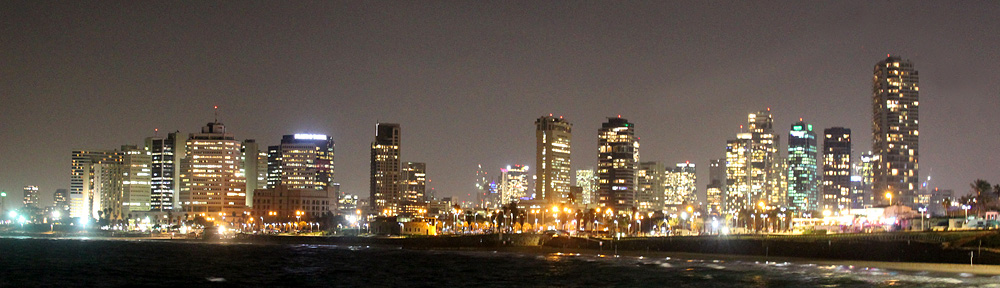

Siberia. View from my train window.
PROLOGUE
The Trans-Siberian Railway. From Moscow to Vladivostok. 9,289 kilometres across the vast expanse of Russia, and eight time zones. The longest railway line in the world. Now, how can one resist a journey of such epic proportions!
I had first heard about the railway service laid out between 1891 and 1916 by two Tsars—Alexander III and his son Nicholas II—when I just started working. Something inside me then and there decided I had to undertake this voyage. No, not because I am a train buff. Hardly. But because then, and today, a few decades later when the dream is being realized, it is the epitome of travel.
Dear Diary, here’s my 14 days of travel on the Trans-Siberian Railway with stops at the historical cities en-route. A journey that turns out to be one of my most authentic travel experiences to date. ❤
– – –
DAY 1: THURSDAY, 31 JULY 2025
Having explored Moscow [which I will write about in a separate post], I find my way to my train at the Kazansky Railway Station through the blur of families, lovers, loners, and the odd businessman. The basic English signage makes it relatively easy.
Inside the first-class coupe, I ask the attendant if there is a dining car. The buxomly lady with an untidy top knot rattles off a short speech in Russian, hands me a train timetable, talks some more, and then happy she had answered my query, nods at me and leaves. But before she does, still confused regarding the dining car, I smile at her. She smiles back. For all you may have heard about the unfriendly Russian, rest assured perseverance does give results. In this case, a smile that reached ear-to-ear.
Aschratscho, my Persian co-traveller from Moscow to Kazan has been living in Moscow for the past two decades. We spend the journey past dark forests communicating with Google Translate, showing each other pictures of our fathers who look uncannily similar.
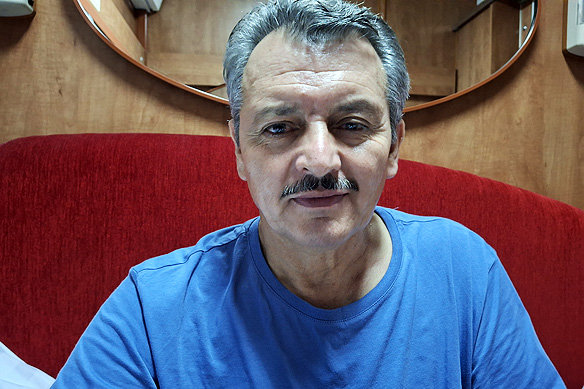
My co-traveller from Moscow to Kazan. Aschratscho is Persian—half-Afghan and half-Pamir.
DAY 2: FRIDAY, 1 AUGUST 2025: KAZAN, CAPITAL OF TATARSTAN
As all travel blogs and vlogs would claim—What’s a Trans-Siberian journey without Kazan, capital of the Russian Federation’s Republic of Tatarstan. Often described as one of the country’s most beautiful cities, Russia’s ‘third capital’ is my first stopover.
Whilst the old colourful and cozy Tatarstan Quarter has been refurbished into a cultural village replete with cafes and souvenir shops, its 18th Century Marjani Mosque still serves the spiritual needs of its Tatar residents.
There is a legend which recounts that after Catherine the Great gave permission to Kazan’s Tatars to build the mosque, the local Slavic Russians complained to her about the height of the minaret. That it was reaching the skies. She replied gravely: “I gave them permission for the land, because I own it. I do not own the skies.”
Kazan’s UNESCO-listed historic Kremlin, meanwhile, is the only one of its kind in Russia where a mosque and Christian Orthodoxy church stand side-by-side. It is an architectural feature that is deeply symbolic. Of two religions that once vied for space and now coexist in harmony.
To understand Kazan and Tatarstan’s complex dynamics better, one needs to understand its history. Founded in 1005, Kazan was once part of the ancient Volga Bulgaria kingdom. When it became the capital of the Mongol Kazan Khanate in the 15th Century, it profited immensely from river trade. This attracted Ivan the Terrible’s wrath who in 1552 pledged to rid the Tsardom of Russia [as Russia was then called] of all foreign influence. He conquered the city, drove the Mongols out, razed its mosques, and built a Kremlin on the site of the Khan’s castle with the onion-domed Annunciation Cathedral at its centre. To mark his landmark victory, he also had the iconic St. Basil’s Cathedral built in his capital city Moscow’s Red Square.
The present blue-domed Kul Sharif Mosque inside the Kazan Kremlin is a recent structure; a reclamation of the city’s past in its entirety. It was built in 2005, 453 years after Ivan the Terrible’s massacre and 1,000 years since the city’s founding, at the exact spot where a medieval mosque had once stood, named after its 16th Century Imam who died trying to protect Kazan from Ivan the Terrible and his troops.
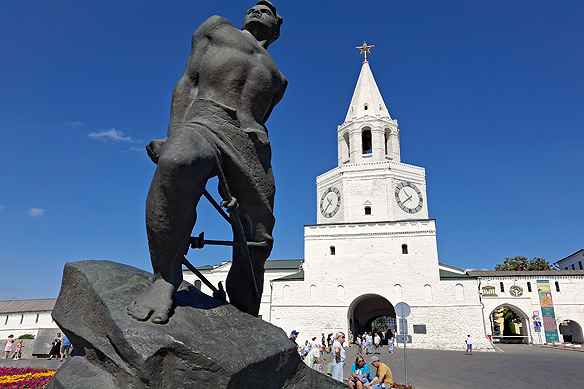
Monument of Musa Jalil, a Soviet-era Tatar poet-cum-soldier, with Kazan Kremlin’s Spasskaya Tower behind it.
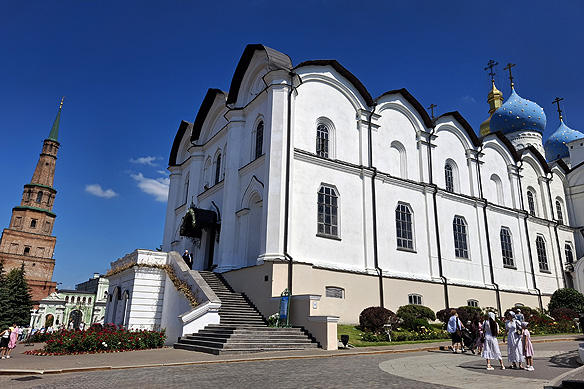
Annunciation Cathedral commissioned by Ivan the Terrible in 1552. To its left is the tilting six-tiered red-brick Suyumbike Tower, named after the last Queen of the Khanate of Kazan.
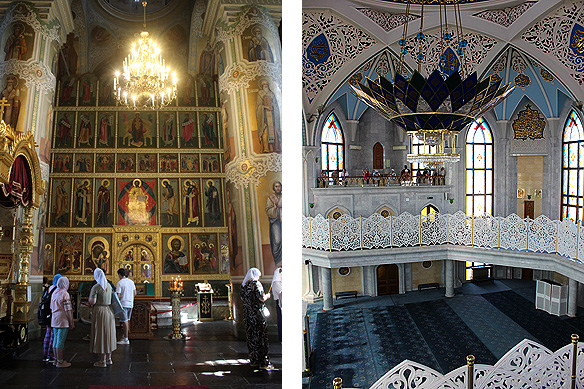
Side-by-side, in our creator we believe. Left: Inside the Annunciation Cathedral; Right: Inside the Kul Sharif Mosque next to it.
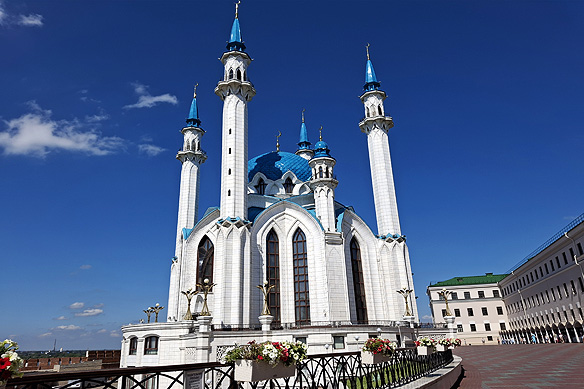
Kul Sharif Mosque, built in 2005 to commemorate the city’s millennium celebrations, is named after a 16th Century Imam at the site of where his mosque once stood.
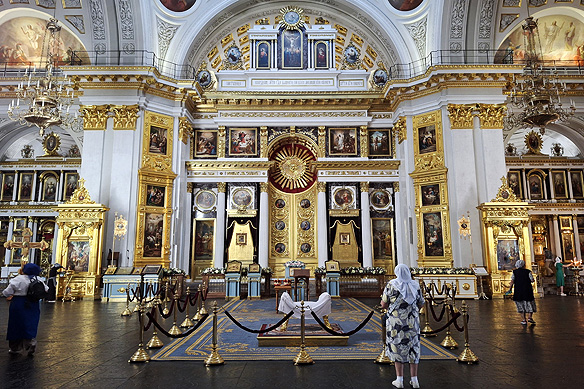
Kazan Cathedral in Bogoroditsky Monastery is built on the site where Russia’s most famous icon, the Kazan Icon of the Mother of God, was discovered in a burnt house in 1579. The current icon inside is a copy gifted by the Vatican as the original was stolen in 1904.
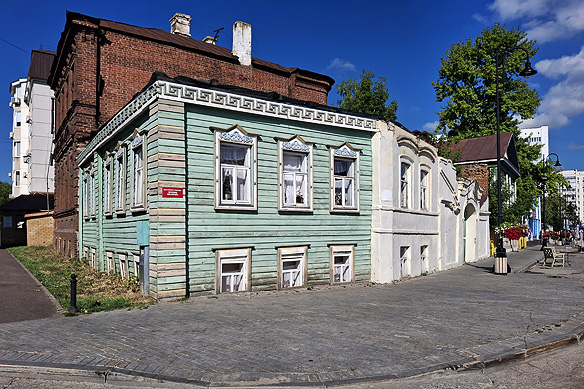
No, this house hasn’t sunk into the ground. Those buried windows are a traditional architectural feature of Kazan’s old Tatar homes.
DAY 3: SATURDAY, 2 AUGUST 2025
Russians must be one of the most unconditionally helpful people around. Proof? A co-passenger walks into my coupe and unfolds my berth. Another sets up the bedding. All whilst I stand clueless when it comes to rail travel.
It is day three and the landscape has changed little. There are still endless pristine forests, except that now the pine trees have given way to birch which are interspersed with enormous meadows, picturesque villages, and pockets of mist-laden lakes and ponds in which wild geese float. Wildflowers continue to bloom everywhere.

My co-traveller from Kazan to Yekaterinburg. Yaroslava is a 20-year-old university student studying economics.
DAY 4: SUNDAY, 3 AUGUST 2025: YEKATERINBURG, IN MEMORY OF THE ROMANOVS
It feels strange to arrive at Yekaterinburg, a city I encountered numerous times when reading about Russia prior to my travels. For the first time since arriving in the country, I also see litter in the form of thousands of cigarette stubs around the railway station. I see alcoholics oblivious to the world, bleak eyes, and rough voices. There is a hardness in the buskers’ music playing in the underpasses.
Yekaterinburg is an industrial hub historically built on the resilience of exiles, convicts, and prisoners-of-war that adamantly peeps through even today. Not too long ago, Stalin’s gulag camps filled this region. Its inmates first building factories, and thereafter working in them.
Two other events have shaped the city’s narrative. One, as the fateful place where Russia’s last Tsar, Nicholas II, his wife, and five children were executed in cold blood by the Bolsheviks on the night of 16-17 July, 1918. It took place in the basement of the Ipatiev House where the family was under house-arrest, following which their bodies were mutilated, burnt, and hurriedly dumped in a pit, to be moved soon after to another area. In 1998, the remains were given a state funeral and reburied in St. Petersburg.
Russian Orthodox Christians still see their Tsars as divine rulers. The last royal family were canonized on 20 August, 2000, elevating them further into saints. Sites associated with their murder have since been turned into pilgrimage centres. Church on the Blood is built over the basement where they were shot, Ganina Yama Monastery stands on the abandoned iron ore mine where the jewellery and crosses the royal family wore in their dying moments were discovered, and a clearing in the forest marks the spot where their burnt bodies were buried. Every year, on the night of 16-17 July, a procession travels through these locations as part of the feast associated with them.
The second event is the founding of the city by Peter the Great’s General Vasily Tatishchev in 1723. Yekaterinburg [Yekaterina is the Russian version of the name Catherine] is named after Peter the Great’s second wife and the love of his life.
Aware of the immense iron ore deposits that lay in the Ural Mountains, Tatishchev established a settlement here to mine and transform these deposits into ammunition for Peter the Great’s conquests. Three hundred years later, these same deposits sustained World War II [or the Great Patriotic War as the Russians call it] which they won against the Nazi Germans in 1945. Credit also goes to Tatishchev for identifying the mineral-rich Ural Mountains as the border of Europe and Asia based on river flows, flora, and fauna, and thereby placing Russia with its western cities firmly as a ‘European’ country.

The basement where Tsar Nicholas II and his family were executed by the Bolsheviks on the night of 16-17 July, 1918, is now a shrine inside the Church on the Blood.

Left: Icon of Nicholas II and his family that is paraded on their feast day; Right: A Christian Orthodox cross in Ganina Yama Monastery marks the mine pit where the family was cremated.

A pilgrim prays at the clearing under which the remains of the Romanov family were found. Nicholas II’s son Alexei and daughter Maria were buried a few metres away in the same forest.

I got a certificate in Russia for the momentous feat of crossing the border of Europe and Asia at 56.5 degrees north Latitude!
![Black Tulip Memorial in memory of the soldiers who died in the pointless and ruthless Soviet-Afghan War [1979 - 1989].](https://ramaarya.blog/wp-content/uploads/2025/09/yekaterinburg-5.jpg)
Black Tulip Memorial in memory of the soldiers who died in the pointless and ruthless Soviet-Afghan War [1979 – 1989].

From iron for ammunition to iron for art. Left: Dutchman Georg Wilhelm de Gennin and Russian Vasily Tatishchev, the founders of Yekaterinburg; Right: Kasli iron sculpture, Fine Arts Museum.
DAY 5: MONDAY, 4 AUGUST 2025
My co-traveller on this leg of the Trans-Siberian Railway is Olga, a gynaecologist-cum-grandmother-cum-Johnson & Johnson Access Manager fluent in English. We spend much of the six hours of travel time we share, laughing about the idiosyncrasies of rail travel and gorging on dark chocolate.
After she gets off at her stop, I go to sleep to wake up to Siberia and a time zone half an hour ahead of India. Miles and miles of bare birch trees and purple wildflowers stretch out under the powder blue sky spattered with cotton ball clouds outside the window. Autumn starts early here. I get a mug of hot water, add my Nescafe 3-in-1, and make myself comfortable on the narrow berth, munching on the raisin cookies I had picked up from the supermarket in Yekaterinburg. It is still another 13 hours to Novosibirsk.
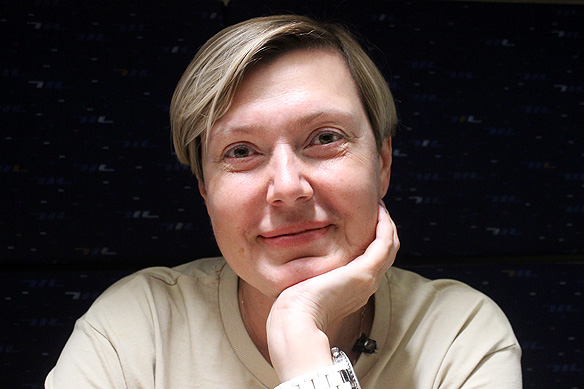
Olga, my co-traveller on the Trans-Siberian Railway Yekaterinburg to Novosibirsk leg. Of all the Russians I meet in my month-long travels, I laugh with her the most.
DAY 6: TUESDAY, 5 AUGUST 2025: NOVOSIBIRSK, THE TRANS-SIBERIAN RAILWAY CITY
Russia’s third largest city, Novosibirsk, meaning New Siberia, is the country’s megapolis most closely tied to the railway. Its beginnings were humble—a settlement of a few thousand workers in 1893 assigned the task of building a railway bridge over the mighty Ob river that sliced through Russia’s breadth. In less than 70 years the settlement, aided by its strategic location on two arteries, a river and railway line, transformed into a transport hub of a million residents. An accomplishment that earned it a place in the Guinness World Records book.
Stalin, and later World War II, contributed by turning Novosibirsk into an industrial centre. Many of European Russia’s factories were relocated here during the war to safeguard the country’s economy. Recent years have seen the city take on the additional mantle of a leader in cross-disciplinary research.
Novosibirsk’s exponential growth in a short span of time has resulted in an eclectic mish-mash of architectural styles peppered with statues of politicians, architects, doctors, writers, and at times just plain humour. Centre-stage is the Stalin-empire-style gargantuan Opera and Ballet Theatre [1944] with Lenin and his Bolsheviks in the Lenin Square reminding the viewer of the prevailing optimism in communism.
A patch of green nearby, dedicated to a handful of Red Army heroes and one heroine, pays homage to the lives lost in the Russian Civil War [1918 – 1922] which took its deadliest toll in Siberia. The tiny, yet functioning, Nikolai Chapel [1915] in the middle of a multi-lane boulevard built to commemorate 300 years of the Romanovs, is a rare remnant of Tsarist rule. Another rare, albeit grander leftover is the city’s only red-bricked late-19th Century Alexander Nevsky Cathedral in honour of Tsar Alexander III who initiated the Trans-Siberian Railway. For the perfect wrap, it is hard to beat a tranquil boat ride down the wide Ob.
Each takes me by surprise in this city which calls itself the Capital of West Siberia. Each charms me. Including its infamous fickle weather which changes a few times over in the space of a single day.

Vladimir Lenin and the Bolsheviks in Lenin Square with Joseph Stalin’s grand Opera and Ballet Theatre in the background.

Like most Russian cities, Novosibirsk too is generously endowed with sculptures, both the serious and the quirky. Left: Bust of a lone woman martyr in the Memory Park of Civil War Victims; Right: I lost my job to the street light in 1936.

Novosibirsk’s few and far between Romanov remnants. Left: Nikolai Chapel in honour of the 300th anniversary of Romanov rule; Right: Inside the imposing Alexander Nevsky Cathedral.

Alexander Nevsky Cathedral is dedicated to Tsar Alexander III. His initiation of the Trans-Siberian Railway led to the founding of Novosibirsk, the railway station city.

Cruising down the Ob river. Its wide expanse is the raison d’être for Novosibirsk’s existence.
DAY 7: WEDNESDAY, 6 AUGUST 2025
It strikes me how travelling across Russia’s Siberia and Far East opens a window to a captivating amalgamation of ethnicities: a mix of Slavic and Buryat traits, with the occasional dash of Tatar Islam.
It is 1 day 6 hours and 23 minutes to Irkutsk near Baikal Lake. There are some WTF moments on the train as I try to sleep straight as a log on the narrow berth, my co-passenger sniffles away, and the train sways and shudders precariously. I wonder why am I even doing this.
Then I look out of the window at a string of sunflowers grinning up at the sky in a remote villager’s picket-fenced vegetable garden, and everything makes sense. I share my Ayurveda tablets for sore throats with my co-passenger, have a monologue with him on Google Translate, and dig into a bowl of instant mash. Eating, even tasteless food, is easier than sleeping.
DAY 8: THURSDAY, 7 AUGUST 2025: IRKUTSK, THE ‘PARIS OF SIBERIA’
Unlike Novosibirsk which came into being because of the Trans-Siberian Railway, Irkutsk had already been around for a couple of hundred years by the time the railway line reached it.
Founded on the banks of the Angara river in 1661 by Yakov Pokhabov, a Cossack explorer, its population was to centre around exiles and fortune-hunters profiting as middlemen between Mongolia and Russia, and mining local gold and diamonds. The most famous of these were the Decembrists exiled here by Tsar Nicholas I for rebelling against him in 1825. Not to be plunged into misery, the exiles soon turned the city into a hub of fashionable life.
Exquisite wooden houses, popularly referred to as ‘Lace Houses‘ for their delicate lace-like wooden ornamentation, fill the old city-centre. These include the homes of the Decembrists which are now house museums. Close-by is the site where Irkutsk’s wooden Kremlin once stood, surrounded by the city’s oldest stone churches—the brightly-coloured Epiphany Cathedral [1718] and Church of Our Saviour [1706]—both of which still stand.
Never really a top favourite with Slavic Russians due to its association as a ‘place for exiles,’ Irkutsk’s current Slavs are descendants of those who moved here during Soviet times. It was compulsory for USSR citizens to work in Siberia for four years towards building the region.
Another reason for stopping at Irkutsk is Lake Baikal, 70 kilometres to its east. The deepest and oldest lake in the world, it contains 20 percent of the world’s unfrozen freshwater and 2,000 animal and plant species. En-route, deep in the forest is the charming outdoor Taltsy Architectural and Ethnographic Museum with exhibits retrieved from flooded local villages to preserve traditional Siberian architecture.
Of special interest are its 17th Century village watchtower and wooden church, and a bunch of Cossack and Buryat homes. Inspired by the Cossacks’ use of wood, the indigenous Buryats started to build their yurts with wood from the 17th Century onward.
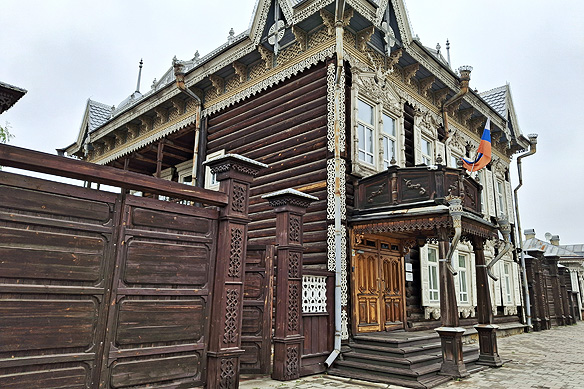
One of the very many Lace Houses in Irkutsk’s historical city-centre decorated with filigree woodwork around the roof and on the corner junctions.
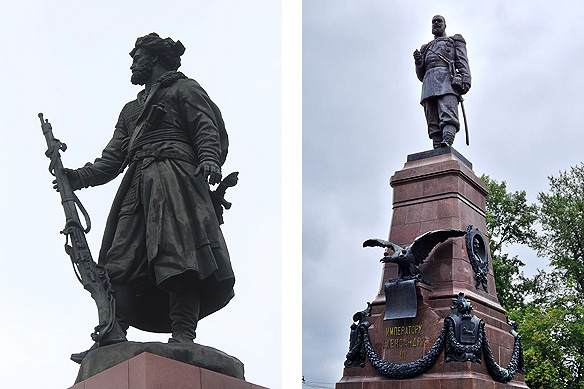
The two men behind Irkutsk. Left: Yakov Pokhabov, the Cossack explorer who established the city in 1661; Right: Tsar Alexander III, who gave the city a major boost by connecting it with the Trans-Siberian Railway in 1898.
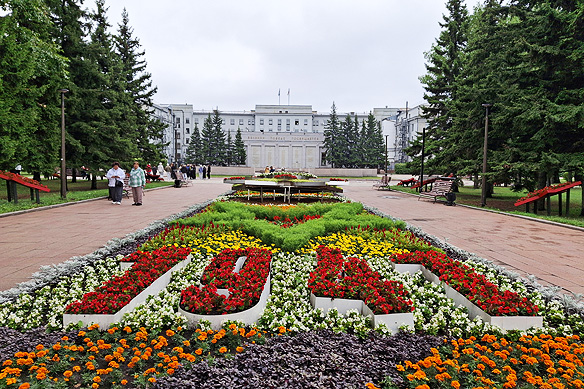
Kirov Square with the Great Patriotic War Monument in the background.
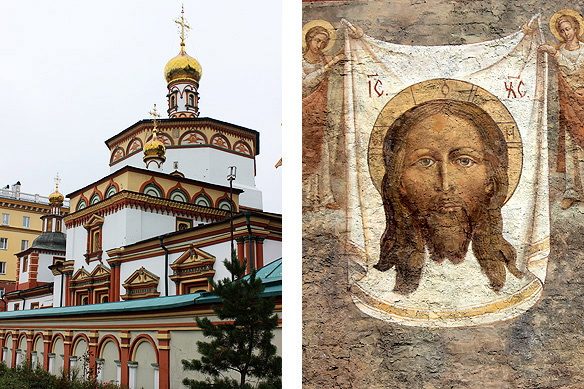
Left: The colourful Epiphany Cathedral was built in 1718; Right: ‘Veil of Veronica’ fresco on the facade of Irkutsk’s oldest church—the Church of Our Saviour dated 1706.
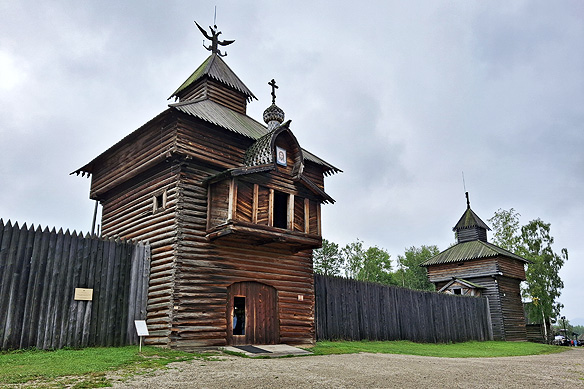
A 17th Century village Kremlin’s watchtower at the Taltsy Architectural and Ethnographic Museum located between Irkutsk and Lake Baikal.
DAY 9: FRIDAY, 8 AUGUST 2025
I have become quite the pro at Russian rail travel! From stocking up on instant noodles and mash potatoes, freshly-baked samsas, and 3-in1 coffees from the local supermarket, to finding my train’s platform and running up flights of stairs with my luggage, to changing instantly into shorts and slippers once at my berth. Hehe.
There are no hiccups now, except for finding that I have my first-class coupe all to myself today. The latter is a treat. I walk down the aisle to find most of the carriage is empty as well. I have three days and six hours of travel to Vladivostok across the forest-clad hills of East Siberia. Outside my window, the Russian landscape in all its summer glory unfurls itself as my train skims past Lake Baikal.
My solitude is eight hours long. I am joined by Zhenya in Ulan-Ude, a 42-year-old soldier with an amputated leg. He was conscripted into the army in 2022. This year he lost his left leg when he accidentally stepped into a landmine in Ukraine. He asks me not to use his photo. He could get into trouble. I promise him I won’t. We chat with our respective translate apps. He tells me about his life. I tell him about mine. Every now and then his eyes mist over when he looks at his leg.
There is another amputated soldier in the carriage. I ask him to join us. He tells me he had thought I was a Ruska Roma [a Russian gypsy]. He then asks me what am I doing travelling the world alone. I remind him of my gypsy soul.

I have Zhenya as my travel companion through part of the Irkutsk-Vladivostok section. A soldier, he lost his left leg in a landmine in Ukraine and has just been released from hospital.
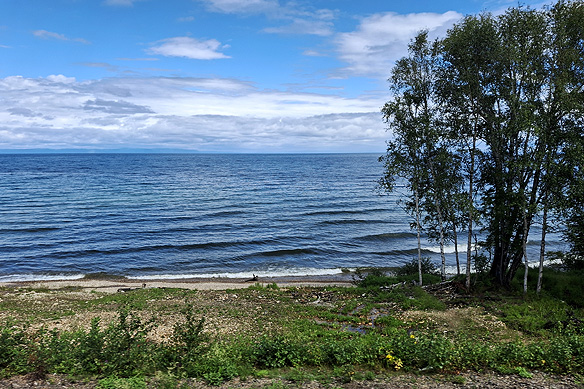
My train skims around Lake Baikal, the world’s deepest and oldest freshwater lake, on its way to Russia’s Far East.
DAY 10: SATURDAY, 9 AUGUST 2025
Around 4:00 am, two nurses come into our coupe to change Zhenya’s dressing.
It is another day. Stunning landscapes. And trying to understand human lives.
The Siberian section from Irkutsk to Vladivostok is undoubtedly the most magical part of the Trans-Siberian Railway. Enormous endless velvety meadows. Shimmering expanses of countless rivers. The skies so blue, it finally makes sense why they are likened to the heavens. No pictures can do justice to what lies in front of me. And all around me.
There are also cemeteries. With fresh flowers and Russian flags. Zhenya tells me they are for the soldiers who have died in the Ukraine war.
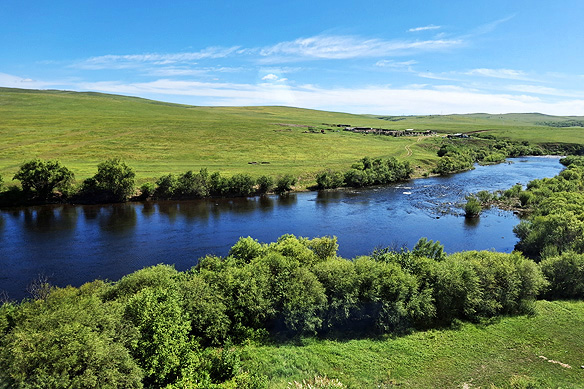
A tiny village nestled in velvety meadows sliced by wide placid rivers.
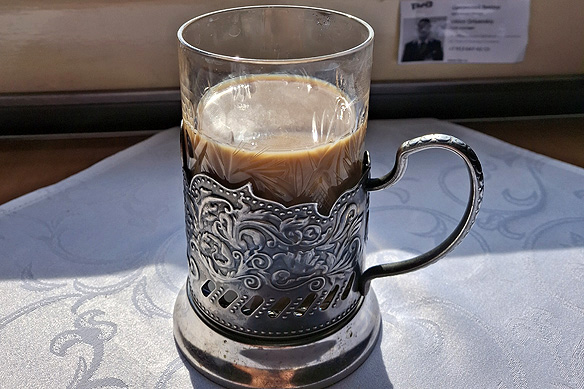
3-in-1 coffees in the trademark Trans-Siberian Railway mug.
DAY 11: SUNDAY, 10 AUGUST 2025
It is grey and overcast today. The endless forests and wildflowers still bloom anyways.
DAY 12: MONDAY, 11 AUGUST 2025
Zhenya leaves the train at Khabarovsk at 3:00 am. In his place Andrei, another soldier [also amputated], joins me in my coupe. He is a commander in the army on his way to work after a holiday. Many of the soldiers fighting the war from the Russian side have been conscripted from Siberia and the Far East. Very few, in comparison, are from the western cities. I see wounded, limping soldiers at all the railway stations the train stops at. Most women I speak to have had a family member killed in the ongoing conflict.
DAY 13: TUESDAY, 12 AUGUST 2025: VLADIVOSTOK, THE SOVIET SAN FRANCISCO
After the grandeur and sobriety of the Trans-Siberian Railway, Vladivostok, the line’s grand finale on Russia’s eastern coast, feels young and carefree. Both, locals and large crowds of Chinese and Korean tourists cannot seem to get enough of lazing on its pebble beaches or wading through the Pacific Ocean to the Tokarevsky Lighthouse [1910]. Music wafts from the city’s many clubs and bars, and there is a hip and happening vibe in the air.
Nikita Khrushchev, Stalin’s successor was so inspired by San Francisco during his US visit, that he was determined to turn Vladivostok into a ‘Soviet San Francisco.’ An endeavour he somewhat succeeded in. But Vladivostok was not always like this. Far from it. From 1958 to 1992, the city as the headquarters of USSR’s naval base, was closed to foreigners and even Russians needed permits to visit.
Two other dates define Vladivostok’s uniqueness: 1860 and 1922. In 1860, Russia took over the Far East from the Chinese, and established their ownership by founding the city which they aptly named Vladivostok, meaning ‘Owner of the East.’
Through most of the late-19th and early-20th Century, their city on the hills served as a melting pot of traders from China, Japan, Korea, and Europe. But when civil war broke out following the October Revolution in 1917, Vladivostok became a landing port for the foreign-funded White Army. After resisting Lenin’s Red Army for four bitter long years, Vladivostok finally surrendered in 1922. Like Khrushchev, Stalin too had had grand dreams for the city and planned to make it a showcase of Soviet greatness.
The result of this eclectic past is a city that is just as eclectic. It is all its past avatars—that of a trading post-cum-Soviet showpiece-cum-closed military base—plus its current avatar of a popular Russian holiday destination for the neighbouring Chinese and Koreans, rolled into one.
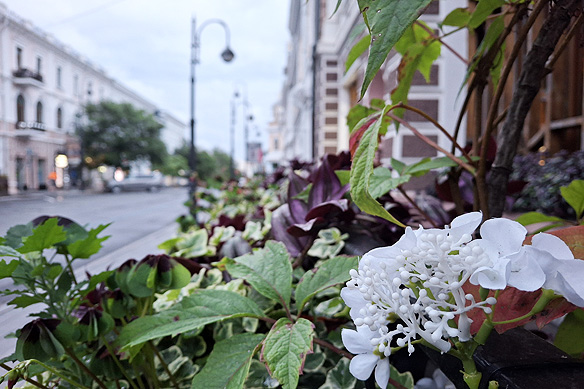
Vladivostok’s charming city-centre.
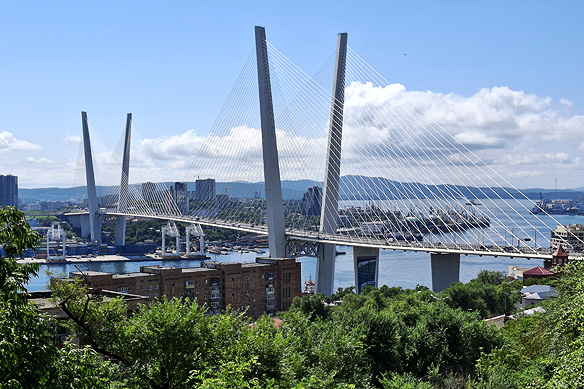
Golden Bridge stretching over Golden Horn Bay. The viewpoint is reached by a funicular railway.
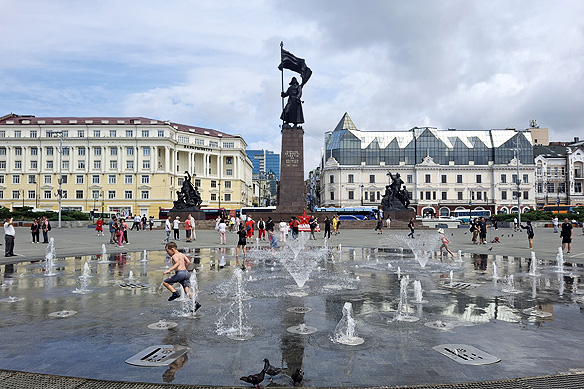
‘Monument to the Fighters for Soviet Power in the Far East’ in the Square of the Fighters of the Revolution. The fountains are a big hit with children in Vladivostok’s sweltering summers.
![Left: Business Lounge in the Vladivostok Railway Station [1912]; Right: Group of Chinese tourists making their way to the Tokarevsky Lighthouse.](https://ramaarya.blog/wp-content/uploads/2025/09/vladivostok-4.jpg)
Left: Business Lounge in the Vladivostok Railway Station [1912]; Right: Group of Chinese tourists making their way to the Tokarevsky Lighthouse.
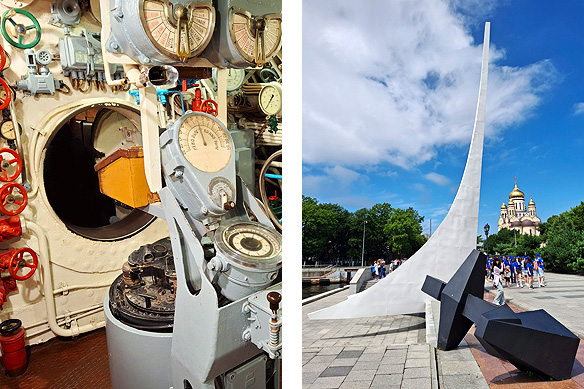
Left: Vladivostok’s sea-front offers a unique opportunity to scramble inside a World War II S-56 Submarine; Right: Monument at the Landing Place of the Founders of Vladivostok. Behind it is the gold-domed Spaso-Preobrazhensky Cathedral, one of the newest additions to the city.
DAY 14: WEDNESDAY, 13 AUGUST 2025
Today is technically my rest day. I spend it peeling away the layers of Vladivostok’s picturesque streets, and have my last canteen meal at the iconic Ne Rydai! which has been around since 1923 with the likes of Vietnam’s former President Ho Chi Minh as its customers. I also start to miss Russia—my home this past one month. Tomorrow, I fly back to Moscow, and on to India.
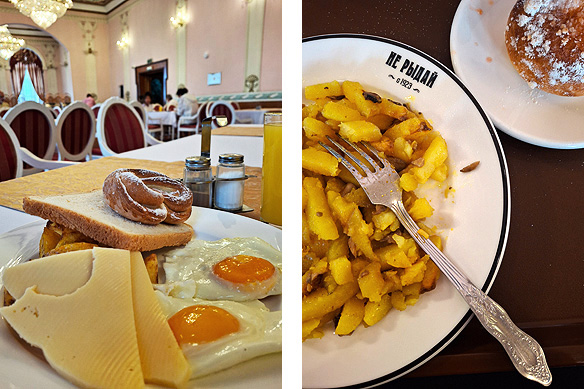
Left: Breakfast at the oh so ornate dining room of the historic Versailles Hotel; Right: Lunch at the legendary Ne Rydai! canteen.
EPILOGUE
Would I do the Trans-Siberian Railway a second time around? Though I would love to, I would not. This journey has been perfect. Perfect heavenly blue skies [most of the time]. Perfect 9,289 kilometres of dense taiga, grand meadows, sparkling rivers, and endless carpets of vibrant wildflowers. Perfect explorations of historic cities each with its own unique story. And perfect smiles across eight time zones from Russians of varied walks of life. It would be hard to match it. I would not even try.
I hope you enjoyed reading this post as much as I enjoyed writing it. Coming up next week is Photo Essay: St. Petersburg, Where the Pragmatic Met the Poetic. 🙂
– – –
Travel tips:
- The Trans-Siberian Railway is a passenger line and is used by regular Russian folks. I was the only tourist in all the sections, a situation exacerbated by the sanctions.
- Also because of the current sanctions, foreign cards do not work in Russia and western portals do not list Russian hotels or guides. I did all my bookings through London-based tour operator Go Russia. They are brilliant and the best priced of the lot currently offering services to Russia.
- My local guides were fabulous. Here are their contact details:
– Kazan: Rezeda, +89375750393
– Yekaterinburg: Evgenia Shikunova, +7[902]8755944, shikunova_e.81@mail.ru
– Novosibirsk: Olga Tkachenko, +7[913]8916081, waytosib@mail.ru
– Irkutsk: Vera Milkina, +7[914]9519953
– Vladivostok: Victoria: +7[964]4492857 - The central hotels I stayed at the stops en-route:
– Kazan: Jazza Hotel
– Yekaterinburg: Marins Park Hotel
– Novosibirsk: Marins Park Hotel
– Irkutsk: Mayak Hotel in Listvyanka
– Vladivostok: Versailles Hotel - Stock up on food from a local supermarket for the train ride. Prices on board are 200 to 300 percent higher.
- Get a pair of slippers. Outdoor shoes are frowned upon inside the train toilets.
- There are [free] hot and cold-water dispensers in each carriage.
- Dining cars are not always available. Shower facilities are at a charge of 150 Rubles.
- Travel light. There are no lifts or escalators in Russia’s interiors.
- Download Google Translate and the Russian language on it. Internet connectivity is intermittent. Do not let the conversations be intermittent too. Plus, the camera feature is invaluable in the supermarket. Please note there is no WiFi on the trains.
- I travelled first-class [two lower births in a coupe] throughout. Fantastic opportunity to have interesting one-on-one conversations with locals if travelling solo.
[Please note there are NO affiliate links or contacts in this post, or in any of my posts. They are provided only to help you with your plans or for you to get extra info. Neither is any of the content in this post or any other post sponsored. The services mentioned in this post are what I used and I am simply sharing them with you.]
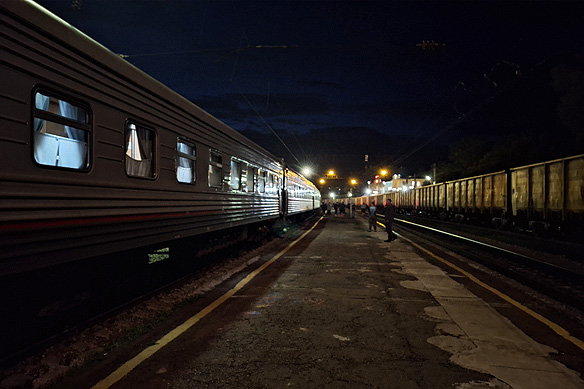
Train station somewhere in the middle of Russia’s Far East. Yekaterina, a university student working the summers as a train attendant, took this picture for me.
 rama toshi arya's blog
You are so adventurous, Rama.
Chapeau !
LikeLiked by 3 people
Hehe. Thank you. I have always met extremely kind local people wherever I have travelled to, so it has been easy to be adventurous. 🙂
LikeLiked by 1 person
Yes, of course.
Considering the length of this trip, I could not do it.
I admire you.
Do you speak Russian?
LikeLiked by 2 people
Not a word, except for yes, no, and thank you. I used the Google Translate app and sign language. 😀
LikeLiked by 1 person
Great!
Maybe you are Marco Polo reborn?
He traveled alll over Asia with translaters, the old-fashioned way.
LikeLiked by 2 people
Now, that’s one big compliment. Thank you. 🙂
LikeLiked by 1 person
Pingback: karelia: when russia met finland | rama toshi arya's blog
Love, love this post, Rama – it’s the stuff of dreams! If I could bear to leave my farm for a long trip, this is the one I would do. Did you get off at each of the towns and spend the day there? What a fabulous experience!
LikeLiked by 1 person
Thank you, and yes I did. How else would I write about them? Hehe. If one does it at one stretch it takes 6 to 7 days, but I wanted to explore the cities enroute. So it took 14 days. I spent at least one day and night in each town. At times more. In all honesty this was one of my most authentic travel experiences I have ever had where I really got to feel and understand a country and its people. 🙂
LikeLiked by 1 person
Slow travel – that’s the way to go 🤗
LikeLiked by 2 people
For the first time in my life I actually wrote my entire blog post series whilst in the country. I had so much time on the train. 😀
LikeLiked by 1 person
A wonderful journey that makes me dream.
LikeLiked by 1 person
Thank you for reading it. It is a long post — 4,400 words, but I did not know how else to narrate this journey. Its meaning lay in it as a whole, and not only in its parts. As I mentioned above to Harini, it was one of my most authentic travels. 🙏
LikeLiked by 1 person
Enjoy your adventures thoroughly 🙏
LikeLiked by 2 people
Thank you, Sir for your kind words. Deeply appreciated.
LikeLiked by 1 person
🙏
LikeLike
Thanks Rama for this magnificent post which brought back so many memories. I got as far as Irkutsk then onto the Trans-Mongolian to end up in Beijing. I always wanted to do the bit to Vladivostok and the extension of the BAM (Baikal-Amur) but now what with age and war it will not happen. Still it is one the best trips I ever did and NO is the answer when people ask don’t you get bored? The endless tracts of Siberian landscape with its great rivers and passing cities, villages, churches and wooden houses is quite hypnotic. And memories of eating the food provided by the ladies and babushkas on the platforms and drinking Russian tea from the samovar at the end of the carriage in the metal glass holder which I still use (though mine has a sputnik on it) and talking with so many people as they get on and off and so on and on … An amazing trip.
LikeLiked by 4 people
I agree with you. It is an epic journey, one that stays with us long after we return to our mundane lives. I am so glad I did it. 🙂
LikeLiked by 1 person
Rama.. This is awesome.. I’m planning to travel on the same route. Is there anyway I can get in touch with you? Will need your guidance.
LikeLiked by 1 person
Hey, I am so glad you found it useful. This train journey is incredible. One of my top most travel experiences ever. Russia is so beautiful and its people truly kind. I did include contacts at the end of the post, including linking to Go Russia who arranged the logistics for me because of the sanctions. You can reach out to me at rama.arya@gmail.com. 🙂
LikeLiked by 1 person