If there is one man who single-handedly changed Russia’s course for keeps, it would be Peter I, better known as Peter the Great. His rule spanning 43 years opened Russia to Europe. By the time he died aged 52, he had made Russia Europe.
Peter the Great came to power early. He was just 10 when he became co-Tsar of all Russia, sharing the throne with his half-brother Ivan V in 1682. Once Ivan V died in 1696, there was no stopping Peter.
A giant, both physically, and metamorphically, he set about putting his vision of a European outward-looking Russian empire, built on marine trade and naval battles, into action. His capital St. Petersburg, which he built from scratch in 1703 on the marshlands of the Neva Delta in the Baltic Sea, was to be his launchpad for these dreams.
Multi-talented, he was just as adept at building ships as he was at stitching a pair of shoes. He was also equally comfortable executing in cold blood those guilty of wilful treason, including his own son Alexei Petrovich, as of intense loyalty to his friend Alexander Menshikov, a commoner, and deep love for his second wife Catherine I, a laundress from Poland-Lithuania.
After his death, for almost a century Russia was ruled by a string of women from St. Petersburg. First his widow Catherine I, then his niece Anna Ioannovna, followed by his daughter Elizabeth I, and finally Elizabeth I’s nephew’s wife Catherine II aka Catherine the Great. This period came to be known as the Petticoat Period, with each Empress embellishing the city with splendid palaces, monuments, and bridges in the Baroque and Neoclassical styles by French and Italian architects, which one sees today.
The arts thrived here. And so did literature. In its 300-year-old history, St. Petersburg has been home to some of Russia’s greatest writers. Alexander Pushkin, the founder of modern Russian literature, Fyodor Dostoyevsky who churned out one masterpiece after the other, Nikolai Gogol who doggedly destroyed romantic illusions, Anna Akhmatova, a rare poetess in a male-dominated field, and Vladimir Nabokov, author of ‘Lolita.’
These 300 years also saw St. Petersburg have its fair share of name changes reflecting changing geo-politics. From 1914 to 1924 it went by the name Petrograd, and from 1924 to 1991 it was known as Leningrad in honour of Lenin, during which for 2 years, 4 months and 19 days [from 1941 to 1944] it was subjugated to one of the deadliest sieges in history, but never captured. After the collapse of the Soviet Union in 1991, the city reverted to its original name St. Petersburg [meaning St. Peter’s City] given by Peter the Great. St. Peter’s City, because the keys the saint held to the heavens, herein represented the keys to the West.
Here is a photo essay of St. Petersburg which started off on a pragmatic note and ended up being sheer poetry, punctuated with quotes from its writers whose favourite muse was their city. ❤

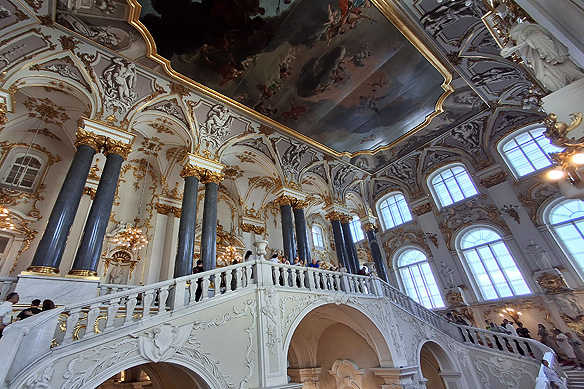
Winter Palace, centrepiece of the Hermitage ensemble, was built for Empress Elizabeth I, Peter the Great’s daughter in 1754. A Russian Baroque masterpiece by Italian architect Bartolomeo Rastrelli, it has been a royal winter residence, field hospital, government office, and one of the world’s greatest museums since 1852.
– – –
“Fickle as water,
our life is as dreamlike as smoke
—at our expense,
fate’s private joke.”
~ Alexander Pushkin, The Bronze Horseman
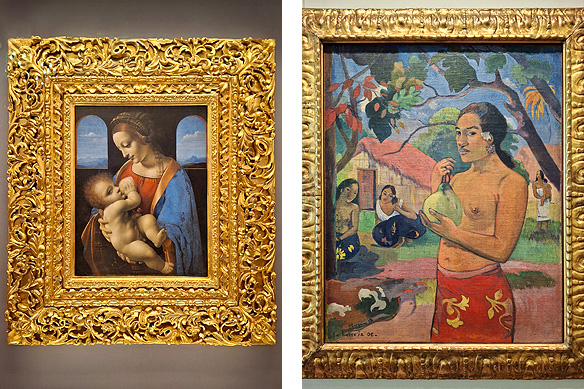
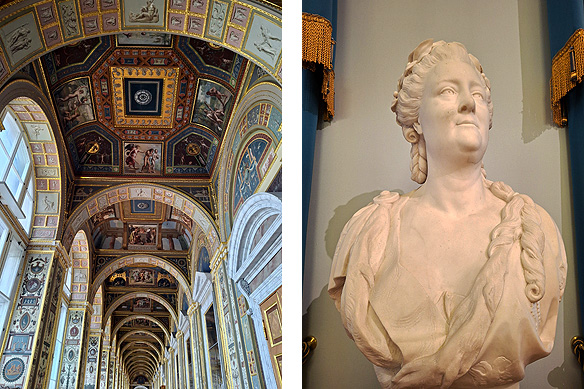
Treasures of the Hermitage: From Leonardo da Vinci’s ‘Litta Madonna’ [1491], to Paul Gauguin’s ‘Ea Haere la Oe’ [1893], to St. Petersburg’s very own exact copy of the Vatican Palace’s Raphael Loggia, to the lady herself Empress Catherine the Great, founder of the museum.
– – –
“The noontide of my life is starting,
Which I must needs accept, I know;
But oh, my light youth, if we’re parting,
I want you as a friend to go!
My thanks to you for the enjoyments,
The sadness and the pleasant torments,
The hubbub, storms, festivity,
For all that you have given me;
My thanks to you. I have delighted
In you when times were turbulent,
When times were calm… to full extent;
Enough now! With a soul clear-sighted
I set out on another quest
And from my old life take a rest.”
~ Alexander Pushkin, Eugene Onegin
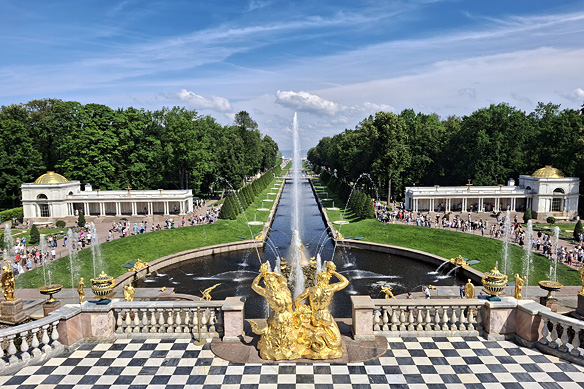
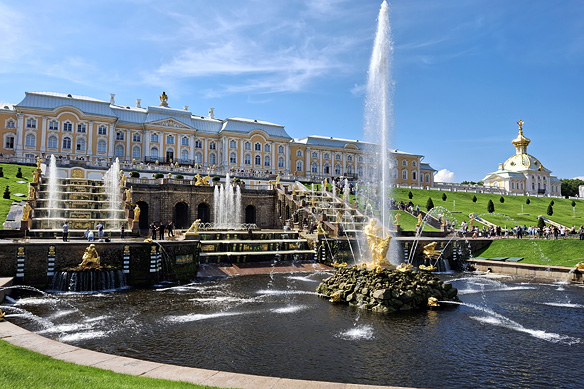
Built on the lines of France’s Versailles, Peterhof is Peter the Great’s palace ‘befitting to the very highest of monarchs’—namely, himself. 5,000 labourers, peasants, and soldiers worked on it with the very best architects, gardeners, sculptors, and engineers for nine years until 1723 when it was officially opened.
– – –
“You will hear thunder and remember me,
And think: she wanted storms. The rim
Of the sky will be the colour of hard crimson,
And your heart, as it was then, will be on fire.”
~ Anna Akhmatova, The Complete Poems of Anna Akhmatova
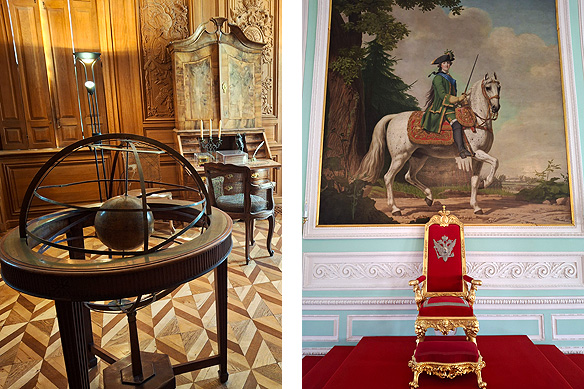
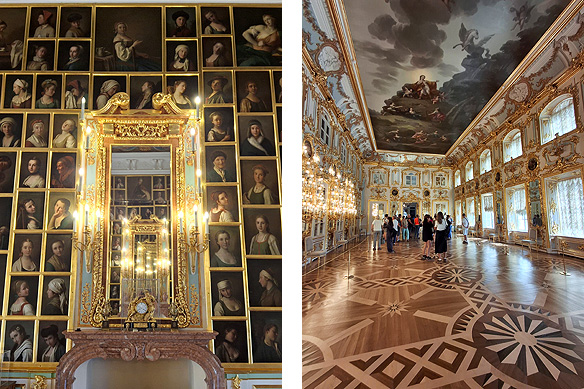
Peterhof’s rooms reflect the aesthetic sensibilities of its residents who designed and redesigned them as per their taste. There’s Elizabeth I’s gilded Baroque opulence, Catherine the Great’s restrained Neoclassicism, and a rare remnant—Peter the Great’s original oak study, replete with a globe in keeping with his global ambitions.
– – –
“If you wish to glimpse inside a human soul and get to know a man, don’t bother analyzing his ways of being silent, of talking, of weeping, of seeing how much he is moved by noble ideas; you will get better results if you just watch him laugh. If he laughs well, he’s a good man.”
~ Fyodor Dostoevsky
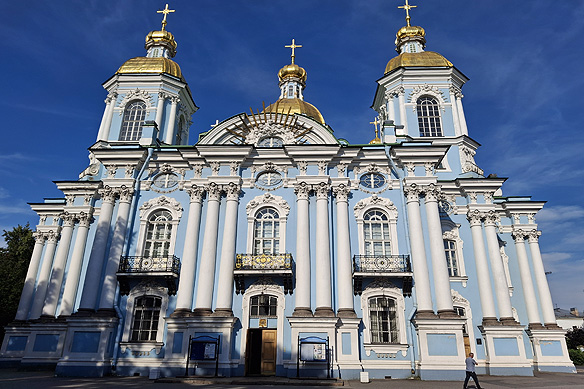
Close to Mariinskiy Theatre is the charming St. Nicholas’ Cathedral also known as the ‘Sailors’ Church.’ It was built in 1753 to serve the mainstay of the city’s economy—its sailors and ship-builders.
– – –
“To love someone means to see them as God intended them.”
~ Fyodor Dostoyevsky
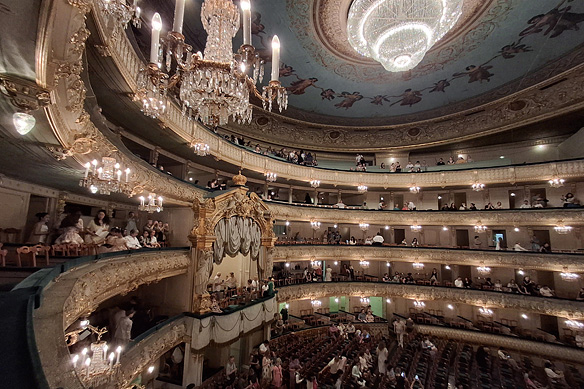
Mariinskiy Theatre is St. Petersburg’s answer to Moscow’s Bolshoi Theatre. What’s a visit to Russia without a ballet performance? Though the Russians like the opera just as much. By the time the performance starts, the hall is packed without a single empty seat to be found.
– – –
“The longer and more carefully we look at a funny story, the sadder it becomes.”
~ Nikolai Gogol
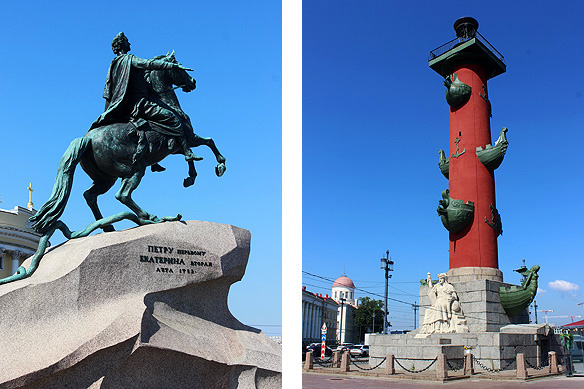
Left: The Bronze Horseman ‘To Peter I from Catherine II’; Right: One of the two Rostral Column lighthouses. Both, Peter the Great and Catherine the Great took St. Petersburg, and Imperial Russia, to dizzying heights by opening its borders to trade and extending it by conquests.
– – –
“It takes something more than intelligence to act intelligently.”
~ Fyodor Dostoyevsky, Crime and Punishment
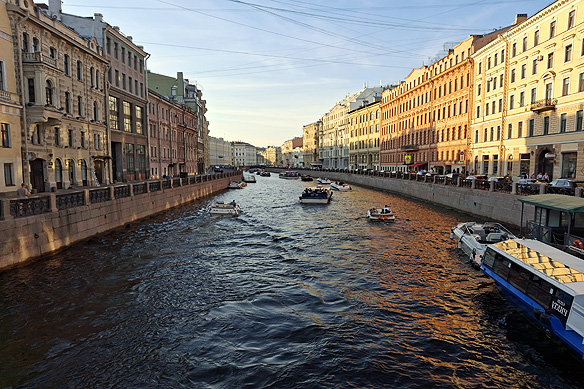
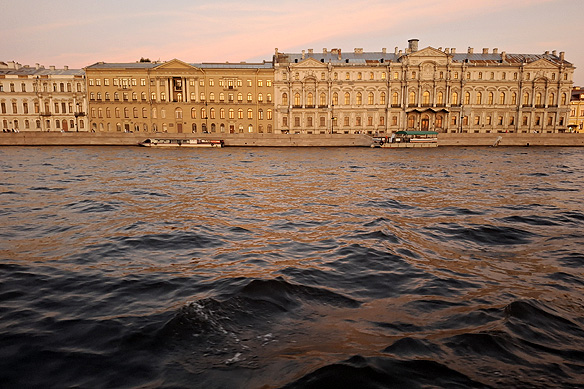
Peter the Great’s determination to open a sea port with direct access to the Baltic Sea changed Russia forever. It transformed Russia from an isolationist inward-looking Tsardom to a western outward-looking empire. Often called the ‘Venice of the North,’ St. Petersburg is crisscrossed with a series of canals leading into the Gulf of Finland.
– – –
“I love thee, work of Peter’s hand!
I love thy stern, symmetric form;
The Neva’s calm and queenly flow
Betwixt her quays of granite-stone,
With iron tracings richly wrought.”
~ Alexander Pushkin, The Bronze Horseman
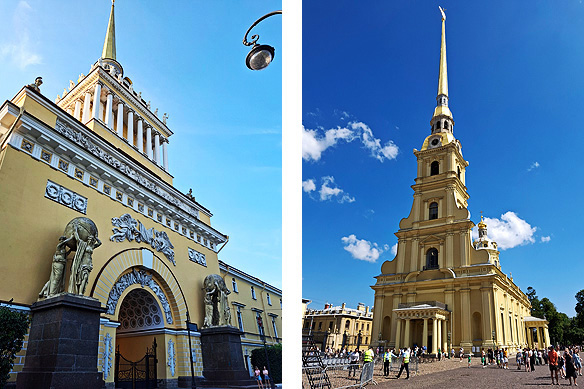
Peter the Great also had a penchant for spires! Left: The Admiralty [1704], a shipyard to build Russia’s first battleships; Right: Bell tower topped with a 122-metre-high spire, Cathedral of SS Peter and Paul [1712], Peter and Paul Fortress.
– – –
“Literature was not born the day when a boy crying “wolf, wolf” came running out of the Neanderthal valley with a big gray wolf at his heels; literature was born on the day when a boy came crying “wolf, wolf” and there was no wolf behind him.”
~ Vladimir Nabokov, Lectures on Literature
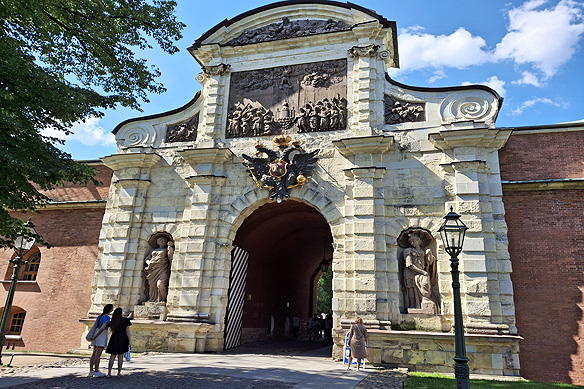
St. Peter’s Gate [1708], entrance to the Peter and Paul Fortress with the Romanov emblem on its facade. The fortress marked the city’s birth, held the graves of its Tsars close to its heart, and served as a site for torture of political prisoners for two hundred years.
– – –
“…how much savage coarseness is concealed in refined, cultivated manners…”
~ Nikolai Gogol
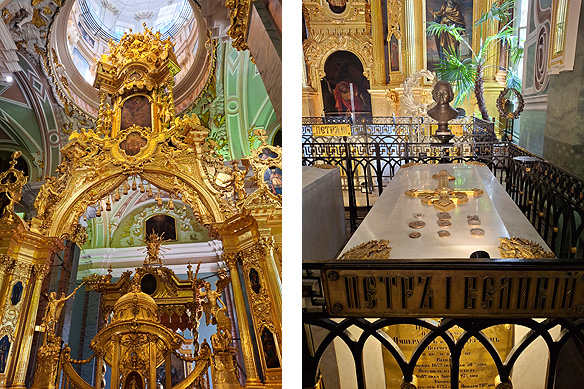
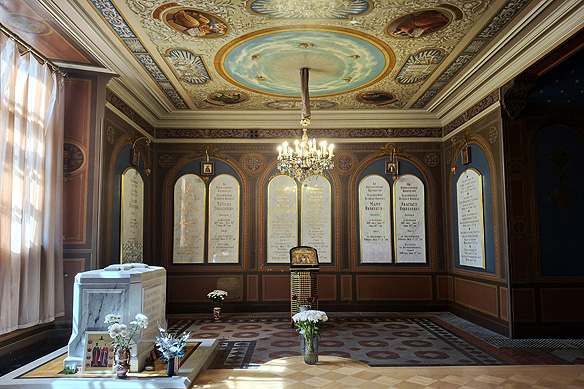
Cathedral of SS Peter and Paul inside the Peter and Paul Fortress became the official burial place of the Romanov Tsars after the capital was moved to St. Petersburg in 1712. They are all here: Peter the Great, Empress Catherine I, Empress Elizabeth I, Empress Catherine the Great, Alexander II. Including the last Tsar Nicholas II and his family who were executed on the night of 16-17 July, 1918 in Yekaterinburg. They were reburied here in 1998.
– – –
“It was a time when only the dead smiled, happy in their peace.”
~ Anna Akhmatova
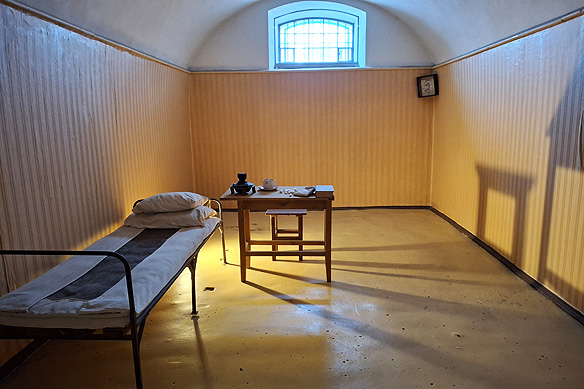
One of the many solitary confinement cells in Peter and Paul Fortress’ Trubetskoy Bastion which housed ‘enemies of the state’ from 1872 to 1921. The window is a later addition.
– – –
“But nothing is lasting in this world. Even joy begins to fade after only one minute. Two minutes later, and it is weaker still, until finally it is swallowed up in our everyday, prosaic state of mind, just as a ripple made by a pebble gradually merges with the smooth surface of the water.”
~ Nikolai Gogol, The Nose
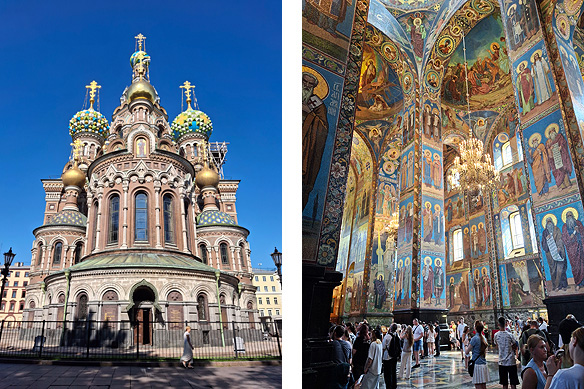
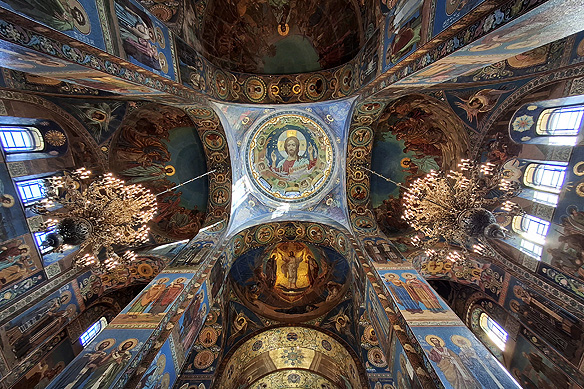
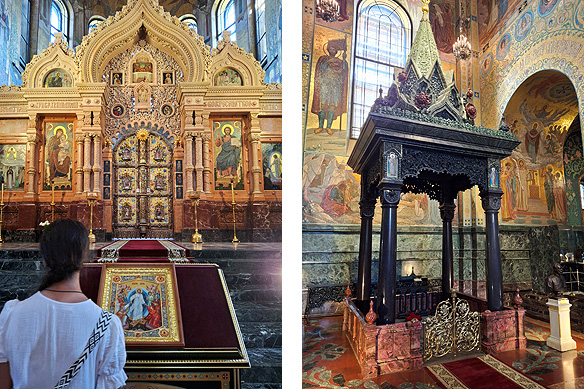
The Church on Spilled Blood stands over the spot where Tsar Alexander II was assassinated on 1 March, 1881. Built in 1883 in the Russian-Revival Style on his son Alexander III’s orders, it is a riot of colourful mosaics, frescoes, and over twenty different types of stone.
– – –
“People speak sometimes about the “bestial” cruelty of man, but that is terribly unjust and offensive to beasts, no animal could ever be so cruel as a man, so artfully, so artistically cruel.”
~ Fyodor Dostoyevsky
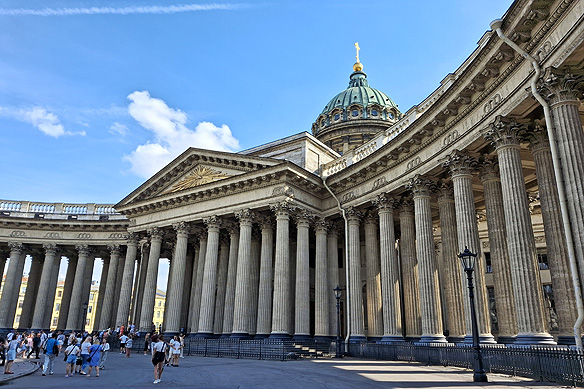
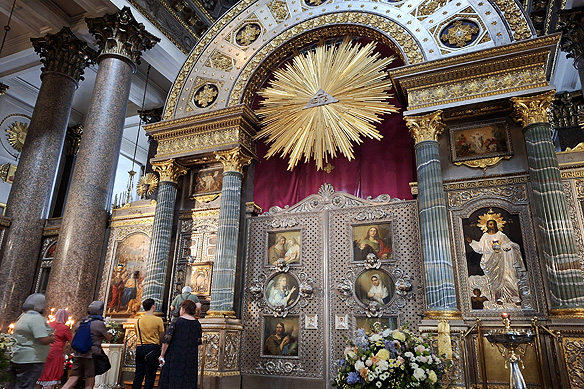
Inspired by St. Peter’s Basilica in Rome, the grand Cathedral of our Lady of Kazan took over a decade to build, opening its doors in 1811. In Soviet times, it was used as the Museum of Atheism.
– – –
“Human life is but a series of footnotes to a vast obscure unfinished masterpiece.”
~ Vladimir Nabokov, Lolita
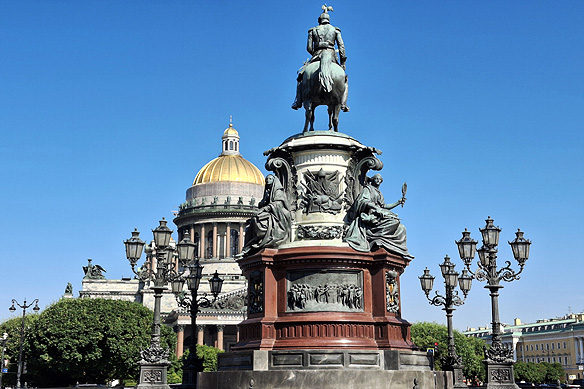
St. Isaac’s Square with the imposing St. Isaac’s Cathedral and an equestrian statue of Tsar Nicholas I; the latter balanced on the horse’s hind legs alone.
– – –
“Do not be angry with the rain; it simply does not know how to fall upwards.”
~ Vladimir Nabokov
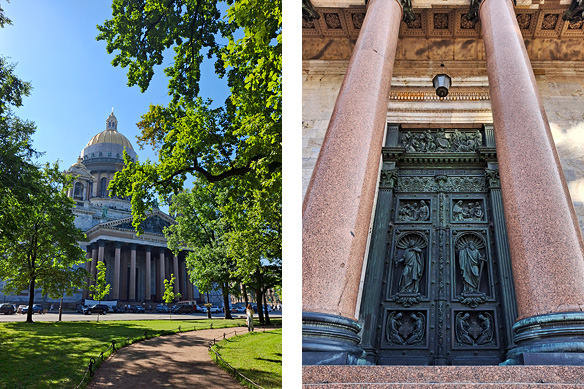
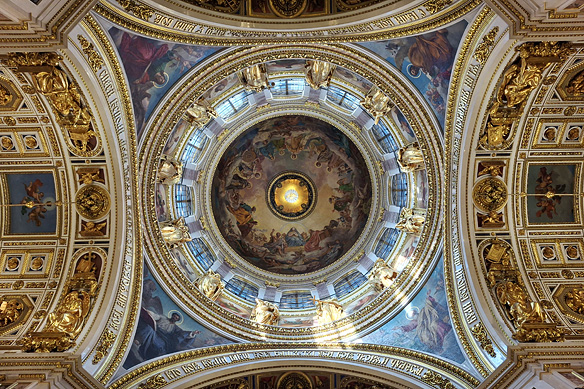
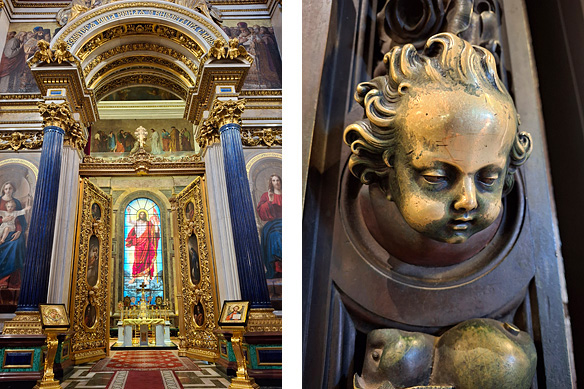
One of the world’s largest cathedrals, St. Isaac’s Cathedral is no less of an engineering miracle. Its enormous weight of 300,000 tonnes is supported by thousands of wooden piles sunk into the marshland underneath.
Consecrated in 1858, it was, like the Cathedral of our Lady of Kazan, also converted into a Museum of Atheism during Soviet times and is officially still a museum. Not of Atheism, but now dedicated to 19th Century Christian art.
– – –
“A certain man once lost a diamond cuff-link in the wide blue sea, and twenty years later, on the exact day, a Friday apparently, he was eating a large fish—but there was no diamond inside. That’s what I like about coincidence.”
~ Vladimir Nabokov, Laughter in the Dark
– – –
I hope you enjoyed this post. Coming up next week is the last and final post in my six-part Russia series: The Top 11 Cultural Highlights of Tsarist, Imperialist, Communist Moscow. 🙂
Travel tips:
- Staying there: I stayed at the Grand Catherine Palace Hotel in the historical centre.
- How many days: I stayed for four days.
- Getting around: I took three private tours with Natalia, natalisokolov@yandex.ru. and walked around to explore the city more.
[Note: I travelled solo across Russia in July-August, 2025 for 30 days. Due to sanctions, international cards do not work in Russia and western travel portals do not list services for Russia. My central hotels, seamless transfers, and private tours with some of the best guides I have ever had, were all arranged by Go Russia.]
 rama toshi arya's blog
Marvellous photo essay, Rama!
LikeLiked by 1 person
Thank you very much. Am happy you liked it. 🙏
LikeLiked by 1 person
Brilliant photo essay, Rama
LikeLiked by 1 person
Many thanks! I learnt so much about Russian literature during my travels to ex-Soviet countries and recently, when in Russia. Am a big fan of Dostoevsky now. 🙂
LikeLike
A lyrical blog indeed..what stunning photos Rama! As always, it’s interwoven with lucid writing.. reading your articles is at once effortless and rewarding..a rare gift in my opinion. loved it!
LikeLiked by 1 person
Thank you! Very kind of you to say so. Russia is incredibly beautiful. I have just copied it over onto my blog. The real thing is even better. 🙂
LikeLike
This was beautifully written. Absolutely fantastic pictures. Makes me want to go to Russia.
LikeLiked by 1 person
Thank you very much! I hope you do get to see Russia. It is an incredibly beautiful country. 🙂
LikeLike
I visited Leningrad in Autumn just before the fall of the Soviet Union in 1991 and St Petersburg in the summer of 2018 and was blown away both times. How such a city was built so far north on marshlands in such a brief period is almost incomprehensible and as usual credit must be given to the architects, craftsmen and thousands of workers who gave their lives in its construction so we can enjoy it today. And yet how close to destruction is was in WW2 after the dreadful siege on 872 days? Your beautiful photos and well chosen poetry verses do justice to one of the great cities of the world and make this one of your best posts yet – a big thanks!
LikeLiked by 2 people
St. Petersburg is indeed special. Resilient and beautiful. Am glad you liked it. Lucky you that you got to visit it twice!
LikeLike
St Petersburg is one of the most beautiful cities of Europe. Even the Russian capital cannot match its beauty and heritage.
LikeLiked by 1 person
Moscow is iconic! It is 600 years older, ten times bigger, and capital before and after St. Petersburg. Which is what makes travelling to the two cities so interesting. They both ‘together’ complete the Russian story. 🙂
LikeLiked by 1 person
Thanks for adding what I wasn’t aware of! I have only read that St Petersburg is much older and used to be the real power center. I do know Moscow is huge.
LikeLiked by 1 person
Definitely not older. 🙂 It was founded in 1703 and became capital in 1712, and stayed so only for a little bit over 200 years under the Romanovs till the 1917 Russian revolution. The Bolsheviks then moved the capital back to Moscow.
LikeLike
Engaging
LikeLiked by 2 people
Thank you for stopping by and commenting. 🙏
LikeLike
The architecture of Saint Petersburg is truly wonderful, and Italian artists played no small part in this. I visited just after the white nights, when the days seem endless.
LikeLiked by 1 person
I was there also just right after the white nights. 🙂 There were open air concerts taking place everywhere, flowers blooming, and everlasting golden sunsets.
LikeLiked by 1 person
Pingback: travel diaries: moscow to vladivostok, sleepless on the trans-siberian railway | rama toshi arya's blog