
No list of world cities is considered complete without the mention of Moscow. Immaterial of whether it was in the Middle Ages or now in the 21st Century. Irrespective of whether it is in times of peace. Or conflict.
Spread over seven hills, just like Rome, Moscow was determined from the outset to outdo Kyiv. Kyiv had been the historical capital of Kievan-Rus as Russia was called till the 13th Century Mongol raid. A higher cathedral, longer city-walls, taller city-gates—Moscow had to be better, and grander than its precursor. Period.
What started off as a wooden Kremlin [fortress] built by Prince Yuri Dolgorukiy in 1156, went on to become the citadel of the Tsars, headquarters of the USSR, and now the office and residence of the world’s largest country’s Head of State.
Moscow has remnants from everyone who ruled Russia from its crenelated walls. The Tsars gave it its grand cathedrals, Red [in Russian is another word for ‘beautiful’] Square, and a fortified stone Kremlin. They then burnt their own city to the ground in 1812 to drive Napoleon’s army out, and rebuilt it in an Empire [Baroque and Neoclassical] style. The Soviets after them gave the city its enormous streets, palatial metro system, and Stalin’s ‘Seven Sisters.’ Modern Moscow threw in the Moscow International Business Centre’s futuristic steel and glass skyscrapers into the mix.
It is a massive city in which an eclectic past and present jostle side-by-side, never far from a Christian Orthodox church or the performing and fine arts.
Here are Moscow’s top 11 cultural highlights from its very many eras. Wishing you travels which widen and deepen our intellect, hearts, and souls. Always. 🙂
1. Uncover the secrets of Moscow’s most iconic cathedral named after a ragged prophet
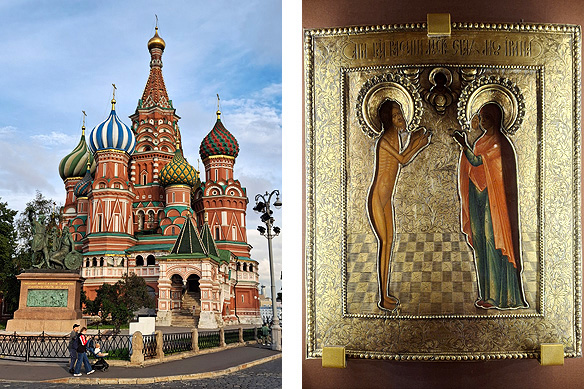
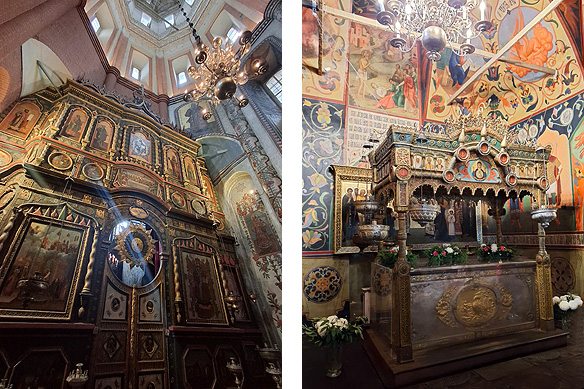
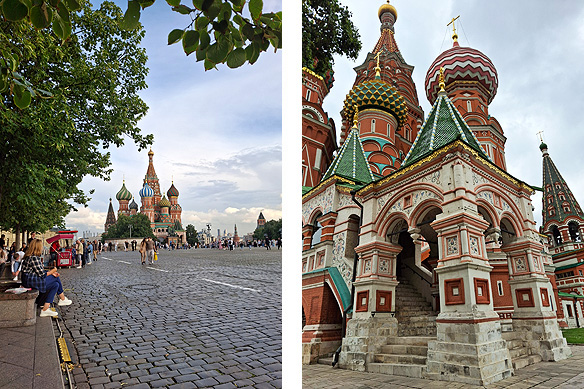
Think about Moscow, and the first image that pops to mind is the colourful 16th Century St. Basil’s Cathedral on Red Square decorated with swirling onion domes. What if I told you the nine cozy chapels inside, connected with dark painted corridors, are even more vibrant, filled with gleaming iconostases and jewel-like frescoes.
Commissioned by Ivan the Terrible in 1552 to celebrate his victory over the Mongol stronghold of Kazan, the graphic domes were not part of the original design. The ribbed and faceted domes replaced the smooth cupolas in 1583, and the reds, greens, blues, and yellows added in 1670. Prior to this, the cathedral was white with golden domes in line with prevailing trends. Here is one more insider piece of info: Officially known as the Cathedral of the Intercession, it got its more popular name from the deeply venerated Shrine of Basil the Blessed, the ‘holy fool,’ which stood next to it. It made sense, thus, to just envelop the shrine into the cathedral in 1588, and do away with the competition.
2. Come face-to-face with Vladmir Lenin at his mausoleum
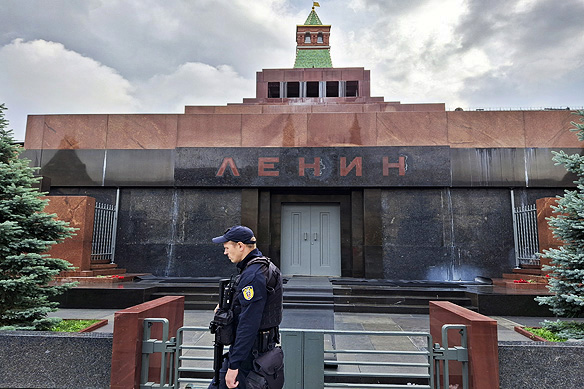

Going to Moscow and not saying ‘Hello’ to Vladimir Lenin? Now that would be sacrilege. But do not expect Russians to understand this overwhelming sentiment. Just like all non-Indians tend to associate only Gandhi with India, and we see him merely as ‘one’ of many other freedom-fighters. Likewise, Russians see Lenin as ‘one’ of many other revolutionaries. But context aside, a visit to Lenin’s mausoleum in the Red Square is an unmissable mandatory ritual. Remember, this blog is for history and culture buffs!
His waxy resting body in a black suit lies inside a pyramid of red and black stone cubes since his death in 1924. It is lit with spotlights in an otherwise pitch-dark chamber. Both Lenin and his widow had been against such displays, but their wishes were brushed aside in the face of political propaganda. Interred behind Lenin’s mausoleum are the likes of Joseph Stalin and Yuri Gagarin.
Travel tip: Entry to the mausoleum closes at 1:00 pm. Photography is prohibited inside.
3. Step back 550 years into Ivan the Great’s magnificent Cathedral Square
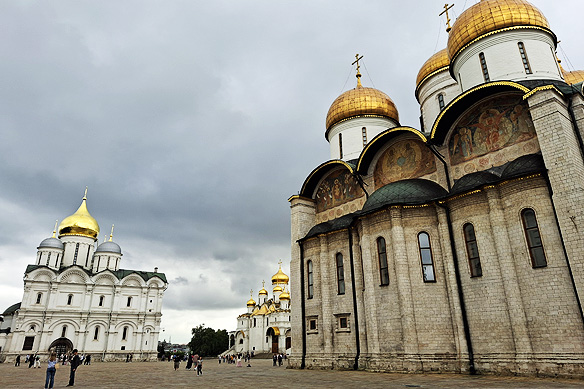
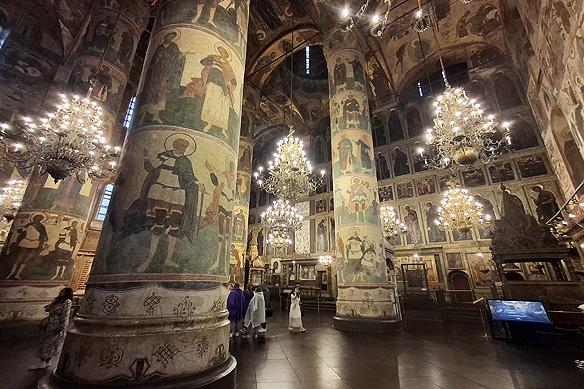
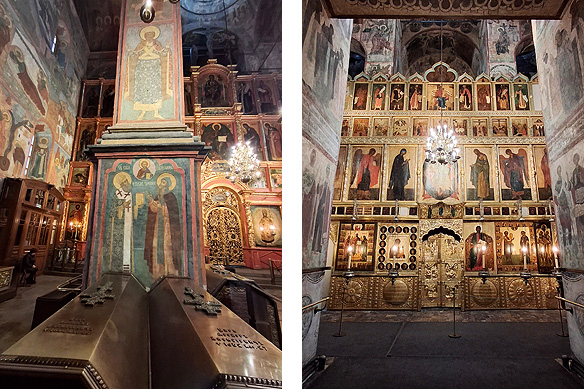
Not much has changed in the past 550 years in Kremlin’s Cathedral Square—a time capsule of grand stone churches topped with golden domes that were once the setting for elaborate royal baptisms, coronations, and burials. After Peter the Great moved the capital to St. Petersburg in 1712, the pageantry left as well. But the later Tsars never forgot Ivan the Great’s High Renaissance-cum-Early Russian ensemble built by Italian masters to reflect the growing might of Russia under his rule.
Pride of place belongs to the Cathedral of the Assumption in which the Tsars were crowned, surrounded by four soaring columns. Next in line is the Cathedral of the Archangel dotted with their tombs, guarded by the Trinity in the central cupola above. Last of the great cathedrals is the Cathedral of the Annunciation which served as the royal chapel. Interspersed between these is a towering bell tower that became the tallest building in Moscow in 1600 when a third storey was added to it, the gigantic Tsar Cannon that never fired a cannon, and the chipped Tsar Bell that holds the honour of being the largest bell in the world.
4. Explore the Russian Tsars’ collection of weapons, jewels, household goods, and royal paraphernalia


The simplest way to describe the Armoury Chamber inside the Kremlin is that it’s a showcase of the Tsars’ belongings. A royal practice [to make and store] that started in 1508, it includes their clothes, carriages, jewels, bibles, dinner-sets, weapons, thrones … each item a priceless work of art. The current building built as a museum dates to 1851. Highlights include the 13th/14th Century Crown of Monomakh used in royal coronations till 1682, Persian Diamond Throne [1659], Catherine the Great’s gilded summer carriage, coronation dresses worn by the empresses, and 10 Fabergé Imperial Eggs.
Within the Armoury Chamber is The State Diamond Fund [tickets are available at the counter]. An excellent audio guide takes one through the Orlov Diamond and Shah Diamond [both from India], Catherine the Great’s Imperial crown inset with 5,000 gems, multiple pieces of royal jewellery, and rocks of gold and silver ore.
5. Feast on world treasures at the Pushkin State Museum of Fine Arts


Named after Alexander Pushkin, Russia’s favourite author, the iconic Pushkin State Museum of Fine Arts was founded in 1912. It is crammed with plaster casts of masterpieces across European history for art students’ study. Though impressive, even if at times a little rough around the edges, its real treasures are something else. Hidden away in side galleries, understated halls, and ignored corners are some of the world’s most incredible original archaeological finds and paintings. They comprise ‘trophy art’ from Berlin after the WWII win and nationalised private art collections during Soviet rule.
The result is one gets to feast on Heinrich Schliemann’s Treasures of Troy, drown in the eyes of a 1st Century Egyptian from the Fayoum oasis painted onto his death mask, sigh at the exquisiteness of Sandro Botticelli’s altar panels, and be wrapped in the palettes of Rembrandt, Rubens, and Canaletto.
For some more art, make your way to the upper floors of the Gallery of 19th and 20th Century European and American Art next door where one of the world’s largest collections of Impressionist and Post-Impressionist art by Cezanne, Gauguin, Kandinsky, Manet, Matisse, Monet, Picasso, Renoir, and Van Gogh, amongst others, fill scores of halls.
6. Soak up Russia’s finest art at the Tretyakov Gallery
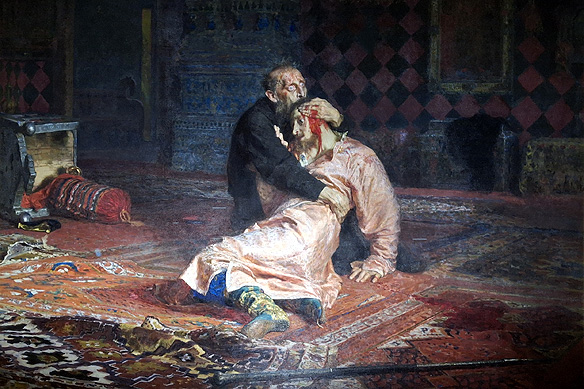
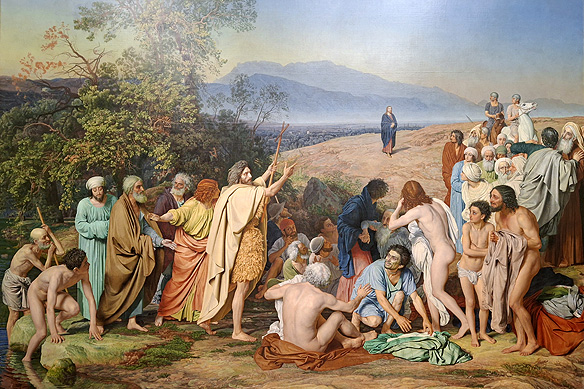
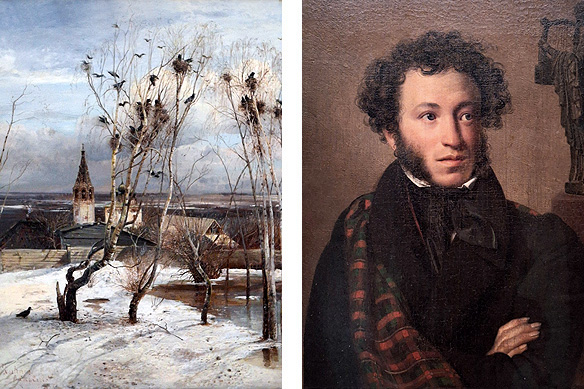
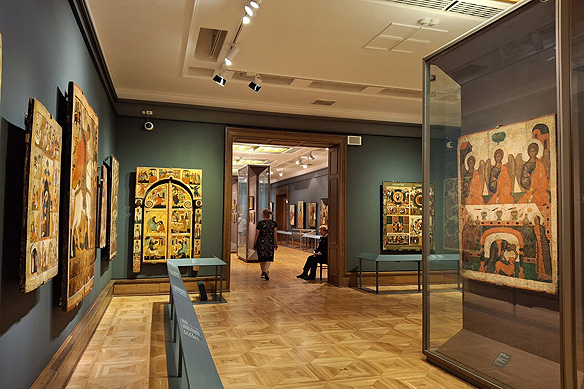
One does not often get the chance to time travel through a millennium of Russian art in the space of a few hours, so when one does, it is one of life’s treats. Moscow’s Tretyakov Gallery, the world’s largest collection of Russian art, starts off with medieval icons from the 11th Century and culminates with 19th Century Classics. These are housed in a building straight out of a fairytale which belonged to the museum’s founder, a wealthy businessman and art collector—Pavel Tretyakov—who gifted his private collection to the city in 1892.
Works to look out for are Alexander Ivanov’s monumental ‘The Appearance of Christ Before the People‘ [1837 – 57] which took him 20 years to paint, Ilya Repin’s heart-wrenching ‘Ivan the Terrible and His Son Ivan‘ [1885], Vasily Surikov’s historical saga ‘The Morning of the Streltsy Execution‘ [1881], Valentin Serov’s ‘Girl with Peaches‘ [1887] which kick-started Russian Impressionism, and Mikhail Vrubel’s ‘The Demon Seated‘ [1890] inspired by the poem ‘The Demon.’
Travel tip: Take a guided tour or the audio guide to understand the artworks’ contexts.
7. Visit Cathedral of Christ the Saviour, Moscow’s church with a problematic past
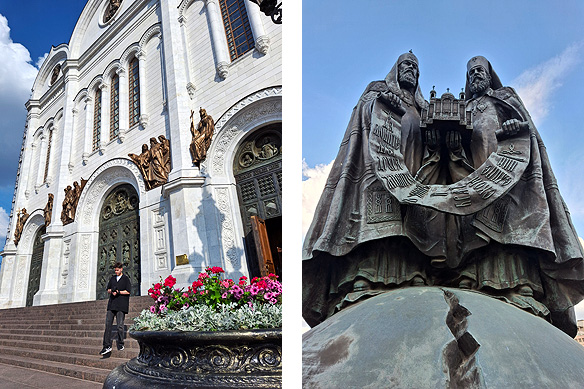
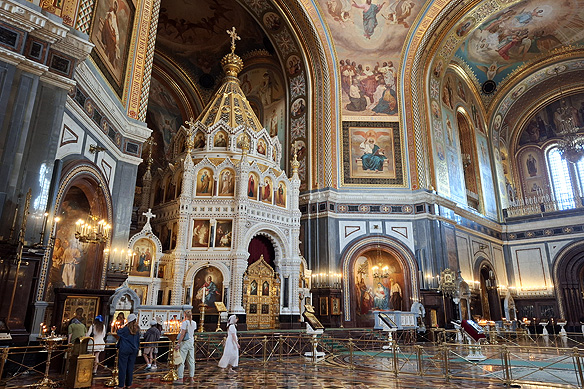
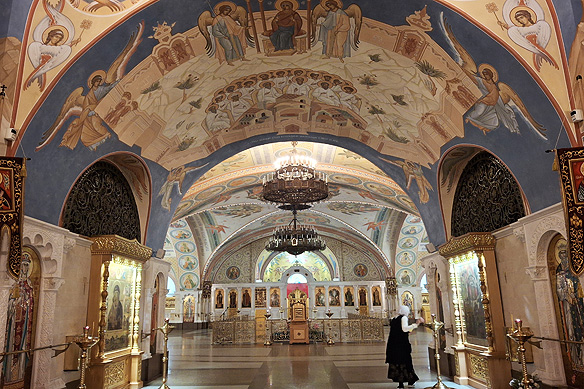
A short walk from the Pushkin State Museum of Fine Arts is the Cathedral of Christ the Saviour, Moscow’s tallest Christian Orthodox church [and the third tallest in the world]. The 103-metre-high cathedral, complete with sumptuous gilded icons and soaring frescoes, has a story worth telling.
The original cathedral which stood at this site was built to commemorate Russia’s victory over Napoleon Bonaparte in 1812. Completed in 1883, it was then Moscow’s tallest building. Stalin had this blown up in 1933 to make way for his Palace of Soviets which never materialised. Instead, the cavity was turned into an outdoor swimming pool in 1959. Figuring the area could be put to better use, the original cathedral was rebuilt in the late-1990s, at the same height. But this too was mired in controversy. Its cost of USD 200 million was largely funded by the State coffers at a time the country was grappling with economic hardship.
8. Hop-on hop-off along Moscow Metro’s ornate Soviet-era stations


With 302 stations, 16 lines, and a headway of 80 seconds, the Moscow Metro has come a long way since it was launched 90 years ago on 15 May, 1935. Back then it was a single 11-kilometre-long line punctuated with 13 stations.
Built with experts from the London Underground, the network became a showcase for Soviet ideals decorated in the Socialist Realism style—the artworks of the 13 original stations gaining both domestic and international acclaim. Till 1991, it was standard practice to decorate each metro station, described by the Soviet government as ‘palaces for the people,’ with monumental mosaics, splendid frescoes, sparkling chandeliers, and life-sized sculptures, in a bid to announce USSR’s political and economic clout. An endeavour that still impresses.
Travel tip: Take a guided tour to navigate through the most spectacular stations and understand the associated messaging.
9. Enjoy royal tranquillity at Novodevichiy Convent
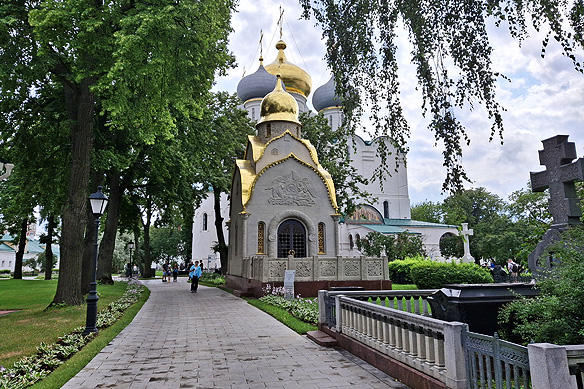
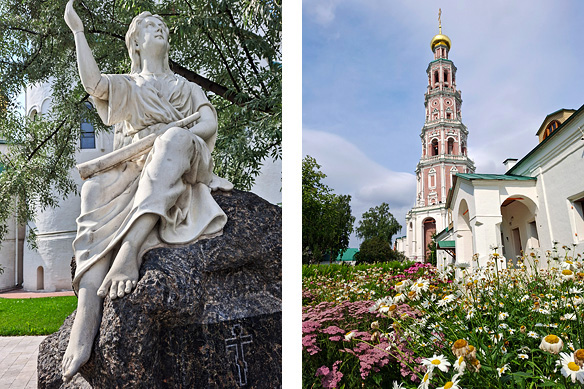
Novodevichiy Convent’s oldest building, the Cathedral of the Virgin of Smolensk, dates to 1524. It is the centrepiece of a fairy-tale whitewashed enclosure with dark-pink Russian Baroque churches, palaces, and a six-tiered octagonal bell tower—an ensemble often described as one of Moscow’s most beautiful fortified religious institutions. When the Tsars had had enough of their mothers, wives, and sisters, they were packed off to convents like these for the rest of their lives. Most of Novodevichiy Convent’s buildings were added in the 17th Century by Sophia, Peter the Great’s half-sister, when she was in power as Regent. In an ironical twist of fate, the lady was incarcerated inside the same walls she had funded.
Tall trees, marble statues, and manicured lawns abloom with colour make for a serene walk as one winds one’s way past the many gold-domed churches. The royal ladies, perhaps, were not too miffed for being sent to live amidst such prettiness.
10. Relive Rurik Russia at the Kolomenskoye Museum-Preserve


Before Peter the Great took over the reins of Russia and Europeanised the country, it was ruled for 736 years by the Rurik dynasty followed by a few generations of Romanovs who were happy to emulate their predecessors. This was a very different Russia, especially architecturally. A rare vestige from this period, albeit a reconstructed version, the Kolomenskoye Museum-Preserve gives one the opportunity to experience this chapter of Moscow’s secular history in all its medieval glory.
From the 14th to 18th Century, the estate with two surviving stone churches was used as the summer residence of Moscow’s rulers. Built and rebuilt a few times over, the current palace [2010] recreates in minute detail what it was like before it was destroyed on Catherine the Great’s orders. Under the pointed roofs is a maze of 250 rooms and corridors built without using a single nail or hook, decorated in rich colourful furnishings.
11. Learn about the Cold War at Russia’s newest museum 65 meters underground


Beneath a nondescript building in one of Moscow’s quiet residential neighbourhoods dotted with pretty churches lies Bunker-42—the country’s former Top Secret Command Centre of the Russian Armed Forces during the Cold War. Military strategies were designed here, and the country’s tens of thousands of nuclear weapons controlled from its communication equipment. The officers who clocked in hours in its tunnels, 65 meters deep in the bowels of the earth, were picked up from different locations in a closed bus. They had no idea where the bunker was. Neither did anyone in the vicinity know about the centre’s existence.
Now that the Cold War is a thing of the past, the centre has been converted into a museum. Visitors can take a rapid lift down into the command centre, learn about its secret tunnels, and even partake in a mock drill. The tour ends at a Soviet-styled restaurant-cum-karaoke bar and souvenir shop selling coffee mugs and cigarette cases printed with Stalin’s face.
Travel tip: The official tour is in Russian. It is recommended you book with a tour guide who can translate for you.
– – –
I hope you enjoyed this last and final post in my six-part Russia series. If you missed any of my previous posts, you can read them here. Thank you for coming along with me virtually on this journey. ❤
Travel tips:
- Staying there: I stayed in Moscow twice during my travels—3 days at the 19th Century Budapest Hotel a short walk from the Kremlin, and 3 days at the very modern and comfortable Cosmos Smart Dubininskaya Hotel.
- Getting around: I took multiple private tours with Maria, WhatsApp +7[909]9977790, and took a Yandex taxi to explore the city further.
- Most museum tickets in Russia are on a timed entry basis. This ensures they are rarely crowded, thus giving a better visitor experience.
[Note: I travelled solo across Russia in July-August, 2025 for 30 days. Due to sanctions, international cards do not work in Russia and western travel portals do not list services for Russia. My central hotels, seamless transfers, and private tours with some of the best guides I have ever had, were all arranged by Go Russia.]

 rama toshi arya's blog
Wow Moscow has so many beautiful things. Well shared 💐
LikeLiked by 1 person
Yes, indeed, Moscow is packed with cultural and historical highlights. 🙂 Thank you for stopping by. Glad you liked the post.
LikeLiked by 1 person
My pleasure 😊
LikeLike
I had two visits in 1991 and 2007 and saw some of the highlights you mentioned and regret not seeing the Tretyakov Gallery and the Bunker although maybe that wasn’t functioning then. Magnificent places and beautifully described and illustrated as usual. Such a shame (for so many reasons) its off limits to Westerners. One can only hope that its not for ever.
LikeLiked by 1 person
The Bunker Museum is recent, so yes, you would not have seen it. Moscow is grand. At multiple levels … I try and do at least one art gallery in a country I visit to reconnect with what I studied for very many years. 🙂
LikeLike
Pingback: photo essay: st. petersburg, where the pragmatic met the poetic | rama toshi arya's blog