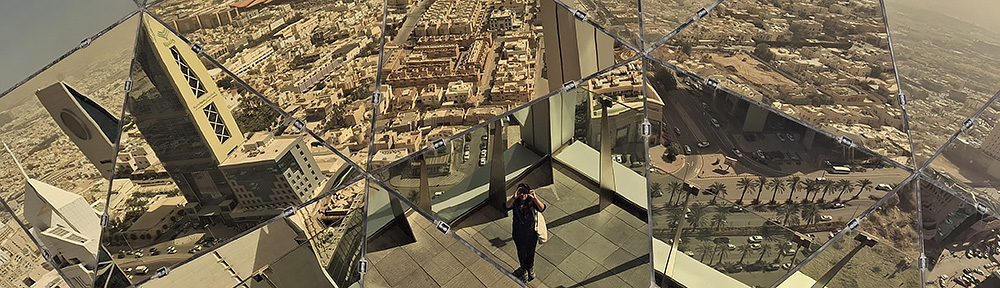

There are over 50,000 khachkars in Armenia. You will see them everywhere. At ancient monasteries and modern cathedrals, along the highways encircling the Armenian Highlands, in medieval cemeteries, inside every museum whether state-of-the-art or plain old-school, and next to frigid mountain lakes.
Indigenous to Armenia, the UNESCO-listed khachkar, literally meaning ‘cross-stone,’ is, yes, a stone with a cross. 🙂 But look closely, and you will soon notice each piece is unique in its details. No two are alike.
With its origins in the 9th Century—a time when Armenia was breaking free of Arab rule and reasserting its Christian heritage—the khachkars were a natural transition from the earlier pagan monolithic Vishapakars or Dragon Stones.
Like their predecessors, the khachkars were markers too. But with a larger portfolio. Whilst the Vishapakars were placed next to a water source and carved with animalistic reliefs geared towards worship of water deities, the khachkars were ornate and served multiple purposes.
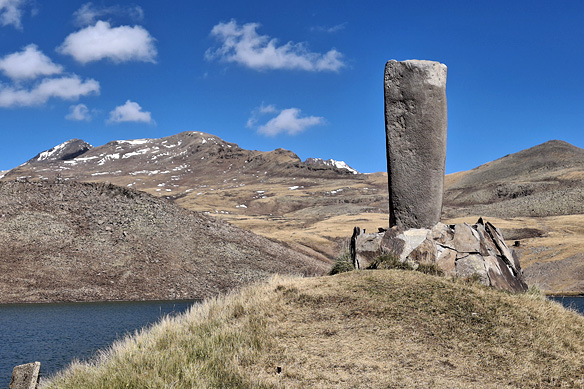
An ancient Vishapakar, the precursor to the khachkar, at Lake Kari on Mount Aragats.
These ranged from memorials to both the living and the dead, announcements of donations, and commemoration of events such as victory in a war or building of a church, to protection from nature’s wrath. The art form, made of local stone by Armenian craftsmen, peaked between the 12th and 14th Centuries, took a hit under the Mongol invasion, and revived in the 16th and 17th Centuries. They are still made in Yerevan’s workshops, using the same material, tools, and motifs from centuries ago.
The primary motif in the khachkars is a cross. However, it is a cross that is distinctively different from the typical Christian cross, standing atop a solar disc or rosette surrounded by grapes, pomegranates, leaves, and lace patterns.
When Christianity was being spread in Armenia, it was preaching to happy pagans who relished the bounty of their fertile lands which their multiple gods blessed. They saw no reason to convert to a religion associated with pain and suffering. To get around this, the cross was depicted as equally life-giving—a tree of life with its ends culminating in lush flora. More importantly, sans the agony of a martyred Jesus nailed to it. The cross, instead, became synonymous with rebirth, rejuvenation, and Christ’s resurrection.
However, the original iconography still managed to find its way into the khachkars, albeit only in around ten of the 50,000 or so existing cross-stones. These rare pieces, some still in their original settings, depict the prophet in his customary crucified avatar.
Next time you see a khachkar when travelling through Armenia or perchance amidst the Armenian diaspora or a world history museum, I hope you see them for what they are: markers of Armenia’s story as the first country in the world to adopt Christianity. ❤
– – –
[Note: I travelled solo and independently across Armenia for 12 days in September-October, 2025. To read more posts in my Armenia series, click here.]
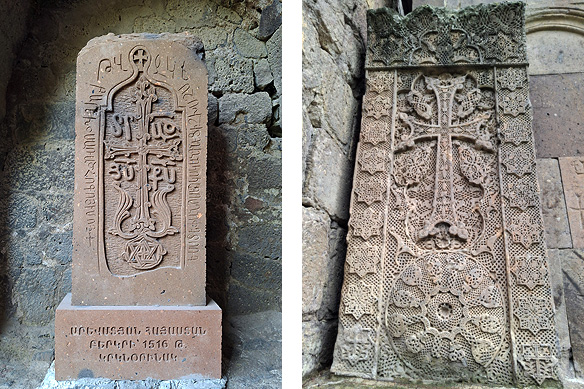
Each khachkar of the 50,000 still around in Armenia is unique. Left: Khachkar dated 1516 in St. Maria of Akhtala Monastery; Right: One of the finest khachkars in the country stands in Goshavank Monastery. It was carved in 1291.
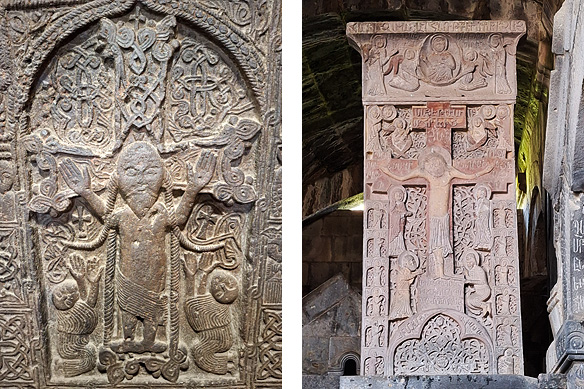
Khachkars with a crucified Christ are the exception, rather than the norm. Left: A rather unusual Christ with Mongolian features and braids is carved onto the khachkar in Sevanavank Monastery on the banks of Lake Sevan; Right: A more familiar Christ on the Holy Saviour khachkar dated 1273, Haghpat Monastery.
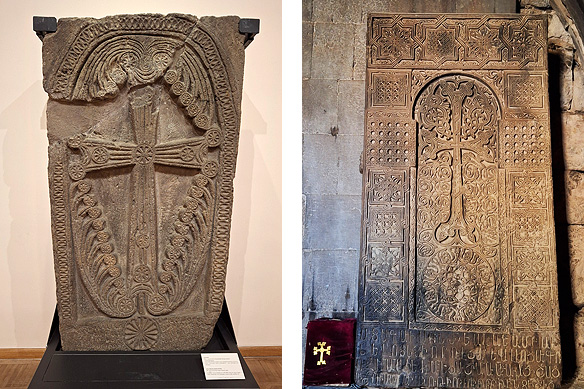
From museums to part of daily worship. Left: Khachkar of the Surb Astvatsatsin Church of Noratus dated 991 in Yerevan’s History Museum; Right: Khachkar in a chapel at the 13th Century Noravank Monastery.
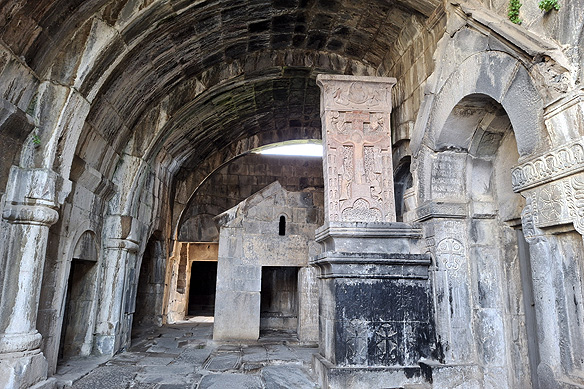
The 13th Century Holy Saviour khachkar still stands in its original setting in Haghpat Monastery.
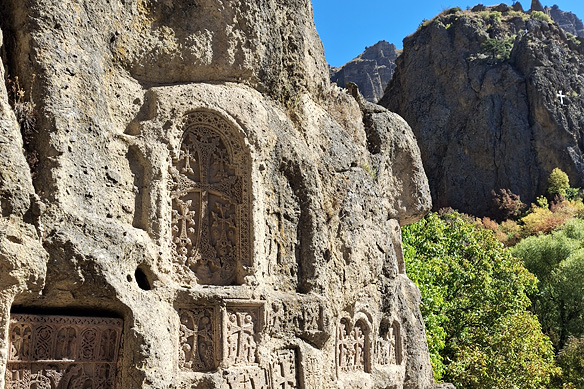
Some khachkars are built onto cliff faces and monastery walls to announce donations by patrons. Geghard Monastery has some of the most outstanding ‘wall’ mounted khachkars.
 rama toshi arya's blog
Amazing. I had no idea that Armenia was the first country to adopt Christianity. You certainly enjoy travelling off the beaten track. Do you join a group or travel solo?
LikeLiked by 2 people
I travel solo 95 percent of the time. It is easier. 😀 But I have done a few group tours too, such as to Iran and the nuclear test site in Kazakhstan. Glad you liked the post. Travel has to be the bestest classroom! I learn so much with every trip. 🙂
LikeLike
I love ancient carvings, and the khachkars are one of the main reasons why I’ve been dreaming of visiting Armenia for quite some time now. And after reading about its origins in this post, my appreciation towards the ancient people of Armenia only grows deeper.
LikeLiked by 1 person
Armenia is a fascinating country with a one-of-a-kind art, architecture, and heritage. All set in magnificent scenery. I hope you get to experience it all for yourself soon!
LikeLiked by 2 people
Khachkars are spectacular. During my trip to Armenia, I learned that there are several types, including those with a curved top.
LikeLiked by 3 people
And each piece unique! I saw so many, like I am sure you did, but one never gets bored of them. 🙂
LikeLiked by 1 person
The crosses are so beautiful and intricately carved with so many variations. I have photos of a couple at Etchmiadzin Cathedral near Yerevan, allegedly the oldest in the world. I was fortunate enough to attend the Sunday mass there with its very moving singing – something never to be forgotten.
LikeLiked by 1 person
Your travels are such an inspiration! If I get to see even half of what you have seen around our world, my life would have been well-lived.
LikeLiked by 1 person
You flatter me Rama. Your visits are so much more in depth than mine were. Thanks for keeping in touch. Your fabulous photos and illuminating commentary help me re-live my experiences. In a world full of horrors your posts reveal the beauties and wonders to be discovered.
LikeLiked by 1 person
Thank you for your kind words. 🙏
LikeLiked by 1 person