
“Armenia, aah she is a prisoner of geography!” My guide Arpi exclaims as she narrates the country’s tumultuous history in a voice that any actor would envy. A professor in linguists, guiding is her second job.
We are on the way to Gyumri, Armenia’s second largest city in the country’s north-west, close to Turkey’s border. Built of local black and orange tuff [a volcanic porous rock], the city is known by various other names: cultural capital, city of arts and crafts, to name a few. But the most evocative is “city of orphans.” 22,000 orphans took refuge in Gyumri during the Armenian Genocide of 1915 – 1923, piecing together a new life in 170 orphanages across the city.
Founded as Kumayri in the 8th Century by the Urartians—the same kingdom which also established Erebuni, Yerevan’s ancestor—it has been renamed numerous times since 1837. Alexandropol on the orders of Russian Tsar Nicholas I after his wife, Leninakan in honour of Lenin, back to Kumayri on independence, and Gyumri in 1992.
A bustling industrial hub during the Soviet era [1922 – 1990], it came crashing down, literally, on 7 December, 1988 in a 6.8 magnitude earthquake. Everything turned to dust, except for Nicholas I’s Alexandropol in the Kumayri historic district. The area is a rare remnant of low-rise Armenian urban architecture in its original setting.
Tell your travel plans to an Armenian, and the first question that pops out is “Are you going to Gyumri?” Not many non-Armenians go up this far north, and if you are doing so, you will be instantly rewarded with an appreciative nod—transforming you from a flighty tourist to a traveller with gravitas.
Though its outskirts are all brand new, because of the earthquake’s devastation, the city holds its memories close to its bosom. The pain and hesitant optimism of its thousands of orphans; the filmmakers, authors, and actors who call Gyumri home; and the craftsmen who churned out masterpieces, and continue to do so, from seemingly insipid raw material.
All these and more whisper out of the black and orange tuff intrinsic to Gyumri. Here are five of Gyumri’s most magical treasures. Do not be surprised if you bookmark a few more of your own should you visit it. ❤
1. Holy Saviour’s Church, Gyumri’s twin-steepled centrepiece


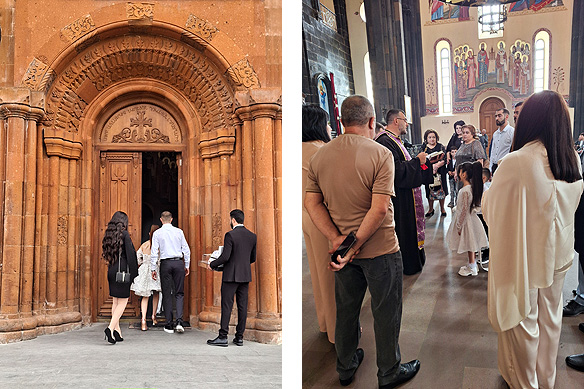
Gyumri’s most famous landmark is the 1873 Holy Saviour’s Church in the heart of the city, funded by donations from its residents. It is a beautiful concoction of Gyumri’s trademark black and orange tuff; the 36-metre-high design inspired by the [UNESCO-listed] early-11th Century Cathedral of Ani in Eastern Turkey.
Fresh from an extensive renovation, the interiors are even more breathtaking with golden-haloed Biblical figures and saints floating across creamy white walls. After being badly damaged in the 1988 earthquake, the current restored structure was re-consecrated in December 2024. Just in time for your visit!
2. Museum of National Architecture and Urban Life, a window to life in Alexandropol
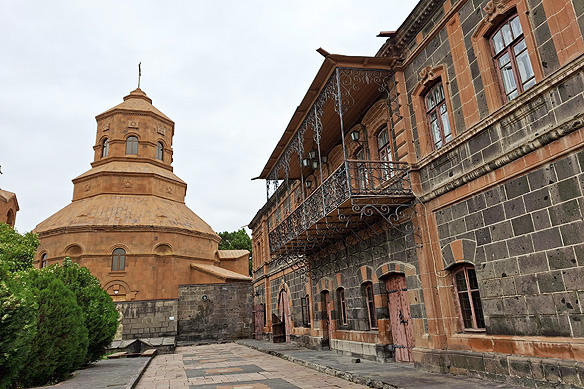
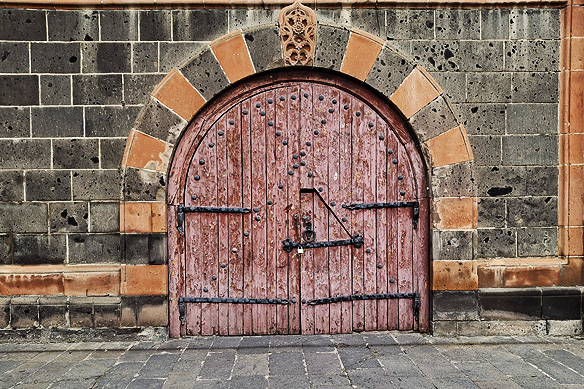
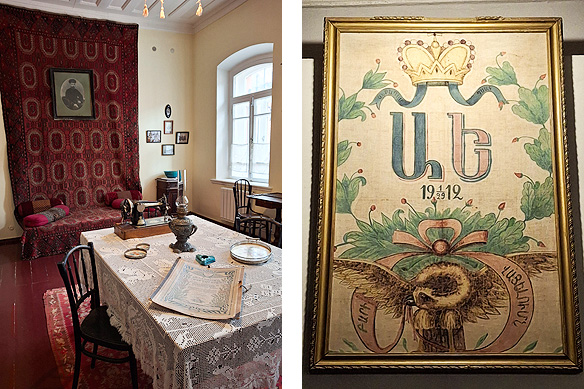
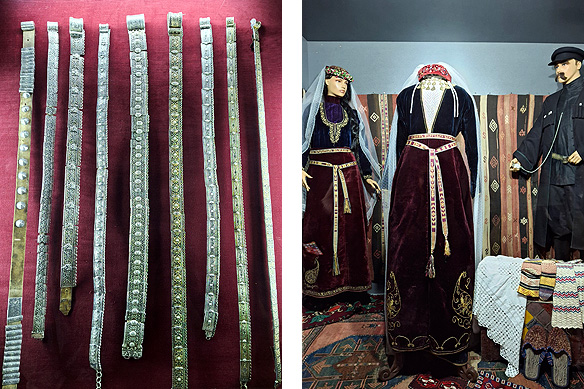
Housed in the 1872 residence of the Dzitoghtsyan family, the Museum of National Architecture and Urban Life offers a unique opportunity to time-travel back to urban life in “Alexandropol.”
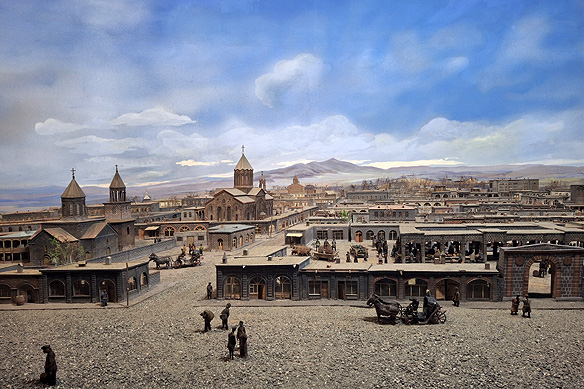
Inside the enormous mansion, which miraculously survived the 1988 earthquake, are the family’s living quarters replete with graduation photographs, a wedding invite, and even the local newspaper. These are propped with galleries devoted to Gyumri’s traditional arts and crafts. Look out for the family’s travelling stool, exquisite silver belts crafted by local silversmiths, and dioramas of 19th Century Gyumri. The latter a reassurance that Gyumri’s historical quarter has not changed much over the years.
3. Gyumri Fortress, Imperial Russia’s Black Fortress
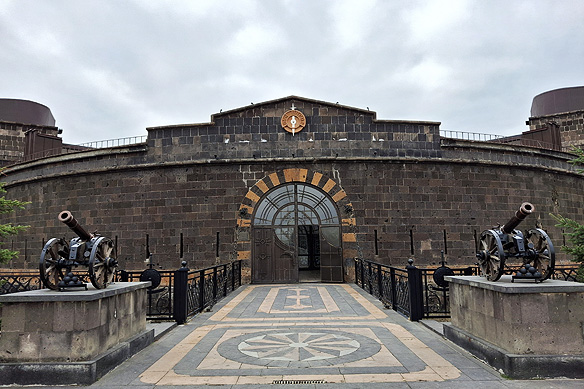
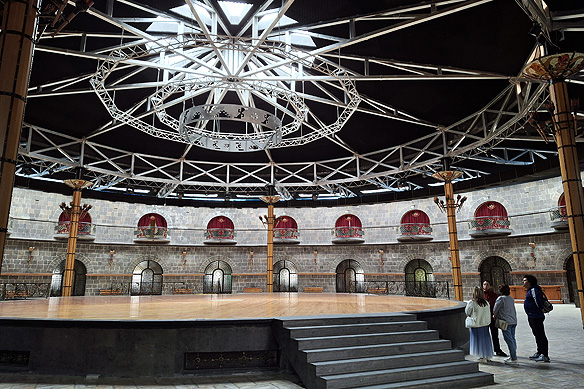

When Tsar Nicholas I refashioned the city as Alexandropol in 1837, one of its key new roles was to be a Russian military stronghold for the Russo-Turkish wars. Perched up a hill, in-between the city and the adjacent border, the circular Black Fortress has seen many a victory over the neighbouring Turks.
Fast forward a couple of centuries, and the Fortress is now planned to take on the mantle of a hotel-cum-entertainment complex. At the bottom of the hill is the mandatory Soviet Great Patriotic War Monument [celebrating USSR’s victory over Germany in WWII] with Gyumri’s Mother Armenia towering above it.
4. Cathedral of the Holy Mother of God, the unusual church
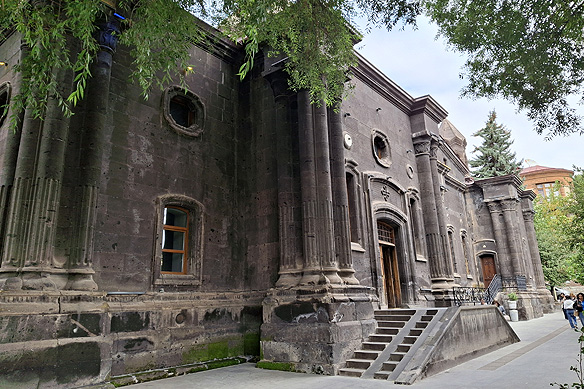
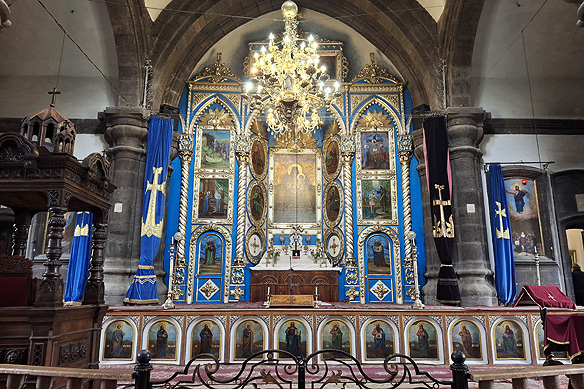
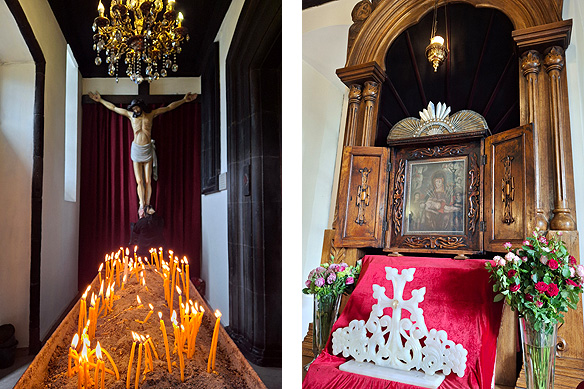
Yes, there is another church in this list! 🙂 The Cathedral of the Holy Mother of God aka Seven Wounds Church in Vardanants Square, right opposite Holy Saviour’s Church, is unique on multiple counts.
Firstly, completed in 1884, only two of its domes were damaged during the 1988 earthquake. The rest of the building survived largely unscathed. Secondly, it is the only Armenian church with an iconostasis typical of Russian Orthodox churches courtesy Gyumri’s association with Imperial Russia. Thirdly, it is the sole church with five altars dedicated to different denominations including Armenian Apostolic, Eastern Orthodox, Roman Catholic, and Assyrian. Oh, and the most unusual of all is its icon—a pieta-styled composition of the Virgin Mary holding a wounded Christ pierced by seven arrows. Seven wounds. The Armenian Apostolic Church does not worship icons. This is the only icon it does.
5. Kumayri Historic District, and its many stories
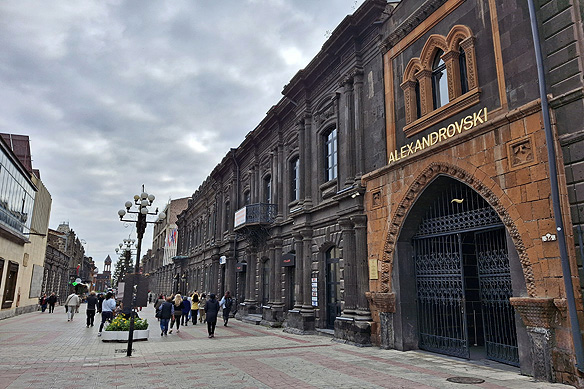

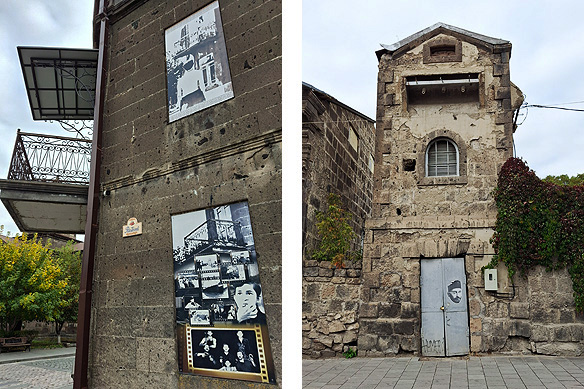

This one is for the heritage walkers. Whilst the earthquake of 1988 was ripping apart Gyumri, its historical centre with some 1,600 buildings managed to stand strong, albeit with a chip and a crack here and there. Reason? Its low rises and the porous flexible material—two intrinsic features of Armenian urban architecture.
The area today is a time capsule of Imperial Alexandropol and Soviet Leninakan. Historic churches, 19th Century mansions of wealthy families, and house museums of actors, artists and poets made it a coveted location for many a Soviet and Armenian film. Cobbled courtyards and public spaces peppered with statues of medieval kings and famous Armenians, such as the American billionaire Kirk Kerkorian who shaped Las Vegas into the world’s entertainment capital and donated USD 1 billion for Armenia’s post-earthquake restoration, make the district a favourite with travellers.
– – –
I hope you enjoyed this post and it has inspired you to visit this off-the-beaten-path city in an off-the-beaten-path country. To read more posts in my Armenia series, please click here. Wishing you happy travels, always.
[Note: I travelled solo and independently across Armenia for 12 days in September-October, 2025.]


Excellent travelogue! Beautifully narrated 🙂 How do you connect to the local female guides on your solo travels? Is there any particular app/website you trust?
LikeLiked by 1 person
Thank you, Yogini. 🙏 It is a slightly long process, and I have had both male and female guides. I first read up about a place, then check out what’s available on viator and getyourguide. Read reviews on these platforms plus on Google. If mentioned, I get in touch with the company or guide directly. See what more tour options exist and then zero in on the ones I want to do. 🙂 Rarely have I been disappointed. Hope this helps. 😄
LikeLiked by 2 people
Hi Rama, thanks a bunch for replying and sharing this with me. Have never used getyourguide, maybe I’ll try it sometime. So yes, that was super helpful 🙂 thanks again! 🙂
LikeLiked by 1 person
You welcome. 🙂
LikeLike
Superb photos and information!
LikeLiked by 1 person
Thank you! Glad you liked it. 🙂
LikeLiked by 1 person
I didn’t have time to visit Gyumri during my trip to Armenia, but judging by these photos, there are many worthwhile things to see. Some peoples are more unfortunate than others, indeed it is certainly difficult to talk about Armenians without thinking about the tragedies they have endured over the last few centuries.
LikeLiked by 1 person
True, the Armenians have had more than their share of troubles. But, what is also inspiring is how the diaspora managed to rise above their misfortunes and succeed in their new homes. And at the same time maintain a connection with their motherland and cultural identity.
LikeLiked by 1 person
We spent a few days in Gyumri. It was our favourite Armenian city. Thanks for taking me back. Maggje
LikeLiked by 3 people
Completely get it — Gyumri is super charming. 🙂 Glad you enjoyed the post. 🙏
LikeLiked by 1 person