Riyadh, the Kingdom of Saudi Arabia’s capital in the middle of the Najd desert is a city of contrasts. Mud-brick fortresses from the ruling family’s yesteryears, and steel and glass skyscrapers reaching for the sky jostle next to each other in seamless ease. It is a city where the country’s past, present, and future have agreed to coexist.
If perchance you find yourself in Riyadh, here is how to make the most of 72 hours in it. Taking in the obvious, and some lesser-known gems.
But first, a little crash-course on the country’s modern political history to put things in context:
– The Kingdom of Saudi Arabia is the only country in the world named after its ruling family. ‘Saudi’ is derived from the the ‘House of Saud,’ who are originally from Diriyah next to Riyadh.
– 1744: The House of Saud establishes its rule over the Arabian peninsula. It also forges a political alliance with the spiritual leader of Wahhabism, a fundamentalist Islamic sect. This rule comprises three periods, known as the three ‘Saudi States,’ punctuated with two short-lived intervals when rival factions [first the Ottomans and then the Rashidi dynasty] took over Riyadh.
– 1744 to 1818: First Saudi State aka Emirate of Diriyah; 1824 to 1891: Second Saudi State aka Emirate of Najd; 1902 to date: Third Saudi State. Each of these States is associated with a specific fortress in Riyadh which served as its political and administrative seat.
– 1932: Third Saudi State is officially proclaimed the Kingdom of Saudi Arabia.
– 1938: One of the world’s largest oil reserves is discovered near the Persian Gulf. The West become the Kingdom’s allies. Why? Oil is necessary for weapons, military, and the economy.
– 2022: Crown Prince Mohammed bin Salman Al Saud aged 37, a liberal pro-west visionary, becomes the country’s Prime Minister. He dismantles Wahhabism from the country’s fabric.
Welcome to Riyadh, a capital city that’s also a key player in global geopolitics. 🙂
DAY 1: MORNING: LEARN ABOUT SAUDI ARABIA’S HERITAGE AT THE NATIONAL MUSEUM AND KING ABDULAZIZ MEMORIAL HALL
A national museum is always a good place to kickstart a city’s exploration, and Riyadh is no different. Especially when the museum has an enviable collection of 4,000 historical objects and a state-of-the-art audio-visual narrative. Don’t miss the 2.7-ton iron meteorite which dropped into the Empty Quarter 400 years ago, a fossilized middle finger bone dated 85,000 BC from Tabuk, and ancient petroglyphs from Najran and AlUla. The star attractions are the Islamic halls which trace the development of Islam and the life of the Prophet, filled with medieval artefacts and copies of the Quran.
Travel tips: Open from 9 am to 7 pm with extended hours till 10 pm on Thursday. The museum is closed on Sunday. Entry is free.
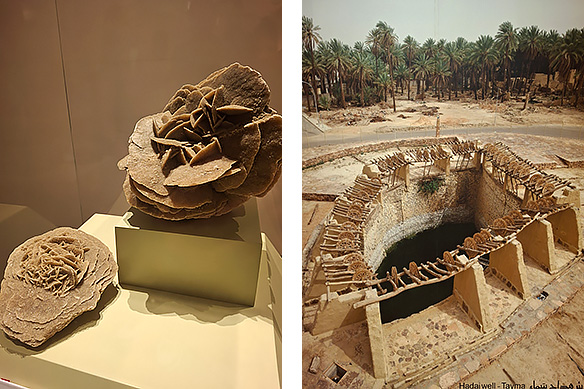
Left: Desert rose, crystal clusters indigenous to the Arabian peninsula and inspiration for Qatar’s National Museum; Right: Traditional well in Tabuk region.
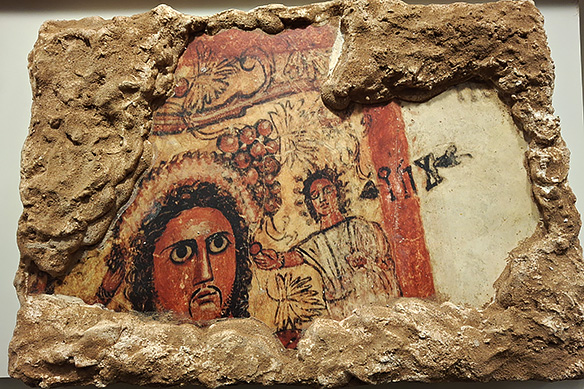
Riyadh during Roman times. A mural blends Arab faces and Roman traditions, 2nd to 3rd Century AD, Qaryat Al-Faw.
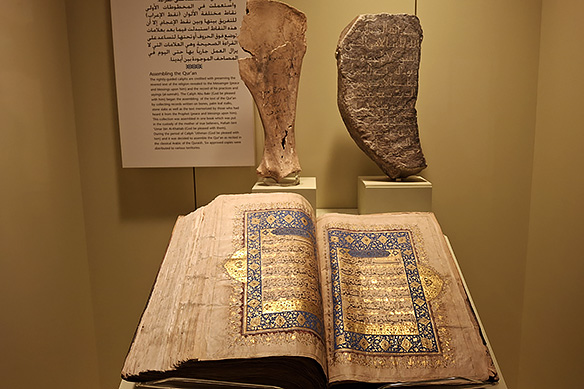
Assembling the Quran: Naskh inscription in ink on camel bone and Verse of the Throne engraved on basalt stone [both 9th Century AD] with a 16th Century manuscript of the Holy Quran.
Right across the museum is the King Abdulaziz Memorial Hall. It is dedicated to King Abdulaziz, grandfather of Mohammed bin Salman, and founder of the Third Saudi State in 1902 and Kingdom of Saudi Arabia in 1932. On display are his personal belongings, historical photographs, and royal car collection marked with the House of Saud crest. The collection includes a green Rolls Royce gifted to the king by former British Prime Minister Winston Churchill in 1946. Entry to the Memorial Hall is free.
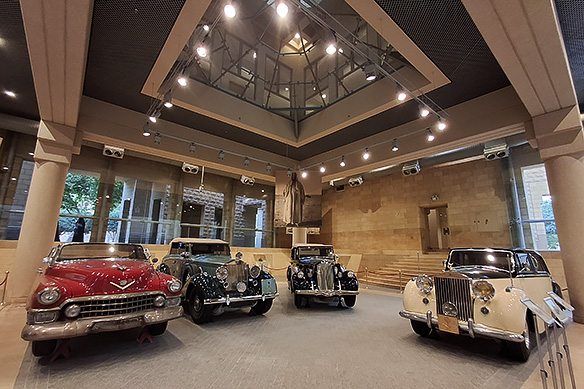
Royal car collection belonging to King Abdulaziz.
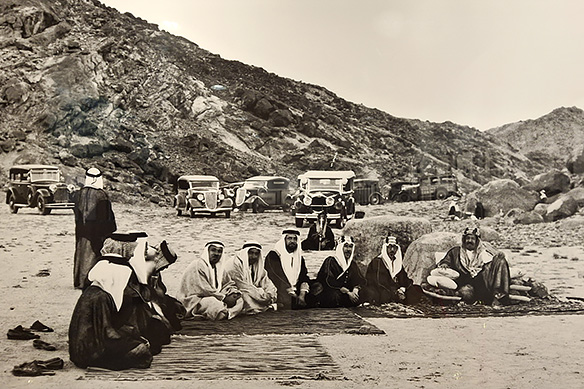
King Abdulaziz [extreme right] with Mardam Bey and the Syrian delegation sitting outside near Taif, 1934.
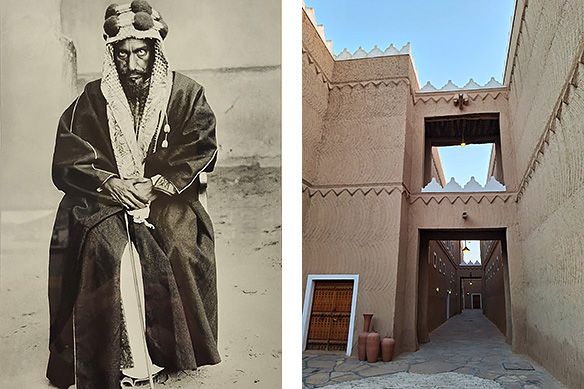
Left: Imam Abdulrahman ibn Faisal, the father of King Abdulaziz in 1902. This is the first known photograph of a member of the Al Saud family. Right: Al Murabba Historical Palace, home and office of King Abdulaziz.
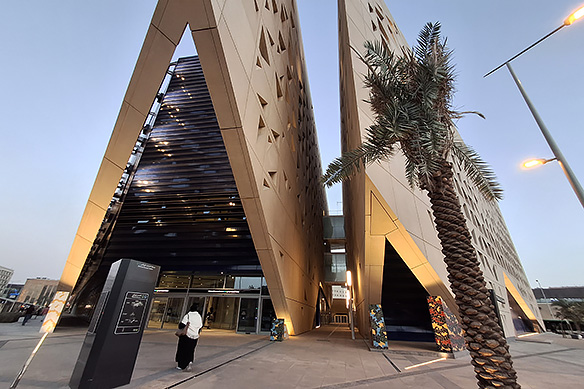
National Museum Metro Station.
DAY 1: LUNCH AT OPERATION: FALAFEL
By now you will most likely be feeling peckish. Dubai-born Operation: Falafel serves middle-eastern street food in a casual dining setting. The bonus? The impeccable superfast service.
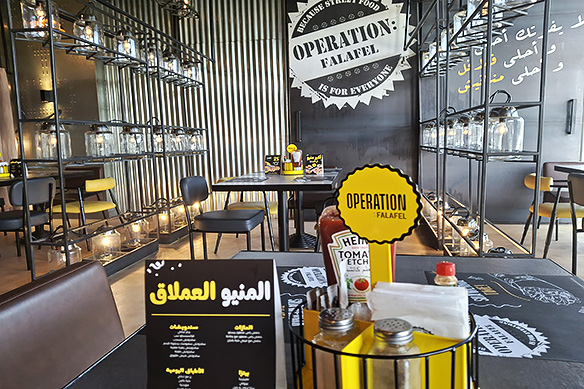
DAY 1: AFTERNOON: TOUR DIRIYAH, BIRTHPLACE OF THE KINGDOM OF SAUDI ARABIA
This is where Modern Saudi Arabia took birth. Diriyah, the ancestral home of the country’s ruling family since the 15th Century, was the first capital of the Al Saud dynasty. Imam Mohammed bin Saud, the forefather of Saudi Arabia’s current King, and Muhammad ibn Abd Al-Wahhab, architect of Wahhabism, signed their historical pact here in 1744.
A UNESCO-listed site, the mud-brick Najdi buildings of At-Turaif in Diriyah served as the First Saudi State’s political, administrative, and spiritual heart. In 1818 the city was destroyed during the Ottoman-Wahhabi War. The House of Saud’s story is brought alive through multiple galleries which weave their way through the ruins.
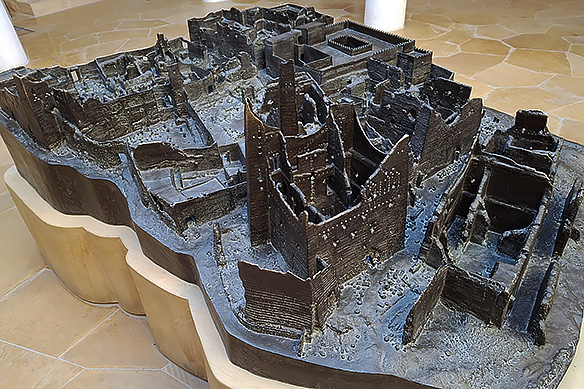
Model of UNESCO-listed At-Turaif in Diriyah, the first capital of the Al Saud dynasty.
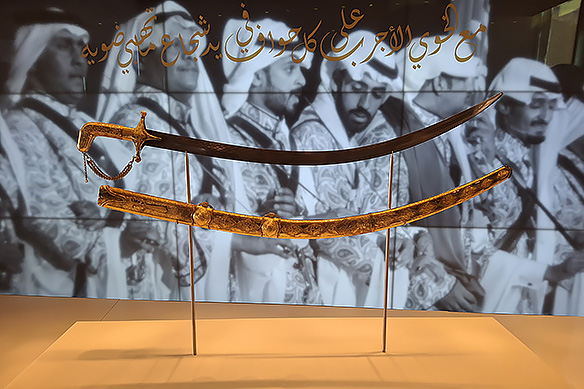
Al-Ajrab [The Rusty] Sword belonged to Imam Turki bin Abdullah, founder of the Second Saudi State [1824 to 1891]. Behind it is a scene from the famed Al-Ardah, the Saudi traditional sword dance.
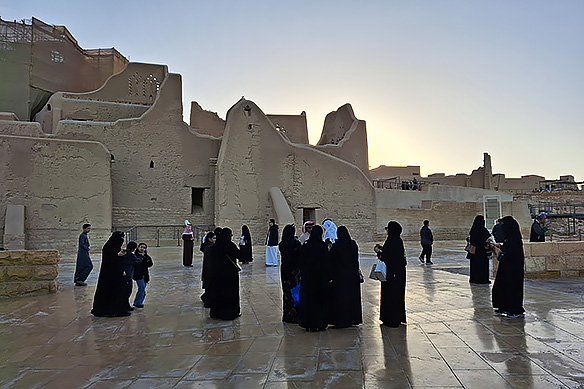
Diriyah is popular with locals and tourists alike, and includes fine dining, walking trails, and a series of museum galleries.
DAY 1: EVENING: ZOOM UP TO KINGDOM CENTRE’S SKY BRIDGE FOR STUNNING BIRD’S-EYE VIEWS OF NIGHTTIME MODERN RIYADH
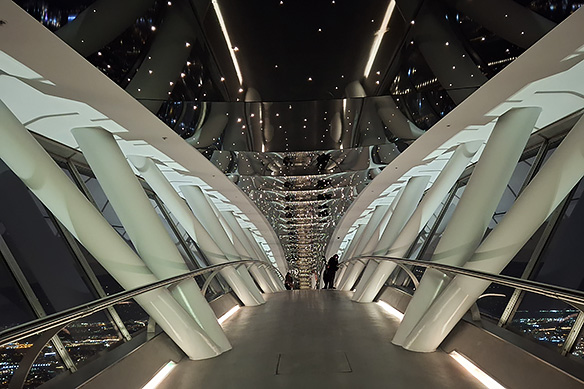
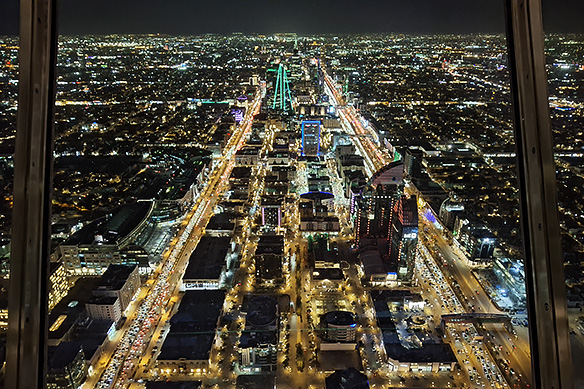
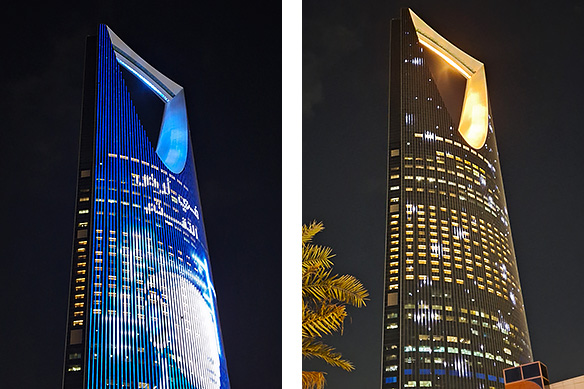
For the perfect wrap, make your way to Riyadh’s most iconic landmark: the 65-metre-long steel Sky Bridge perched on the 99th floor of Kingdom Centre [formerly Kingdom Tower]. From 300 metres up in the air, far above the city’s notorious traffic, Riyadh looks like an oasis of calm. And at night, a Christmasy calm. Designed by Ellerbe Becket and winner of the International Design and Development Award in 2003, it houses the second-highest mosque in the world on its 77th floor.
DAY 2: SUNSET AT THE EDGE OF THE WORLD
No visit to Riyadh, sorry the Kingdom of Saudi Arabia, is complete without a hike at the Edge of the World. The views from the 1,131 metres elevation are worth the 2-hour largely offroad drive to the Tuwaiq Escarpment which overlooks a prehistoric ocean-bed. Locals call the geological wonder Jebel Fihrayn. Sans any road-markers, cliff railings or internet, it is advisable one visits with a local guide. To make it for sunset, most tours start at 2 pm from a specified meeting point in Riyadh, and return by 8.30 – 9.00 pm. Let the pictures do the rest of the talking.
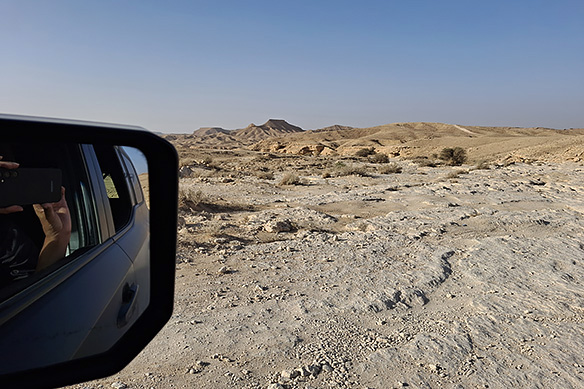
On the way to the Edge of the World in the Tuwaiq Mountains, 120 kilometres from Riyadh. Part of the journey is offroad.
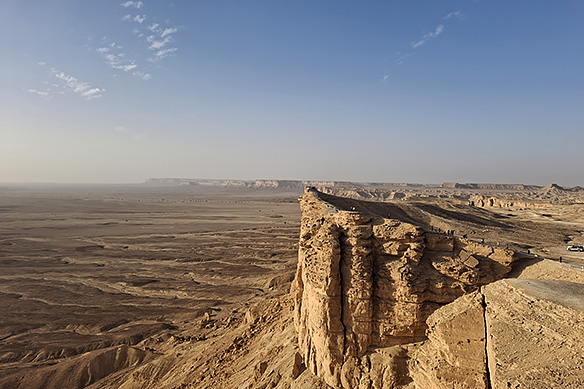
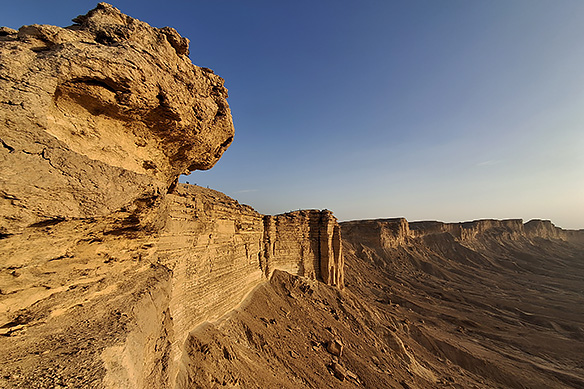
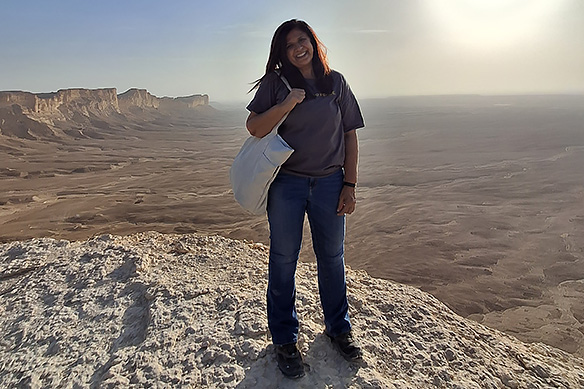
Picture toh banta hai. 🙂
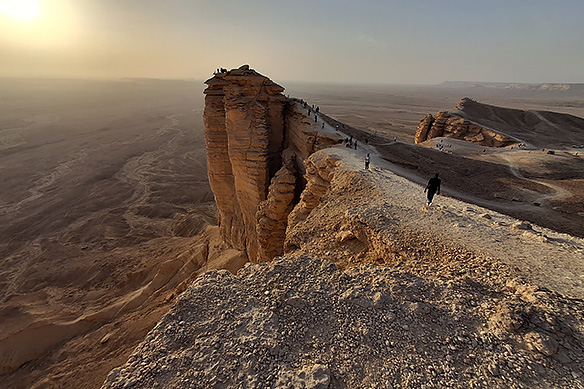
This is one of the reasons we travel. Don’t you agree?
DAY 3: MORNING: EXPLORE RIYADH’S LESSER VISITED TREASURES—A TOWER, MUSEUM, AND LIBRARY
This morning is about peeling away the layers of Riyadh and getting up close with some of its most interesting, and often overlooked, sites.
Before Kingdom Centre’s Sky Bridge became Riyadh’s prime observation deck in 2003, it was the 267-metre-high Al Faisaliah Tower’s 360-degree open-air platform that reigned supreme. The country’s tallest building from 2000 to 2002 and very first skyscraper, the pyramid-shaped mixed-use structure designed by Foster + Partners is named after King Faisal bin Abdulaziz. True to its architects’ reputation for innovative design, the tower, in this case, is punctuated with a massive mirrored globe which houses a fine dining restaurant, named, you guessed right: ‘The Globe.’
Travel tips: The entry ticket from reception gives access to the viewing platform and a coffee. These tickets, often available with discounts, can also be bought online here.
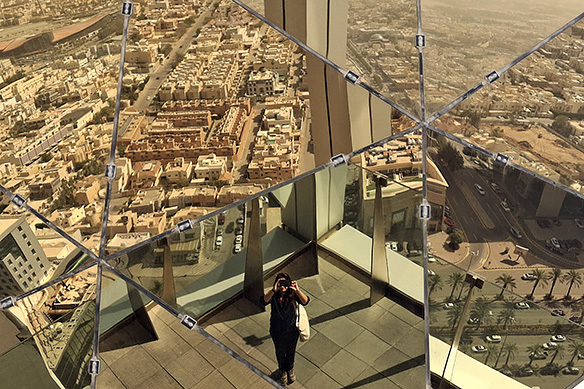
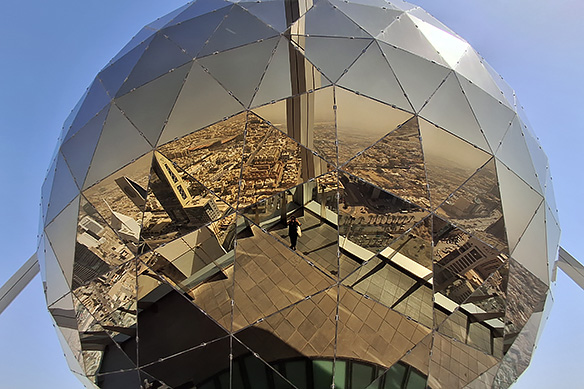
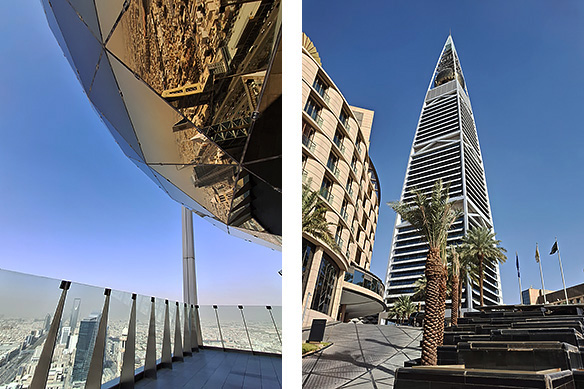
Al Faisaliah Tower: Up close. From above. From ground level.
A short walk from Al Faisaliah Tower, within the same complex, is the fabulous Al-Faisal Museum for Arab-Islamic Art. An absolute gem. Compact and recently renovated, the museum has 28,500 Islamic manuscripts in its collection of which 36 rare masterpieces are on display in a beautifully curated exhibition upstairs. The ground floor, meanwhile, displays 92 items under the theme ‘Narrative of Arab-Islamic Civilization’ with exhibits from across the world.
Travel tips: Open Saturday to Thursday, 9 am to 9 pm. Entry is free.
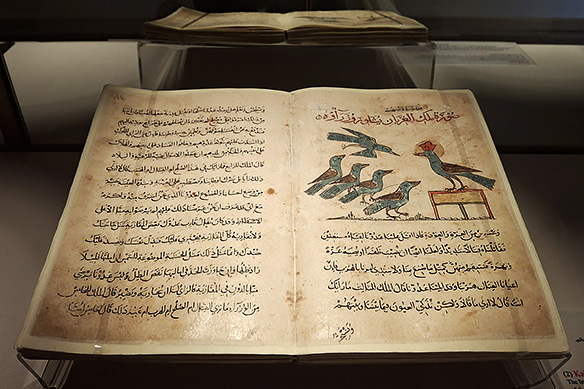
The second oldest Arabic copy in the world [14th Century] of the Persian translation of the Panchatantra, an ancient Indian book of fables narrated by animals. The book was translated into Arabic in 750 AD wherein it took on the name ‘Kalilah wa Dimnah.’
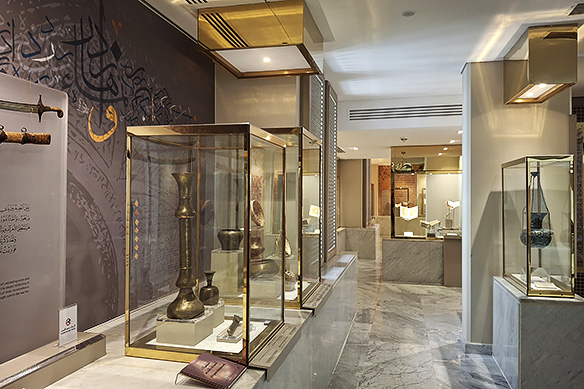
‘Narrative of Arab-Islamic Civilization’ section with exhibits from across the Islamic world.
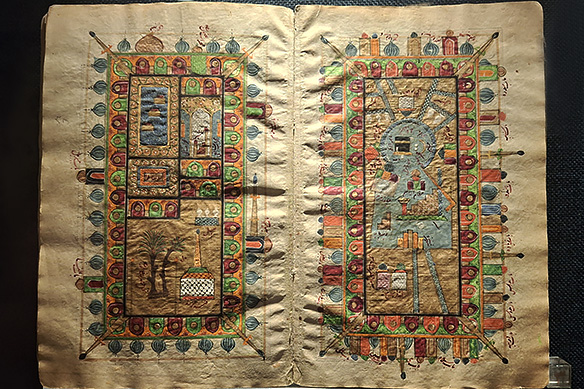
Indian copy of a square-format manuscript dated 1903 with an illustration of the Holy Kaaba [right page] and the Noble Rawda inside the Prophet’s Mosque in Medina [left page].
After having had your fill of the museum’s collection, walk over to King Fahad National Library [KFNL]. You may well ask, what’s a library doing in this itinerary. Well, because this is no ordinary library, neither in its architecture nor in its interiors.
Established in 1990 on the request of Riyadh’s citizens, KFNL is the country’s legal deposit and copyright library with 2.4 million items. In 2013 the whole building was encased in a glass cube and filigree steel cable construction designed by Frankfurt-headquartered engineering firm Bollinger+Grohmann. The purpose was to protect the edifice from direct sunlight and allow only 7 percent of solar transmission to pass through. Helps in a country where temperatures reach 50 degrees Celsius. Inside, are a handful of mini-galleries surrounded by vast peaceful spaces for study.
Travel tips: 1) Entry is free, but requires registration at the reception desk. 2) There’s a little cafe serving coffee and sandwiches on the top floor.
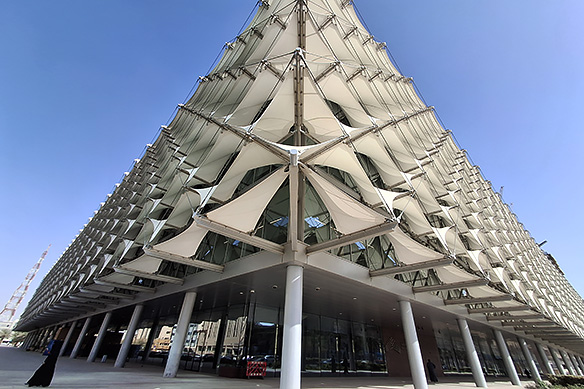
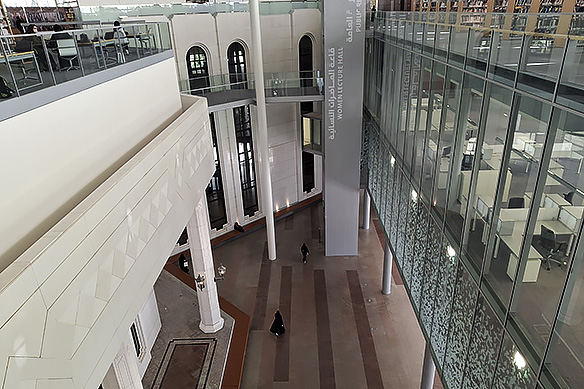
Sustainability and clean energy in practice at the King Fahad National Library.
DAY 3: AFTERNOON: VISIT MASMAK FORTRESS, SITE OF A LANDMARK VICTORY THAT CREATED THE THIRD SAUDI STATE
End your Riyadh explorations with a visit to Masmak Fortress.
And a flashback to 1891. The Al Saud dynasty had been ousted; the capital Riyadh captured by their rivals—the Rashidi dynasty. The last Emir, Abdulrahman, and his family first went into hiding amongst the Bedouin tribes of the south and then on to Kuwait where he shifted his focus to religion.
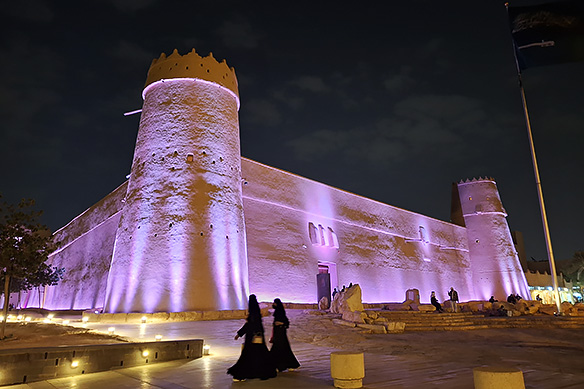
That may well have been the end of the House of Saud’s rule over the Arabian peninsula if it had not been for one man and his determination to regain his family’s territories. In 1902, Abdulrahman’s son Abdulaziz, together with 40 men, climbed over Masmak Fortress’ walls using bent palm trees. A battle ensued between both sides. Abdulaziz won, and the new Saudi State was announced on the ramparts.
Today, a museum inside the fortress recounts this period and landmark event. In the evening, the adjacent Deera Square aka Chop Chop Square, which once used to be the site for public executions, is bathed in golden lights, sparkling fountains, and lively outdoor cafes.
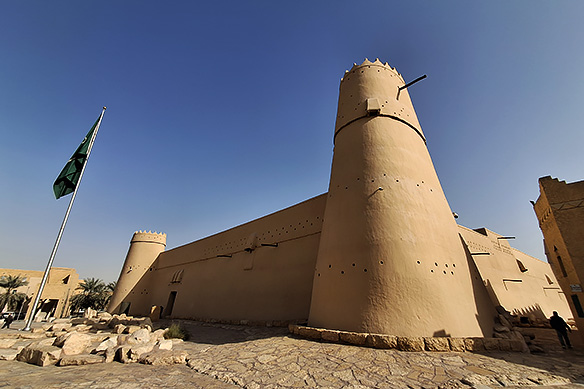
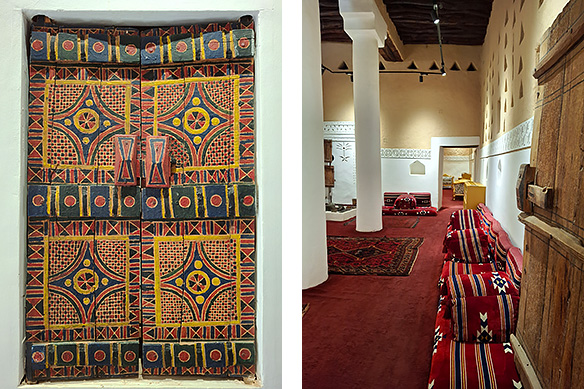
Started by the Al Saud dynasty, completed by the Rashidi dynasty, and won back by Al Saud King Abdulaziz. Masmak Fortress is a museum now, with free entry.
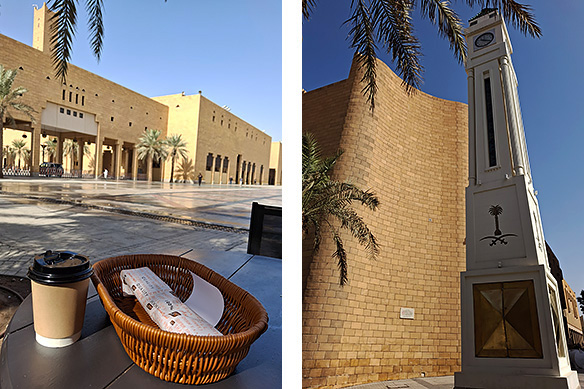
Chop Chop Square, lined with cafes and a clock tower …
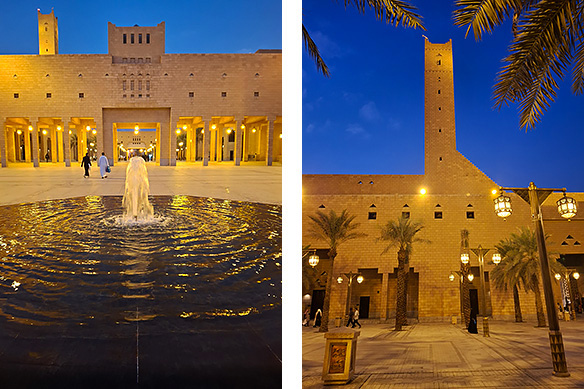
… comes alive once the sun sets. Right: Minaret of the Imam Turki bin Abdullah Grand Mosque, built by the founder of the Second Saudi State.
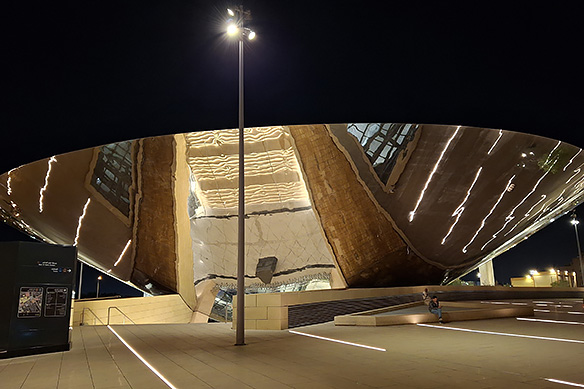
Closest metro station: Qasr Al Hokm.
– – –
Inspired to spend 72 hours in Riyadh? Wishing you travels to places off the beaten path where the past, present, and future coexist. ❤️
Travel tips:
- Staying in Riyadh: I stayed at the SamtInn Hotel on King Fahd Road. It’s close to the metro station and mall.
- Getting around: The Riyadh metro is fabulous. There’s no need to buy a ticket or pass. Just tap your debit/ credit card when entering and exiting the flap barriers, and the amount of the ride will be charged to your card. It is slightly over a dollar per ride.
- Riyadh city guide: I had Dr. Thamer of EchoRabia for day 1, +966 50 524 7564. A mine of knowledge with a great sense of humour.
- Edge of the World: I did a sunset tour with Hike KSA.
- Day 3’s sites I explored on my own.
[Note: I travelled through Saudi Arabia for 17 days in January-February this year. To read more posts in my Saudi Arabia series, click here.]


Riyadh seems to have quite a few interesting things to see, unlike what I had in mind of the Saudi Arabian capital all these years. I will definitely go back to this blog post if I ever get the chance to visit this city.
LikeLiked by 1 person
Thank you, Bama. Glad you found the post useful. I liked Riyadh. It is very easy to navigate and there is enough to make it worth exploring: incredible nature nearby, rich heritage, and modernity. I liked the whole of Saudia Arabia to be honest. It is a very welcoming nation. 🙂
LikeLiked by 1 person
Interesting well shared
LikeLiked by 1 person
Thank you, Priti. Glad you liked it. 🙂
LikeLiked by 1 person
🙏🏼
LikeLike
Lots of cool things to see and do here! Great write up as always!
LikeLiked by 1 person
Thank you, Anna, for your kind words. Appreciated. 🙏 Yes, lots on the Riyadh spread. 🙂
LikeLiked by 1 person
Pingback: travel diaries: one traveller, mount shada, and happiness | rama toshi arya's blog