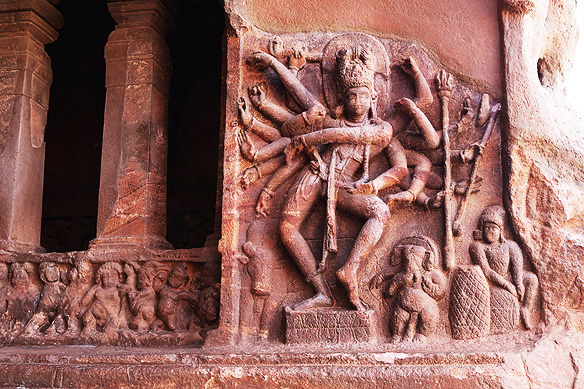
One of Badami Cave Temples’ most impressive sculptures: Shiva as the 18-armed Nataraja doing the Tandava Nritya—the cosmic dance of creation, preservation, and destruction.
One is never far from the gods in India. They are everywhere. Carved out of living rock. Carved into living rock. As far back as even 578 CE.
It is just after lunchtime, and I am at the foot of a gigantic red sandstone escarpment. Hundreds of school-children are racing down the steep uneven steps hewn into the cliff’s face. Their teachers shout behind them to slow down. Not that their wards pay any attention to the ominous warnings. Dressed in shiny tracksuits, they run in and out of the cavernous halls, doubled over in unstoppable giggles.
Slicing their way through this human avalanche are staid family groups. Their elderly matriarchs stomping ahead, undeterred by limps or wobbly canes.
“Aaj bahut bheed hai [It is very crowded today],” I observe to the security guard at the gate. “Roz aisa hai. Season hai na aaj kal [It is like this every day. It is the season nowadays],” he smiles back happily.
In a few months these cliffs will be deserted again, first under the scorching summer sun and then because of the monsoons which would make the stone steps a veritable death trap.
Yet such ominous weathers rarely affected pilgrims in the distant past. 1,400 years ago.
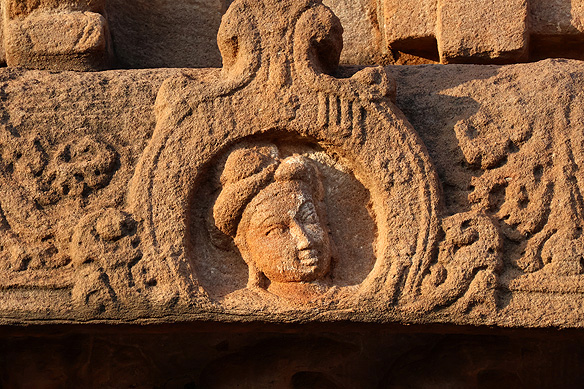
Portrait of a man in Ancient India. Ancient Hindu temples, by virtue of their depiction of both the sacred and secular, offer a fascinating insight into the then prevailing norms and societies.
Carved into the facade of a red sandstone monolithic expanse in a remote village in north Karnataka are the Badami Cave Temples, one of Ancient India’s most incredible jewels. Badami, because the mounts are badaam [almond] coloured.
Comprising of one Jain and three Hindu rock-cut cave temples, the site, listed on UNESCO’s World Heritage Tentative List, dates back to the 6th Century. Back then, Badami, known as Vatapi, was the capital of the Early Chalukya Kings who ruled from the 6th to 8th Centuries. They sponsored these temples, scalloped out of the rock and generously decorated with life-sized stone effigies of gods, their avatars, and scenes from mythology. There are no joints inside. No loose pieces. Each cave, one continuous whole which in its original format would have been painted in vibrant mineral pigments. I look closely and can see traces of ochre and some cerulean blue still on the ceiling.
Every now and then the crowds recede, and I am left alone to drift back in time, and all the centuries in-between.
If cave 1, the closest to the ground, charms me with its 18-armed Shiva as Nataraja, cave 2’s effigies of Vishnu as Trivikrama and Varaha inspire me to clamber further up. I am not disappointed. Cave 3, the largest of the four is magnificent with colossal figures of Vishnu and his many avatars, replete with an inscription dating the cave to 578 CE and its patron King Mangalesha. Climbing over a stepped ridge brings me to the empty Jain temple embellished with Mahavira, Bahubali, Parshvanatha, and multiple Tirthankaras.
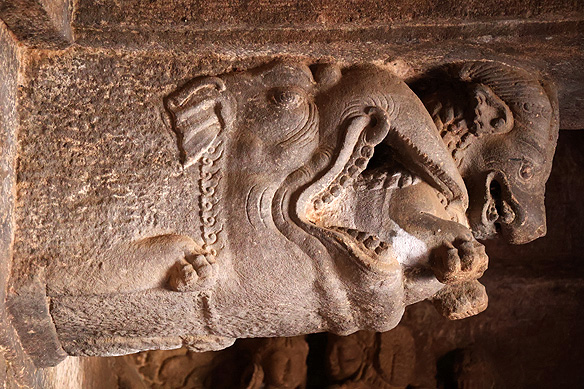
Bracket in Cave 1. The cave was excavated around 550 CE and dedicated to Shiva.
![Shaiva-Dvarapala with a trishul [trident] on the left extension of Cave 1's porch entrance.](https://ramaarya.blog/wp-content/uploads/2025/12/badami-cave-1-3.jpg)
Shaiva-Dvarapala with a trishul [trident] on the left extension of Cave 1’s porch entrance.
![Sculptural relief in Cave 2 narrates the story of Vishnu's 5th avatar, Vamana, in which he transforms into the towering Trivikrama to defeat the evil King Mahabali. The ceiling is decorated with a Matsya Chakra [Fish Wheel] and Swastika patterns.](https://ramaarya.blog/wp-content/uploads/2025/12/badami-cave-2-1.jpg)
Sculptural relief in Cave 2 narrates the story of Vishnu’s 5th avatar, Vamana, in which he transforms into the towering Trivikrama to defeat the evil King Mahabali. The ceiling is decorated with a Matsya Chakra [Fish Wheel] and Swastika patterns.
![Matsya Chakra [Fish Wheel] on the ceiling of Cave 2's veranda, also known as Mukhamantapa.](https://ramaarya.blog/wp-content/uploads/2025/12/badami-cave-2-2.jpg)
Matsya Chakra [Fish Wheel] on the ceiling of Cave 2’s veranda, also known as Mukhamantapa.
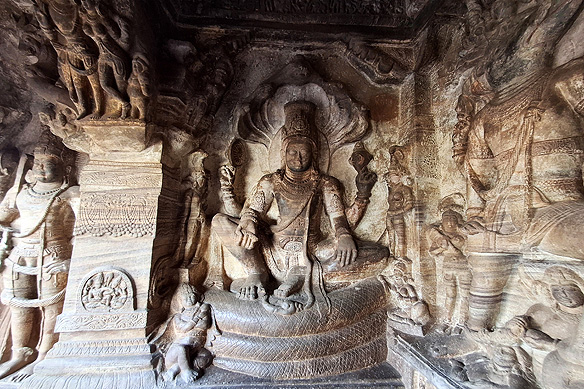
An inscription dates Cave 3, dedicated to Maha Vishnu, to 578 CE. Maha Vishnu is seen seated here on a seven-headed mythical serpent, flanked by an eight-armed Vishnu and Varaha, Vishnu’s 3rd avatar.
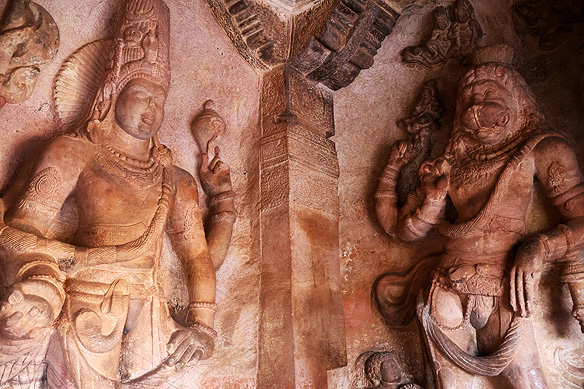
Harihara, a unified form of the gods Vishnu and Shiva, with the lion-headed Narasimha, Vishnu’s 4th avatar, in Cave 3.
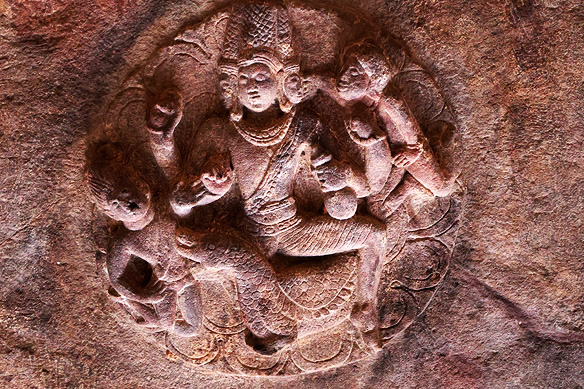
Bas relief of Brahma, the Creator, on the ceiling of Cave 3’s Sabhamantapa or Congregation Hall.
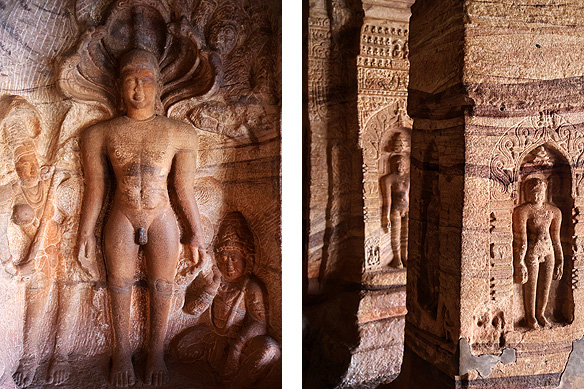
Unlike the first three caves, Cave 4 is a Jain rock-cut cave temple. Left: Parshvanatha, the 23rd Tirthankara is identified by the five-headed snake above his head.
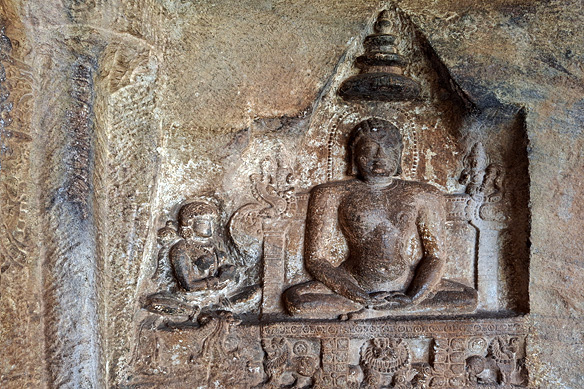
Mahavira with the nun Jakkave who attained moksha, Cave 4.
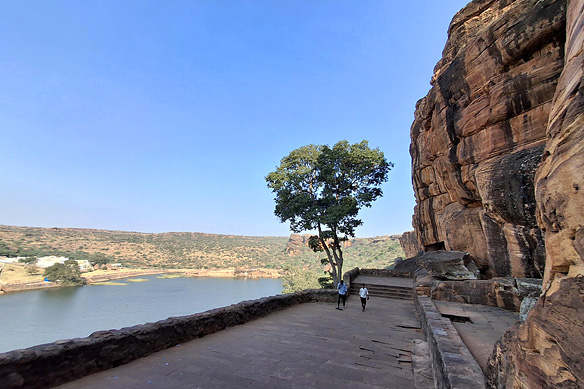
In the forecourt of Cave 4. To the left, down below, is the sacred 7th Century lake Agastya Teerth.
I make myself comfortable on a weathered low wall, surrounded by a palpable sense of eternity. My reverie is broken by a giggle. Would I take a picture of him, a little boy asks me pointing towards my camera. How can I say No.
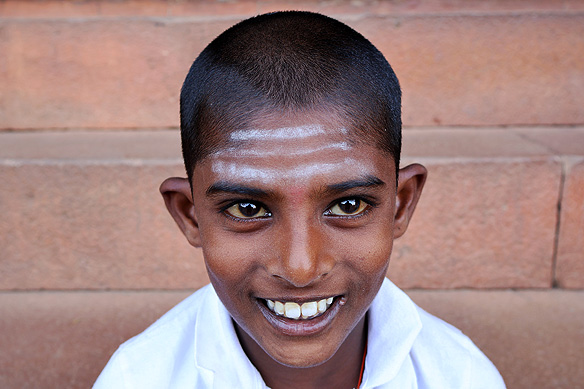
He wanted a serious portrait. I wanted him to smile. 🙂
It is late afternoon by now, and I wind my way down, albeit reluctantly, to the Museum and on to the Bhoothnath Shiva Temples through Badami village, past an 18th Century Bijapur Sultanate Tomb. The azan calls the Muslim faithful to prayer whilst their Hindu neighbours carry on with their chores.
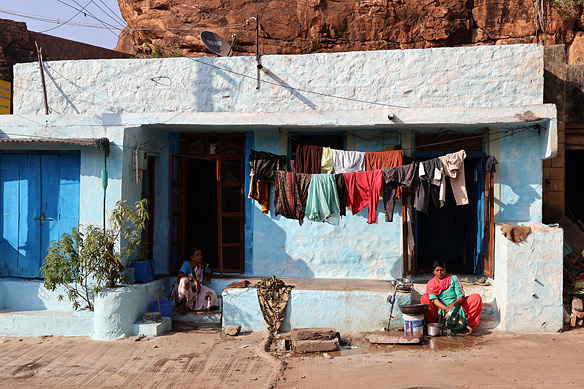
Passing through Badami village, on my way to the Museum.
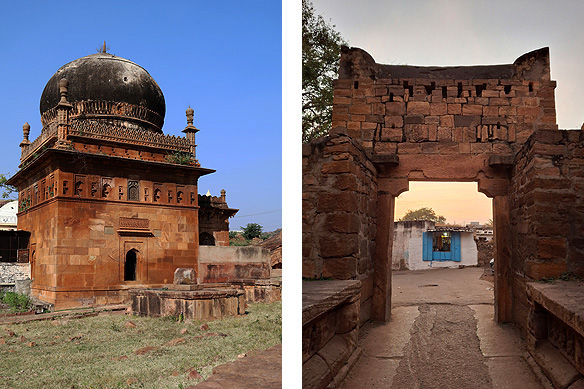
Left: 18th Century tomb of Malik Abdul Aziz, governor of Badami during Bijapur Sultanate rule; Right: Ruins of a fortified entrance near the Museum.
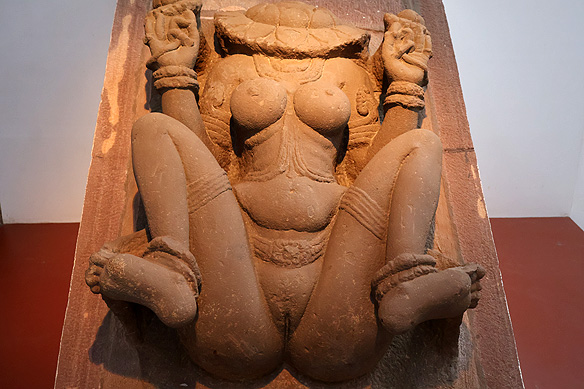
Lajjagauri, an 8th Century lotus-headed goddess of fertility at the Badami Museum is typical of tribal sculpture in the Deccan during the first millennium CE. This effigy was discovered in a cave, 8 kilometres from Badami.
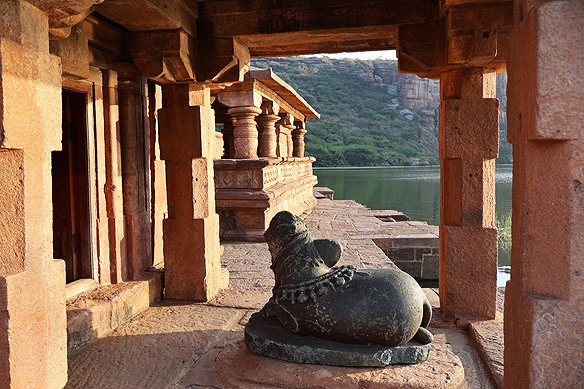
Early-8th Century Bhoothnath temple complex with a Nandi on the banks of Agastya Teerth.
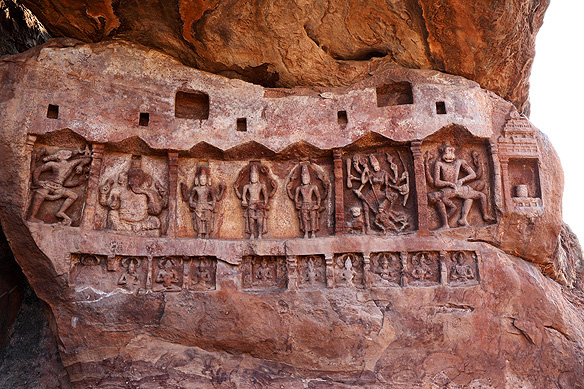
Frieze with multiple deities on a massive boulder near the Bhoothnath temple complex.
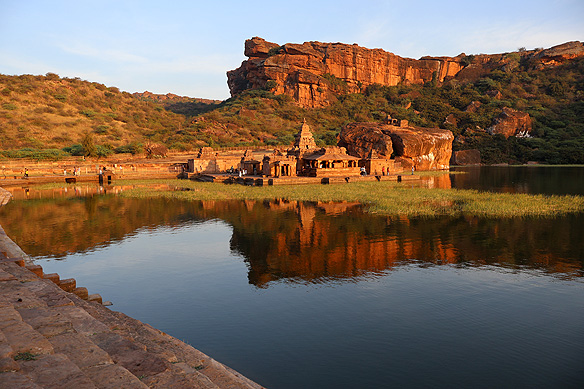
Sunset on the steps of the 7th Century Agastya Teerth with the Bhoothnath temple complex and Badami Caves escarpment in the background. A view that has not changed over the past millennium and a half.
There are two groups of Bhoothnath temples hugging the edges of the man-made sacred 7th Century Agastya Teerth. The newer [11th/ 12th] Century northern Nagara-styled Mallikarjuna temple complex and the older [early-8th Century] southern Dravida-styled Bhoothnath temple complex.
After I poke around the two and stumble upon a riot of gods emblazoned on nearby boulders, I sit down on the steps that surround the lake. Just like millions have done over the past millennium and a half. I try to think of profound questions and ideas that would befit the place. Badami tells me, “Hush, let it be.” The setting sun says one last goodbye before it plunges the site, and me, into dusk.
These past five days, I have been exploring this ancient strip in north Karnataka. From Hampi to Badami.
Let me take you to the rest of my journey, going backwards to where I started. Come meet me again next week. What say? And in the interim, wishing you a very happy 2026. May it bring many happy travels your way. ❤
– – –
Travel tips:
- Staying there: I stayed at the Mavi Retreat, a fabulous eco-friendly resort with a limited, but delicious breakfast spread and a chilled-out cafe/ restaurant.
- Getting around: I took shared autos to the site and back. Rs. 100 each way.
- The caves have detailed printed description boards and audio guides accessible by QR codes. To read more about the sculptures in the four caves, do have a look at this fantastic blog by Lawrence Rodrigues.
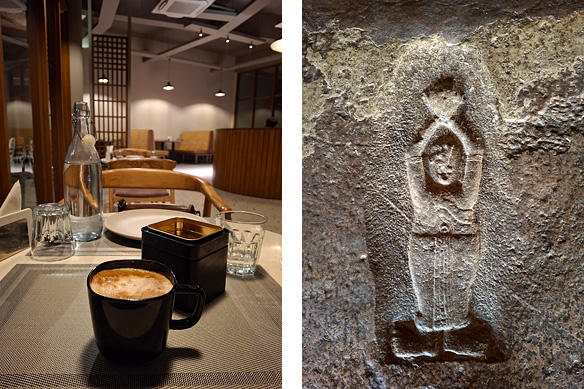
Left: Mavi Retreat’s cafe/ restaurant; Right: Prostrated devotee carved on a floor slab in one of the Badami Cave Temples.
 rama toshi arya's blog
Magnificent!
LikeLiked by 1 person
Thank you. Glad you liked it. 🙏
LikeLiked by 1 person
Your photos and story from Badami not only are beautiful, but they also remind me that I really have to go back to India to explore more of the country. Apart from Badami, in Karnataka I also want to see the Hoysala temples with their incredibly ornate carvings.
LikeLiked by 2 people
Thank you, Bama. 🙏 Agreed, you need to revisit India. 🙂 The Hoysala temples are indeed stunning. I went just before Covid. Am happy they now have UNESCO-listed status. Have written about them as well.
LikeLiked by 1 person
Beautifully written with wonderful photos. Wishing you a very happy new year 🥳
LikeLiked by 1 person
Thank you, Priti. 🙂 Wishing you a very happy new year too!
LikeLiked by 1 person
🙏
LikeLike
Great article on Badami architecture & sculptures Ramaji !Thanks for sharing such an informational story! Wish you a great year ahead :2026 fulfilling all your aspirations in life !
LikeLiked by 2 people
Thank you, Sir! Wishing you and your family a very happy new year too. 🙏
LikeLiked by 1 person
🙏🙏🙏
LikeLike
Pingback: aihole, birthplace of indian temple architecture | rama toshi arya's blog
A great post Rama with lovely photos and vibrant engaged text as usual. There is something primal about cave temples and the sculptures and paintings in the flickering subterranean light seem more alive that they do in constructed temples above ground. You have captured the spirit of the place when you write “surrounded by a palpable sense of eternity” and “Hush, let it be.” I’ve visited Ellora and Ajanta amongst other similar sites in India and this brings back those experiences. The fact that you are also in the wilderness so to speak and open to the heat and dust and wind also adds to the experience. Plus the silence (when not overwhelmed by schoolkids!). What an experience. Thanks
LikeLiked by 1 person
Many thanks once again for sharing your extensive and perceptive travel experiences. I often feel that when we travel we start trying to analyze different cultures and experiences in our effort to understand them better. But at times, instead of putting them under a microscope, all we need to do is accept them. Wholeheartedly. 🙂
LikeLike
PS happy travels in 2026!
LikeLiked by 1 person
Thank you! And wishing you the same too. I have some interesting places lined up in my 2026 bucket list. Let’s see how many of them materialise. 🙂
LikeLike
That’s incredible. Informative post.
LikeLiked by 3 people
Thank you, Ashish, for stopping by and your kind words. 🙂
LikeLiked by 1 person
Pingback: photo essay: hampi, stories told and untold | rama toshi arya's blog
what’s it like to explore those caves? 🏰
LikeLiked by 1 person
It was fabulous. 🙂
LikeLike
thanks for you
LikeLiked by 1 person
Thank you for stopping by and commenting. 🙏
LikeLike
Lakes in Karnataka are vital natural resources that support ecological balance, agricultural productivity, and urban life. Protecting and managing these lakes effectively remains crucial for maintaining the environmental and economic well-being of the state.
LikeLiked by 1 person