What’s this blog without some art? 🙂
Contemporary art has been a regular fixture in the Kingdom of Saudi Arabia’s cultural scene since the country drew up a vision which placed itself as a hub for global events.
For a few weeks every Arabian winter, AlUla’s incredible landscape in the north-west of the Arabian Desert plays host to large-scale site-specific temporary installations by some of the most ground-breaking artists from across the world. This year was no different. Luckily for me, it coincided with my visit.
Currently in its 4th edition, Desert X AlUla [16 January to 28 February, 2026] was conceptualized in USA’s Coachella Valley in 2017. In 2020, the event expanded into Saudi Arabia, and has showcased over 100 artists to an audience of 2 million since its inception. The theme for 2026 was ‘Space Without Measure’ inspired by Lebanese-American poet Kahlil Gibran’s writings.
The open-air exhibition offers a completely unique way to interact and relate with the desert. After exploring its ancient and futuristic treasures, I thought I understood the shifting sands and burnt craggy canyons under the vivid blue skies. I was wrong. There was another dimension to the desert’s vastness and stillness—as the backdrop and inspiration for personal creative expression.
Here are ten artworks that were on display with a synopsis of the artist and what they wished to say. At times, rooted in the personal, and at others a commentary on global issues, and at others just an experiment to see what if? But always cajoling the spectator to reflect, deeply.
Wishing you safe and happy travels, filled with art!
Hector Zamora
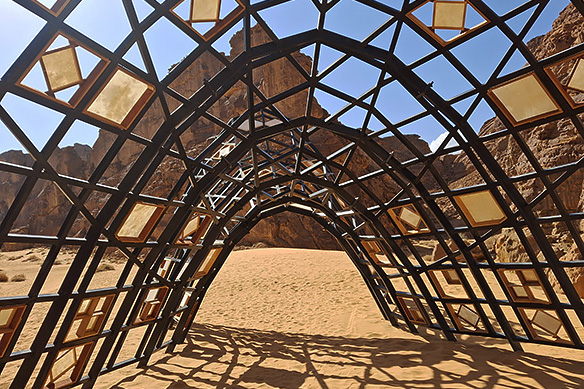
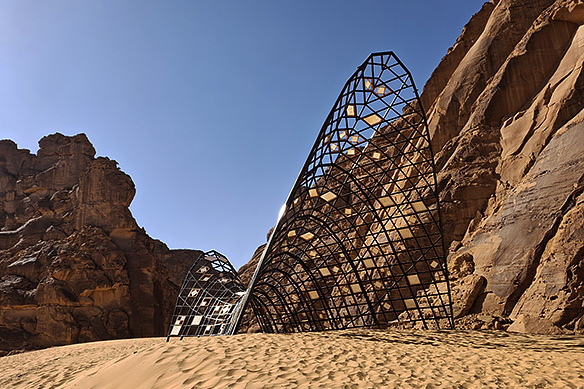
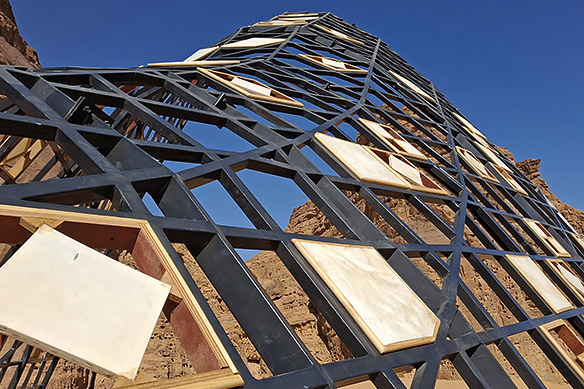
Tar HyPar
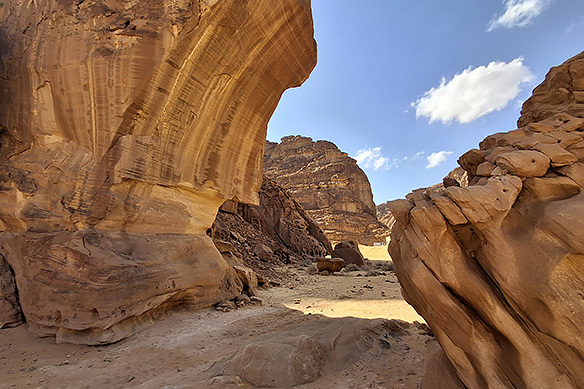
Mexican-born Zamora’s blend of the traditional Saudi drum ‘Tar’ and the saddle-like hyperbolic paraboloid, shortened to ‘hypar,’ activates the whole valley into a musical instrument.
Viewers are invited not just to look, but to play its surfaces as drums. He explains, “drums are a way to connect with nature, and the tales that are in the desert … The paradox is the sonic environment amplifies our perception of silence, a humbling reminder of our place in the universe.”
Basmah Felemban
Murmur of Pebbles
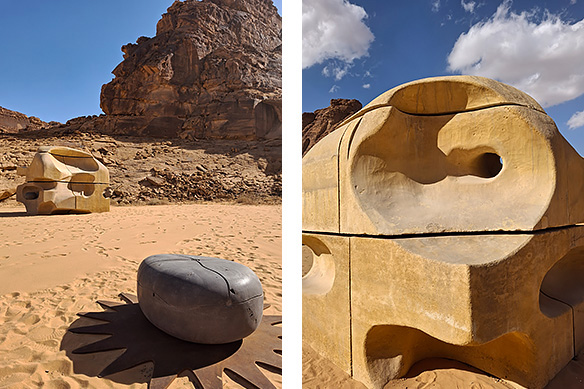
Known for his installations that draw inspiration from Islamic geometry, Saudi artist Felemban takes a tiny geological element and makes it monumental in Desert X. Huge ‘pebbles’ carved from limestone sit on steel plates—an amplified version of prehistoric nature at work.
He observes, “The pebbles carry the knowledge of our ancient rivers. These pebbles with their roundness and lengths, tell us about the speed of the water flow and how the waves move them away, or closer to our feet. They carry within them an energetic resonance of our land, of its ups and downs.”
Mohammad AlFaraj
What was the Question Again?
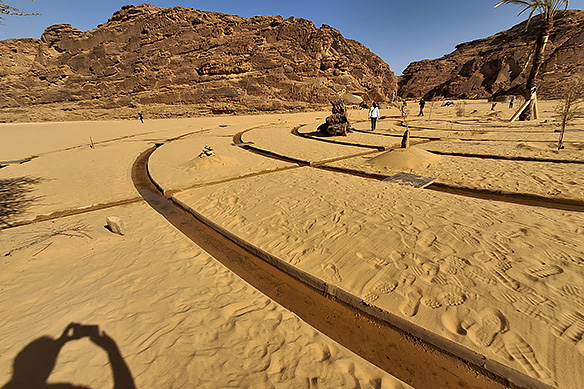
If Felemban asks the audience to view the desert’s geology more carefully, multidisciplinary Saudi artist AlFaraj invites the spectator into a labyrinth reminiscent of his childhood in Al Ahsa where palm trees, water channels, soil, and dates were part of everyday life.
The maze leads to a palm tree made of many trees in the centre—it symbolizes a grafting process he had seen his grandfather carry out. Once grafted, the dying trunk was able to get an extended life, growing as one with another. This was to become an invaluable lesson of “how renewal often emerges through coexistence, how harmony naturally exists in the environment, and co-dependency is a crucial act of survival.”
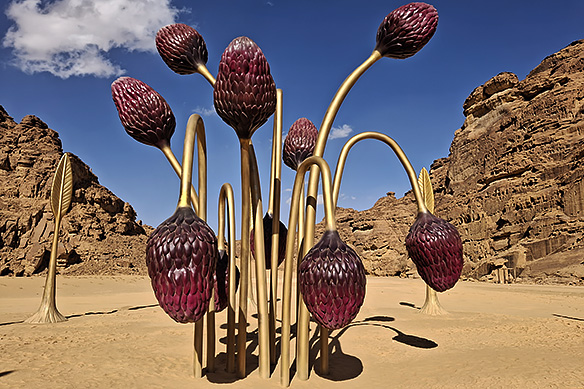
Maria Magdalena Campos-Pons
Imole Red
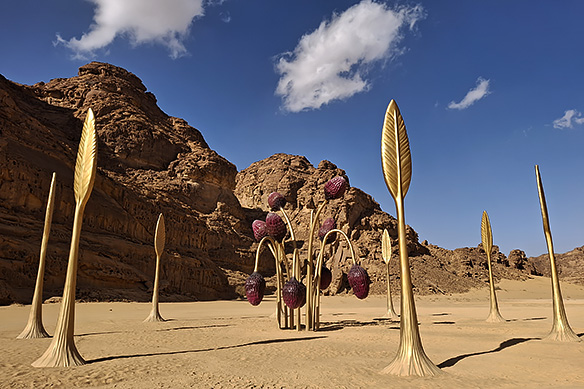
Multiple themes stitch Cuban-born US-based Campos Pons’ Imole Red garden together. To start with, her gargantuan flowers capture AlUla’s intense sunsets in which the canyons change from yellow, ochre, red, to purple and blue. The word ‘Imole’ comes from the Yoruba language and means light. She chooses to represent these colours through native plants that flower on the same visual spectrum, namely, date palms, jujubes, and the allium atroviolaceum.
On another vein, by locating it on a flood plain, she makes an ode to the landscapes that have changed from sea to desert, with the water living on through the stems searching for a connection.
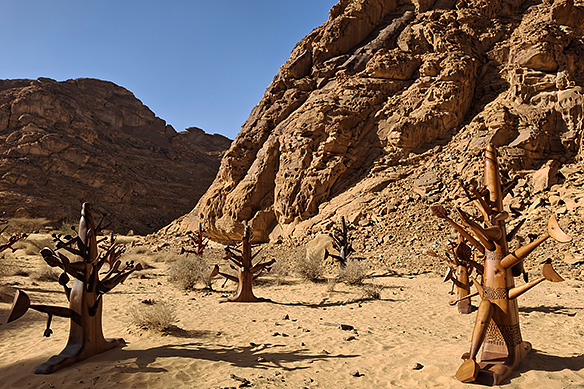
Ibrahim El-Salahi
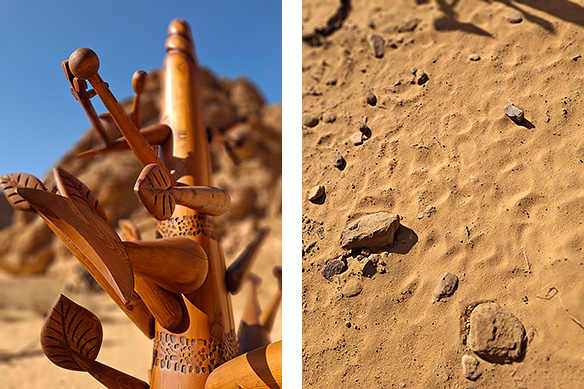
Haraza Tree
Sudanese Modernist El-Salahi has long held the ambition to realize a forest of ‘tree’ sculptures in which the individual and the collective exist in harmony [and] unity emerges from multiplicity.
Part of his ongoing series of ‘meditation trees’, the installation is an investigation of the tree/ body as a link between heaven and earth, creator and created. His ‘trees’ in Desert X draw inspiration from the Haraza Acacia on the Nile riverbank, and symbolize the various Acacia species that grow in AlUla’s desert canyons, providing shade, nourishment to animals, and firewood.
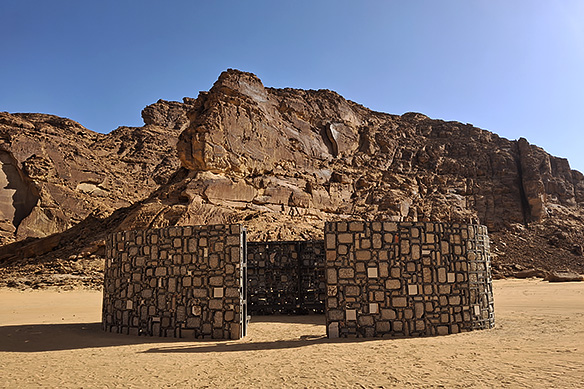
Vibha Galhotra
Future Fables
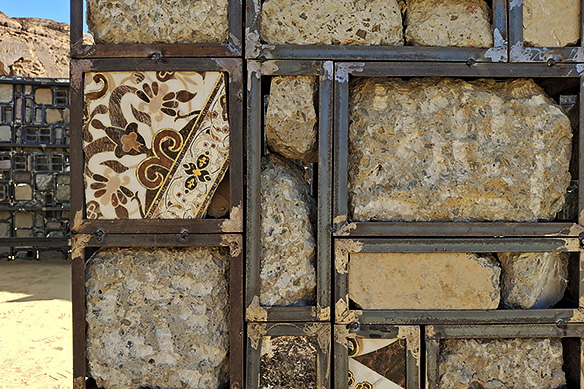
What seems at first glance to be simply a shelter from the desert’s unforgiving sun, reveals itself as a gathering place to ponder over environmental destruction and climate change, and consider alternative futures together.
Using rubble from AlUla’s demolished buildings, New Delhi-based Galhotra gives the fragments a new lease of life. For the artist, “embedded in each fragment is a history of water, labour, and aspiration.” Concrete contributes 8 percent to global warming.
Mohammed AlSaleem [1939 – 1997]
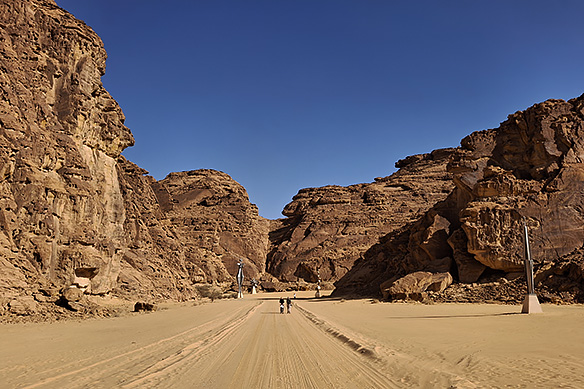
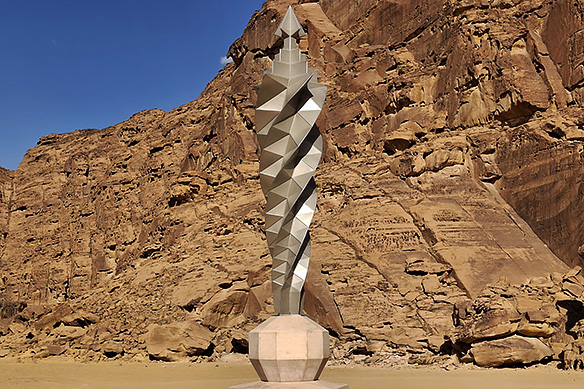
Flower Bud, The Triangles, AlShuruf Unit, Al Ahilla, The Thorn
Late AlSaleem was a visionary in Saudi Arabia’s modern art movement. The first to hold an art exhibition in Riyadh and creator of the Kingdom’s first art house to support local artists, he attained critical acclaim for his signature ‘horizonism’ style.
One of his lesser-known projects was a sculpture series created in the 1980s for the Riyadh Municipality. Inspired by the desert, each of the five displayed at Desert X uses symbolic geometric motifs. Take for instance AlShuruf Unit’s twisting facets which represent knowledge, understanding and communication, and The Triangles that serve as a metaphor for the strength of combined cultures.
Sara Abdu
A Kingdom Where No One Dies: Contours of Resonance
“Conceal all borders
Feel the earth beneath you,
Stand still,
Be rooted
And remember your first home
Her womb…
Now breathe
You are in the kingdom
Where no one dies.”
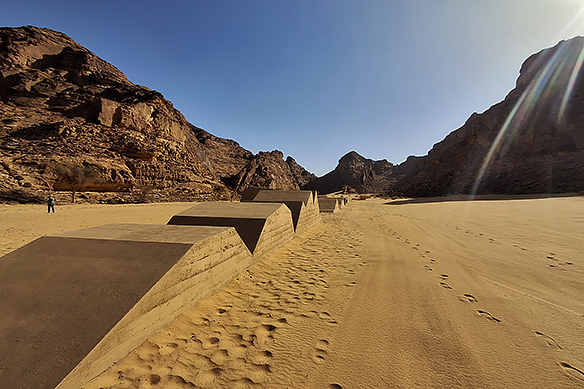
Born to Yemeni parents in Saudi Arabia, Abdu’s installation comprises stratified rammed earth walls made of sands from both AlUla and Yemen in an ancient construction technique. The magic lies in the zig-zag lines. They are the sound waves of the recorded poem which, by a twist of design, also reflect the strata of the canyon.
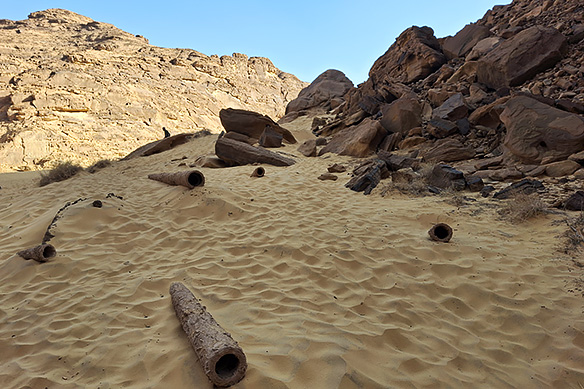
Tarek Atoui
The Water Song
This one is an absolute treat. In a narrow valley, half-buried hollow clay pipes lie scattered as if in an archaeological site; a gurgling sound permeates the air evocative of gushing life. As one tries to gauge its source in the barren landscape, the echoes reach a zenith, and then die away.
Closer inspection reveals a small pool with a network of sound cables. The work of Lebanese-born Atoui, an artist and electro-acoustic composer, the Water Song, like his other works, explores the medium of sound and the way it shapes our perceptions.
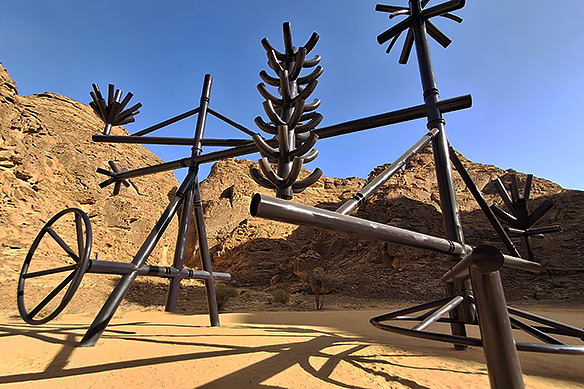
Bahraini-Danish
Bloom
Bahraini-Danish, a collective creative practice in art, architecture, and design, comprises of three artists: Batool AlShaikh, Maitham AlMubarak, and Christian Vennerstrøm Jensen. Their colossal installation titled ‘Bloom’ replays the interplay of sun and shade on desert flowers.
Interaction with the kinetic sculpture forms an integral part of the installation. By spinning its wheels, the viewer sets into motion a series of shadows that change with the time of the day. It takes considerable effort, but the combination of the distorted shadows on the ground and intricate large mechanism overhead, makes for a grand finale to Desert X AlUla 2026. ❤
– – –
If you wondering what happens to these installations after the exhibition, they hang around for a while. After which, most are dismantled and destroyed. Others stay on, tucked away in the desert for future intrepid art enthusiasts. I leave you with Vibha Galhotra’s poem-commentary on ‘Future Fables’:
The desert remembers.
Wind writes in stone,
time gathers quietly,
and what we abandon endures.Future Fables grows from this horizon,
not to mourn the past,
but to imagine what may still emerge.
Concrete debris becomes my material:
the bone of cities,
ambition cast into permanence,
then left behind.I collect these fragments and listen,
the hum of former industry, the scent of distant rain,
footsteps once certain they could shape the world.
In AlUla, the desert receives them.
Deep time opens like a slow breath,
sand and ruin speak in one tongue,
fragile, resilient.A monumental elliptic rise.
From afar: solid, steady.
Up close: fractured, tender,
like skin remembering a story.
This work is a fable made of rubble.
No instructions, only an invitation.
Step inside.Leave a word, a hope, a trace of yourself.
Voices collect like wind in chambers of stone,
and the sculpture becomes a living archive,
quiet, breathing, unfinished.The desert is not empty.
It listens.
It holds what we were
and what we might yet become.
Lean closer.
There is a future here,
soft as sand,
ready to shift beneath our feet.
– – –
[Note: I travelled through Saudi Arabia for 17 days in January-February this year. To read more posts in my Saudi Arabia series, click here.]


It’s a very original approach, and there’s plenty of space to do it.
LikeLiked by 1 person
The whole exhibition was fabulous. The sheer scale and colours of the desert adding an extra dimension to the narrative. Easily one of the highlights of my Saudi Arabia travels. 🙂
LikeLiked by 1 person
Wow fantastic artwork in a cool location! Great to see for sure!
LikeLiked by 1 person
Thank you, Anna. 🙂 I love contemporary art. It is my favourite form, and I also have this thing about desert landscapes so Desert X AlUla was a complete treat on every level!
LikeLiked by 1 person
Beautiful art pieces with a stunning backdrop. Love the contrast in pictures
LikeLiked by 1 person
Thank you, Arvind. So nice to hear from you. It’s been a while. Hope you have been well. Yes, great contrasts. Very photogenic, especially for a photographer. My camera and I both loved the exhibition. 🙂
LikeLiked by 1 person
Yes, it has been a while. Been caught up with many things. Also, I’m trying to focus on creating blogs on unique themes. Not sure if you recently headed to my blog but writing about communities that have not been talked about much – overshadowed by certain others. Haven’t been writing much just a little.
Pictures show your love for the exhibit
Hope you are doing well.
LikeLiked by 1 person
Yes, I have been reading your posts. The last I read was on bamboo scaffolding. Will go over and give it a like. 🙂
LikeLike
Pingback: travel diaries: one traveller, mount shada, and happiness | rama toshi arya's blog