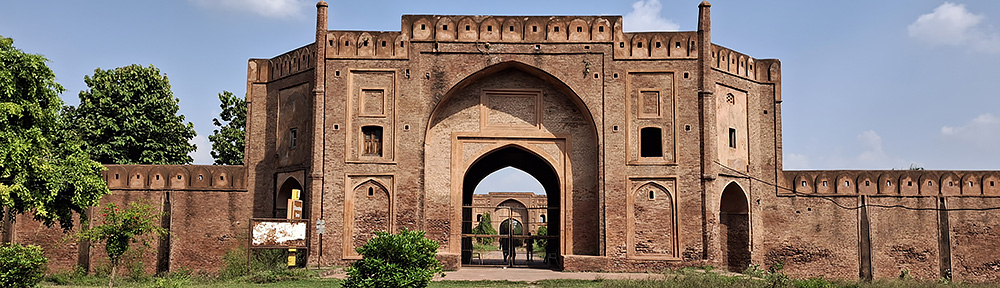
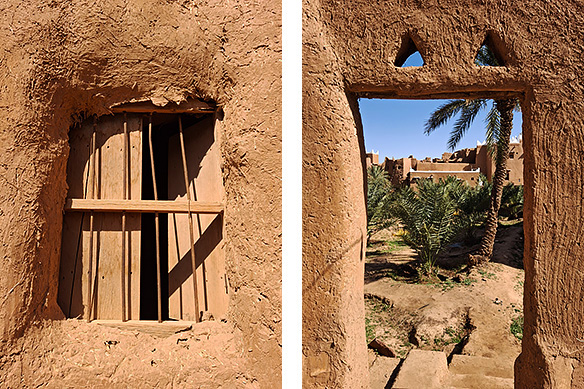
Looking in, Looking out. Ushaiqer heritage village in Saudi Arabia’s Najd desert has been around for 1,500 years.
Before Saudi Arabia’s settlements transformed into steel and glass extravaganzas, they used to be made of mud-brick and rock-shards, built out of the earth they stood on. Not surprising then that very little remains of them. Over time they crumbled back into the alluvial oases or rocky outcrops on which they once stood.
Their styles were regional, with architectural features adapted to climate and available material, stamped with motifs distinctive to the local tribes. Two of the Kingdom’s most picturesque surviving villages [amongst very many] are Thee Ain and Ushaiqer. One is in the Al-Baha mountains, and another in the Najd desert. And they could not be more different from each other!
In recent years, both have been painstakingly restored, but parts have been left untouched, offering insights into what they once looked like, and how they look with the ravages of time.
Thee Ain heritage village stands atop a marble hill in Saudi Arabia’s south; its 30 tightly clustered multi-storey houses seeming to flow out of the mount. It is hard to say where one ends and the other begins—the marble just transposes into volcanic rock. A small state-of-the-art museum puts its story in context and is a good place to start one’s explorations.
Dating back to the 16th Century, the village overlooks Wadi Rash and is surrounded by craggy peaks. The rather poetic name—Thee Ain—comes from a natural spring that fills the foothills with fruit trees and basil.
Close to Thee Ain heritage village and newer, but in the same southern highlands style is the Bakrosh Ben Allas Heritage Castle. Roughly 200 years old, it was a stronghold against the Ottomans and was built by Bakrosh bin Allas Al-Zahrani aka the “Arab Tiger.” He was a tribal leader and military commander during the First Saudi State [1744 – 1818]. Do look out for the white quartz triangles, a design feature associated with the Zahran—one of Saudi Arabia’s oldest and most influential tribes, and indigenous to the Al-Baha region.
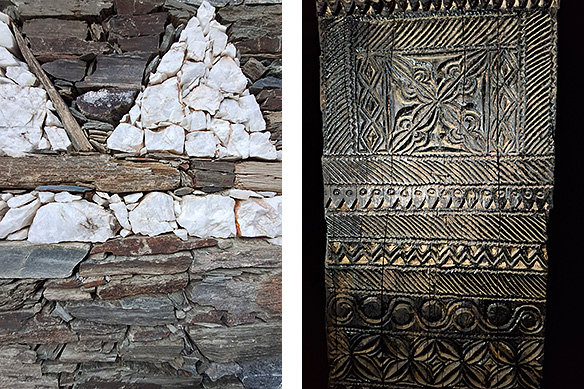
Quartz triangles and carved wooden pillars decorate the 18th Century Bakrosh Ben Allas Heritage Castle in the Al-Baha mountains.
On the other side of the country, across the desert, 200 kilometres from Riyadh, is the Ushaiqer heritage village built in the central desert-adapted Najdi style. Ushaiqer means ‘small blonde’ and is named after a small red mountain to its north. Back in the old days, the two words, blonde and red, were often used interchangeably.
The 1,500-year-old village is pretty as a picture. Even the decimated sections behind half-ajar doors. One of the oldest villages in the Najd region, for the longest time it straddled the pilgrimage route for Muslims travelling from the east to Mecca.
Inside the village boundary, 400 mud-brick houses and 25 mosques—all with thick walls, palm-leaf roofs, and wooden doors—huddle around narrow winding covered lanes, surrounded by an oasis wrapped in date palms.
Over a hundred of these buildings have been restored to their earlier glory, replete with the trademark Najdi furjat [triangular openings] and shurfat [crenelated parapets]. Some of the most stunning ones are: House of Shaikh Ibrahim bin Saleh Aleisa [1854 – 1925], a historian and scholar, Shaikh Abdulrahman bin Sulaiman Al-Reziza Al-Angari’s home from 1877 to 1928, and the Ushaiqer Governor’s House. The restorations for all three were undertaken by the gentlemen’s’ respective heirs.
Here’s a slide show of images from the road less travelled in Saudi Arabia: its heritage villages. Click on the arrows to navigate through the set and read the captions.
Wishing you travels which help us understand each other better. ❤️


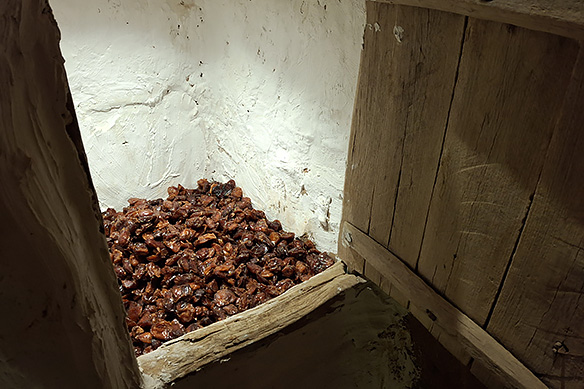
Would you like to have a date? Synonymous with Saudi hospitality, Saudi Arabia produces close to 2 million tonnes of dates annually.
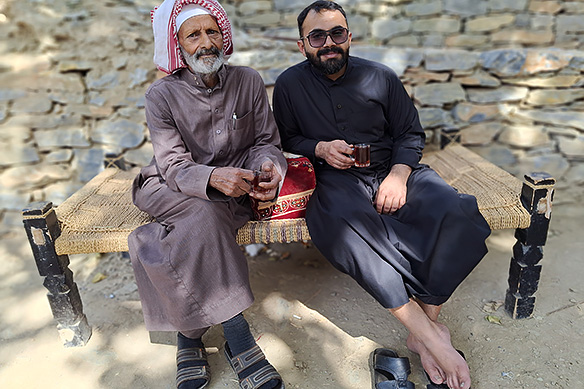
Al-Baha tribesmen enjoying their chai.
Travel tips:
- Ana Ahmed Abu Fahad was my guide for Thee Ain. In his 80s, his knowledge and enthusiasm is inspiring. He can be contacted at +966 50 580 4875.
– – –
[Note: I travelled through Saudi Arabia for 17 days in January-February this year. To read more posts in my Saudi Arabia series, click here.]


I’m glad this place exists and is being preserved. I was worried that Saudi Arabia had bought itself a future by forgetting its past. Both deserve our attention.
LikeLiked by 1 person
I agree fully. Both deserve our attention. I found Saudi Arabia to be very conscientious in preserving its heritage, holding much pride in their past. I only wrote about two of the villages. There are scores of others, and in Riyadh and Jeddah, I saw the past, present and future coexist in easy comradery.
LikeLiked by 1 person
Pingback: travel diaries: one traveller, mount shada, and happiness | rama toshi arya's blog