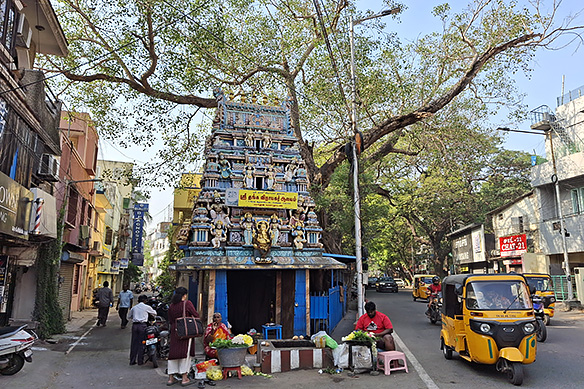
Chennai had long been on my wish-list. Even though I have travelled extensively through Tamil Nadu, including its magical temple towns’ route, the southern state’s capital had somehow evaded me.
When I got an opportunity earlier this year to explore the city whilst on a personal philanthropic project [I run pro bono workshops in development communication skills for the social sector], no surprises that I grabbed it with glee! The weather was perfect. It was February. I was going to be based in Alwarpet, right next to the city’s historical centre, Mylapore. And I was in no rush.
A bastion of Dravidian culture, British East India Company’s very first military stronghold in India, final resting place of St. Thomas, Jesus Christ’s Apostle who took it upon himself to spread the word in India, and home of Kollywood, India’s second-largest film industry—Chennai is many things rolled into one.
Here, Tamil social, cultural, and religious traditions coexist with a colonial history, and movie stars and politics are irrevocably entwined. It’s a heady mix of contradictions sans any friction.
Would you like to explore this city too? Deep-dive into its well-known landmarks and hidden away gems? Then read on.
Note: The itinerary below is thematic, rather than area-based. This is to allow Chennai be understood holistically, one layer at a time, rather than as a mishmash of sites. I hope by the end, you too have Chennai on your own wish-list. ❤
DAY 1: DISCOVER COLONIAL MADRAS’ HIDDEN GEMS
British rule in the Indian subcontinent technically began in Madras, as Chennai was known until 1996. It was here, under the guise of the British East India Company, that the British established their first seat of power—Fort St. George—in 1644.
Though consistently attacked by the native Indians and rival French, the fort continued to expand. Its fortified walls much bolstered by Gothic and, later, Indo-Saracenic buildings in the city, even after the British moved their capital to Calcutta in 1772, and thereafter to New Delhi in 1911.
These architectural gems, meticulously restored and now transposed into museums and government offices, are clustered in and around the colonial town of Fort St. George and the adjacent ‘Indian town’ of Egmore.
Stop 1: Government Museum Complex, Egmore
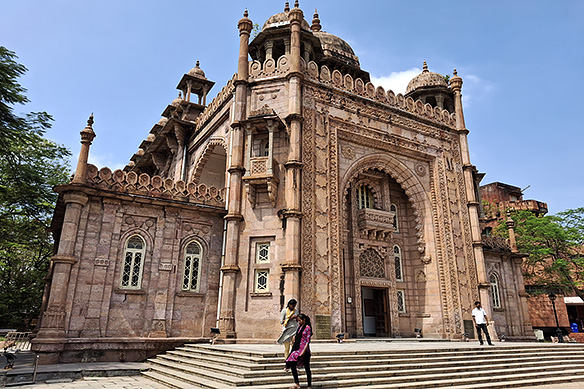
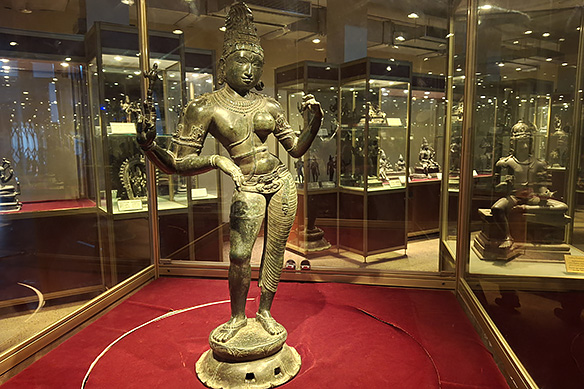
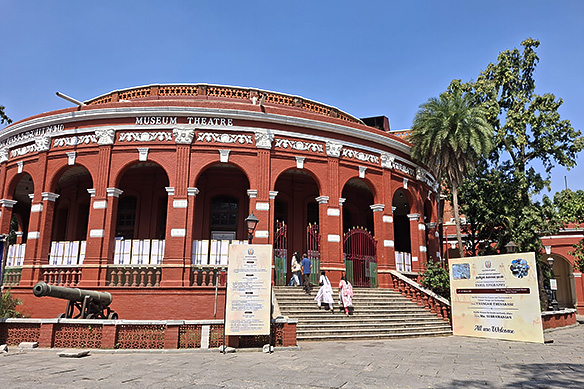
Chennai’s Government Museum Complex comprises an eclectic mix of British India architectural masterpieces. The State Government Museum, dated 1851 has multiple galleries, the most outstanding of which are the Bronze Gallery with its inimitable collection of Chola bronzes [9th to 13th Century CE] and Archaeology Gallery with rare 2nd Century CE Amaravati Buddhist panels.
Next to it is the Pantheon, a once entertainment-venue for the British bureaucracy, the lace-like National Art Gallery [1906] containing Tanjore, Miniature and Raja Ravi Varma works, and the Connemara Public Library [1896], one of India’s four national depositary libraries.
Stop 2: Time for a break at Writer’s Cafe, Egmore

Stop 3: Colonial administrative buildings, Periamet and Park Town
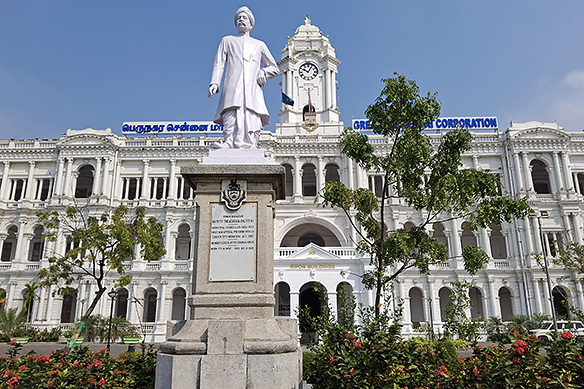
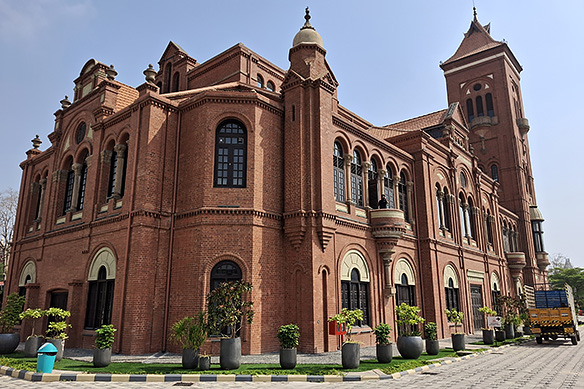
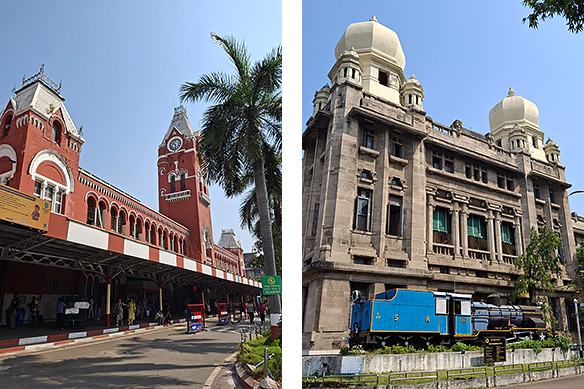
Standing tall on EVR Periyar Salai Road, like sentinels in a row, are a string of colossal British India edifices clearly built to impress. Ripon Building [1913], Victoria Public Hall [1890], Chennai Central Railway Station [1873], and the Southern Railway Headquarters [1922] are all within walking distance of each other. Heritage walks are held regularly inside both the Ripon Building and Victoria Public Hall. Slots tend to fill up fast.
Stop 4: Fort St. George
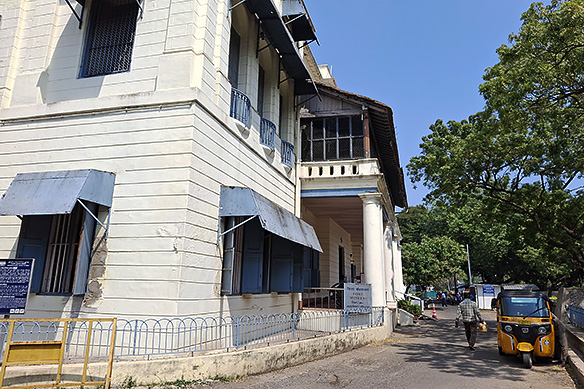
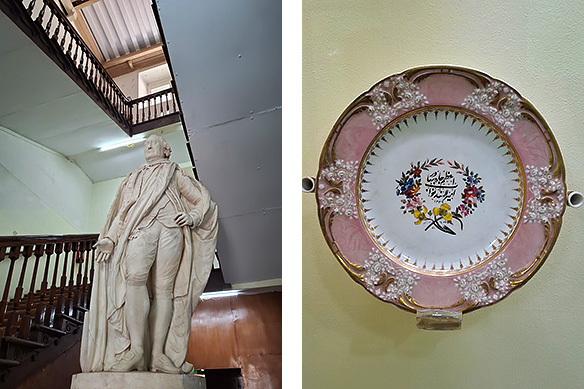
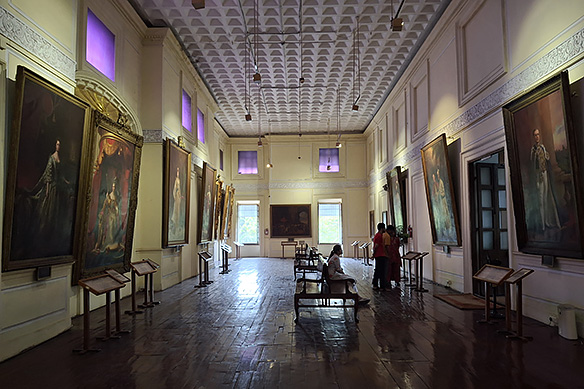
Close by is Fort St. George, the pulsating heart of British East India Company’s activities in the subcontinent in the 17th and 18th Centuries. And inside the Fort: the Public Exchange. Here, the British merchants wheeled, dealed and gossiped over coffee, stored their goods in its many warehouses, and banked at the city’s first bank.
Now a museum, the building provides an overview of early British colonial life replete with uniforms, coins, weapons, and books. Star attractions are Anstruther’s Cage, the portrait gallery on the first floor and some Daniells on the second floor, and Independent India’s only surviving flag from August 1947.
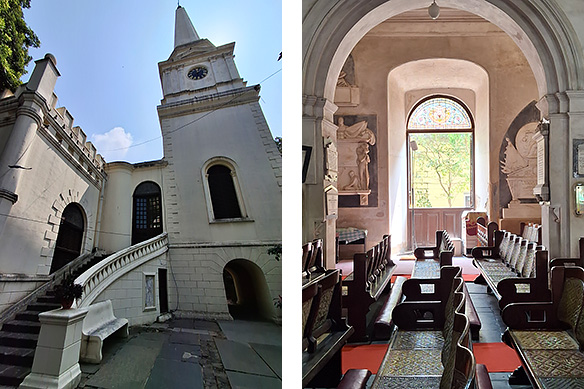
Within the Fort is St. Mary’s Church [1680], the oldest Anglican church in Asia, and earliest extant English building in the country. The first ever wedding which took place here was that of Welshman Elihu Yale, governor of Madras in 1687 who amassed a fortune through slave trade and by flouting rules.
Yes, this is the same Mr. Yale who in 1718 donated 800 pounds to a college in the USA from the proceeds of books and goods he’d shipped to it, and in return got the college named after himself. Hello Yale University!
Stop 5: Madras University’s Senate House, Marina Beach
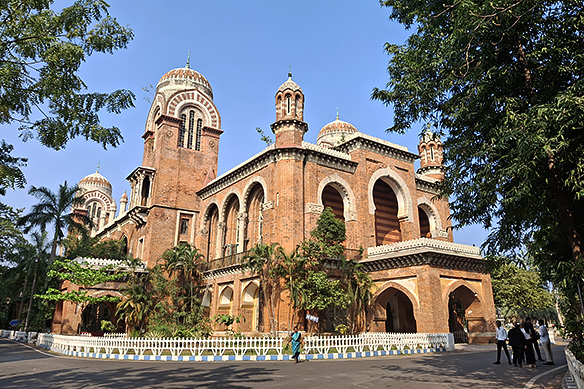
A short walk south from Fort St. George, past Victory War Memorial in honour of soldiers who fought in WWI, WWII and other wars, and across Napier Bridge, will bring you to Madras University’s Senate House on Marina Beach. Regarded as one of the finest and oldest examples of Indo-Saracenic architecture, the red-bricked marvel was completed in 1879. Entry is restricted, but the views from outside are still worth the walk.
Stop 6: Anna Samadhi, Marina Beach
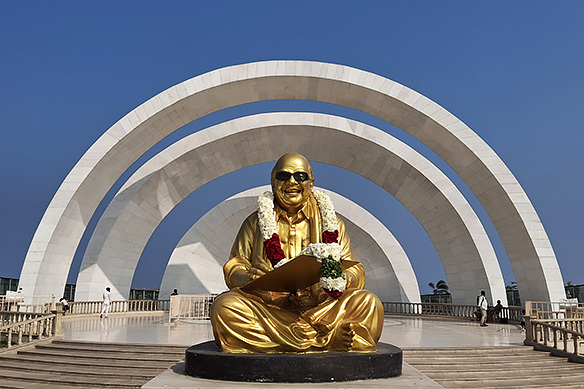
Whilst in the vicinity, cross over to the other side of the road into Anna Samadhi dedicated to CN Annadurai. Though outside the ‘colonial’ theme of the day’s itinerary, the stop throws light on Chennai’s deep pride in its Dravidian roots. Annadurai had led the Dravidian movement in 1967 which changed Tamil Nadu’s social and political landscape for keeps.
Next to it are the mega memorials of Chennai’s most beloved movie stars turned chief ministers—MG Ramachandran, followed by his companion, Jayalalitha Jayaram. Remember, I told you in the beginning of this post, Chennai’s film stars have a massive hold on Tamil psyche, and through it, Tamil politics. 🙂
DAY 2: CHURCH-HOP ACROSS CHIRISTIANITY
There are only three churches in the world which can boast of being built over the remains of Christ’s Apostles. St. Peter’s Basilica in the Vatican on St. Peter’s tomb, Santiago de Compostela Cathedral in Spain on St. James’ tomb, and St. Thomas Cathedral Basilica in Chennai on the tomb of St. Thomas. Surprised?
St. Thomas came to Kerala, South India, in 52 CE, and passed away near the shores of Chennai in 72 CE. During this period, he converted many into Christianity. The descendants of these early Christians, some of the first Christians in the world, are known as Thomas Christians.
Over the centuries, other denominations also started to arrive in Chennai, giving rise to a varied mix of churches from across the Christian world: Anglican to Armenian to Catholic to Presbyterian.
Stop 1: St. Thomas Cathedral Basilica, Mylapore
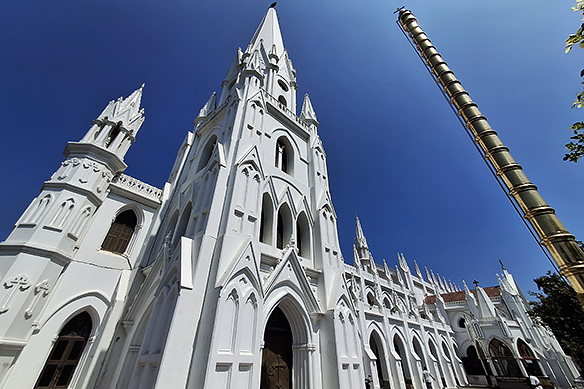
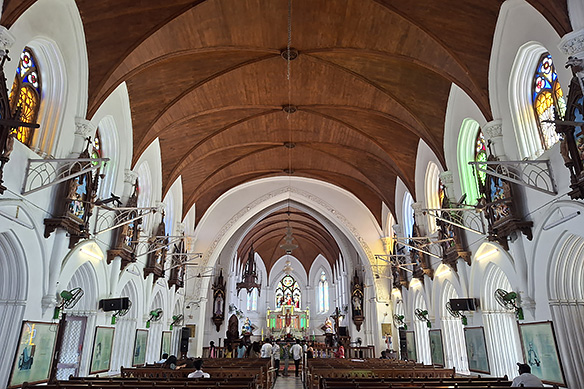
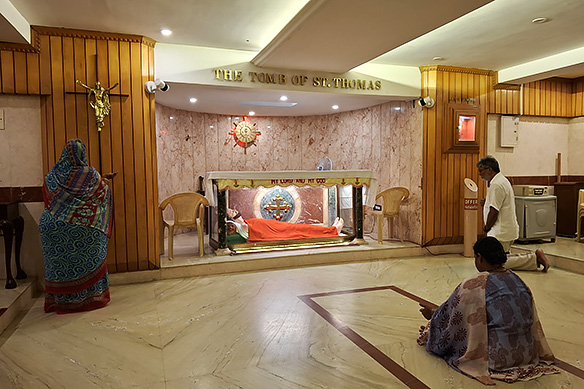
Built first by the Portuguese in 1523, and rebuilt by the British in 1896 in the neo-Gothic style, St. Thomas Cathedral Basilica stands over the tomb of St. Thomas. The crypt can be accessed from a small museum behind the church. Of interest is the stambh—a traditional Indian pillar—in the grounds topped, in this instance, with a cross.
Stop 2: St. George’s Cathedral, Gopalapuram
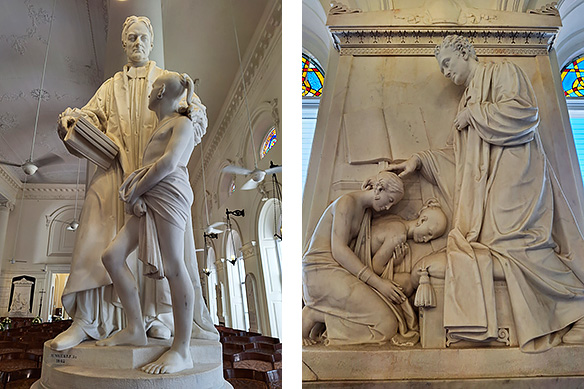
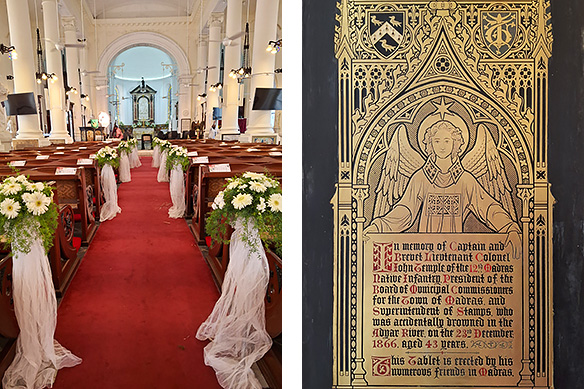
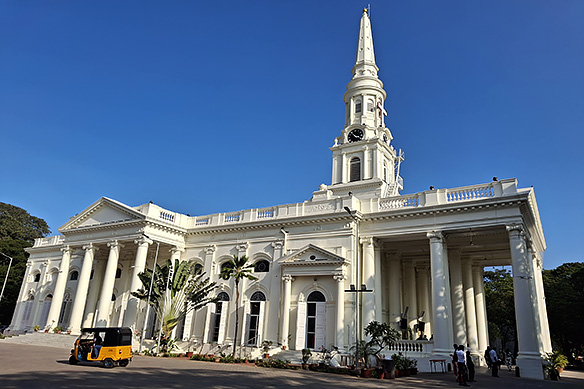
Better known as where the Church of South India was inaugurated in 1947, St. George’s Cathedral was Chennai’s most important church during colonial rule. The Governors, and later the visiting Viceroys, used to pray here. Marble sculptures of Christian missionaries blessing Hindu natives fill the aisles and mounted tablets of the 1816 neo-Classical edifice. The cathedral’s still-in-use evocative cemetery houses colonial-era graves and a massive banyan tree.
Stop 3: St. Andrews Kirk, Egmore
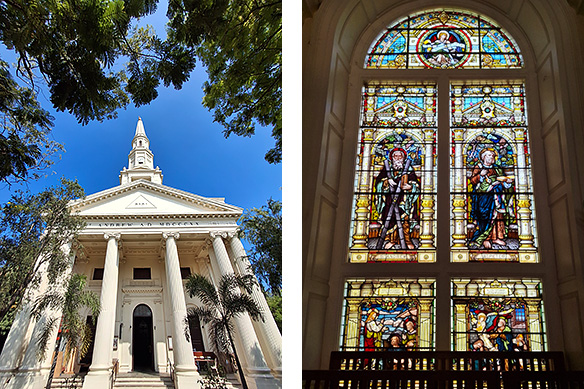
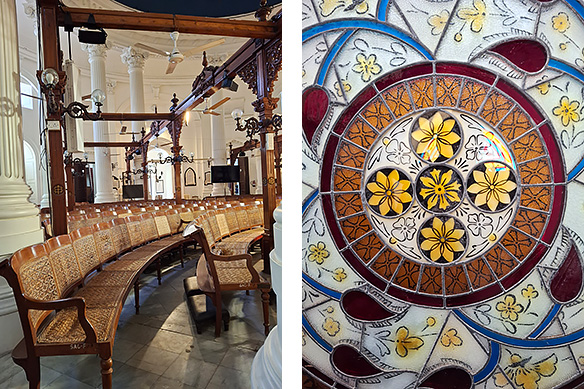
This one is an absolute gem with its circular layout, polished rattan chairs, exquisite stained-glass windows, and hidden staircases. The Presbyterian St. Andrews Kirk was built in 1821 for the Scotsmen in the British army based in Madras. Kirk is Scottish for church. Try and climb up the belfry, as well as the roof, if the office allows you. Behind the church are ruins of the Parochial School, forerunner of the Madras Christian College [1877].
Stop 4: The Armenian Church of St. Mary, Armenian Street, George Town
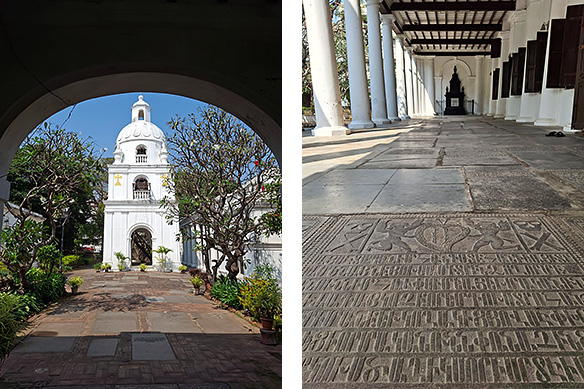
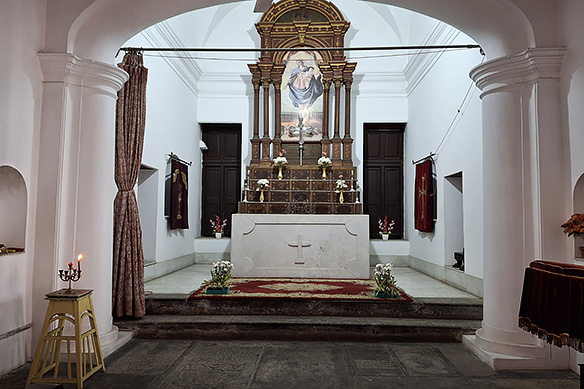
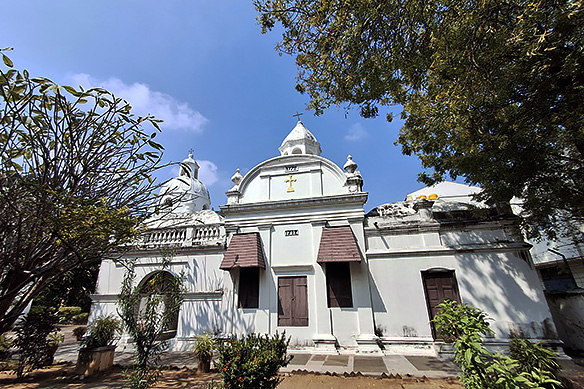
Back in the 17th and 18th Centuries, there used to be a small but wealthy Armenian merchant community living in Chennai. They built for themselves an Armenian church in 1712, and rebuilt it in 1772. One of the oldest extant churches in India, it is paved with 350 gravestones. Amidst these is the grave of the founder and publisher of the world’s first Armenian periodical, Azdarar.
Though the Armenians have long left Chennai, the few that still call the city home come here to worship and the caretaker rings the six large bells in the belfry every Sunday. At other times, the church is a heritage site open till 2:30 pm.
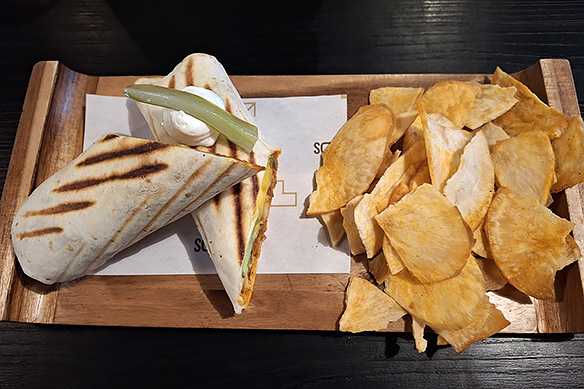
Stop 5: Feeling peckish by now? How about a late lunch at Sortd in Alwarpet
Stop 6: Our Lady of Light Shrine aka Luz Church, Mylapore
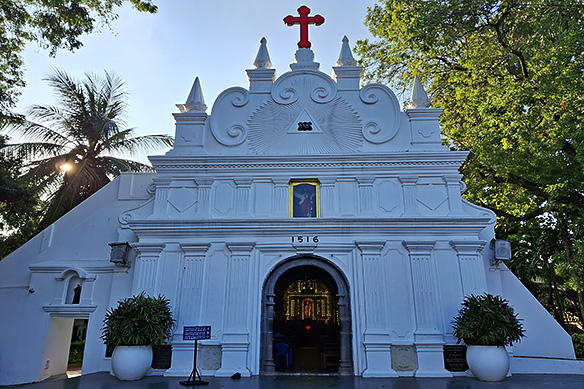
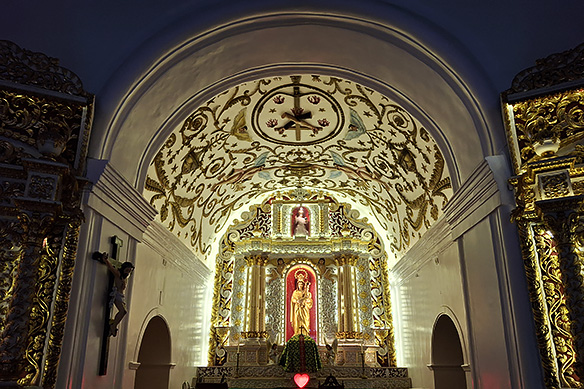
Our Lady of Light Shrine aka Luz Church is a rare [albeit renovated] remnant of the Portuguese settlement in Chennai in the 16th Century. There is an interesting story behind its name. As per local legend, eight Portuguese Franciscan friars were on their way to India and got lost at sea. They prayed to the Virgin Mary for help and soon saw a beam of light which guided them to safety in a forest on India’s coast. Luz [meaning light in Portuguese], built in 1516, is where the light led them to.
DAY 3: EXPLORE CHENNAI’S ANCIENT HINDU HEART
Despite the colonial mantle and rich Christian heritage, Chennai’s heart still beats in its ancient Dravidian Hindu past. Over 80 percent of the city’s population is Hindu who worship in some 600 temples spanning 1,600 years dotted across its expanse. This is excluding the countless road shrines tucked inside boundary walls and perched on crossroads.
Inside Chennai’s intricately carved stone temples, community life and religion converge to form the backbone of what it is to be Tamil. In the epicentre of this world is Mylapore, a historical neighbourhood built around a 7th Century temple dedicated to Shiva in his peacock [Mayil] avatar, giving the area its name.
Here are Chennai’s must-visit temples, each different and with its own story to tell.
[Note: Hindu temples are closed from Noon to 4:00 pm. Photography is not allowed inside the temples.]
Morning: Stop 1: Kapaleeswarar Temple, Mylapore
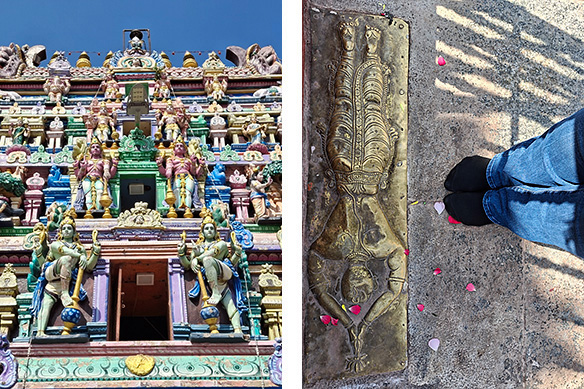
Left: Kapaleeswarar Temple’s western gopuram in all its glory; Right: Floor slab depicting a prostrating devotee in supplication.
When exploring Chennai’s Dravidian Hindu heritage, what better place to start off the itinerary than at its most popular temple. Irrevocably tied to the city’s identity, the Kapaleeswarar Temple in Mylapore was first built in the 7th Century by the Pallava kings, destroyed thereafter by the Portuguese, and rebuilt in the 16th Century during Vijayanagar rule.
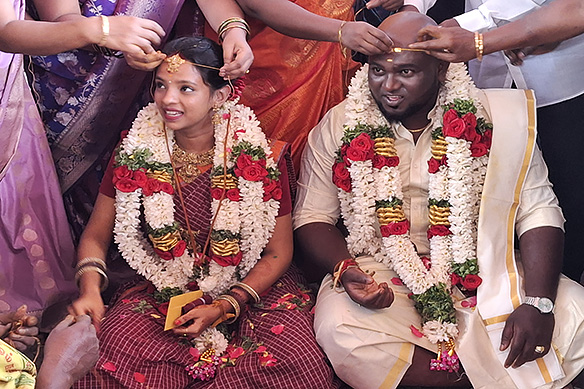
Marriages are regularly held inside Kapaleeswarar Temple’s marriage hall. I gate-crashed into this one.
Stop 2: Adi Kesava Perumal Temple, Mylapore
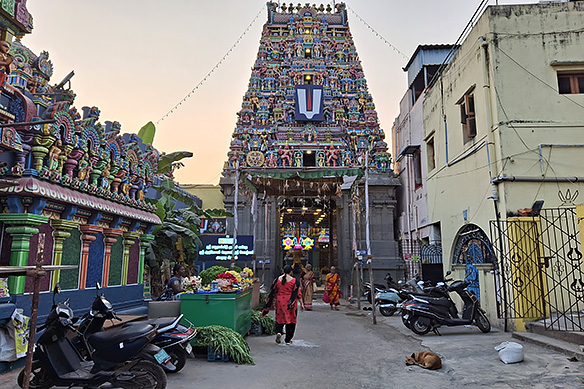
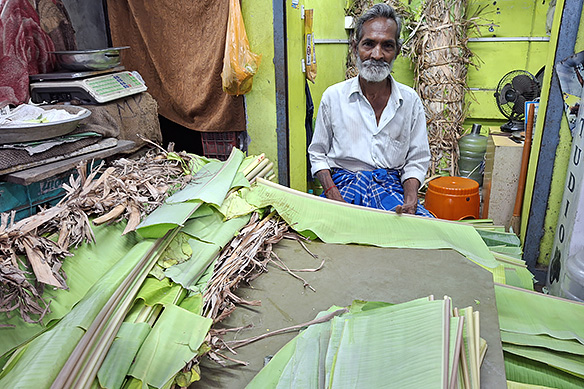
Tucked away in a side-lane, the charming Adi Kesava Perumal Temple is dedicated to Vishnu and his consort Lakshmi. Sacred on multiple counts in Dravidian tradition, it attracts devotees looking for blessings in education and marriage. A rather unusual feature in its liturgy is the practice of using Bilva leaves to worship Lakshmi, a tradition otherwise used only in Shiva rituals. The tank behind the temple predates it and is an example of rainwater harvesting 4,000 years ago.
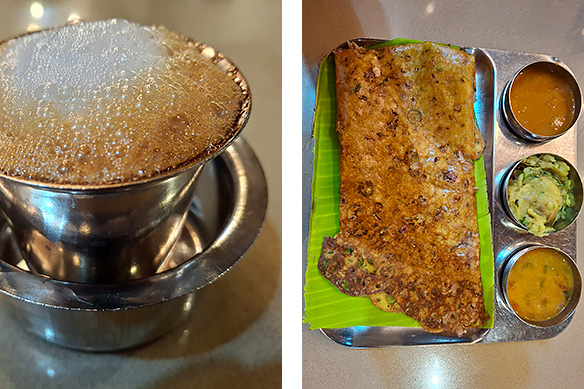
Stop 3: Time for brunch at Sangeetha Restaurants in Mylapore
Stop 4: The twin temples of Chennakesava Perumal and Chenna Malleeswarar, George Town
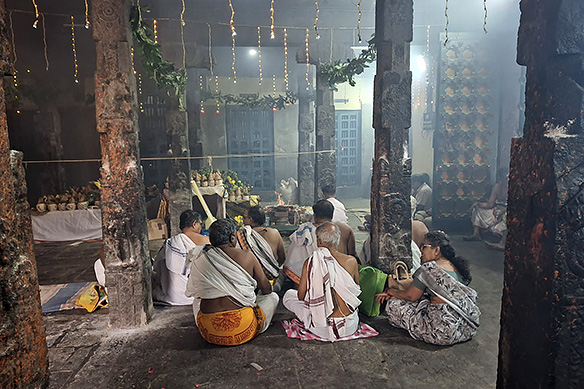
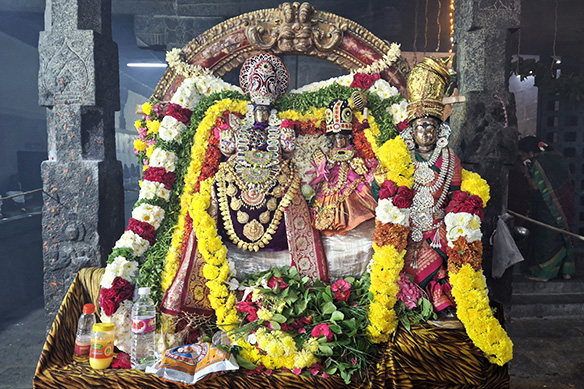
In Chennai’s north, in George Town, are two 17th Century temples—Chennakesava Perumal and Chenna Malleeswarar—which have given the city its name. Believed to be the first set of Hindu temples built during colonial rule, they are both dedicated to Vishnu. Though scholars disagree on the exact details regarding who built it and when, they are unanimous in the opinion that the patron was a Tamil gentleman working for the British East India Company.
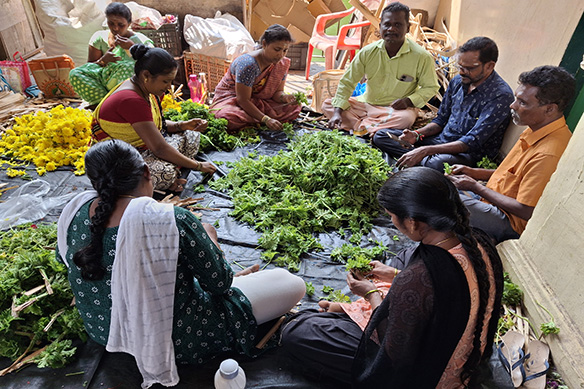
Rarely visited by tourists, the two offer an insight into an unchanged community life over the centuries replete with Vedic rituals, playful children, large family gatherings, volunteers preparing garlands for the gods and goddesses, and the occasional devotee in deep meditation.
Evening: Stop 5: Parthasarathy Temple, Triplicane
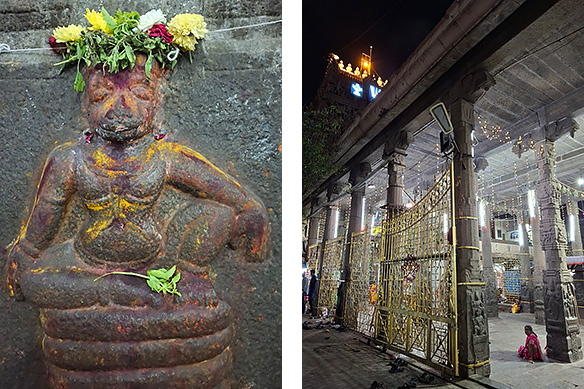
A contemporary of the Kapaleeswarar Temple, but still standing in its original form is the 6th Century Parthasarathy Temple in Triplicane. It is dedicated to Vishnu’s avatar, Krishna, as Arjun’s Parthasarathy [charioteer] in the Hindu epic Mahabharata.
Stop 6: Shri Ramakrishna Mutt, Mylapore
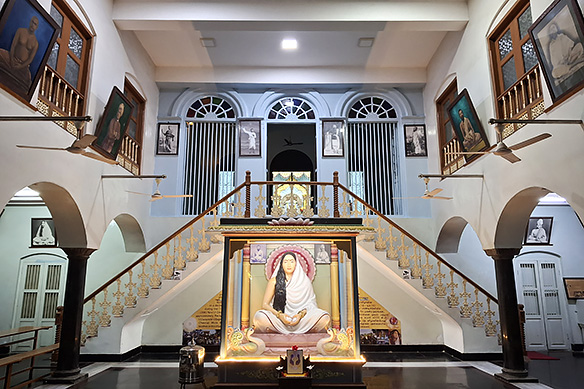
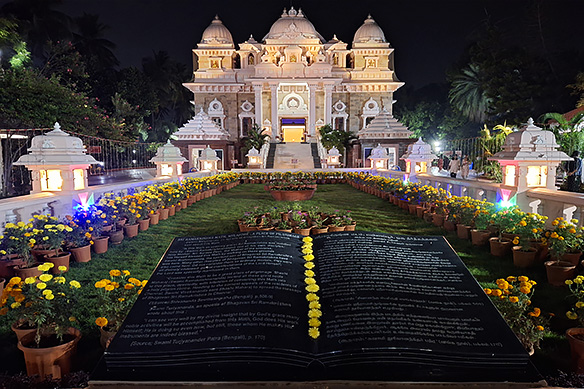
Back in Mylapore, make your way to the Shri Ramakrishna Mutt temples, an oasis of calm in Chennai’s urban chaos. Though next to each other, the two temples, old and new, have separate entrances. When the old temple [1917] became too small for the growing number of devotees, a new Universal Temple [2000] was built and true to its name combined Hindu, Islamic, Christian, Buddhist, and Rajput styles.
Stop 7: Ashtalakshmi Temple, Besant Nagar Beach
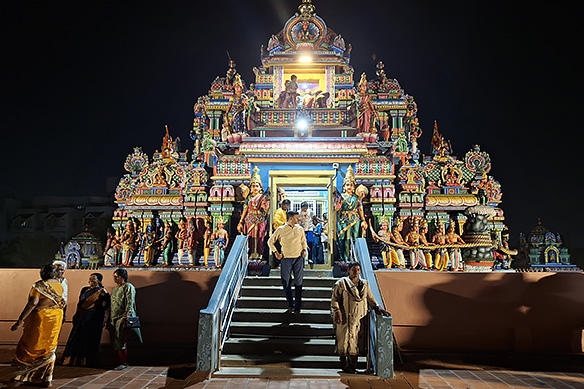
A recent entrant to the city’s list of temples [1976, renovated in 2012], but one that has quickly risen the ranks in sanctity is Ashtalakshmi Temple on Besant Nagar Beach. Freshly painted in a riot of colour, the temple in Chennai’s south is dedicated to Lakshmi as giver of eight [ashta] forms of wealth. Do climb up the narrow-cloistered staircases to the topmost shrine for views of Chennai’s wide sandy beach.
For the perfect wrap to your 72 hours in Chennai, why not take a leisurely walk along that same beach under moonlight?
– – –
Travel tips:
- Staying there: I stayed at Kaira Park in Alwarpet. Fabulous central location. There is no breakfast service, but the boutique hotel is surrounded with eateries. My favourite is Theobroma. It opens at 8:00 am and there’s always good coffee and grilled sandwiches at reasonable prices.
- Getting around: I walked or took Uber autos/ cabs.


I enjoyed my stay in Chennai back in 2015. A lot of people didn’t like the city, but maybe because I had a local friend who took me around, my experience was a lot more positive. When I was there, a metro line was under construction right in front of the Ripon Building. I remember I was particularly impressed with St. Andrew’s Church. This blog post of yours bring back a lot of good memories, Rama.
LikeLiked by 1 person
Yes, the metro is in full swing now. It has also changed the city. Chennai used to have a rural feel earlier. Now, with its metro, malls, blocks of flats and traffic, it could pass off as any other city in India. Yet, it is intrinsically different.
Chennai has never made a pretense to be a tourist city. It is rooted in local tradition, and caters to its residents. Hence, the pockets of rich heritage across the city are raw and unadulterated. The real thing, I would say, offering an insight into real local life. Am glad you got a local to show you around. 🙂
LikeLiked by 1 person
Great…. well presented, great read and wonderful captures!!
LikeLiked by 1 person
Thank you, Jyothi. Glad you feel I did justice to the city. 🙏
LikeLiked by 1 person