The relationship between Georgia and Russia is, well—complicated. Irrevocably woven, yet defiantly independent, Georgia’s past avatar as the Georgian Soviet Socialist Republic still peeps through across the country. You only need to look. A brutalist masterpiece. A colossal deserted mine with cable cars still frozen mid-air in space and time. Poker-faced apartment blocks sliced with horizontal walkways and plunging lifts. Magnificent abandoned sanatoriums built over healing springs that have given way to tall overgrown trees, moss, and wildflowers.
An urbex paradise. A lesson that nothing lasts forever.
Twice, Georgia proclaimed its independence from Russia’s rule. First, albeit briefly, in 1918, and then again in 1991. Tbilisi’s Museum of Soviet Occupation, housed in the national museum, pays an evocative homage to local resistance and the snuffing out of Georgia’s creative elite during the 70 years it was part of the Soviet Union [USSR]. Meanwhile Moscow still celebrates its ex-Republics at the VDNKh Exhibition of Achievements of National Economy and modern-day Russians throng the historically familiar streets of Tbilisi in search of the perfect weekend getaway.
Soviet Georgia took birth in 1921, post the Russian Civil War, and ended abruptly under former USSR President Mikhail Gorbachev in 1991. During these 70 long years, Georgia’s fertile lands and mineral-rich mountains were a key source of food and manganese for the world’s largest country. It was a contribution that warranted the construction of the Soviet Union’s 4th metro station in 1966 in Tbilisi, and the large-scale expansion of Georgia’s railway line to export its agricultural produce en-masse.
But these years also saw forced famines and abject poverty, ironically because of a son of its own soil.
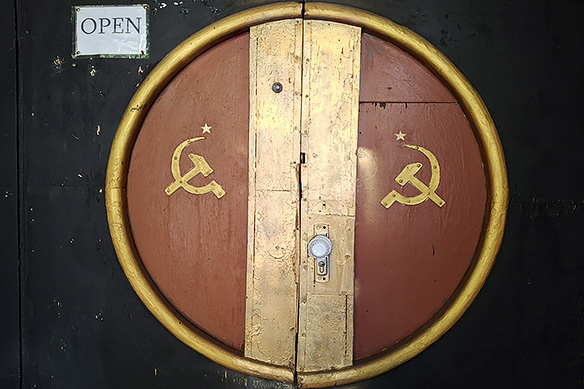
Entrance to the Joseph Stalin Underground Printing House Museum in Tbilisi.
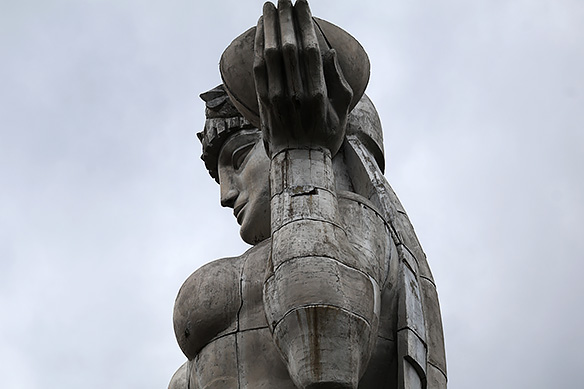
Kartlis Deda, the ‘Mother of Georgia’ statue in Tbilisi holds wine in one hand for her friends and a sword in the other for her enemies. She is one of four sword-wielding motherland monuments erected during Soviet times to represent national identity. The others are in Armenia, Kyiv, and Russia.
Infamous for his repressive policies and political executions that ran close to a million, Joseph Stalin was born Ioseb Besarionis dze Jughashvili on 18 December, 1878, in Gori, eastern Georgia. Stalin, derived from ‘Stal’ [Russian for ‘steel’], was not his real name. He adopted it in 1912. Perhaps as an undercover for his Bolshevik revolutionary activities. Perhaps to align with the tough persona he desired for himself. Perhaps to be part of the Russian bigger picture.
Whilst his successor, Nikita Khrushchev [1953 to 1964], and time have not been kind to him, Stalin’s hometown celebrates him as a hero. Gori’s city-centre houses a monumental museum which faithfully documents his more positive achievements and a protective shell encases the house he was born in.
When the USSR, the world’s largest country encompassing 22,400,000 sq. kms, 15 Soviet Socialist Republics, and the second largest economy collapsed in 1991, it transformed abruptly into 15 disjointed nations: severed, bleeding, and free. One of them was Georgia.
Join me in my photo essay on remnants of Soviet Georgia, broken into six chapters which together offer a window into the extent of Soviet influence on the nation that joins Asia with Europe, and describes itself as the Europe in Asia.
CHAPTER 1: TBILISI’S BRUTALIST MASTERPIECES
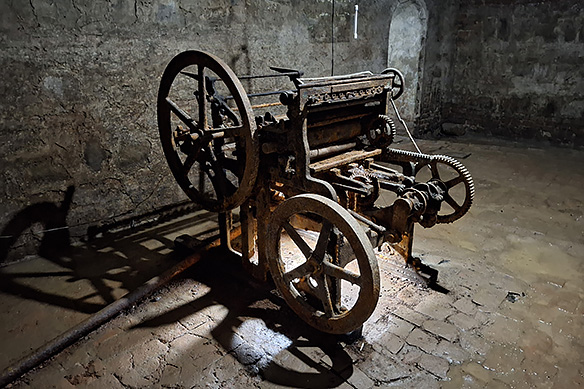
A good place to begin is Joseph Stalin’s printing press, now part of a small museum filled with quirky Soviet-era memorabilia, historical photographs, and printed leaflets, in a nondescript alley in Tbilisi.
This was not the only printing press the young Bolshevik revolutionary had set up. There were others. But this one survived. It lay hidden away in a secret concrete bunker under an ordinary home and accessed through a convoluted loop in a well. Inside, the 1893 Augsburg printing press produced thousands of propaganda material between 1903 to 1906 to fuel the anti-Tsarist revolution.
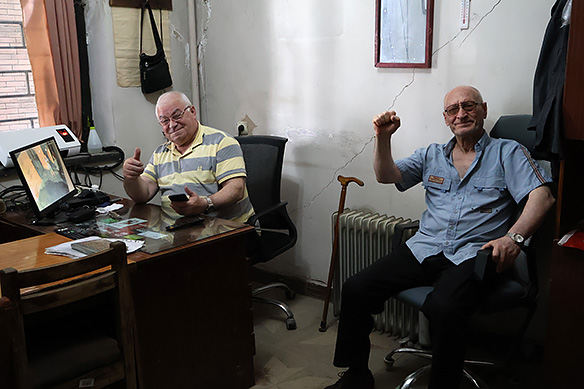
Soso [to the right], curator of the Joseph Stalin Underground Printing House Museum and a die-hard communist, with his colleague. Guess they were happy to see me. 🙂
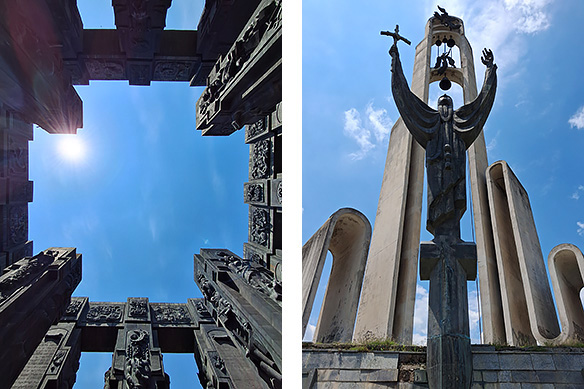
Though one of the key markers of Soviet ideology was the dismissal of religion and its expression, it made two exceptions in Tbilisi. One was the colossal Chronicle of Georgia [1985] and the second, the Monument to St. Nino [1988 – 1994], the saint from Cappadocia who brought Christianity to Georgia in the early-4th Century [right photo]. Both were the artistic creation of Georgian sculptor Zurab Tsereteli.

Chronicle of Georgia, also called ‘Tbilisi’s Stonehenge,’ is an incomplete ensemble of 16 pillars reaching up to 35 metres high, encased in an alloy of bronze and copper relief figures. Arranged in three bands, at the lower end are Biblical scenes, in the middle are larger-than-life effigies of Georgian kings, queens, heroes and poets, and at the top are Georgian cultural motifs. All 3,000 years of Georgian history and heritage in one place.
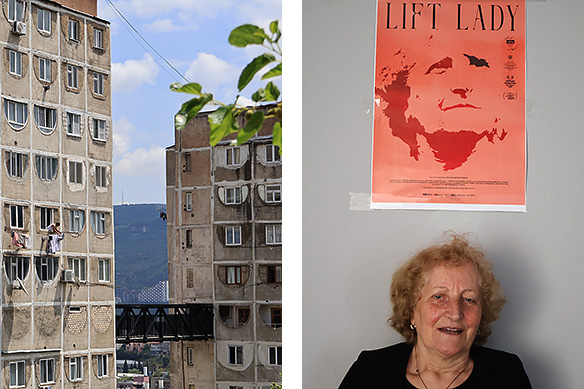
What did the Soviets do when three high-rise apartment blocks stood on a steep incline in Tbilisi? They built a walkway high up in the air, accessed through a 0.20 GEL coin-operated lift to connect the 10th, 12th, and 14th floors of the Brutalist-styled trio to help its residents commute. Back in the 1970s, Nutsubidze Apartments and its Skybridge were Soviet Tbilisi’s vision of the future. Of a city of skyscrapers connected with elevated footpaths.
Right photo: 72-year-old Mzia Sabanadze, who lives next to the lift shaft in a one-room-apartment with her cats, has been manually operating the lift for Nutsubidze Skybridge over the past two decades. It is a life that has warranted a couple of award-winning documentaries. Here she is with the movie poster for Lift Lady.
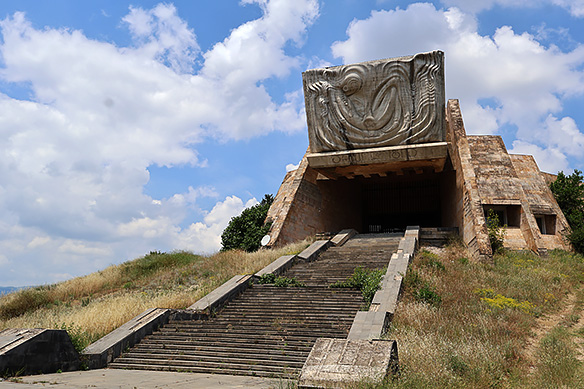
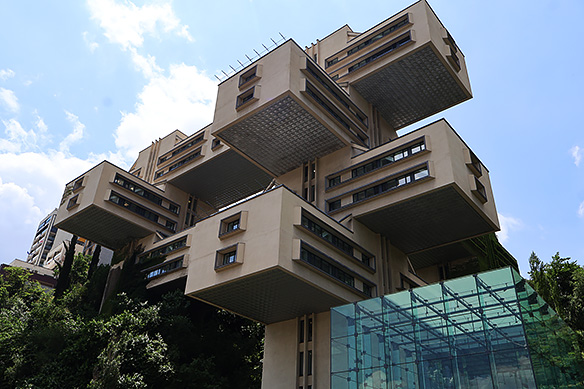
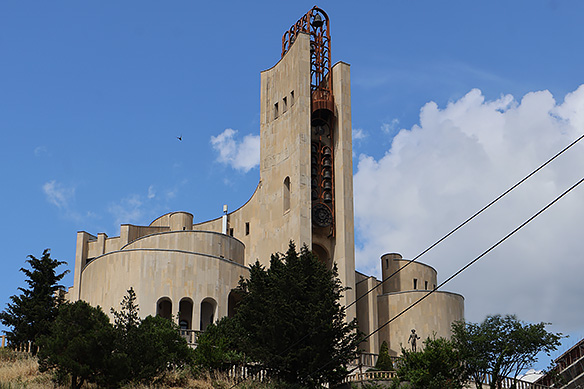
Not all Soviet architecture was the same. Here’s a case in point:
Top photo: Former Museum of Archaeology [1988] with a massive bas-relief depicting an ancient burial scene was designed to resemble a cave. What added to its creative Brutalist design was that it repurposed a defunct water reservoir.
Middle photo: A blend of Constructivism and Brutalism, the former Ministry of Automobile Roads, and later headquarters of Bank of Georgia built in 1975 took an 18-storey grid of interlocking concrete blocks and suspended it over a garden.
Above photo: Wedding Palace aka Palace of Rituals, a wedding venue from 1984. A cross between medieval Georgian church architecture and neo-expressionism, the edifice resembled a woman’s reproductive organs when seen from above.
CHAPTER 2: SECRETS OF TBILISI’S METRO AND RAILWAY
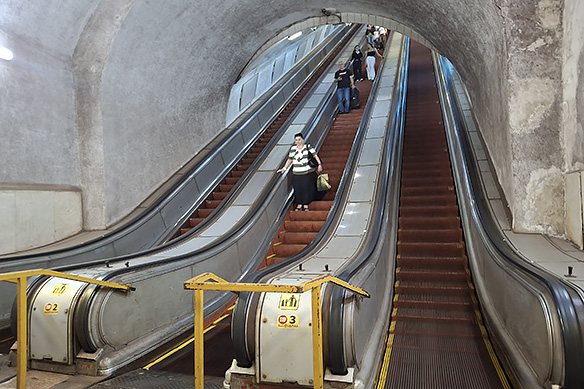
Tbilisi’s importance in the USSR’s scheme of things can be deduced from the fact that it got the Soviet Union’s fourth metro system, after Moscow, St. Petersburg, and Kyiv. Tbilisi even bypassed a key pre-qualification that required a population of at least one million, which it was short of when construction started.
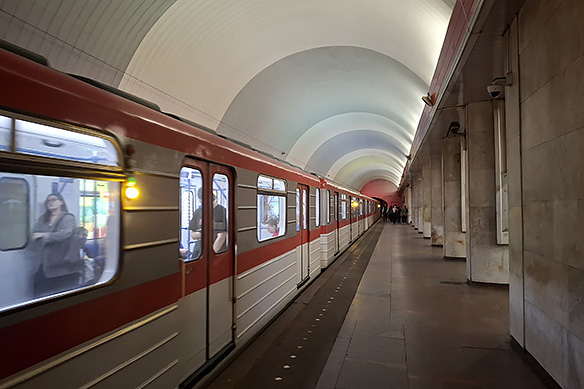
Launched on 11 January 1966, Tbilisi’s metro system has not changed much in the past 60 years, apart from the addition of a couple of stops. It still uses the same stations upto 60 metres deep in the bowels of the earth [aimed at doubling up as shelters if required], same lines, same tunnels and 4-car long trains which rattle and shudder at full speed, sans any breakdowns.
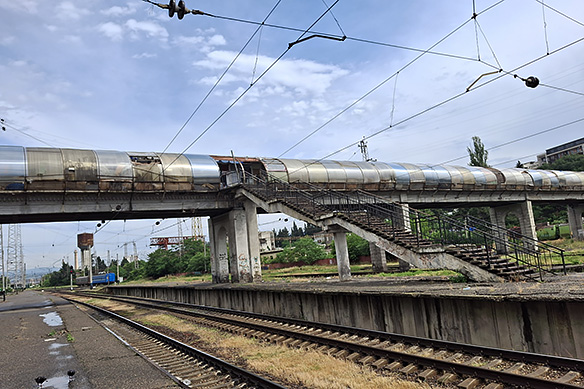
Soviet-era walkway in Tbilisi’s central railway station from where all outbound trains commenced, and still do.
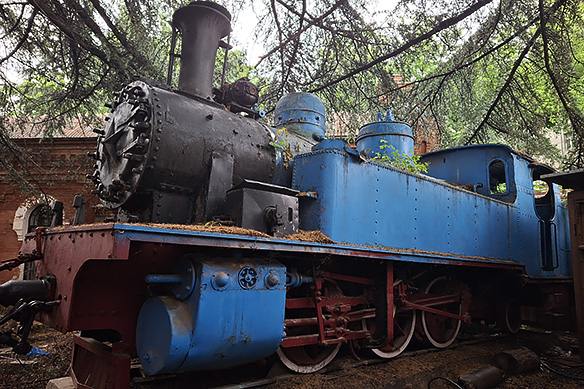
Georgia’s railway system was initiated during the Russian Empire days in 1872. But it was the later USSR which ensured all Georgian towns and cities connected with each other, as well as with the network that crisscrossed across the 15 Republics. This was to ensure Georgia’s abundant agricultural produce could reach the rest of the Soviet Union. A walk around the railway yards reveals abandoned engines and coaches, at times in the least expected places.
CHAPTER 3: TSKALTUBO, THE SOVIET SPA RESORT
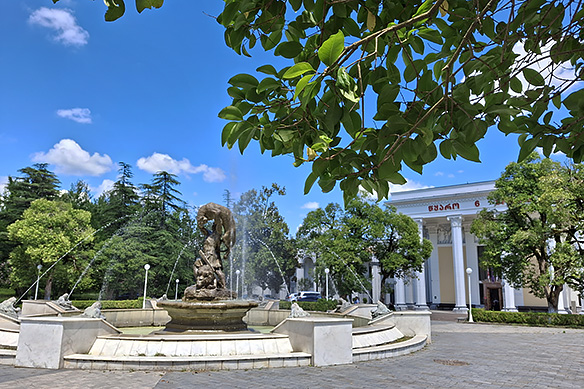
Tskaltubo, meaning ‘Place of Water,’ near the historical city of Kutaisi is former Soviet Georgia’s most poignant site. Photographed incessantly, explored endlessly—urbex enthusiasts rarely tire of it.
Comprising 22 sanatoriums built over radon-carbonated mineral springs around a vast central park, the spa resort favoured by USSR’s communists came with a dedicated railway station of its own. Hundreds of thousands of Soviets, both elite and proletariat, used to visit the town every year on state-sponsored holidays.
With the USSR’s collapse in 1991, Tskaltubo too met its end. Except for two spas. One of which was Spring 6, dated 1950, where Joseph Stalin had his own exclusive bathtub.
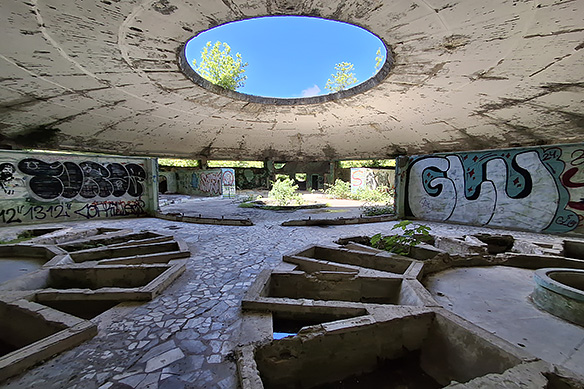
There were nine thermal baths in Tskaltubo. Bathhouse No. 8 [1959], akin to a huge spaceship with its central skylight, served as a communal bath for the Soviet Union’s industrial working class.
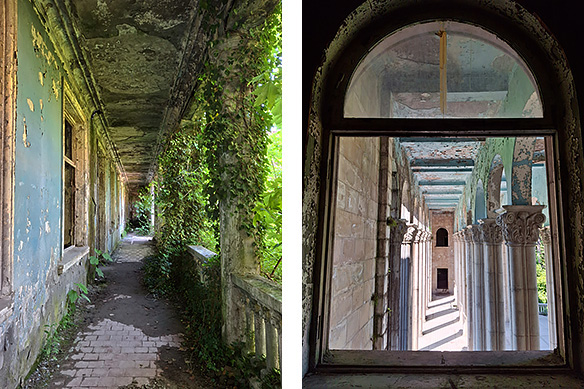
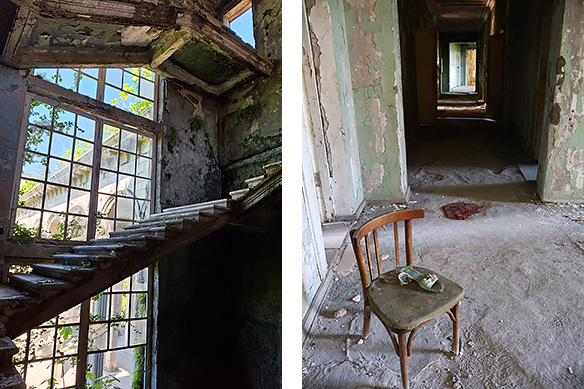
326 beds, eight years in the making, a neo-classical masterpiece of lofty Corinthian columns, expansive windows, and sweeping staircases. Sanatorium Medea, named after the Greek goddess of medicine, was one of Tskaltubo’s most elitist hotel-sanatoriums when it opened its doors in 1962 with a Who’s Who guest list.
After the USSR fell, its residents also changed. Overgrown trees and hundreds of displaced Georgians from the 1992 Abkhazia War took over the abandoned building this time. Though most of the refugees have since left, one sole middle-aged gentleman still calls Medea his home.
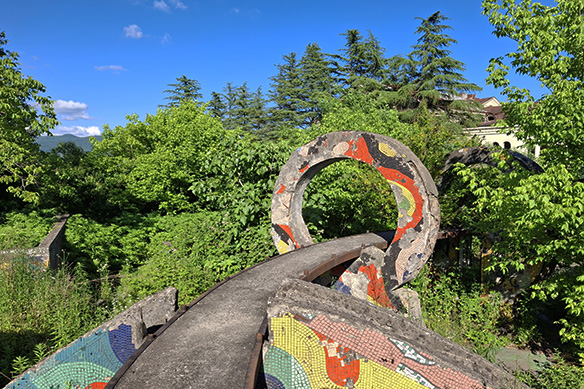
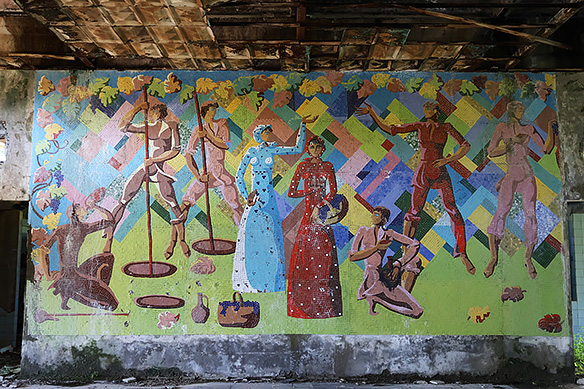
The Soviets loved decorating their cities with mosaics. Tskaltubo was no exception. Some of the finest examples can be found in the skeletal remains of the spa-town’s only children’s playground in Sanatorium Gelati [1964]. Another key site is the Modernist-styled Hotel Aia [1985] with two fabulous Georgian-themed murals. The above mural inside the latter’s main building celebrates traditional Georgian wine-making, qvevri et al.
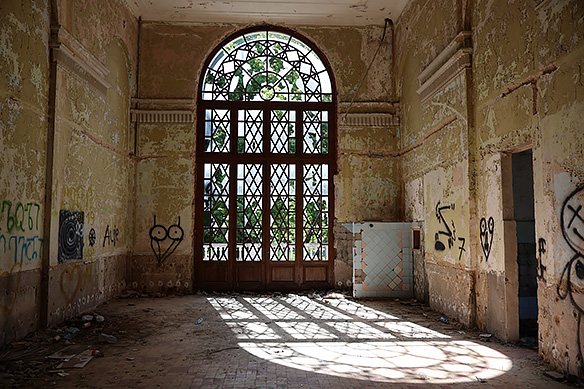
Last, but not least, Tskaltubo Railway Station [1955] which brought in Soviet visitors directly from Moscow for their ‘right to rest and leisure‘ all expenses paid holiday mandated by Article 119 of USSR’s Constitution!
CHAPTER 4: CHIATURA, SOVIET GEORGIA’S MINING VALLEY OF CABLE CARS
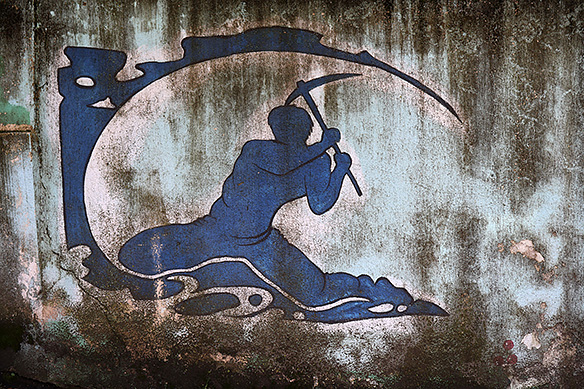
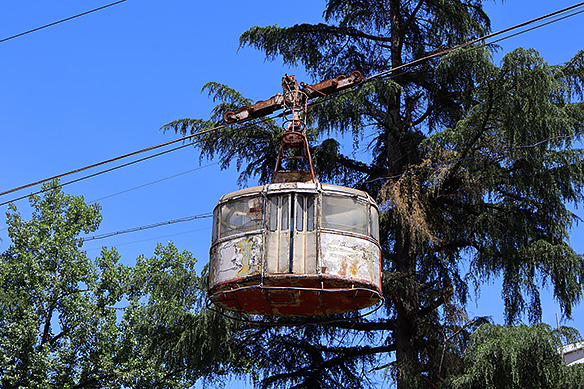
In its heyday in the 1970s and 1980s, Chiatura in western Georgia produced over one million tons of manganese ore annually, contributing to USSR’s standing as its largest producer in the world.
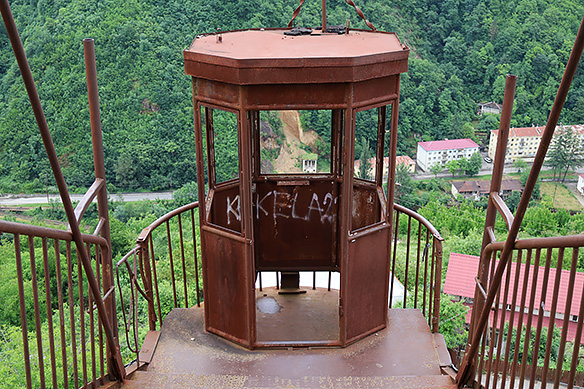
But a traveller does not visit Chiatura for its mines. Rather, it is for the network of nearly 20 cable car ropeways and two cargo lines the Soviets laced the deep valley with between the 1950s and 1970s. They were built to help workers reach the deposits stacked on the steep slopes, and transport ore.
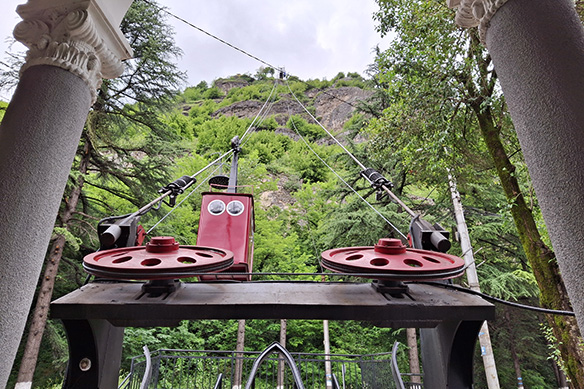
Freedom in 1991 brought with it an end to the mines’ supply systems, leading to a pause in production. The Soviet-era cable cars, described as ‘flying coffins,’ however, continued to function, ferrying residents up and down until 2018 when they were deemed unsafe, and replaced with new, more advanced versions.
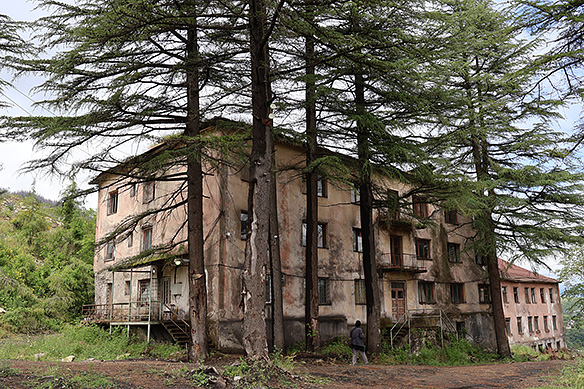
These earlier modes of transport still hang mid-air over the city-centre, whilst the Sashevardno Ropeway [1966] at a heady 48-degree-angle has been turned into a tourist attraction offering free rides. At the upper end of the ropeway is a deserted apartment block famed for offering Chiatura’s best views to its long-gone senior mining officials.
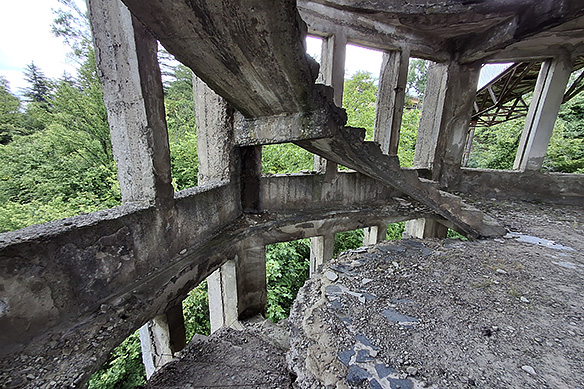
At the other end of Chiatura, reached by one of the four spruced-up new ropeways, is Naguti residential area. A short walk through Soviet-era apartment blocks brings one to Chiatura’s very own urbex highlight: a stripped-to-the-bone, deserted Soviet-era hospital with exquisite terrazzo floors and a towering crumbling 5-storey cable car station perched precariously atop a cliff.
According to a local story, the husband [who worked at the cable car office] of one of the ladies working at the hospital had this additional station built here to make it easier for her to get to work.
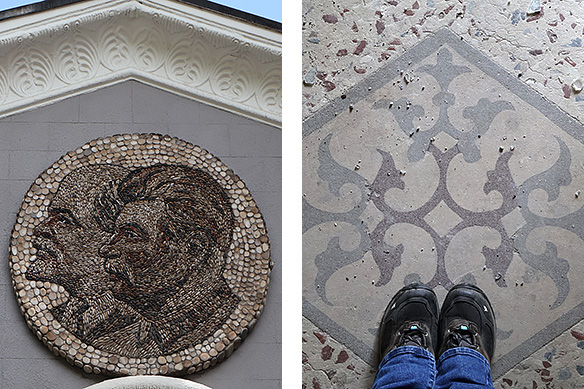
What was, and what is. Left: Mosaic of Lenin and Stalin on the facade of the Sashevardno Ropeway cable car station; Right: Inside Naguti’s once-upon-a-time state-of-the-art hospital.
CHAPTER 5: GORI, BIRTHPLACE OF STALIN
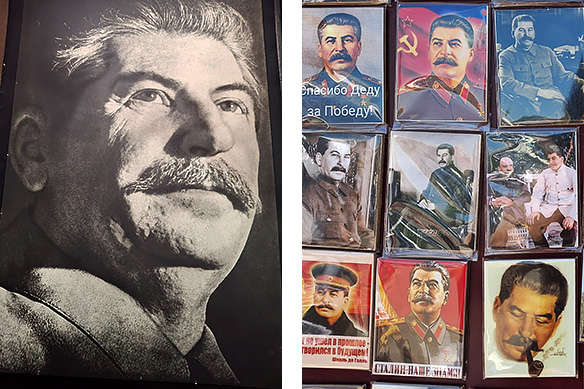
Ioseb Besarionis dze Jughashvili, better known as Joseph Stalin, was born in Gori in 1878. His father was an impoverished alcoholic cobbler who beat him up. His mother a launderer who wanted her son to become a priest. Stalin, meanwhile, chose to become a Bolshevik. A bit of a Robinhood, the young revolutionary carried out multiple heists for a ‘good’ cause: to fund printing presses and weapons for the Bolshevik movement.
All images one sees of Stalin are airbrushed versions. This was as per his instructions. Except for this one rare photograph in Gori’s Joseph Stalin Museum [left photo]. As a child, Stalin had had a severe bout of smallpox which left him heavily scarred.
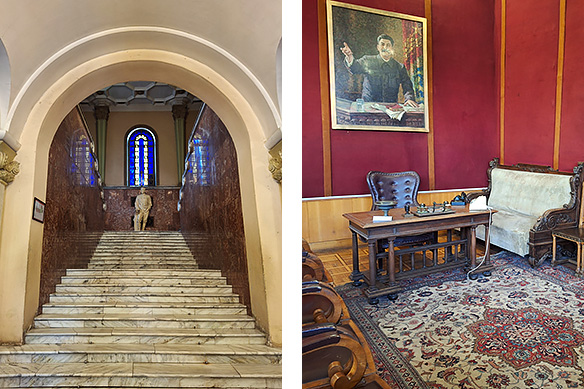
The palazzo-styled Joseph Stalin Museum in Gori’s city-centre was established in 1957, next to his childhood home. Filled with his belongings, state gifts, and photographs documenting his rule [with a halo] from 1924 to 1953, it is Georgia’s most popular and lucrative museum with visitors coming from around the world.
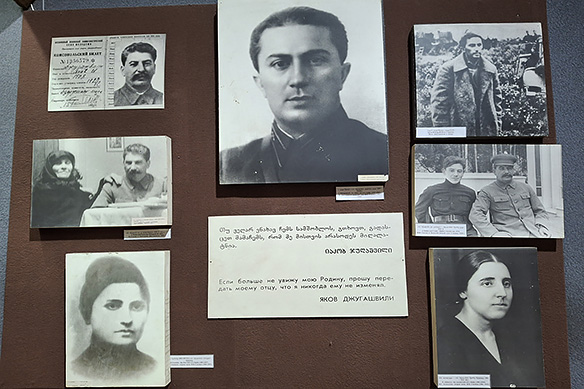
Joseph Stalin’s personal life in one frame.
Left, from top to bottom: His ID Card; With his mother, Ekaterina Dzhugashvili, who he last visited in 1935; Kato Svanidze, Stalin’s first wife [m. 1906 – 1907]. Middle: Yakov Dzhugashvili, Stalin’s eldest son [1907 – 1943]. Right, from top to bottom: Yakov Dzhugashvili in captivity; Stalin with his second son, Vasily [1935]; Nadezhda Alliluyeva, Stalin’s second wife [m. 1919 – 1932].
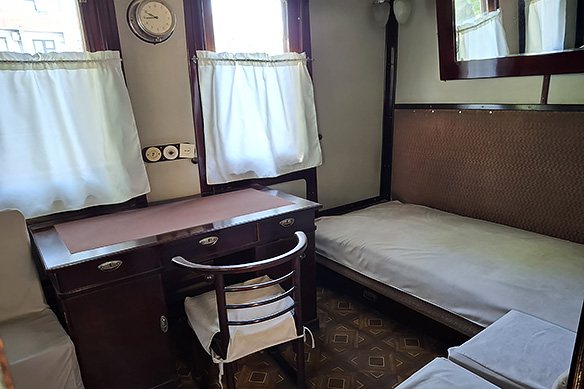
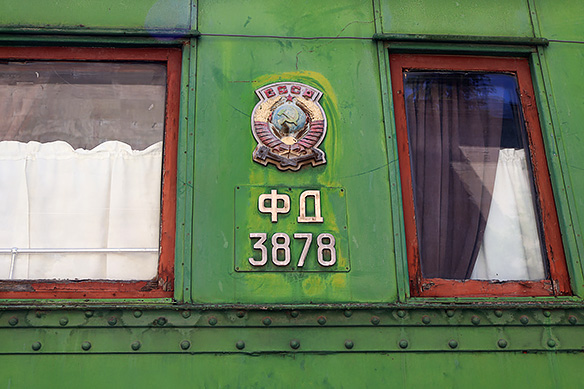
Stalin’s office-cum-bedroom [top photo] in his personal railway carriage. Weighing 83 tons and armour-plated, the carriage was used by Stalin from 1941 onward, including for attendance of the Yalta Conference in 1945 to discuss post-WWII reorganisation of Germany and Europe. Stalin was paranoid about flying, and flew only twice in his lifetime.
CHAPTER 6: CELEBRATING 200 YEARS OF RUSSIA-GEORGIA FRIENDSHIP
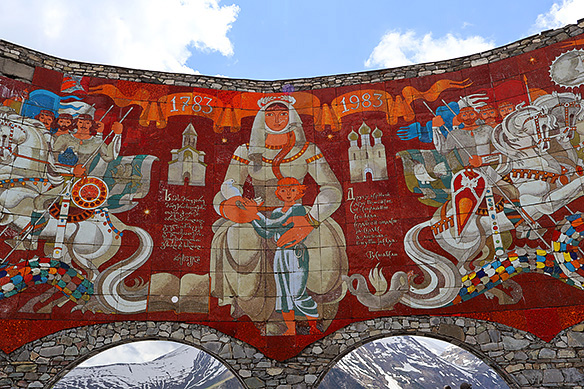
When travelling to picturesque Kazbegi via the Military Highway, one passes a gigantic stone and concrete semi-circle high up on a cliff in the Greater Caucasus Mountains. It is embellished with magnificent mosaic tiles, in the centre of which is a mother and child, representing Russia and Georgia, flanked with scenes from Georgian history to its left, and Russian history to the right.
Here’s a little secret. As a practice, Russians are usually portrayed blonde, and Georgians with russet hair. The Georgian craftsmen working on the mosaic tiles decided to give their country its due. They made the central mother figure Georgian, and the child Russian. By the time the Soviet authorities saw it, it was too late, and that’s the way it has stayed.
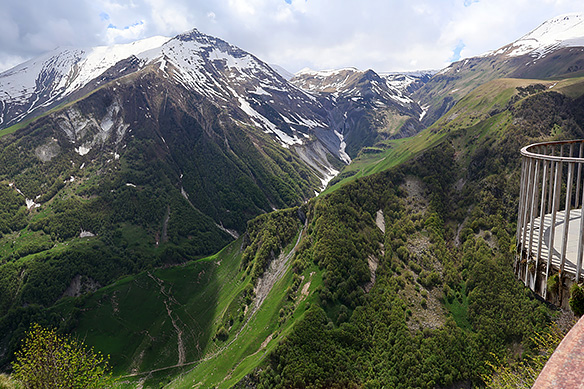
It all started when the Georgian King Erekle II reached out to the Russian Empire in 1783 for protection from looming Persian invasions and his kingdom became a Russian Protectorate. The Persians invaded, the Russians looked the other way. In 1801, Russia annexed his kingdom for itself and made it part of its empire. In 1921, the USSR annexed Georgia and made it a part of the Soviet Union.
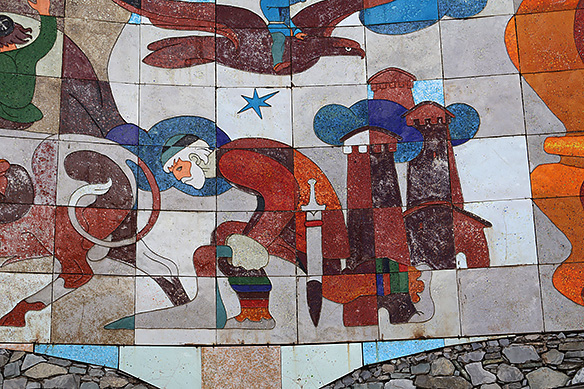
Scene from Svaneti with a Svan in a traditional hard felt hat seated next to the Georgian region’s archetypical cluster of medieval stone towers.
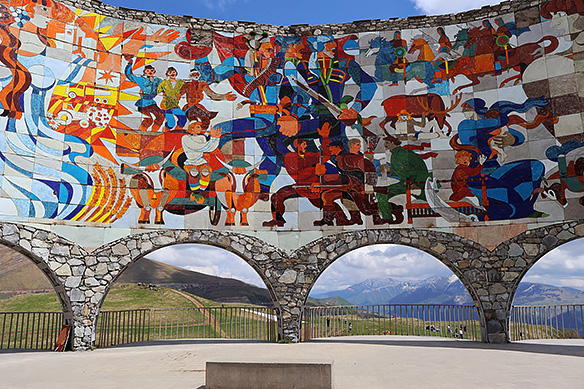
Two hundred years later, in 1983, the USSR decided to celebrate this friendship with a grand Soviet-styled mosaic-sheathed monument overlooking one of Georgia’s most spectacular valleys. Since then, there has been the fall of the USSR, Georgia’s independence, and one full-blown war between the two in August 2008, and a monument that now sits firmly on every Georgia itinerary.
– – –
I explored the above sites through various day tours from Tbilisi and Kutaisi with some of the most incredible guides I have met in my travels.
- Soviet Tbilisi with Zezva [+995 597 671767] from Real Georgia Tours.
- Secrets of Tbilisi’s Metro and Railway with Feel In Georgia.
- Tskaltubo with Lasha [+995 598 793720] from Budget Georgia.
- Chiatura with BFT Group.
- Joseph Stalin Museum and Russia-Georgia Friendship Monument with Gamarjoba Georgia Tours.
If you would like to know more about Joseph Stalin, this is a very interesting documentary on him: Stalin, The Red Terror.
– – –
[Please note there are NO affiliate or sponsored links or contacts or content in this post, or in any of my posts. These are provided only to help with your plans or for you to get extra information. The services mentioned are what I used and I am simply sharing them with you.]
This blog post is part of a series from my travels to Georgia for 17 days in June 2026. To read more posts in my Georgia series, please click here.


Absolutely fascinating! Thanks for posting.
LikeLiked by 1 person
Thank you, Mick. Glad you enjoyed it. 🙏
LikeLiked by 1 person
What a wonderfully written post. Very few people can compile such a comprehensive set of pictures. Indeed, Georgia has many soviet era reminders. Very few CIS countries have these memorabilia. The countries which have been less prosperous – can have some exceptions, tend to have more of them. There are people who love these soviet relics. There is a very small number of people who travel to see these relics.
Tiblisi is one the few places or may be the only place where elevetor in old soviet era residential buildings require coin, a charge for the visitors to use. This was to cover the operating cost from users. Owners of these apartments pay for it on monthly basis- maintenace. Not sure if you came across such buildings.
LikeLike
Thank you, Arvind for your kind words. Yes, I did visit such an apartment block. I mention it in the Soviet Tbilisi section. The one I visited was the Nutsubidze Skybridge Apartments, the most famous of the lot. 🙂
LikeLike
just skimmed through, looks interesting. Will read in detail over the weekend 🙂.
LikeLiked by 2 people
Thanks! I hope you enjoy the detailed read. I was first introduced to the world of urbex and the Soviet Union when I did a specialized tour of the Polygon, the Soviet Union’s nuclear test site in Kazakhstan. The 4 day tour and my co-travellers, all seasoned urbexers, changed the way I saw the Republics, giving me a deeper understanding of them which I have carried with me since. A few years ago, I would not have even imagined myself writing about abandoned or extant Soviet buildings. Now, I relish uncovering their secrets through image and word. 🙂
LikeLiked by 1 person
We spent a month in Georgia last summer, but travelling with my husband who grew up in a former communist country gave me a much less favourable view of these relics.
LikeLiked by 2 people
Travel is always subjective. Our past experiences playing a key role in how we process the present. Thank you for sharing your thoughts. 🙂
LikeLike
Pingback: batumi: stories told and untold | rama toshi arya's blog
Pingback: towering peaks and gold jewellery: georgia, land of the golden fleece | rama toshi arya's blog
Pingback: a cultural buff’s guide to tbilisi | rama toshi arya's blog
Pingback: georgia: a story of war and faith | rama toshi arya's blog