
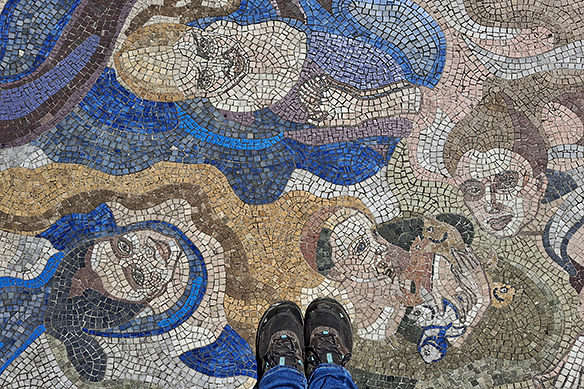
Mosaic in Batumi Piazza by Georgian-Swiss designer Natalia De Pita-Amirejibi comprises 88,244,735 cut and treated tiles of 1 sq. cm each. The marble for the tiles was sourced from 15 different countries.
Batumi sits on the far western frontier of Georgia, on a pebble-strewn Black Sea coast a mere 20 kilometres away from neighbouring Türkiye. Not many travellers to Georgia make it this far. Which is a pity. The chalk to the rest of Georgia’s cheese, Batumi is an over-the-top Las Vegas-styled sea-side resort in a country known otherwise for its soaring mountains, Soviet remains, Georgian Orthodox history, and earthy wine.
Brazen, brash, and straight out of Disneyland, Batumi is generous to the curious traveller. It tosses in a Byzantine fortress and a world-famous botanical garden into a quirky mix of fantastical skyscrapers, restored Russian Imperial-era edifices, fabulous outdoor art, mega events, and global cuisine.
Much like it did with me.
I did not know whether I was charmed or perplexed when I first stepped into Batumi. It was everything Georgia was not. And that’s what is its ultimate trump card.
![Alphabet Tower [2012], dedicated to Georgia's UNESCO-listed 33-letter standalone script, mimics the DNA double helix. The rationale behind the design? Georgia's one-of-a-kind alphabet is Georgia's one-of-a-kind DNA.](https://ramaarya.blog/wp-content/uploads/2026/07/batumi-city-4.jpg)
Alphabet Tower [2012], dedicated to Georgia’s UNESCO-listed 33-letter standalone script, mimics the DNA double helix. The rationale behind the design? Georgia’s one-of-a-kind alphabet is Georgia’s one-of-a-kind DNA.
Remnants of this layered history and recent rapid modernization has catapulted it into a bucket-list casino-cum-beach resort since 2010.
A hot favourite with the Russians and Turks, and slowly building a loyal base with regular travellers from across the world, Batumi is, nonetheless, more than its casinos and pebble beaches. Filled with stories, both told and untold from its eclectic past, it is a city one visits for a short break, and when about to leave, promises to return to.
Yes, I hope I do too. 🙂

There are botanical gardens and then there is the Batumi Botanical Garden. It is not often one gets to explore 108 hectares of subtropical vegetation with spellbinding views of the Black Sea.
Add to it the opportunity to circumnavigate through over 2,000 species of endemic vegetation from around the globe: from the Caucasus to East Asia, Australia, New Zealand with a pit stop at the Himalayas, and on to Central and South America and even the Mediterranean!

Almost three decades in the making, Batumi Botanical Garden is the handiwork of one single man, Andrei Krasnov, a Russian botanist, aided by his two gardeners.
Two years after his private garden was opened to the public, 114 years ago, Krasnov passed away. He is interred inside the hills and ravines he painstakingly tended to till his death. These gardens later grew to become one of Soviet Union’s largest botanical gardens towards the study and conservation of subtropical vegetation. A role it still takes seriously.


Above right: Want to take a little bit of Georgia’s iridescent wildflowers, including those abloom in Batumi Botanical Garden, back with you? Teona in Kutaisi makes these gorgeous pieces of jewellery with them. Each hand-crafted with love. You can check out her Instagram page here.


Batumi Boulevard is where all the city’s action is. Laid out in 1881, the 7-kilometre stretch flanks the pebbled coastline [New Boulevard] and includes landscaped historical gardens and avenues [Old Boulevard]. Along its length are sculptures, musical fountains, a giant Ferris wheel, and Batumi’s insta-worthy architecture.


Every 10 minutes, two 8-metre-tall transparent figures crafted from steel turn towards each other, accompanied with soft music. They slowly come closer, looking into each other’s eyes with longing. They kiss. Their bodies merge into one another. Only to then flow out of each other and stand apart. To stare at the Lower Caucasus Mountains in desolation. Waiting for a reunion. Yet constantly forced to part every time they meet.
Ali and Nino, Batumi’s celebrated kinetic sculpture by Georgian artist Tamara Kvesitadze is based on the 1937 tragic love story of Ali, a Muslim Azeri boy, and Nino, a Christian Georgian girl, by Azeri author Kurban Said.
In a way, the sculpture is more heart-rending than the story. In the novel, it was one parting. On Batumi’s sea-side boulevard, it is heartbreak every 10 minutes.


Love it or question it, Batumi’s architecture spanning two centuries seems to relish breaking the rules.
A fully-functional golden Ferris wheel embedded on the façade of Batumi Tower. A ribbon embossed with Georgia’s 33-letter script swirling around the frame of Alphabet Tower that’s topped with a café. An inland lighthouse first built in 1863 where 41 degrees latitude and longitude meet and snow-white colonnades dated 1934 standing guard at the now defunct entrance to the Old Boulevard. In Batumi, old and new rub shoulders without prejudice.


Have you heard the story of the golden fleece? One of Ancient Greece’s most well-known legends, it recounts Jason and the Argonauts’ quest for a fabled golden sheepskin. In the end, they did get it, as well as the lady who helped them: Medea.
Some scholars are of the opinion today that it was not all myth, but rooted in reality. Colchis, Georgia’s ancient kingdom, had abundant reserves of gold and used sheepskin to ‘catch’ the gold particles in the gushing rivers.
In the heart of Batumi’s central Europe Square is a tall column on top of which stands this same lady, Medea, holding the golden fleece. A gentle reminder of a period in Georgia’s history that transformed into a Classical legend.


Flashback to 1865. Batumi was then under the Ottoman Turks. A delegation of Greek Christians asked the Ottoman Sultan for permission to build a church. The Sultan agreed, but on one condition: no bells were to be rung, whatsoever. Up came the landmark St. Nikoloz Church. It was a sign foretelling the end of Turkish domination in Batumi, because 13 years later those church bells did ring. It was to welcome the Russian army.


Touted for its invincibility; guarded by both rock and sea. Petra fortress on the outskirts of Batumi gets its name from the terrain it stands on—’Petra’ is the Greek word for ‘rock.’ The 6th Century fortress was originally named after Justinian I, the Byzantine Emperor under whose jurisdiction Batumi fell.
The now crumbling ensemble of squat citadel walls, bathhouses, barracks, basilica, and a settlement has had its fair share of wars because of its strategic location. In the 6th Century it was the Byzantine Empire versus Sasanian Persia. In the 19th Century it was the Russians against the Ottomans.

Petra Fortress’ basilica served as the seat of the bishop. 1,400 years later, the ruins have not lost their sanctity. The day I visited, there were icons and offerings, and a recent picture of the much-loved Catholicos-Patriarch Ilia II who had passed away in March 2026 aged 93 after holding the post for 48 years. He was the longest serving patriarch in church history.


Archaeological findings from Petra Fortress are housed at the site museum. They cover the full spectrum of its existence. Of special mention are fragments of the 6th Century basilica’s mosaic floor and graceful clay pottery. But my favourite was the still intact miniature jar [top right]. I found it to be simply exquisite!
So, dear reader, are you tempted to make it to Batumi?
– – –
[This blog post is part of a series from my travels to Georgia for 17 days in June 2026. To read more posts in my Georgia series, please click here.]
 rama toshi arya's blog
I have enjoyed watching many videos of Batumi. Most of them focussing on casinos and a relaxed pace of life as a city with a sea. Thanks for sharing about the botanical garden, this is a first time I hae heard about it. As always, I enjoy the pictures you post, which are always pretty.
LikeLiked by 1 person
Thank you. 🙂 I liked Batumi and would not mind revisiting it. The botanical garden was especially lovely.
LikeLike
👍😊
LikeLike
Pingback: georgia: a story of war and faith | rama toshi arya's blog