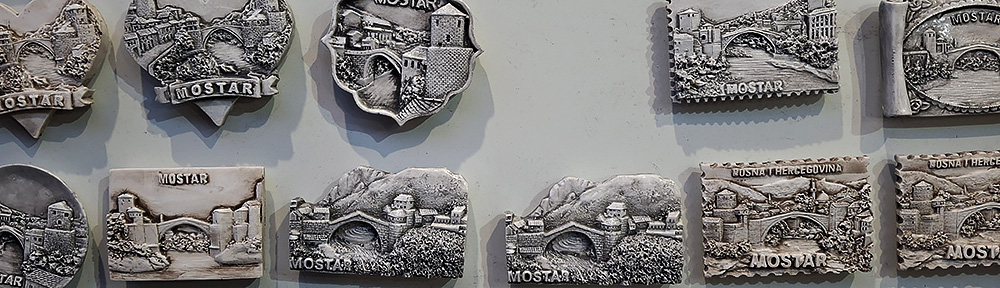
“You have to stay overnight in Mostar. During the day, the tourist groups block everything. It’s a really charming historical town surrounded by mountains. I think you will love it here!”
I take travel advice from my friend Jana very seriously, a Czech, who is more Indian than any Indian I have ever known. Riding her scooter through Delhi’s chaotic traffic and digging into Indian food with her bare hands. We met on a heritage walk and after that did countless more walks together. Though now we live on different sides of the globe—she in Austria, and me in Goa, we still exchange notes. This was one such. And as always, she was spot on.
Mostar is like a fairy-tale. Plucked from a different era, and plonked into the mayhem of 21st Century mass-tourism. Then slowly the day-trippers start to leave. Back to Sarajevo or onward to another destination. And Mostar reverts to the 16th Century and stays there till morning in its cobble-stoned Ottoman glory. One overnight to see all this. An extra overnight, because once seen, one wants to revel in it a little bit more. Fairy-tales don’t come our way often enough.
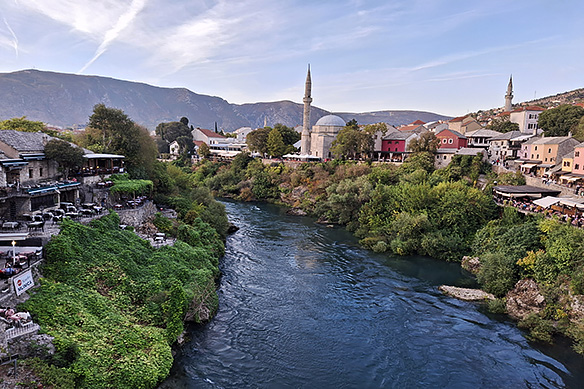
The Neretva river.
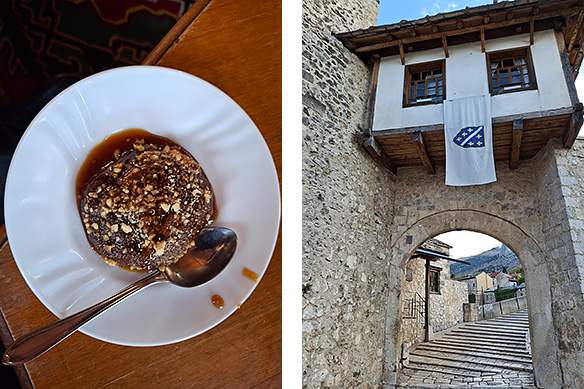
Left: Mostar Fig Cake, a local speciality; Right: The historic Najstariji Kafic-Cardak, housed in Halebija Tower, serves this delicious treat in a cosy setting with spectacular views.
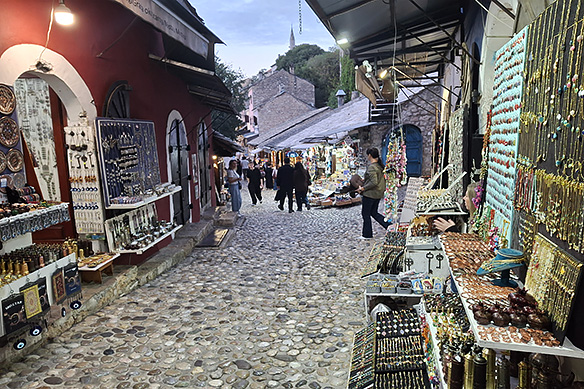
Market in Mostar’s Old Town.
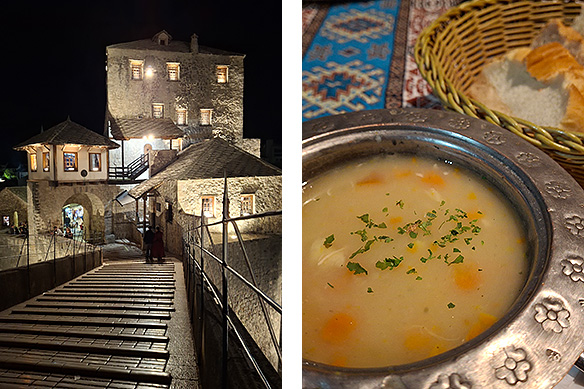
Once all the day-trippers have left … Stari Most at night and a dinner of Bosnian Bey’s soup with freshly-baked bread.
Stari Most, meaning ‘Old Bridge,’ is the city’s centrepiece, and soul. It was commissioned by the Ottoman Sultan Suleiman the Magnificent in 1557. So important was the bridge’s role in the scheme of things, the city was named after its guards. Mostar, literally meaning ‘bridge-keepers,’ refers to the officials once housed in the Tara and Halebija stone towers which flank the bridge over the Neretva river. Their task was to tax travellers and traders who crossed it so as to get to the opposite bank.
Mimar Hayruddin never expected his architectural experiment, the then world’s widest human-made arch—29 metres long, 4 metres wide, and 24 meters high—to survive even its launch. Nine years in the making, the stone bridge held together by egg-whites, was a perfect single semi-circle. He was so sure it would collapse, he even made preparations for his own funeral envisaging the Sultan’s wrath.
But Stari Bridge continued to stand: right until 1993. With bustling markets, snug homes, and grand places of worship, both churches and mosques, added around it over the years.
What time and history saved for over four centuries, a war smashed into pieces in a day. The two groups, Bosnian Muslims and Croat Catholics who started off as allies against the Orthodox Serbs in the Bosnian War, ended up fighting each other. Mostar Bridge was one of its victims in 1993, along with the hundreds of Bosnian Muslims who lie buried in and around the city under snowy-white grave-markers.
Mostar’s Stari Most was propped back to its original glory in 2004, rebuilt by Aga Khan Trust for Culture, UNESCO, World Bank, and World Monuments Fund from the pieces which had fallen into the river. In July 2005, along with the historic city-centre around it, the bridge was declared a UNESCO World Heritage Site as a symbol of reconciliation, coexistence, and peace.
Jana Sigmundová, this post is for you. 🙂
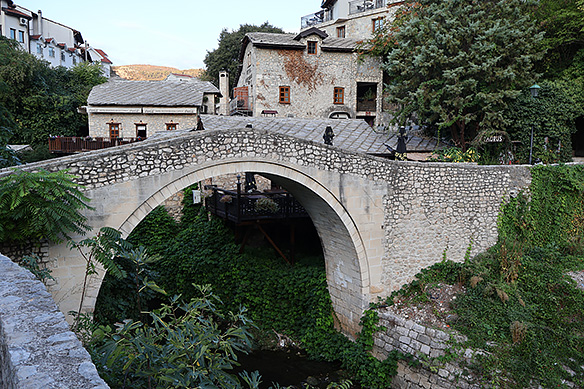
Crooked Bridge [1558, reconstructed in 2002]. One of the other many Ottoman bridges across the city and country.
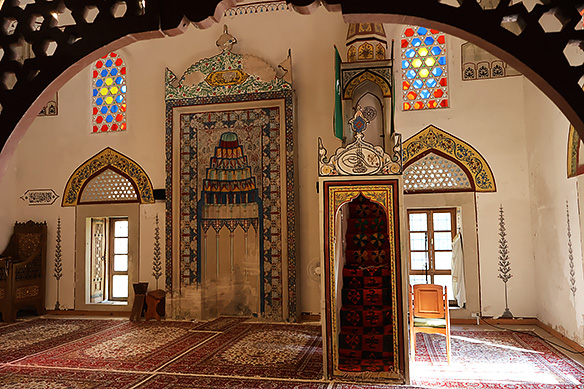
Koski Mehmed-pasha Mosque is named after a high-ranking Ottoman official who commissioned it in 1618.
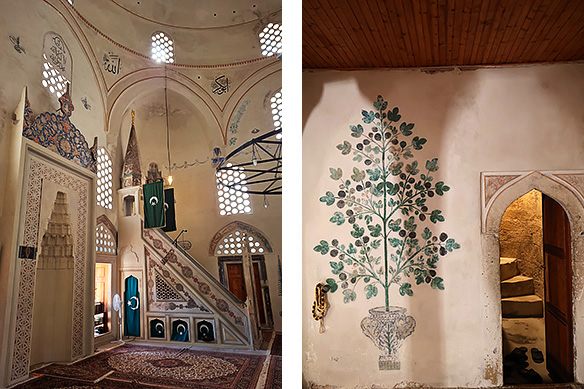
Bosnia and Herzegovina’s largest mosque, Karadoz Beg Mosque [1558] is legendary Ottoman architect Mimar Sinan’s only work in the country. Four layers of frescoes from different centuries cover its walls.
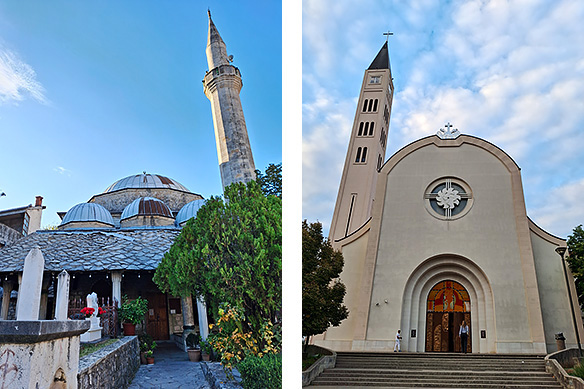
Reconciliation and coexistence. Left: Nesuh-Aga Vucjakovic Mosque [1564]; Right: Franciscan Church and Bell Tower.
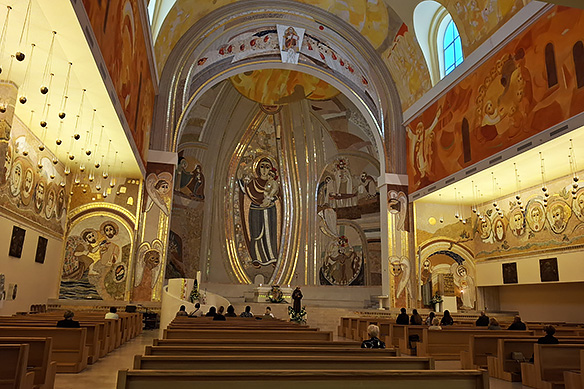
Built by the Franciscan community in Mostar in 1866, the Franciscan Church was destroyed during WWII and the Bosnian War. The current version dates to 1999 replete with the tallest belltower in south-east Europe at 107 metres.
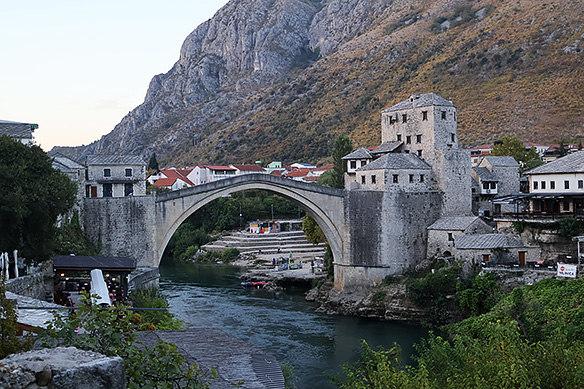
Dawn at Stari Most [Old Bridge]. ❤
– – –
Travel tips:
- Staying there: I stayed at the lovely family-run Pansion Bubamara Mostar in the Old Town.
- How many days: I stayed for three days, two nights.
- Getting around: All sights are within walking distance of each other.
- Cafes, restaurants, and souvenir shops on the left bank are cheaper than those on the right.
[I travelled solo and independently across Bosnia and Herzegovina for 11 days in September-October 2026. To read more posts in my Bosnia and Herzegovina series, please click here.]


Another amazing-looking place!
LikeLike