travel shorts: mostar, the city of stari most

This slideshow requires JavaScript.

“You have to stay overnight in Mostar. During the day, the tourist groups block everything. It’s a really charming historical town surrounded by mountains. I think you will love it here!”

I take travel advice from my friend Jana very seriously, a Czech, who is more Indian than any Indian I have ever known. Riding her scooter through Delhi’s chaotic traffic and digging into Indian food with her bare hands. We met on a heritage walk and after that did countless more walks together. Though now we live on different sides of the globe—she in Austria, and me in Goa, we still exchange notes. This was one such. And as always, she was spot on.

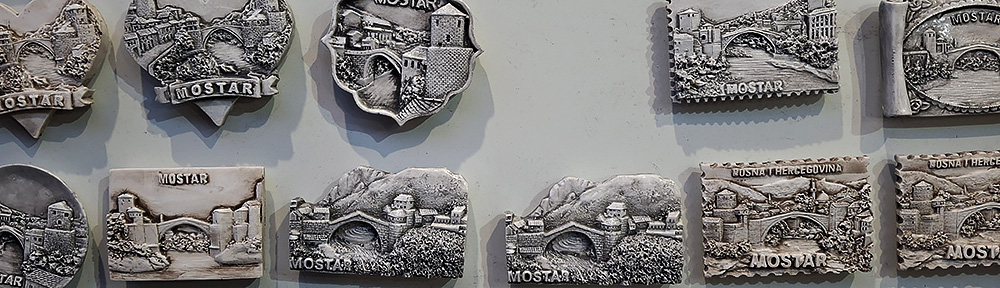
Mostar is like a fairy-tale. Plucked from a different era, and plonked into the mayhem of 21st Century mass-tourism. Then slowly the day-trippers start to leave. Back to Sarajevo or onward to another destination. And Mostar reverts to the 16th Century and stays there till morning in its cobble-stoned Ottoman glory. One overnight to see all this. An extra overnight, because once seen, one wants to revel in it a little bit more. Fairy-tales don’t come our way often enough. Continue reading →
in search of sarajevo, the jerusalem of europe

At certain times of the day, the peal of church bells merges with the muezzin’s call in Sarajevo. It is hard to separate the two. They are in such perfect harmony.

When Pope John Paul II, during his visit in 1997, called the city on Miljacka river the ‘Jerusalem of Europe,’ he was not off the mark. Sorry. Perhaps he was. Just a tiny bit.

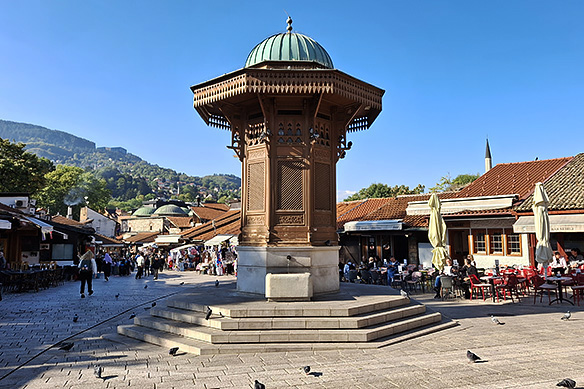
Whereas in Jerusalem the various Abrahamic religions’ places of worship are fitted neatly into their own respective walled quarters, Sarajevo throws all such restrictions to the wind. Every hundred metres or so is a mosque or a Roman Catholic church or a Serbian Orthodox church or a synagogue, filled with glorious religious art and jostling next to each other in a spiritual kaleidoscope.

Sarajevo’s unusualness lies not just in its marriage of the Abrahamic faiths, but also of East and West—the eastern Ottoman [1463 – 1878] and western Austro-Hungarian [1878 – 1918] empires which ruled over the city. There is even a line drawn across a street aptly named ‘meeting of cultures’ where the two cultures technically meet.

Yet, none of these religious and cultural identities have ever merged to create a syncretic new form. Rather, they chose, and still choose, to coexist, unwalled and untethered, in their own individual lights. Next to each other.

I wanted to see this in person. So, I set off in search of Europe’s Jerusalem. Come along with me? 🙂 Continue reading →

a cultural buff’s guide to tbilisi

So, you like museums, art, theatre, and live music. Then you are in the right place if you are in Tbilisi. 🙂

I spent 10 days in Georgia’s capital this June before travelling deeper west into the country. Though I would venture out on some days to discover the country’s north, south, and east, coming back to Tbilisi always felt like I was returning home.

The city’s hills hugged both the Kura river and hot sulphur springs; its slopes dotted with medieval stone churches. Strains of music would waft through the air, an accompaniment to the fragrance of freshly baked cheesy pies. A patchy sky overhead seemed perpetually torn between sunshine and rain.

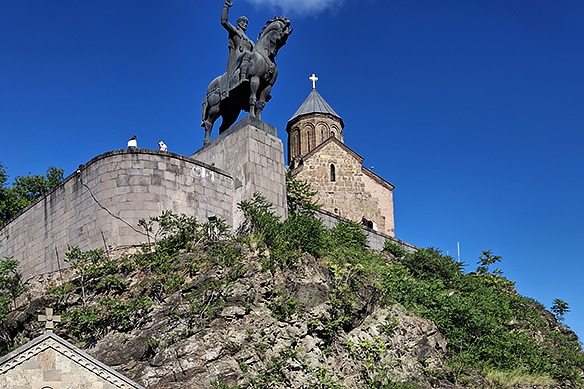
Popular legend credits King Vakhtang I Gorgasali as the city’s founder in 458 CE. An achievement reaffirmed by an equestrian statue of him perched on the riverbank. The story goes somewhat as follows: One day the king and his falcon went hunting. The falcon caught a pheasant, but both birds fell into a nearby hot sulphur spring. Chaffed at his discovery of these scalding hot waters miraculously emerging from the earth, the king decided to build a city at this spot. And so, Tbilisi—meaning the ‘warm place’—was born. Archaeological findings tend to dismiss this tale and place the city’s habitation further back in time to the Palaeolithic age. Continue reading →