Two stories define Sakartvelo. War and faith.
We know this ancient country as Georgia. But that’s not what Georgians call it. For them, it is Sakartvelo, land of the Kartvelians. Kartvelian means ‘a person of Kartli’—the historical name of the region since the 4th Century BCE.
Caught between powers hungry for regional domination, Georgia has spent millennia keeping itself and its identity intact in the face of attacks.
As the third country in the world to adopt Christianity in 327 CE, religion runs deep in the Georgian veins. It was faith that strengthened their resolve. It was equally imperative to protect that same faith.
Together these two stories are the story of Georgia. And the Georgian.
Each is incomplete without the other. Which explains why all the fortresses built over the centuries were essentially towering walls that surrounded an impregnable stone church in the middle.
Ananuri Fortress is the most dramatic of the lot with its 17th Century high walls looming over the Zhinvali Reservoir. Home of the Aragvi dukes since the 13th Century, it stands sentinel on the road to the Greater Caucasus in the north. Inside, squashed within the walls are two churches whilst a third is perched on the outside. Despite a siege, massacre and arson in 1739, the main church remains a masterpiece with its massive grapevine cross on the facade and a delicate fresco of the purgatory inside.
If Ananuri is formidable, Rabati Castle aka Akhaltsikhe [New Castle] is about a Georgian ruler who converted to Islam during Ottoman rule. A bit of a misnomer, it was first built in the 9th Century, and morphed over the centuries in tandem with geopolitical developments. The result is a concoction of Turkish elegance and Georgian might wrapped around a medieval citadel, 16th Century gold-domed mosque and madrasa, and a 9th/ 10th Century Georgian Orthodox church.
Not much survives of the historical city of Sighnaghi, except for its 4.5-kilometre-long defensive wall punctuated with 23 of the original 28 towers. The city itself was carefully restored in 2005 to its current picture-postcard pretty self. Built by King Erekle II in 1772 to ward off raiders from Dagestan, the crumbling stone walls overlook Alazani Valley sheathed in vineyards with the snow-capped Greater Caucasus Mountains in the background.
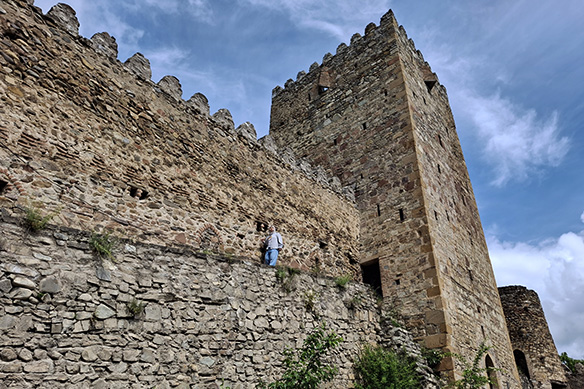
The name Ananuri comes from Ana of Nuri village who chose to die rather than reveal the whereabouts of a secret tunnel to marauding enemy armies.
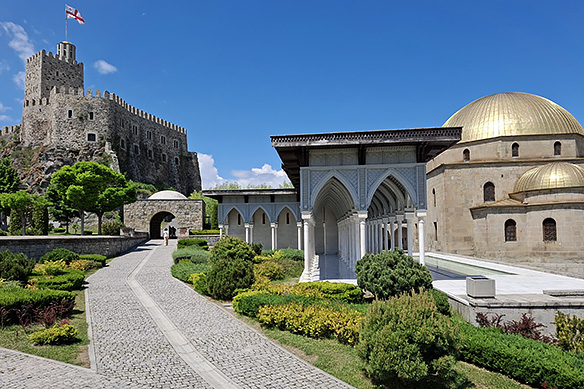
Rabati Castle comprises an upper Medieval Georgian citadel and a lower section with an Ottoman mosque and Georgian Orthodox church amidst pools and gardens.
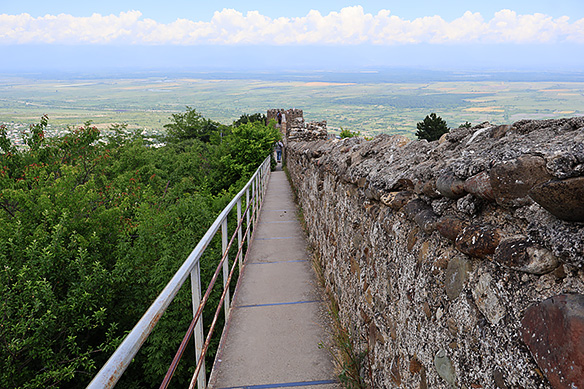
Sighnaghi’s defensive walls built in 1772 by King Erekle II overlook the pretty Alazani Valley.
When Georgia’s churches were not enveloped in high walls, they stood on remote mountain peaks, isolated from the world. These inaccessible solitary stone structures served as vaults for the safeguard of sacred Georgian Orthodox crosses and icons from raids by the Arabs, Seljuks, Mongols, Ottomans, and yes, even the Soviets.
Over the past two millennia, thousands of cross-dome Georgian Orthodox churches have been built across the country. Gergeti Trinity Church [14th Century] in Kazbegi, tasked to protect the most valuable Christian icons and crosses in turbulent times, tops in terms of majestic setting. Look out for the lizard reliefs on the slit windows. They signify spiritual renewal. Bodbe Monastery [9th Century], built over the tomb of St. Nino is the most revered. There is the quirky thrown in for good measure too. Namely, the 7th Century chapel atop a 40-metre-high limestone Katskhi Pillar near Chiatura in which to-date a monk lives and prays.
Before Tbilisi, UNESCO-listed Mtskheta used to be the capital of the Kingdom of Kartli. In keeping with its role as the political and religious centre of one of the world’s earliest Christian states, it was filled with grand cathedrals, monasteries, and chapels. Each of immense historical import.
Jvari Monastery [590s], perched on a mount overlooking the confluence of the Kura and Aragvi rivers, marks the spot where St. Nino pierced a pagan site with a cross and changed the course of the country for good. Svetitskhoveli Cathedral, the country’s principal church consecrated in 1029, stands in the historical city centre. The name translates to ‘Living Pillar’ after Jesus Christ’s robe which is enshrined inside.
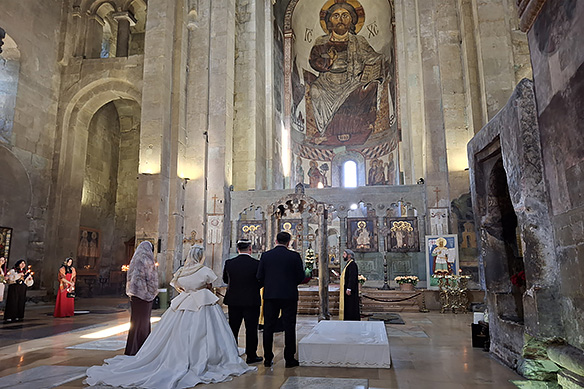
A wedding in full swing at the grand early-11th Century UNESCO-listed Svetitskhoveli Cathedral in Mtskheta.
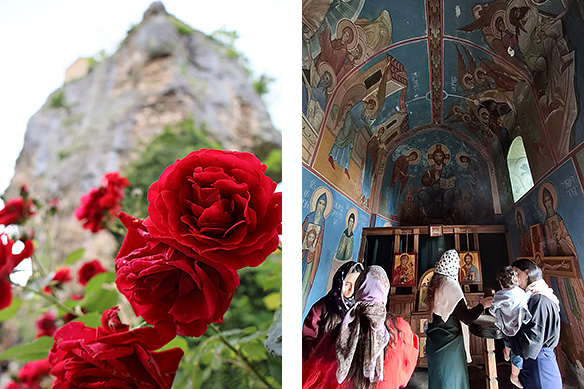
For 1,400 years monks have lived and prayed atop the Katskhi Pillar. Laymen are not allowed up and have to do with the chapel at ground level.
After David IV the Builder [r. 1089 – 1125] reunited Georgia, Kutaisi in western Georgia became the epicentre of religious architecture. Up came the magnificent UNESCO-listed Gelati Monastery-cum-Academy in 1106 with David IV buried under the main gateway so that everyone would walk over his grave. A case of extreme humility?
Closer to the city is the equally grand, though now partially reconstructed Bagrati Cathedral built by King Bagrat III in 1003. Motsameta Monastery, also 11th Century and known for its scenic location, is dedicated to two 8th Century saints—the siblings David and Constantine who were martyred fighting Arab invaders. Mtsvanekvavila Church [1913], remarkable for its gallery-like display of icons, closes the loop of key religious structures in and around Kutaisi.
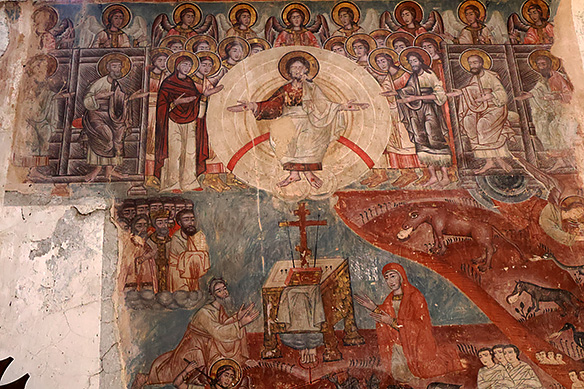
Detail, 17th Century fresco inside the Church of the Assumption, Ananuri Fortress. The fresco depicts the purgatory, a popular theme in Christian iconography.
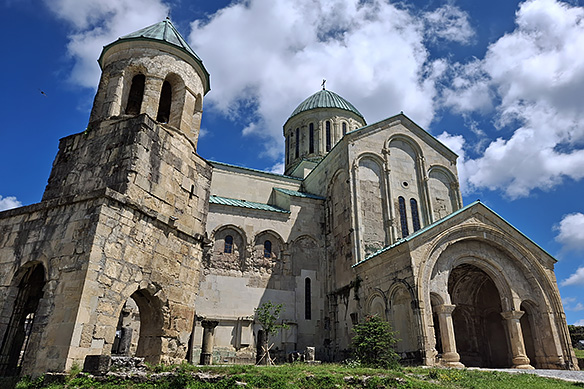
Bagrati Cathedral built by King Bagrat III in 1003 used to be a UNESCO-listed site. It lost its status after excessive restoration work.
Besides the fortresses and churches is another unique architectural feature typical of Georgia. An outcome of war and faith, and fortresses and churches rolled into one, they are the country’s underground city-monasteries.
Georgia is no stranger to cave dwellings. This architectural concept preceded St. Nino who brought the faith to the country, holding a cross made of two pieces of grapevine held together with strands of her hair. She was not exactly welcomed with open arms—it took a solar eclipse for King Mirian III to come around. He was atop a peak, and the skies went dark. Bewildered, he prayed frantically to his pagan gods. But in vain. Then he remembered St. Nino who had healed his wife and called out to Jesus. The skies cleared and there was daylight again. Georgia, thenceforth, became a Christian state.
People in this part of the world had seen the advantages of subterranean dwellings in a warring region as far back as 1000 BCE. Uplistsikhe was one of Georgia’s oldest urban settlements. It lay underground.
Continuously inhabited from the Early Iron Age until the 13th Century, it was a unique mix of pagan [cave architecture] and Christian architecture [10th Century basilica]. The city was eventually destroyed by the Mongols and never revived.
Inspired by Uplistsikhe, enormous subterranean city-monasteries such as Vardzia and David Garaja were also carved out of Georgia’s mountains. These took the shape of multiple levels connected with steep stairs eked out of the living rock, replete with bakeries and wineries, and places of worship, hidden away from the world.
Before being sliced open by an earthquake in 1283, Vardzia’s 19 ‘floors’ consisted of a full-fledged plumbing system and 6,000 rooms to house monks, libraries, pharmacies, wine cellars, a nunnery, and multiple churches and chapels. The most significant was the Church of the Assumption with a rare portrait painted during the lifetime of King Tamar who had commissioned the monastic complex in the 1180s. Post the earthquake and with time, Vardzia has been reduced to the current 13 levels and 641 chambers.
Meanwhile, the David Gareja Monastery one sees today, and which is still in use, is a fraction of the whole. Flush next to the Azerbaijan border, the rest of the monastery, which ran into around 5,000 monk cells carved into the sandstone ridges in the semi-desert, lies on the other side of the border. David Garejeli was one of the 13 Assyrian Fathers who brought monasticism to Georgia in the 6th Century, and a proponent that true monasticism needed to be devoid of all distractions. Hence, the desert location!
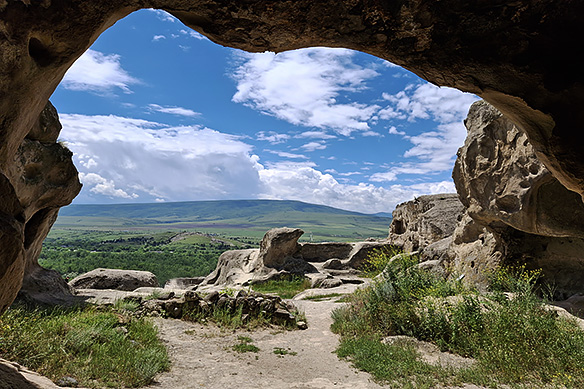
Uplistsikhe was continuously inhabited from the end of the 2nd Millennium BCE to the 13th Century CE. It reveals an unusual mix of pagan and Christian architectural elements.
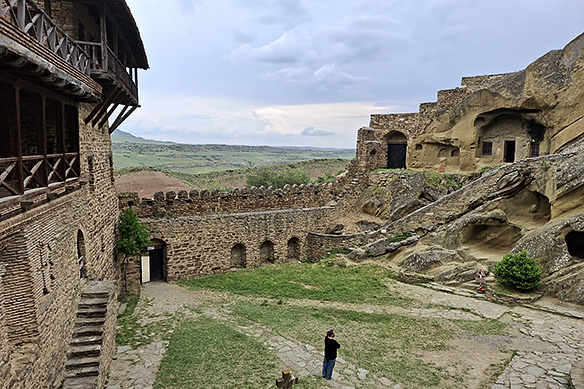
David Gareja Monastery, founded by the Assyrian Father David Garejeli dates to the 6th Century.
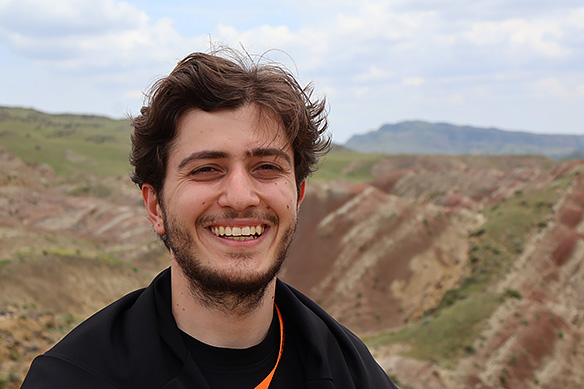
Nika, my guide, on our hike in the ‘Rainbow Mountains’ that surround David Gareja Monastery.
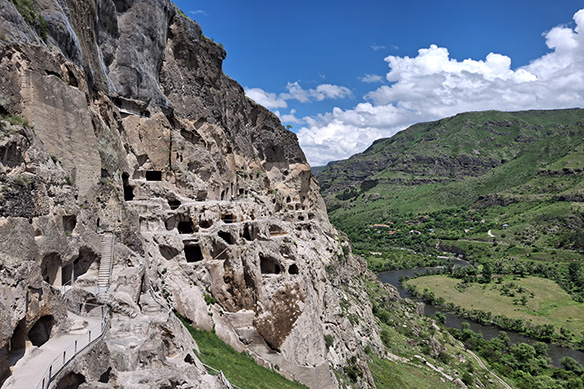
12th Century Vardzia, when built on the orders of King Tamar, was fully encased in the sandstone mountains. An earthquake in 1283 ripped it open.
To see more images of Georgia’s fortresses, stone churches, and cave city-monasteries, click on any image below to start a slide show with captions and use the arrows to navigate through the lot. The three are irrevocably tied to each another, and Georgia’s story of war and faith. ❤


![David IV the Builder's [r. 1089 – 1125] grave at the entrance of Gelati Monastery.](https://i0.wp.com/ramaarya.blog/wp-content/uploads/2026/08/georgia-churches-kutaisi-gelati-1.jpg?w=190&h=190&crop=1&ssl=1)


And on that note, I come to the end of my Georgia series as well. If you missed any of the earlier posts and would like to read them, here they all are. Next week, another country, another piece of sunshine from our beautiful world.
- Travel shorts: Home at the Kutaisi Family House Museum
- Photo essay: Remnants of Soviet Georgia
- Travel shorts: Georgia, birthplace of wine and the toastmaster
- Travel diaries: In search of King Tamar’s Svaneti
- Batumi: Stories told and untold
- Towering peaks and gold jewellery: Georgia, land of the golden fleece
- A cultural buff’s guide to Tbilisi
- Georgia: A story of war and faith [this post]


Thanks from a history buff who did not delve deeply enough in this age of Georgia on her visit. My interest tended to veer off into circa 1300 BCE. 🙂 Beautiful photographs!
LikeLiked by 1 person
Thank you. I am the perpetual Alice in Wonderland when travelling. Everything fascinates me. Hehe.
LikeLike
Another remarkable set of photographs. Fascinating!
LikeLiked by 2 people
Many thanks, Mick. Guess my bachelors in fine arts comes in useful in more ways than one. But I cannot take all the credit. Georgia is a very beautiful country. 🙂
LikeLiked by 2 people
If I were you, I’d take the credit!
LikeLiked by 1 person
You are kind. 🙏
LikeLiked by 2 people
“Powerful storytelling through photography- capturing history and faith together in such a compelling way. Looking forward to more features like this.”https://www.abirpothi.com/
LikeLiked by 1 person
Thank you for your kind words. The link you shared is very interesting. 🙏
LikeLiked by 1 person
Pingback: batumi: stories told and untold | rama toshi arya's blog
I thoroughly enjoyed this sum up of some of the ancient churches and monasteries you visited in Georgia, with back stories to give them more context. Your photos are beautiful too — they certainly show the charm of these historical sites.
LikeLiked by 2 people
I am a sucker for back stories and context — I believe they imbue an edifice with life and make it a part of living history. 🙂 Like I know you do too. Glad you enjoyed the writeup and pictures. I enjoyed putting it together.
LikeLiked by 2 people
Whenever I read about Georgia, it reminds me of the wonderful times I spent there exploring the country. It is a land so rich in history.
LikeLiked by 2 people
Glad the post brought back happy memories. I really enjoyed Georgia too. All that incredible history amidst such beautiful nature.
LikeLiked by 2 people