
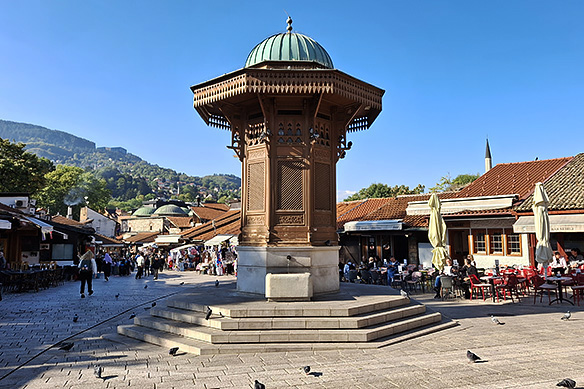
At certain times of the day, the peal of church bells merges with the muezzin’s call in Sarajevo. It is hard to separate the two. They are in such perfect harmony.
When Pope John Paul II, during his visit in 1997, called the city on Miljacka river the ‘Jerusalem of Europe,’ he was not off the mark. Sorry. Perhaps he was. Just a tiny bit.
Whereas in Jerusalem the various Abrahamic religions’ places of worship are fitted neatly into their own respective walled quarters, Sarajevo throws all such restrictions to the wind. Every hundred metres or so is a mosque or a Roman Catholic church or a Serbian Orthodox church or a synagogue, filled with glorious religious art and jostling next to each other in a spiritual kaleidoscope.
Sarajevo’s unusualness lies not just in its marriage of the Abrahamic faiths, but also of East and West—the eastern Ottoman [1463 – 1878] and western Austro-Hungarian [1878 – 1918] empires which ruled over the city. There is even a line drawn across a street aptly named ‘meeting of cultures’ where the two cultures technically meet.
Yet, none of these religious and cultural identities have ever merged to create a syncretic new form. Rather, they chose, and still choose, to coexist, unwalled and untethered, in their own individual lights. Next to each other.
I wanted to see this in person. So, I set off in search of Europe’s Jerusalem. Come along with me? 🙂
SOUTH SLAV MUSLIMS OF THE OTTOMAN EMPIRE
Bosnians have historically been a bit of a rebel. In a time when the Christian world was split between Roman Catholicism and Eastern Orthodoxy, the medieval Bosnian kingdoms chose to go their own way. They founded their own Bosnian Church in the 12th-13th Century, rooted in Bosnian traditions, headed by its own bishop.
After the Ottomans conquered the region in 1463, it was relatively easy to convert the Bosnians without the need for ethnic amalgamation. Labelled a heretic by the two Christian denominations, Islam offered the Bosnians the same monotheistic beliefs coupled with social and economic benefits. Slowly and steadily, over the next century, the South Slavs of Bosnia and Herzegovina adopted their new faith, and have practiced it ever since to form 51 percent of the country today. Blue-eyed and blonde in hijabs and prayer caps.
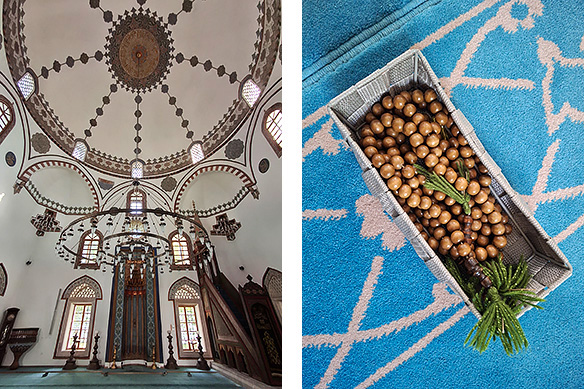
Emperor’s Mosque was the first mosque to be built in Sarajevo by the Ottomans after they conquered the Bosnian kingdoms. Originally built in 1457, it was rebuilt in 1565.
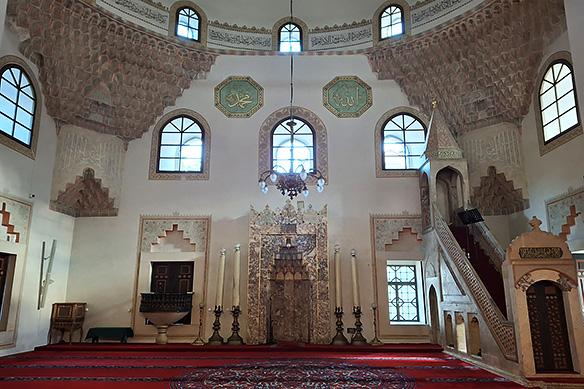
Sarajevo’s central mosque, Gazi Husrev-beg Mosque is the country’s primary congregational mosque since it was built in 1531.
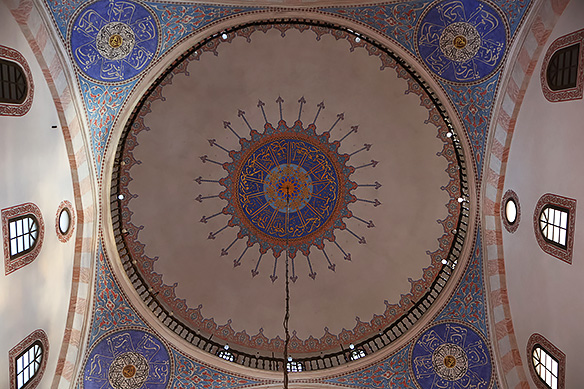
Painted ceiling with Quranic verses and the many names of Allah inside Gazi Husrev-beg Mosque.
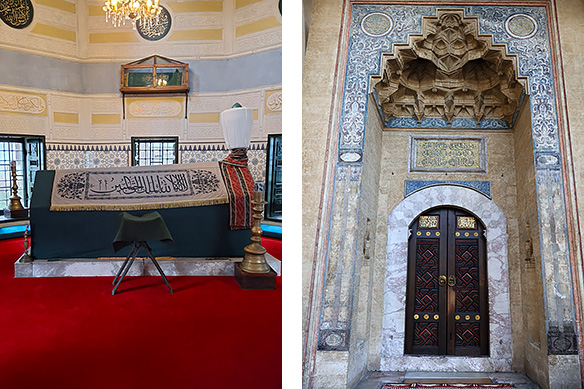
Left: Gazi Husrev-beg’s mausoleum in the courtyard; Right: Main entrance of Gazi Husrev-beg Mosque.
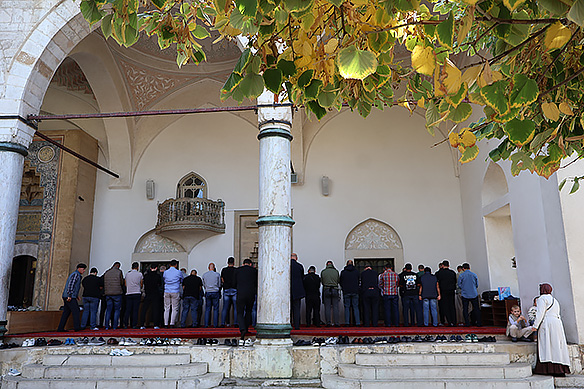
Prayer time at Gazi Husrev-beg Mosque. The mosque has a capacity of 1,500 worshippers.
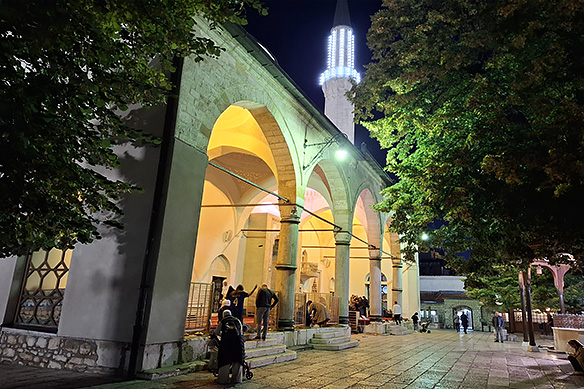
Built by Gazi Husrev-beg, the Ottoman governor of Sarajevo, the mosque was the centrepiece of an endowment which also comprised a madrasah, market, and hammam, around which the city grew. The mosque was, and continues to be, a focal part of local community life.
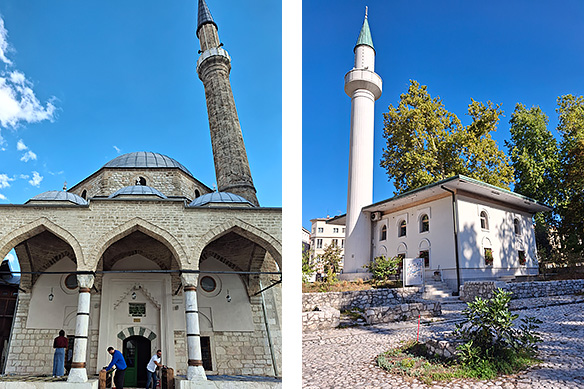
There are over a hundred active mosques in Sarajevo, ranging from small neighbourhood ones to the grand historical ones. Left: Bascarsija Mosque [1528]; Right: Bakr-Baba Mosque [first built in 1544 and rebuilt multiple times with the most recent being 2011].
CROATS, THE SOUTH SLAVS WHO CHOSE ROMAN CATHOLICISM
Not all medieval Bosnians chose Islam when their kingdoms were taken over by the Ottoman rulers. Some veered towards Roman Catholicism practiced by the neighbouring Croats. A number that rose further with the arrival of the Austro-Hungarian empire. 15.4 percent of Bosnia and Herzegovina’s population [2013 official census] is Roman Catholic of which 98 percent are ethnically Croats.
Unlike its neighbours who chose very specific religious and political trajectories, Bosnia and Herzegovina’s journey has often been that of a melting pot. Sandwiched between Roman Catholic Croatia aligned with Rome and Western Europe, and Eastern Orthodox Serbia who were pro-Constantinople and later pro-Russian, both Croats and Serbs spilled into the nation in-between over the centuries—and called it home.
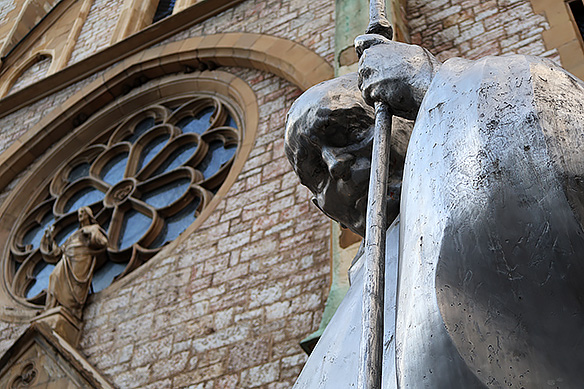
Pope John Paul II’s statue outside the Sacred Heart Cathedral in memory of his visit to the city in April 1997.
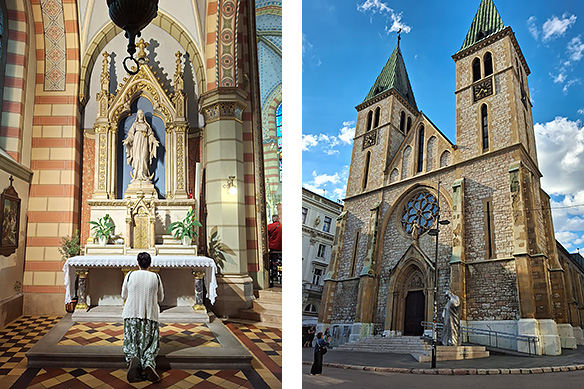
Modelled after France’s Notre Dame, Sarajevo’s Sacred Heart Cathedral is a cross between Neo-Gothic and Romanesque Revival styles, and serves as the centre of Catholic worship in the city.
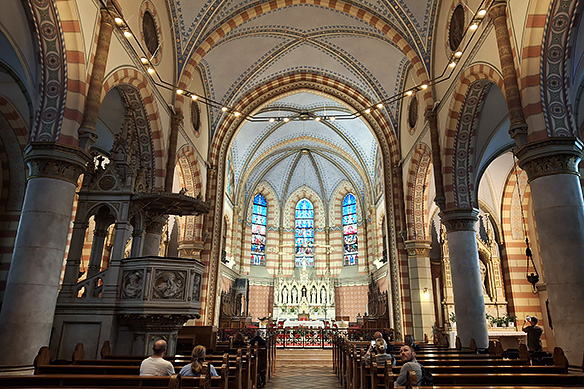
Inside the Sacred Heart Cathedral: facing the altar. It was consecrated in 1889 during Austro-Hungarian rule.
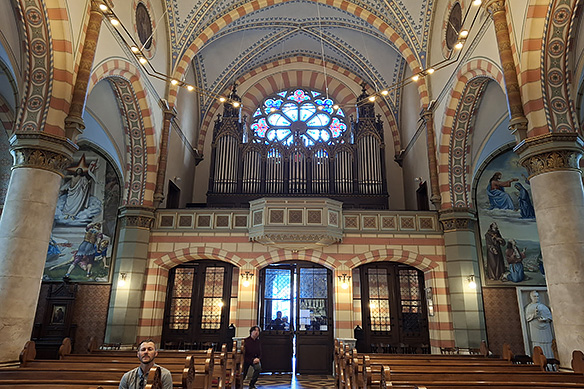
Inside the Sacred Heart Cathedral: facing the entrance, rose window, and church organ.
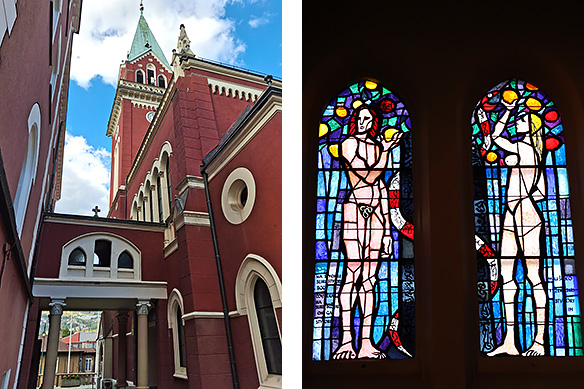
Church of Saint Anthony in the city’s historical Bistrik neighbourhood is attended by people of all faiths, earning it the moniker ‘church of all Sarajevans.’ Consecrated in 1914, it is dedicated to the Franciscan friar Anthony of Padua. Right: Stained glass window [2006] depicting Adam and Eve.
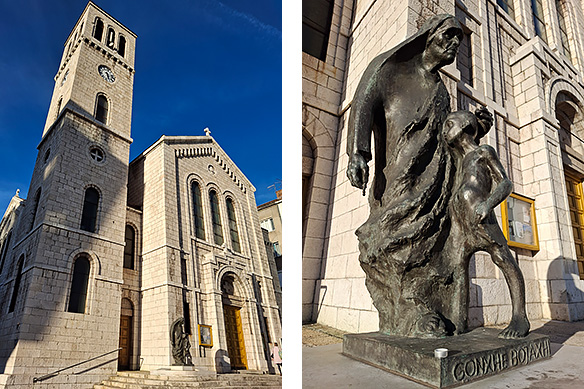
An effigy of Mother Teresa guards the 1940 Romanesque-styled Saint Joseph’s Church. A reminder that “we cannot all be beautiful, smart or important, but we can all be good.”
EASTERN ORTHODOX SERBS WHO MADE BOSNIA THEIR HOME
Thirty-one percent of Bosnia and Herzegovina’s population is Serbian Eastern Orthodox; it is practiced by ethnic Serbs. Since 1995, they are centred in Republika Srpska, one of the two political entities formally established within a single national border, courtesy of the Dayton Peace Agreement.
Things were different before the Bosnian War. Prior to 1992, Eastern Orthodox Serbs lived across the country, including Sarajevo. A spill-over from next door Serbia over centuries, they enjoyed special protected status under the Ottomans; a practice started by Sultan Mehmed the Conqueror and continued by later rulers. This helped the Serbs boost their numbers, build churches and monasteries, and even have their own metropolitan bishops in an otherwise Muslim region.
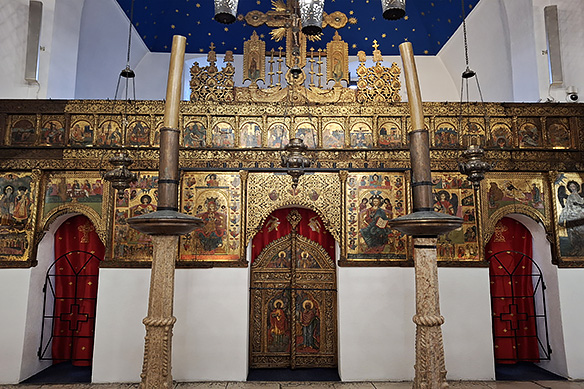
17th Century carved wooden iconostasis in the Old Orthodox Church, also known as the Church of the Holy Archangels Michael and Gabriel [1539].
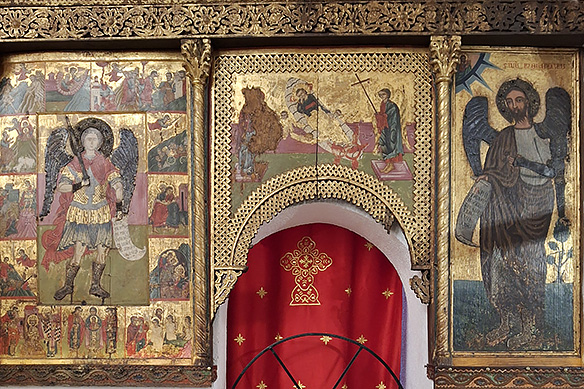
Detail of iconostasis depicting the Holy Archangels Michael [left] and Gabriel [right] in the Old Orthodox Church.
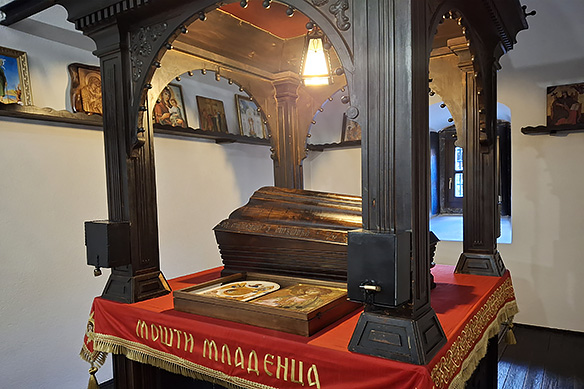
Child’s Tomb in the Old Orthodox Church is believed to have mystical powers. Since medieval times Sarajevan women have walked around the structure thrice and then crawled under it if wishing for fertility or protection for their children.
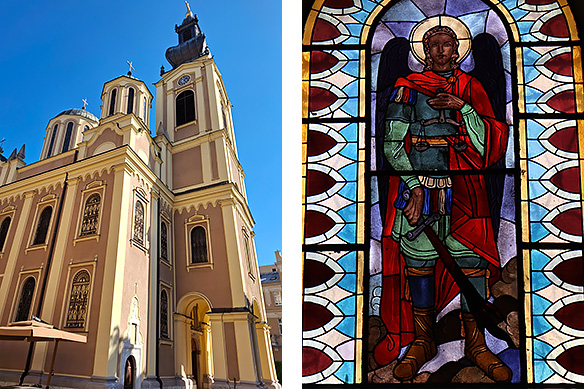
Cathedral of the Nativity of the Theotokos was Sarajevo’s first non-Muslim building to be taller than its mosques. It was partly funded and completed with the Ottoman Sultan’s blessings and protection in 1874.
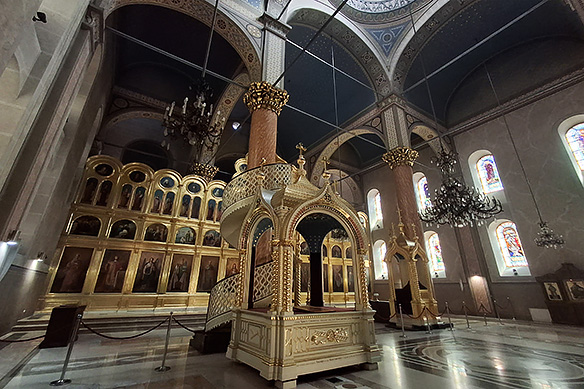
Inside the Cathedral of the Nativity of the Theotokos, the largest orthodox church in Sarajevo and one of the largest in the Balkans.
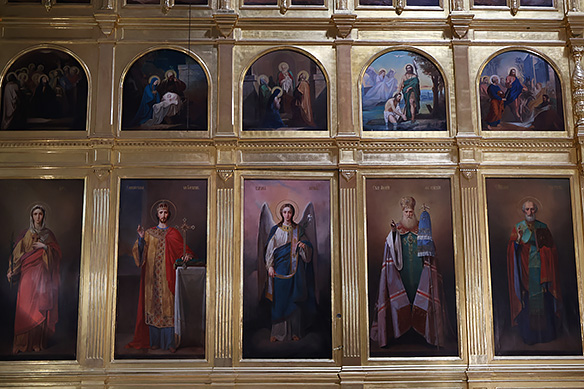
Detail of the Cathedral of the Nativity of the Theotokos’ iconostasis with icons from Russia.
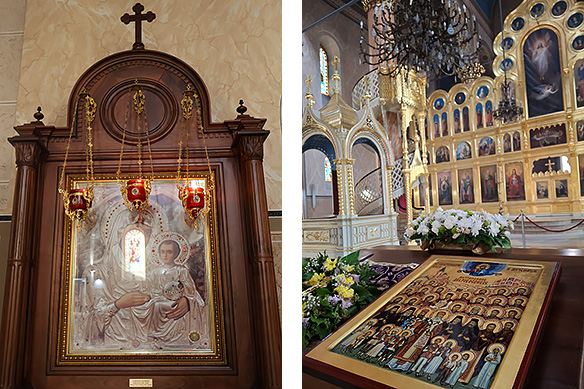
Theotokos, Most Holy Mother of God icon [left image] and All Saints icon [right image] in the Cathedral of the Nativity of the Theotokos.
SEPHARDIC JEWS WHO FOUND REFUGE IN SARAJEVO
The Ottoman empire’s fetish for plurality, especially as a source for economic growth, also included Jews. When Sephardic Jews were expelled from Spain and Portugal, amidst the Spanish Inquisition’s bloodbath launched in 1492, they found a safe haven in Sarajevo. Arriving in the hundreds, they brought with them their rich traditions and the famed 15th Century Haggadah. A few centuries later, they were followed by an influx of Ashkenazi Jews under Austro-Hungarian rule.
These numbers have since dwindled significantly—because of the holocaust and many choosing to move to Israel during the Bosnian War [1992 – 1995]. Though Bosnian Jews amount to a mere few hundred today, they form an inseparable part of the soul of the city having contributed to its trade, art and crafts, and literature over the years.
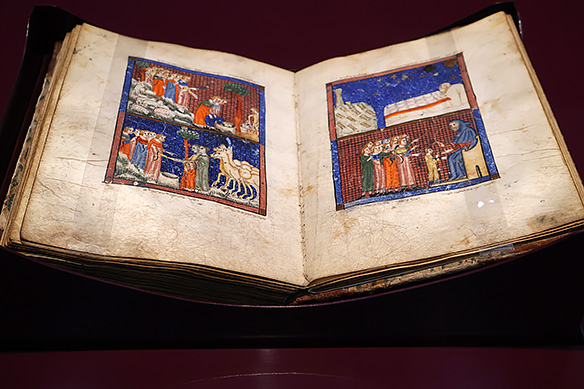
One of the oldest Haggadahs in the world, the Sarajevo Haggadah is housed in the National Museum. Composed in Spain in the 14th Century, it came to Sarajevo after the expulsion of the Jews. Its miraculous survival is credited to a secret nook under the threshold of a village mosque during WWII, and the National Bank’s vaults during the Bosnian War [1992 – 1995].
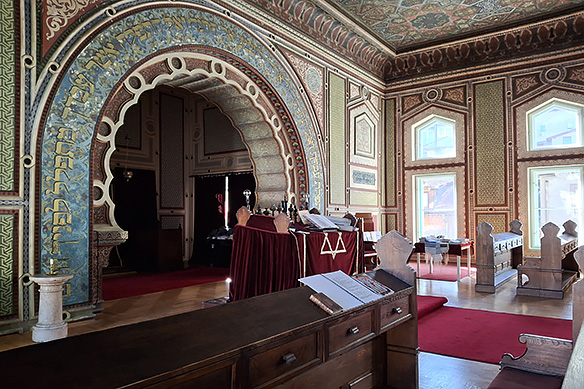
Ashkenazi Synagogue, also known as the Sarajevo Synagogue, was built in 1902, in the then fashionable Moorish Revival style.
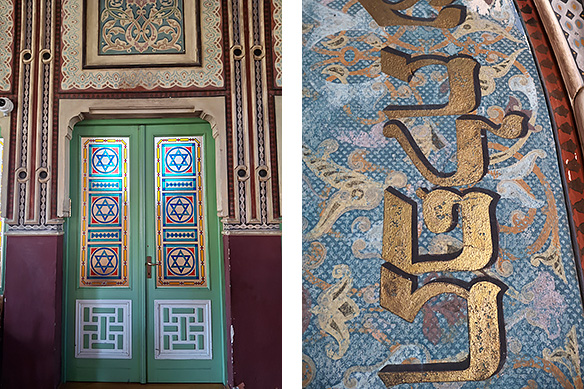
There used to be eight active synagogues in Sarajevo. Now there are only two—the Ashkenazi Synagogue caters to the city’s whole Jewish community, both Ashkenazi and Sephardic.
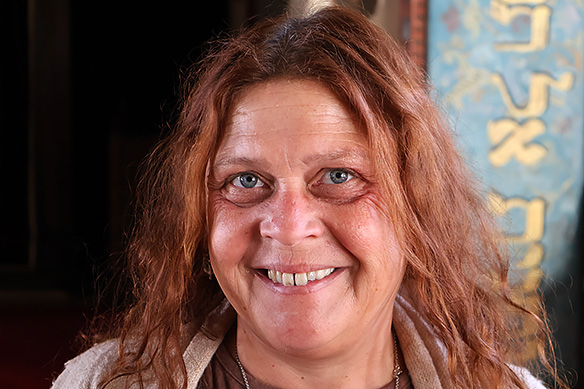
Anja, a Sephardic Jew and my guide at the Ashkenazi Synagogue, left for Israel during the Bosnian War. After the war ended, she chose to return to Bosnia and Herzegovina. She explained: “All my friends, family, my roots are here in Sarajevo.”
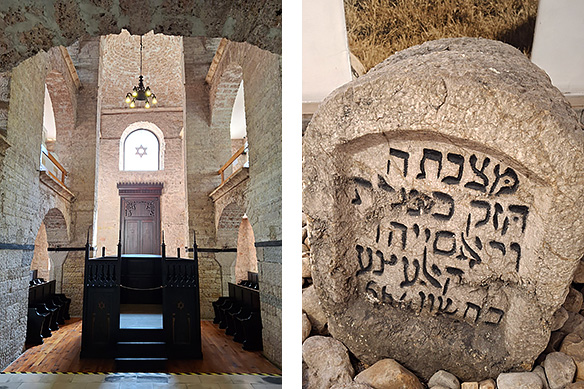
The once-upon-a-time Old Sephardic Synagogue has been converted into a synagogue-cum-Jewish Museum. Right: Medieval Sephardic ‘lion’ tombstone.
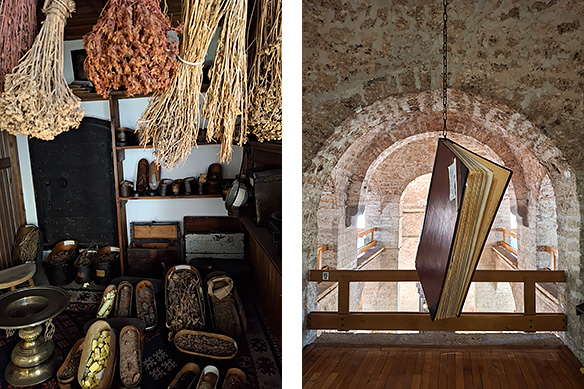
Jewish Museum. Left: Attar [apothecary, herbalist] shop of the Papo family which stood on the same site for more than 300 years; Right: Book of the 12,000 Jewish victims of World War II.
EPILOGUE
One city. Four religions.
The very mix that made Sarajevo different, became the reason for its biggest wounds through a four-year long siege [1992 – 1995], and ultimately its strength to withstand it and rise again. Stronger. More kind.
For a secular spiritual person, as I like to see myself, Sarajevo is plurality in all its earthly flawed splendour. The word was: Jerusalem. ❤
I hope you enjoyed this post. Next week, come along with me to Mostar, the city of the iconic Stari [Old] Bridge.
– – –
Travel tips:
- Staying there: I stayed at the very lovely, comfortable, and spotless family-run Halvat Guesthouse in Sarajevo Old Town. Valida, the hostess is an absolute sweetheart and super-hospitable.
- I explored Sarajevo first on a walking tour, and then more on my own. My guide for the walk, Taljic Lejla [cell no. +387 62 709273] of Sarajevo Insider is fabulous.
- Getting around: All sights are within walking distance of each other.
- Recommended café: Slatko i Slano Carsija for delicious coffee, pastries, and home-cooked meals.
[I travelled solo and independently across Bosnia and Herzegovina for 11 days in September-October 2026. To read more posts in my Bosnia and Herzegovina series, please click here.]
Note: There are NO affiliate links in this post, or in any of my posts. Links are provided only to help you with your plans or to give extra info. Neither is any of the content in this post or any of my posts sponsored. The services mentioned in this post are what I used and I am simply sharing them with you.


Really beautiful post, Rama – fantastic art and stories! Have you read Joe Sacco’s Safe Area Goražde. It’s quite a traumatic read. Your post gives me an entirely different and happier view of the region.
LikeLiked by 1 person
Glad you liked it, Harini. No, I have not read the book you mention. One thing I have learnt in life is everything is subjective, and we carry our own light. Am not saying the country has not had more than its share of pain. I will be writing about the Bosnian War and the Genocide later in the series. But, I also saw pluralism and peace aplenty. 🙂
LikeLiked by 1 person
Btw, how were you able to ‘like’ the post? I got a notification. I ask, because I have disabled the ‘like’ feature on them. At times I do not understand WordPress. 🙂
LikeLiked by 1 person
I dunno, just saw the like button and clicked it – nothing clever!
LikeLiked by 1 person