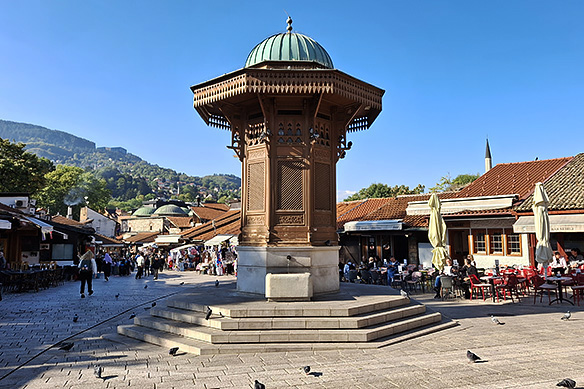
At certain times of the day, the peal of church bells merges with the muezzin’s call in Sarajevo. It is hard to separate the two. They are in such perfect harmony.
When Pope John Paul II, during his visit in 1997, called the city on Miljacka river the ‘Jerusalem of Europe,’ he was not off the mark. Sorry. Perhaps he was. Just a tiny bit.
Whereas in Jerusalem the various Abrahamic religions’ places of worship are fitted neatly into their own respective walled quarters, Sarajevo throws all such restrictions to the wind. Every hundred metres or so is a mosque or a Roman Catholic church or a Serbian Orthodox church or a synagogue, filled with glorious religious art and jostling next to each other in a spiritual kaleidoscope.
Sarajevo’s unusualness lies not just in its marriage of the Abrahamic faiths, but also of East and West—the eastern Ottoman [1463 – 1878] and western Austro-Hungarian [1878 – 1918] empires which ruled over the city. There is even a line drawn across a street aptly named ‘meeting of cultures’ where the two cultures technically meet.
Yet, none of these religious and cultural identities have ever merged to create a syncretic new form. Rather, they chose, and still choose, to coexist, unwalled and untethered, in their own individual lights. Next to each other.
I wanted to see this in person. So, I set off in search of Europe’s Jerusalem. Come along with me? 🙂 Continue reading