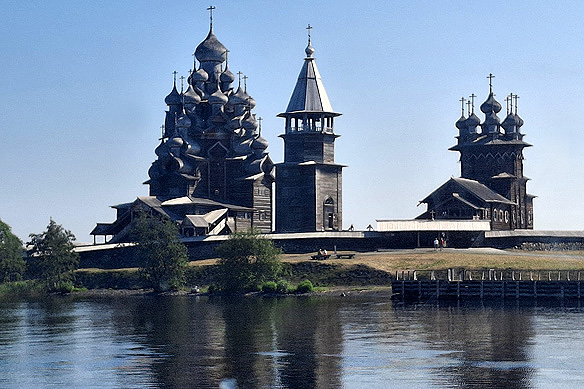
Surrounded by 1,650 islands, the 22 Aspen shingle domes tumbling down the Church of the Transfiguration on Lake Onega’s Kizhi Island seems straight out of a fairytale. Just when you expect a goblin to peep out from behind a carved gable, the church bells on the nearby bell tower break into a peal of lilting musical notes. Inside the church itself built of pine logs in 1714, a four-tiered wooden iconostasis with 102 icons recounts tales of prophets and feasts in colourful gilded, recently restored glory.
Together with the equally unique nine-domed Church of the Intercession built in 1764 and 19th Century Bell Tower, it forms the Kizhi Pogost, a UNESCO-listed ensemble of medieval Russia’s grandest wooden churches. They are evocative of the country’s archetypal onion-domed cathedrals, but are made completely out of wood, sans any nails except to hold the domes’ shingles in place, in keeping with local building traditions. There are other buildings on the island including the tiny 14th Century Resurrection of Lazarus Church, and numerous houses, barns, and windmills.
Kizhi Island is the centrepiece of the Republic of Karelia, a region which has found itself amidst a tug-of-war between neighbouring Finland and Russia through much of its history. This has resulted in a heady mix of Russian Orthodoxy laced with rituals and superstitions rooted in Finnish folklore which stubbornly live on.
Though Peter the Great [r. 1682 – 1725] and Catherine II [r. 1762 – 1796] turned Karelia’s iron-rich fields into a ‘factory’ at Petrozavodsk to produce ammunition for their wars against the Swedes and Turkey respectively, and the Soviets made it the site for their infamous White Sea Canal gulag camp, Karelia still retains its goblin Finnish charm. Look closely, it is hiding under the eaves of those quaint wooden homes and mythical churches scattered across the verdant isles and meadows.

Church of the Intercession and Church of the Transfiguration. Continue reading
 rama toshi arya's blog