towering peaks and gold jewellery: georgia, land of the golden fleece

This is the story of Colchis. A contemporary of the Sumerians and Ancient Egyptians, with references in Classical Greek mythology, this pre-Christian kingdom today lies somewhat in obscurity.

But three-and-a-half thousand years ago, Colchis was not some figment of literary imagination. It was Jason and the Argonauts actual gold-encased quest. Its peaks that touched the heavens, where narrative saga decided Zeus would chain Prometheus.

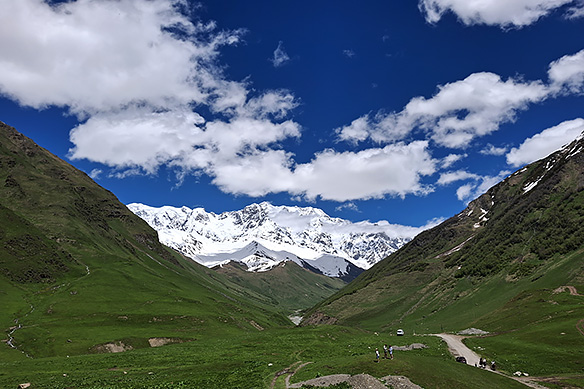
Deep inside the isthmus joining Europe and Asia, in valleys tightly sandwiched between the soaring peaks of the Greater and Lesser Caucasus Mountains were a people of immense wealth. Gold dust speckled its rivers which when caught using sheepskin with shaggy hair, turned them into ‘golden fleece.’ The people there then transformed this gold into exquisite jewellery typified by fine granulation and inlaid gems.

The Greeks called this kingdom Colchis, and that is what it has been known as since. Located across the eastern arm of the Black Sea in Georgia, its political centre was Aia [present-day Kutaisi] and Vani was the spiritual hub.

But these Ancient Colchians did not invent their goldsmithery. They inherited it from a yet older culture, the proto-Colchian Trialeti Great Barrows Culture who developed the archetypical Colchian style in the first half of the 2nd Millennium BCE.

For almost a millennium, from the middle of the 2nd Millennium BCE to the 8th Century BCE there was a lull in Colchis’ gold production. When goldsmithery emerged again, it simply took off from where it had been left off.

During these later years, the Colchians came in contact with the Greeks and Achaemenids [Persians], borrowing on a design element here or a process there. But never losing the unique goldsmithery techniques they had burnished to perfection. This quintessential style survived till the 4th Century CE, past the Greek and Roman colonisation of Colchis.

Excavations since 1947 have revealed multiple hoards in Colchian burial sites. The largest comprised 1,500 pieces of gold jewellery in burial 11 of a noble Colchian woman in Vani, dated mid-5th Century BCE. Another treasure unearthed was the famed 4th Century BCE Akhalgori hoard with pieces that would make many a jeweller gasp in awe.

Welcome to my photo essay on those very mountains from where the gold was sourced and the exquisite Colchian jewellery that was created from it. These pieces are today in the Archaeological Treasury of Tbilisi’s Simon Janashia Museum of Georgia. And though the rivers are no longer awash with gold, the mountains still echo the ancient wealthy Colchian world that called it home.

Necklace with agate centre-piece, Trialeti Great Barrows Culture, early-2nd Millennium BCE.

Necklace with agate centre-piece, Trialeti Great Barrows Culture, early-2nd Millennium BCE.

Trialeti Gold Cup, Trialeti Great Barrows Culture, 18th – 17th Centuries BCE.

Trialeti Gold Cup, Trialeti Great Barrows Culture, 18th – 17th Centuries BCE.

Continue reading

batumi: stories told and untold

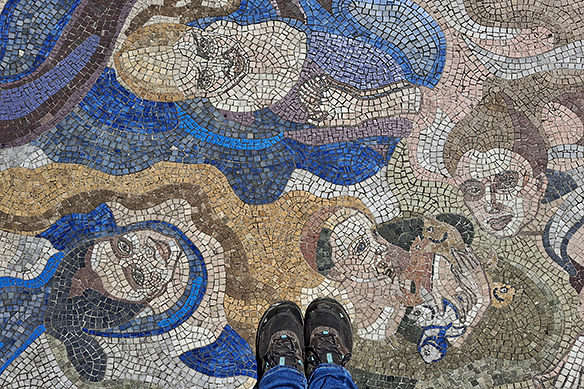
Mosaic in Batumi Piazza by Georgian-Swiss designer Natalia De Pita-Amirejibi comprises 88,244,735 cut and treated tiles of 1 sq. cm each. The marble for the tiles was sourced from 15 different countries.

Mosaic in Batumi Piazza by Georgian-Swiss designer Natalia De Pita-Amirejibi comprises 88,244,735 cut and treated tiles of 1 sq. cm each. The marble for the tiles was sourced from 15 different countries.

Batumi sits on the far western frontier of Georgia, on a pebble-strewn Black Sea coast a mere 20 kilometres away from neighbouring Türkiye. Not many travellers to Georgia make it this far. Which is a pity. The chalk to the rest of Georgia’s cheese, Batumi is an over-the-top Las Vegas-styled sea-side resort in a country known otherwise for its soaring mountains, Soviet remains, rich Orthodox Christian history, and earthy wine.

Brazen, brash, and straight out of Disneyland, Batumi is generous to the curious traveller. It tosses in a Byzantine fortress and a world-famous botanical garden into a quirky mix of fantastical skyscrapers, restored Russian Imperial-era edifices, fabulous outdoor art, mega events, and global cuisine.

Much like it did with me.

I did not know whether I was charmed or perplexed when I first stepped into Batumi. It was everything Georgia was not. And that’s what is its ultimate trump card.

Alphabet Tower [2012], dedicated to Georgia's UNESCO-listed 33-letter standalone script, mimics the DNA double helix. The rationale behind the design? Georgia's one-of-a-kind alphabet is Georgia's one-of-a-kind DNA.

Alphabet Tower [2012], dedicated to Georgia’s UNESCO-listed 33-letter standalone script, mimics the DNA double helix. The rationale behind the design? Georgia’s one-of-a-kind alphabet is Georgia’s one-of-a-kind DNA.

Continue reading

travel diaries: in search of king tamar’s svaneti

Fresco of King Tamar [left] with her father King Giorgi III. This fresco in Vardzia is the only surviving portrait of Tamar painted during her lifetime in the 12th Century.

Fresco of King Tamar [left] with her father King Giorgi III. This fresco in Vardzia is the only surviving portrait of Tamar painted during her lifetime in the 12th Century.

Mepeta Mepe, King of Kings Tamar was only 18 when she was crowned co-ruler of the Kingdom of Georgia in 1178. Six years later, when her father King Giorgi III died, she became its sole ruler. Here, I’d like to add some context regarding the word ‘Mepe’ before I write further. Georgian is a gender-neutral language, and Mepe means king or sovereign ruler, immaterial of whether the person is male or female.

Coming back to Tamar, her title was not the only unusual part of her story. Georgia, under her rule, reached its political and cultural zenith. Its borders spread from the Black Sea in the west to the Caspian Sea in the east, and the Greater Caucasus Mountains in the north all the way to eastern Türkiye and northern Iran in the south. She founded multiple cultural academies, and the arts and literature flourished with masterpieces such as the epic poem Knight in the Panther’s Skin by Shota Rustaveli written as an ode to her extraordinariness.

Eight centuries ago, deeply religious herself in a deeply orthodox country, she also chose to divorce the husband the court nobles had chosen for her. She then found herself a second husband [David Soslan, an Ossetian prince] in 1189 who was more to her liking.

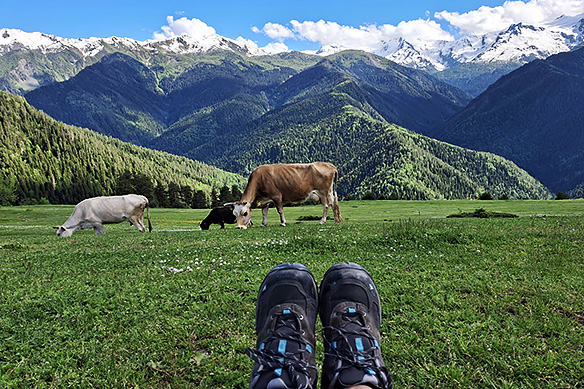
According to Georgian legends, Tamar had a special fondness for Svaneti, a region in the upper reaches of the Greater Caucasus Mountains, where, come summer, she would make the journey to a castle named after her. Here, snow-capped peaks reached out to iridescent blue skies, hemming in emerald meadows in which cows mooed and stone towers pricked its sleepy valleys.

Continue reading

travel shorts: georgia, birthplace of wine and the toastmaster

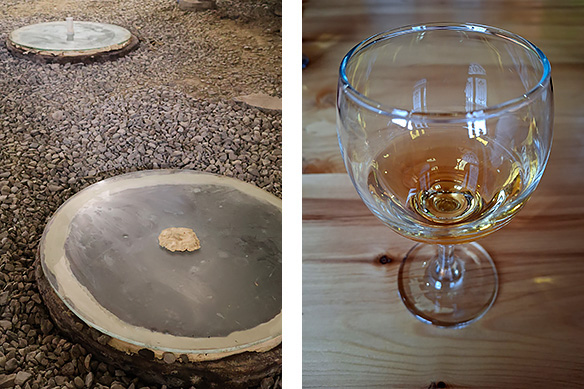
When the word for ‘cheers’ [Gaumarjos] translates to ‘to victory,’ it tells you a lot about the role of wine drinking in a country that has been racked by attacks for millennia.

Wine in the Caucasian country of Georgia is not just a drink. It is an integral part of elaborate feasts called ‘supra‘ led by a ‘tamada‘ or toastmaster, who makes fiery toasts using scooped-out animal horns without ever getting drunk. It is a celebration—of a people holding onto their own identity. Hoping for wins at war. Winning those wars. Rejoicing in those wins. Whether the borders expanded or shrunk.

On a spiritual level, Georgia’s Christian orthodox monks have been making bread and wine for its liturgy from the time Christianity officially landed on the country’s doorstep in 326 CE. The bread and wine symbolising Christ’s flesh and blood.

Wine routes crisscross the entire nation, at times leading to small family-owned wine cellars, and at others to gigantic corporations. At times the wines find their way into exclusive branded high-end glass bottles and at others into ordinary plastic containers with gaudy caps. Each area in Georgia, except for the soaring Caucasus Mountains, produces an indigenous wine. The most famous region being Kakheti. Continue reading

photo essay: remnants of soviet georgia

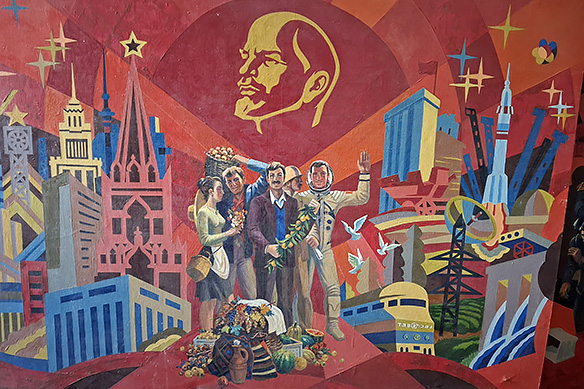
The relationship between Georgia and Russia is, well—complicated. Irrevocably woven, yet defiantly independent, Georgia’s past avatar as the Georgian Soviet Socialist Republic still peeps through across the country. You only need to look. A brutalist masterpiece. A colossal deserted mine with cable cars still frozen mid-air in space and time. Poker-faced apartment blocks sliced with horizontal walkways and plunging lifts. Magnificent abandoned sanatoriums built over healing springs that have given way to tall overgrown trees, moss, and wildflowers.

An urbex paradise. A lesson that nothing lasts forever.

Twice, Georgia proclaimed its independence from Russia’s rule. First, albeit briefly, in 1918, and then again in 1991. Tbilisi’s Museum of Soviet Occupation, housed in the national museum, pays an evocative homage to local resistance and the snuffing out of Georgia’s creative elite during the 70 years it was part of the Soviet Union [USSR]. Meanwhile Moscow still celebrates its ex-Republics at the VDNKh Exhibition of Achievements of National Economy and modern-day Russians throng the historically familiar streets of Tbilisi in search of the perfect weekend getaway.

Soviet Georgia took birth in 1921, post the Russian Civil War, and ended abruptly under former USSR President Mikhail Gorbachev in 1991. During these 70 long years, Georgia’s fertile lands and mineral-rich mountains were a key source of food and manganese for the world’s largest country. It was a contribution that warranted the construction of the Soviet Union’s 4th metro station in 1966 in Tbilisi, and the large-scale expansion of Georgia’s railway line to export its agricultural produce en-masse.

But these years also saw forced famines and abject poverty, ironically because of a son of its own soil.

Entrance to the Joseph Stalin Underground Printing House Museum in Tbilisi.

Entrance to the Joseph Stalin Underground Printing House Museum in Tbilisi.

Continue reading

travel shorts: home at the kutaisi family house museum

I am
what inspires me.
You are
what you love.
If you set your heart
upon a purpose,
you shall arrive there—
and believe me—
there,
you will find me.
~ Mari Berdzenadze, Excerpt from LAK’ECH

Deep in the heart of Kutaisi’s oldest neighbourhood is Mari’s home. Number 39 on Dato Berdzenadze Street—the street is named after her brother who died aged 21. He was the bodyguard of Eduard Shevardnadze, foreign minister during the Soviet-era, and independent Georgia’s second president. Dato was killed during elections. The house goes by the name Kutaisi Family House Museum.

Descended from the royal nobility which once ruled Western Georgia, 56-year-old Mari is a doctorate in law, published poet, and painter all rolled into one.

She has, like the four generations behind her, lived her whole life in this 150-year-old house bursting in the seams with artifacts that have held a special place in its residents’ hearts. A tiered four-season twinkling contraption that accompanied the family Christmas trees stands proudly next to a gleaming piano. Chinese cabinets and European figurines vie with a row of exquisite stringed musical instruments propped up on a damask sofa, whilst family photographs and paintings sheath the wall right up to the ceiling. Continue reading

the top 11 cultural highlights of tsarist, imperialist, communist moscow

No list of world cities is considered complete without the mention of Moscow. Immaterial of whether it was in the Middle Ages or now in the 21st Century. Irrespective of whether it is in times of peace. Or conflict.

Spread over seven hills, just like Rome, Moscow was determined from the outset to outdo Kyiv. Kyiv had been the historical capital of Kievan-Rus as Russia was called till the 13th Century Mongol raid. A higher cathedral, longer city-walls, taller city-gates—Moscow had to be better, and grander than its precursor. Period.

What started off as a wooden Kremlin [fortress] built by Prince Yuri Dolgorukiy in 1156, went on to become the citadel of the Tsars, headquarters of the USSR, and now the office and residence of the world’s largest country’s Head of State.

Moscow has remnants from everyone who ruled Russia from its crenelated walls. The Tsars gave it its grand cathedrals, Red [in Russian is another word for ‘beautiful’] Square, and a fortified stone Kremlin. They then burnt their own city to the ground in 1812 to drive Napoleon’s army out, and rebuilt it in an Empire [Baroque and Neoclassical] style. The Soviets after them gave the city its enormous streets, palatial metro system, and Stalin’s ‘Seven Sisters.’ Modern Moscow threw in the Moscow International Business Centre’s futuristic steel and glass skyscrapers into the mix.

It is a massive city in which an eclectic past and present jostle side-by-side, never far from a Christian Orthodox church or the performing and fine arts.

Here are Moscow’s top 11 cultural highlights from its very many eras. Wishing you travels which widen and deepen our intellect, hearts, and souls. Always. 🙂

Continue reading

photo essay: st. petersburg, where the pragmatic met the poetic

If there is one man who single-handedly changed Russia’s course for keeps, it would be Peter I, better known as Peter the Great. His rule spanning 43 years opened Russia to Europe. By the time he died aged 52, he had made Russia Europe.

Peter the Great came to power early. He was just 10 when he became co-Tsar of all Russia, sharing the throne with his half-brother Ivan V in 1682. Once Ivan V died in 1696, there was no stopping Peter.

A giant, both physically, and metamorphically, he set about putting his vision of a European outward-looking Russian empire, built on marine trade and naval battles, into action. His capital St. Petersburg, which he built from scratch in 1703 on the marshlands of the Neva Delta in the Baltic Sea, was to be his launchpad for these dreams.

Multi-talented, he was just as adept at building ships as he was at stitching a pair of shoes. He was also equally comfortable executing in cold blood those guilty of wilful treason, including his own son Alexei Petrovich, as of intense loyalty to his friend Alexander Menshikov, a commoner, and deep love for his second wife Catherine I, a laundress from Poland-Lithuania.

After his death, for almost a century Russia was ruled by a string of women from St. Petersburg. First his widow Catherine I, then his niece Anna Ioannovna, followed by his daughter Elizabeth I, and finally Elizabeth I’s nephew’s wife Catherine II aka Catherine the Great. This period came to be known as the Petticoat Period, with each Empress embellishing the city with splendid palaces, monuments, and bridges in the Baroque and Neoclassical styles by French and Italian architects, which one sees today.

The arts thrived here. And so did literature. In its 300-year-old history, St. Petersburg has been home to some of Russia’s greatest writers. Alexander Pushkin, the founder of modern Russian literature, Fyodor Dostoyevsky who churned out one masterpiece after the other, Nikolai Gogol who doggedly destroyed romantic illusions, Anna Akhmatova, a rare poetess in a male-dominated field, and Vladimir Nabokov, author of ‘Lolita.’

These 300 years also saw St. Petersburg have its fair share of name changes reflecting changing geo-politics. From 1914 to 1924 it went by the name Petrograd, and from 1924 to 1991 it was known as Leningrad in honour of Lenin, during which for 2 years, 4 months and 19 days [from 1941 to 1944] it was subjugated to one of the deadliest sieges in history, but never captured. After the collapse of the Soviet Union in 1991, the city reverted to its original name St. Petersburg [meaning St. Peter’s City] given by Peter the Great. St. Peter’s City, because the keys the saint held to the heavens, herein represented the keys to the West.

Here is a photo essay of St. Petersburg which started off on a pragmatic note and ended up being sheer poetry, punctuated with quotes from its writers whose favourite muse was their city. ❤ Continue reading

travel diaries: moscow to vladivostok, sleepless on the trans-siberian railway

Siberia. View from my train window.

Siberia. View from my train window.

PROLOGUE

The Trans-Siberian Railway. From Moscow to Vladivostok. 9,289 kilometres across the vast expanse of Russia, and eight time zones. The longest railway line in the world. Now, how can one resist a journey of such epic proportions!

I had first heard about the railway service laid out between 1891 and 1916 by two Tsars—Alexander III and his son Nicholas II—when I just started working. Something inside me then and there decided I had to undertake this voyage. No, not because I am a train buff. Hardly. But because then, and today, a few decades later when the dream is being realized, it is the epitome of travel.

Dear Diary, here’s my 14 days of travel on the Trans-Siberian Railway with stops at the historical cities en-route. A journey that turns out to be one of my most authentic travel experiences to date. ❤ Continue reading

karelia: when russia met finland

Surrounded by 1,650 islands, the 22 Aspen shingle domes tumbling down the Church of the Transfiguration on Lake Onega’s Kizhi Island seems straight out of a fairytale. Just when you expect a goblin to peep out from behind a carved gable, the church bells on the nearby bell tower break into a peal of lilting musical notes. Inside the church itself built of pine logs in 1714, a four-tiered wooden iconostasis with 102 icons recounts tales of prophets and feasts in colourful gilded, recently restored glory.

Together with the equally unique nine-domed Church of the Intercession built in 1764 and 19th Century Bell Tower, it forms the Kizhi Pogost, a UNESCO-listed ensemble of medieval Russia’s grandest wooden churches. They are evocative of the country’s archetypal onion-domed cathedrals, but are made completely out of wood, sans any nails except to hold the domes’ shingles in place, in keeping with local building traditions. There are other buildings on the island including the tiny 14th Century Resurrection of Lazarus Church, and numerous houses, barns, and windmills.

Kizhi Island is the centrepiece of the Republic of Karelia, a region which has found itself amidst a tug-of-war between neighbouring Finland and Russia through much of its history. This has resulted in a heady mix of Russian Orthodoxy laced with rituals and superstitions rooted in Finnish folklore which stubbornly live on.

Though Peter the Great [r. 1682 – 1725] and Catherine II [r. 1762 – 1796] turned Karelia’s iron-rich fields into a ‘factory’ at Petrozavodsk to produce ammunition for their wars against the Swedes and Turkey respectively, and the Soviets made it the site for their infamous White Sea Canal gulag camp, Karelia still retains its goblin Finnish charm. Look closely, it is hiding under the eaves of those quaint wooden homes and mythical churches scattered across the verdant isles and meadows.


Church of the Intercession and Church of the Transfiguration. Continue reading