a travel guide to the vietnam war

This post is not a political article. It is a travel feature. But to fully understand certain places in our world, it becomes essential to know their political contexts. Why they are the way they are. The answers are invariably in their political history. Such is the case for South Africa, Israel … and Vietnam.

A major event in world history, what the world refers to as the Vietnam War, the Vietnamese call the American War, and history books call the Second Indochina War. But this war actually has four perspectives: That of North Vietnam, South Vietnam, America, and the world at large. Also, this war was not just between Vietnam and America, but between North and South Vietnam as well.

Confusing? Read on.

The photo that stopped the war: Pulitzer prize-winning photograph 'The Terror of War,' also known as 'Napalm Girl,' Associated Press, 8 June 1972. [War Remnants Museum, Ho Chi Minh City]

The photo that stopped the war: Pulitzer prize-winning photograph ‘The Terror of War,’ also known as ‘Napalm Girl,’ Associated Press, 8 June 1972. [War Remnants Museum, Ho Chi Minh City]

Continue reading

72 hours in ho chi minh city

Aah, the buzz of Ho Chi Minh City, better known simply as HCMC, as thousands of scooters whiz past towering colourful tube-houses. Whether you are here in search of elegant Saigon or Uncle Ho’s namesake, looking for Vietnamese modern art or Soviet brutalism, fancy a street-side noodle soup or the perfect quiche in a quiet patisserie, you won’t be disappointed in this fastest growing city on Vietnam’s southern end sliced by the Saigon river.

No other south-east Asian city has quite captured the imagination of travellers the way HCMC has done. And continues to do.

Part of a unified Vietnam under the Nguyen Lords and Nguyen Dynasty, the city on the fringes of the Mekong Delta became a French colonial stronghold from 1862 to 1954. Next in line was its role as the capital of US-backed South Vietnam. After being ripped apart by decades of war, the city finally fell to communist North Vietnam on 30 April, 1975, paving the way for a re-unified nation.

On 2 July 1976, Saigon was renamed Ho Chi Minh City, as a mark of respect to the man who had dreamt of a free and reunited Vietnam, and the dream that came true.

The city has seen it all, at close quarters. Yet there is no bitterness or anger or melancholy whatsoever. No vengeance or self-pity. Instead, it seems to waltz better, with a more experienced step and twirl.

One could easily spend a week in this frenzied fast-paced populous city which never seems to sleep, and still not be bored of it. Where does one start? How about 72 hours to see the best it has to offer? And then maybe a few more days to relish it further. ❤️

[Title photo: Detail, Central South and North Spring Garden by Nguyen Gia Tri, Lacquer on Wood, 540 cm x 200 cm, 1969 – 1989, HCMC Museum of Fine Arts.]

Table of Contents:

Continue reading

vietnam’s capital hanoi, stories told and untold

A thousand years of Chinese rule, followed by a thousand years of independence. Except for a misfit seventy years under the French, somewhere in-between.

Hanoi’s story is like no other.

After being a Chinese territory from 179 BC onward, it finally threw off the yoke in 1010 when the first indigenous Vietnamese dynasty [Ly Dynasty] made Hanoi its capital. Since then, multiple local dynasties stuck to the tradition, apart from the Nguyen dynasty who moved their capital to Hue. The later French occupation followed suit, and chose Saigon in the south as their base, but made Hanoi capital of French Indochina from 1902 to 1945.

By the time Hanoi took back its mantle of being a political and administrative seat in 1954, Vietnam had ousted the French and part of the country was communist. Today, Hanoi is the capital of one of only five officially communist countries in the world, balancing Marxism-Leninism socialism with a market-oriented economy.

The result of this eclectic past and present has created a culturally rich city where contradictory layers coexist. Ancient Confucian temples, Buddhist pagodas, and a sprawling royal citadel which doubled up as both a medieval fortress and a 20th Century war bunker. Colonial houses replete with wooden shutters and a towering French stone cathedral, surrounded by local eateries jostling for space on footpaths and railway tracks. A communist-styled marble memorial for an embalmed ‘Uncle Ho,’ and sombre Lenin statue in a city square. It would not be too far off the mark to say there is something for every ideology in Hanoi!

Small wonder then that there are stories galore in this Vietnamese city tucked away in the country’s north. Some repeated often. Some which only the locals know. And some, midway between the two, which intrepid curious travellers stumble upon.

Shall we begin? 🙂
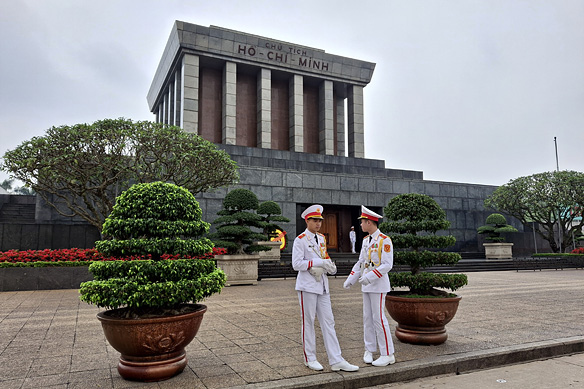

Hanoi’s most iconic landmark is the Ho Chi Minh Mausoleum where visitors silently file past the embalmed corpse of Vietnam’s beloved Uncle Ho. If it was not for him, the French may not have left or the country not united. He had wanted a simple cremation after his death. Instead, he got a gigantic marble mausoleum, like those accorded other communist stalwarts: Lenin and Mao. Continue reading