travel diaries: four caves, a lake, a seeker and badami

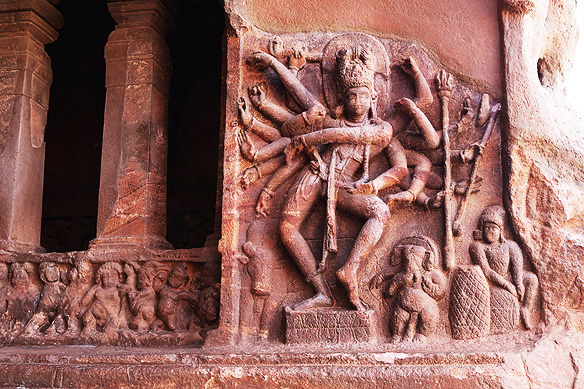
One of Badami Cave Temples' most impressive sculptures: Shiva as the 18-armed Nataraja doing the Tandava Nritya—the cosmic dance of creation, preservation, and destruction.

One of Badami Cave Temples’ most impressive sculptures: Shiva as the 18-armed Nataraja doing the Tandava Nritya—the cosmic dance of creation, preservation, and destruction.

One is never far from the gods in India. They are everywhere. Carved out of living rock. Carved into living rock. As far back as even 578 CE.

It is just after lunchtime, and I am at the foot of a gigantic red sandstone escarpment. Hundreds of school-children are racing down the steep uneven steps hewn into the cliff’s face. Their teachers shout behind them to slow down. Not that their wards pay any attention to the ominous warnings. Dressed in shiny tracksuits, they run in and out of the cavernous halls, doubled over in unstoppable giggles.

Slicing their way through this human avalanche are staid family groups. Their elderly matriarchs stomping ahead, undeterred by limps or wobbly canes.

Aaj bahut bheed hai [It is very crowded today],” I observe to the security guard at the gate. “Roz aisa hai. Season hai na aaj kal [It is like this every day. It is the season nowadays],” he smiles back happily.

In a few months these cliffs will be deserted again, first under the scorching summer sun and then because of the monsoons which would make the stone steps a veritable death trap.

Yet such ominous weathers rarely affected pilgrims in the distant past. 1,400 years ago.
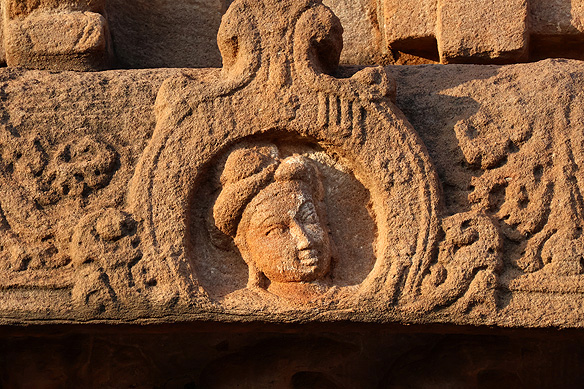
Portrait of a man in Ancient India. Ancient Hindu temples, by virtue of their depiction of both the sacred and secular, offer a fascinating insight into the then prevailing norms and societies.
Portrait of a man in Ancient India. Ancient Hindu temples, by virtue of their depiction of both the sacred and secular, offer a fascinating insight into the then prevailing norms and societies.

Continue reading

delhi’s national museum bronze gallery: where bronzes sing tales of god and art

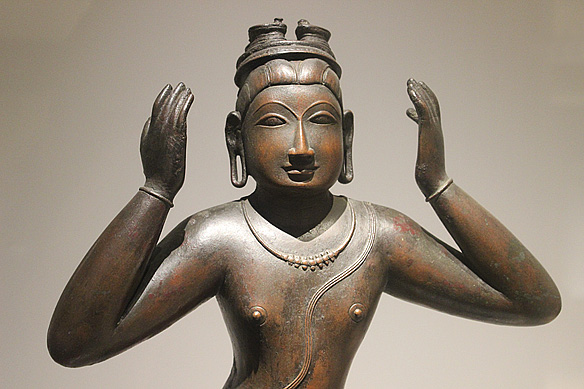
A babel of meditative Hindu, Jain, and Buddhist chants fills the gallery. Breaking the rhythmic loop is the tinkle of bells on a dainty anklet wrapped around a goddess’ voluptuous leg. Almost in competition, I hear the stomping of feet as Shiva, the destroyer, dances in passionate abandon, flames emanating in a fiery ring around him. Bharata, Rama’s brother from the Ramayana, a mere couple of feet away, holds up his brother’s sandals on his head to place them on the throne to rule as regent of the Ayodhya kingdom, accompanied by verses from the epic.

“Excuse me.”

The clipped British accent snaps me out of my reverie. And that of the deities too, who freeze mid-dance, mid-song, mid-chant, in sparkling glass cubicles scattered across the air-conditioned hall—lurching the room to pin-drop silence. And I wonder if I had imagined it all. Continue reading

indian sculpture’s 1,500 year journey at the indian museum, kolkata

indian_museum

A nondescript placard on the wall reads: “Buddhist Stupa, 2nd Century BC, Bharhut, Madhya Pradesh.”

I turn around and almost knock into a magnificent red sandstone 9-feet high railing and 23-feet high gateway, teetering in awe at its grandeur and proximity. It is covered profusely with intricate imagery of secular life and Buddhist teachings in 2nd Century BC India. Short inscribed labels in Brahmi script record the names of donors.

The monumental piece is nothing short of breathtaking. Much like everything else in the archaeology gallery of India’s oldest and largest museum, the Indian Museum located just around the corner of Park Street, Kolkata, and built in 1878 by the then British Raj.

Arranged in chronological rather than thematic order, the gallery showcases 1,500 years of India’s sculpture art, from which emanate its various schools and inter-linkages, in a seamless story.

Piqued? Come join me on a virtual tour of this collection under whirring fans, encased in a hot humid corridor in a Doric columned colonial edifice. 🙂 Continue reading