Unknown's avatar

About Rama Arya

I travel for the love of travelling. I blog for the love of blogging. About Me: ramaarya.com My Personal [Travel and Art] Blog: ramaarya.blog My Work: thecommunique.co.in

the top 11 cultural highlights of tsarist, imperialist, communist moscow

No list of world cities is considered complete without the mention of Moscow. Immaterial of whether it was in the Middle Ages or now in the 21st Century. Irrespective of whether it is in times of peace. Or conflict.

Spread over seven hills, just like Rome, Moscow was determined from the outset to outdo Kyiv. Kyiv had been the historical capital of Kievan-Rus as Russia was called till the 13th Century Mongol raid. A higher cathedral, longer city-walls, taller city-gates—Moscow had to be better, and grander than its precursor. Period.

What started off as a wooden Kremlin [fortress] built by Prince Yuri Dolgorukiy in 1156, went on to become the citadel of the Tsars, headquarters of the USSR, and now the office and residence of the world’s largest country’s Head of State.

Moscow has remnants from everyone who ruled Russia from its crenelated walls. The Tsars gave it its grand cathedrals, Red [in Russian is another word for ‘beautiful’] Square, and a fortified stone Kremlin. They then burnt their own city to the ground in 1812 to drive Napoleon’s army out, and rebuilt it in an Empire [Baroque and Neoclassical] style. The Soviets after them gave the city its enormous streets, palatial metro system, and Stalin’s ‘Seven Sisters.’ Modern Moscow threw in the Moscow International Business Centre’s futuristic steel and glass skyscrapers into the mix.

It is a massive city in which an eclectic past and present jostle side-by-side, never far from a Christian Orthodox church or the performing and fine arts.

Here are Moscow’s top 11 cultural highlights from its very many eras. Wishing you travels which widen and deepen our intellect, hearts, and souls. Always. 🙂
Continue reading

photo essay: st. petersburg, where the pragmatic met the poetic

If there is one man who single-handedly changed Russia’s course for keeps, it would be Peter I, better known as Peter the Great. His rule spanning 43 years opened Russia to Europe. By the time he died aged 52, he had made Russia Europe.

Peter the Great came to power early. He was just 10 when he became co-Tsar of all Russia, sharing the throne with his half-brother Ivan V in 1682. Once Ivan V died in 1696, there was no stopping Peter.

A giant, both physically, and metamorphically, he set about putting his vision of a European outward-looking Russian empire, built on marine trade and naval battles, into action. His capital St. Petersburg, which he built from scratch in 1703 on the marshlands of the Neva Delta in the Baltic Sea, was to be his launchpad for these dreams.

Multi-talented, he was just as adept at building ships as he was at stitching a pair of shoes. He was also equally comfortable executing in cold blood those guilty of wilful treason, including his own son Alexei Petrovich, as of intense loyalty to his friend Alexander Menshikov, a commoner, and deep love for his second wife Catherine I, a laundress from Poland-Lithuania.

After his death, for almost a century Russia was ruled by a string of women from St. Petersburg. First his widow Catherine I, then his niece Anna Ioannovna, followed by his daughter Elizabeth I, and finally Elizabeth I’s nephew’s wife Catherine II aka Catherine the Great. This period came to be known as the Petticoat Period, with each Empress embellishing the city with splendid palaces, monuments, and bridges in the Baroque and Neoclassical styles by French and Italian architects, which one sees today.

The arts thrived here. And so did literature. In its 300-year-old history, St. Petersburg has been home to some of Russia’s greatest writers. Alexander Pushkin, the founder of modern Russian literature, Fyodor Dostoyevsky who churned out one masterpiece after the other, Nikolai Gogol who doggedly destroyed romantic illusions, Anna Akhmatova, a rare poetess in a male-dominated field, and Vladimir Nabokov, author of ‘Lolita.’

These 300 years also saw St. Petersburg have its fair share of name changes reflecting changing geo-politics. From 1914 to 1924 it went by the name Petrograd, and from 1924 to 1991 it was known as Leningrad in honour of Lenin, during which for 2 years, 4 months and 19 days [from 1941 to 1944] it was subjugated to one of the deadliest sieges in history, but never captured. After the collapse of the Soviet Union in 1991, the city reverted to its original name St. Petersburg [meaning St. Peter’s City] given by Peter the Great. St. Peter’s City, because the keys the saint held to the heavens, herein represented the keys to the West.

Here is a photo essay of St. Petersburg which started off on a pragmatic note and ended up being sheer poetry, punctuated with quotes from its writers whose favourite muse was their city. ❤ Continue reading

travel diaries: moscow to vladivostok, sleepless on the trans-siberian railway

Siberia. View from my train window.

Siberia. View from my train window.

PROLOGUE

The Trans-Siberian Railway. From Moscow to Vladivostok. 9,289 kilometres across the vast expanse of Russia, and eight time zones. The longest railway line in the world. Now, how can one resist a journey of such epic proportions!

I had first heard about the railway service laid out between 1891 and 1916 by two Tsars—Alexander III and his son Nicholas II—when I just started working. Something inside me then and there decided I had to undertake this voyage. No, not because I am a train buff. Hardly. But because then, and today, a few decades later when the dream is being realized, it is the epitome of travel.

Dear Diary, here’s my 14 days of travel on the Trans-Siberian Railway with stops at the historical cities en-route. A journey that turns out to be one of my most authentic travel experiences to date. ❤ Continue reading

karelia: when russia met finland

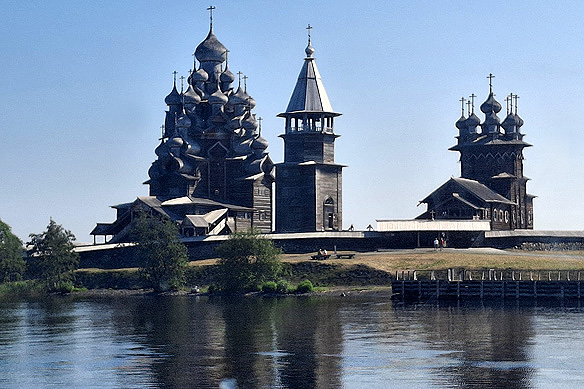
Surrounded by 1,650 islands, the 22 Aspen shingle domes tumbling down the Church of the Transfiguration on Lake Onega’s Kizhi Island seems straight out of a fairytale. Just when you expect a goblin to peep out from behind a carved gable, the church bells on the nearby bell tower break into a peal of lilting musical notes. Inside the church itself built of pine logs in 1714, a four-tiered wooden iconostasis with 102 icons recounts tales of prophets and feasts in colourful gilded, recently restored glory.

Together with the equally unique nine-domed Church of the Intercession built in 1764 and 19th Century Bell Tower, it forms the Kizhi Pogost, a UNESCO-listed ensemble of medieval Russia’s grandest wooden churches. They are evocative of the country’s archetypal onion-domed cathedrals, but are made completely out of wood, sans any nails except to hold the domes’ shingles in place, in keeping with local building traditions. There are other buildings on the island including the tiny 14th Century Resurrection of Lazarus Church, and numerous houses, barns, and windmills.

Kizhi Island is the centrepiece of the Republic of Karelia, a region which has found itself amidst a tug-of-war between neighbouring Finland and Russia through much of its history. This has resulted in a heady mix of Russian Orthodoxy laced with rituals and superstitions rooted in Finnish folklore which stubbornly live on.

Though Peter the Great [r. 1682 – 1725] and Catherine II [r. 1762 – 1796] turned Karelia’s iron-rich fields into a ‘factory’ at Petrozavodsk to produce ammunition for their wars against the Swedes and Turkey respectively, and the Soviets made it the site for their infamous White Sea Canal gulag camp, Karelia still retains its goblin Finnish charm. Look closely, it is hiding under the eaves of those quaint wooden homes and mythical churches scattered across the verdant isles and meadows.


Church of the Intercession and Church of the Transfiguration. Continue reading

travel shorts: jewelled eggs and quirky surprises fit for a tsarina

When common Russian folks were painting Easter eggs, getting them blessed at the local church, and then sharing them with friends and family, the Tsars did things a little differently. They had Easter eggs of pure gold inlaid with diamonds and precious gems made by the House of Fabergé, the most famed jeweller in the Russian empire. These they gifted to their royal better halves. Befitting a Tsarina, each was a standalone work of art and contained a ‘surprise’ element to amuse and pique the lady’s curiosity. Continue reading

travel guide: the five untold unesco-listed treasures of western russia

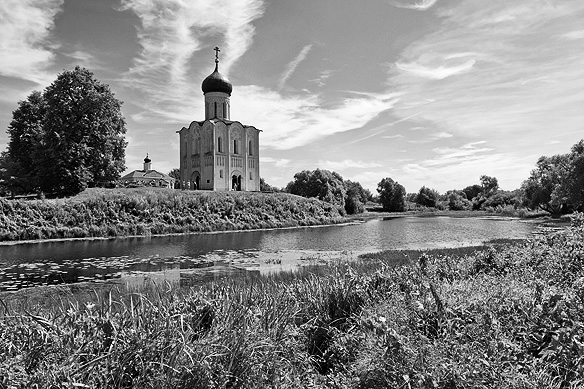
Not far from Moscow lies a ring of UNESCO-listed historical towns where the Russian nation, religion, arts, and architecture first took shape a thousand years ago under the rule of the Rurik dynasty. Frozen in time, these towns are a far cry from the enormity of Moscow. But their legacy has survived a millennium, through the cold-blooded Mongol onslaught and despite Soviet industrial atheism, forming the blueprint of what is intrinsically ‘Russia.’

Here are the finest of those towns. Achingly beautiful, and steeped in history and traditions, no visit to Russia is truly complete without them. And it is not just me who thinks so. The locals will vouch for it too. ❤️ Continue reading

72 hours in qatar in pictures

The fifth smallest country in the middle-east also has the highest GDP per capita in the world at USD 114,648.03. It is a data point made possible because of a 38-fold growth in the economy over the past three decades. 88.4 percent of this country’s population are foreign workers, and 92 percent of the population lives in its capital city. It is the headquarters of Al Jazeera English, an acclaimed independent editorial media channel, and the world’s best airline. Outdoor air-conditioning is common, desalination is the primary source of potable water since there are no rivers in its arid plains, and there is no personal income tax.

Welcome to Qatar.

Until 1939, however, things were very different in this peninsula jutting off Saudi Arabia’s coast into the Persian Gulf. A British Protectorate from 1916 to 1971, the pearling industry which sustained the emirate had died a rapid death in the 1920s with the introduction of the cultured pearl by Japan; the economy was sinking. Qatar was fast becoming one of the poorest countries in the world. Then a miracle happened. Not one, but two. The second even more incredible in scope, and its timing.

Oil was discovered in the Dukhan Field in 1939. Ten years later, the first crude oil exports left Qatar’s harbours. The Qataris were happy enough with this. But there was more wealth in store for them. In 1971, immediately after gaining Independence from the British, one of the world’s largest gas-fields was discovered off its shores—the North Field. Qatar exported its first shipment of liquefied natural gas [LNG] in 1996.

Ruled by the House of Al Thani since 1776, Qatar today contains 14 percent of the world’s known natural gas reserves, third only to Russia and Iran’s, and is the second largest LNG exporter globally with China, India, and Japan the country’s top trade partners.

There has been no looking back for Qatar after 1996. It just continues to surge ahead.

Immense wealth and traditional Bedouin values guide this nation where in two hours one can traverse its 160 kilometres length from north to south, and go from east to west in half that time.

Here’s how to spend 72 hours in Qatar. In pictures. For at times, pictures just say it better. 🙂 Continue reading

a travel guide to the vietnam war

This post is not a political article. It is a travel feature. But to fully understand certain places in our world, it becomes essential to know their political contexts. Why they are the way they are. The answers are invariably in their political history. Such is the case for South Africa, Israel … and Vietnam.

A major event in world history, what the world refers to as the Vietnam War, the Vietnamese call the American War, and history books call the Second Indochina War. But this war actually has four perspectives: That of North Vietnam, South Vietnam, America, and the world at large. Also, this war was not just between Vietnam and America, but between North and South Vietnam as well.

Confusing? Read on.

The photo that stopped the war: Pulitzer prize-winning photograph 'The Terror of War,' also known as 'Napalm Girl,' Associated Press, 8 June 1972. [War Remnants Museum, Ho Chi Minh City]

The photo that stopped the war: Pulitzer prize-winning photograph ‘The Terror of War,’ also known as ‘Napalm Girl,’ Associated Press, 8 June 1972. [War Remnants Museum, Ho Chi Minh City]

Continue reading

72 hours in ho chi minh city

Aah, the buzz of Ho Chi Minh City, better known simply as HCMC, as thousands of scooters whiz past towering colourful tube-houses. Whether you are here in search of elegant Saigon or Uncle Ho’s namesake, looking for Vietnamese modern art or Soviet brutalism, fancy a street-side noodle soup or the perfect quiche in a quiet patisserie, you won’t be disappointed in this fastest growing city on Vietnam’s southern end sliced by the Saigon river.

No other south-east Asian city has quite captured the imagination of travellers the way HCMC has done. And continues to do.

Part of a unified Vietnam under the Nguyen Lords and Nguyen Dynasty, the city on the fringes of the Mekong Delta became a French colonial stronghold from 1862 to 1954. Next in line was its role as the capital of US-backed South Vietnam. After being ripped apart by decades of war, the city finally fell to communist North Vietnam on 30 April, 1975, paving the way for a re-unified nation.

On 2 July 1976, Saigon was renamed Ho Chi Minh City, as a mark of respect to the man who had dreamt of a free and reunited Vietnam, and the dream that came true.

The city has seen it all, at close quarters. Yet there is no bitterness or anger or melancholy whatsoever. No vengeance or self-pity. Instead, it seems to waltz better, with a more experienced step and twirl.

One could easily spend a week in this frenzied fast-paced populous city which never seems to sleep, and still not be bored of it. Where does one start? How about 72 hours to see the best it has to offer? And then maybe a few more days to relish it further. ❤️

[Title photo: Detail, Central South and North Spring Garden by Nguyen Gia Tri, Lacquer on Wood, 540 cm x 200 cm, 1969 – 1989, HCMC Museum of Fine Arts.]

Table of Contents:

Continue reading

vietnam’s capital hanoi, stories told and untold

A thousand years of Chinese rule, followed by a thousand years of independence. Except for a misfit seventy years under the French, somewhere in-between.

Hanoi’s story is like no other.

After being a Chinese territory from 179 BC onward, it finally threw off the yoke in 1010 when the first indigenous Vietnamese dynasty [Ly Dynasty] made Hanoi its capital. Since then, multiple local dynasties stuck to the tradition, apart from the Nguyen dynasty who moved their capital to Hue. The later French occupation followed suit, and chose Saigon in the south as their base, but made Hanoi capital of French Indochina from 1902 to 1945.

By the time Hanoi took back its mantle of being a political and administrative seat in 1954, Vietnam had ousted the French and part of the country was communist. Today, Hanoi is the capital of one of only five officially communist countries in the world, balancing Marxism-Leninism socialism with a market-oriented economy.

The result of this eclectic past and present has created a culturally rich city where contradictory layers coexist. Ancient Confucian temples, Buddhist pagodas, and a sprawling royal citadel which doubled up as both a medieval fortress and a 20th Century war bunker. Colonial houses replete with wooden shutters and a towering French stone cathedral, surrounded by local eateries jostling for space on footpaths and railway tracks. A communist-styled marble memorial for an embalmed ‘Uncle Ho,’ and sombre Lenin statue in a city square. It would not be too far off the mark to say there is something for every ideology in Hanoi!

Small wonder then that there are stories galore in this Vietnamese city tucked away in the country’s north. Some repeated often. Some which only the locals know. And some, midway between the two, which intrepid curious travellers stumble upon.

Shall we begin? 🙂


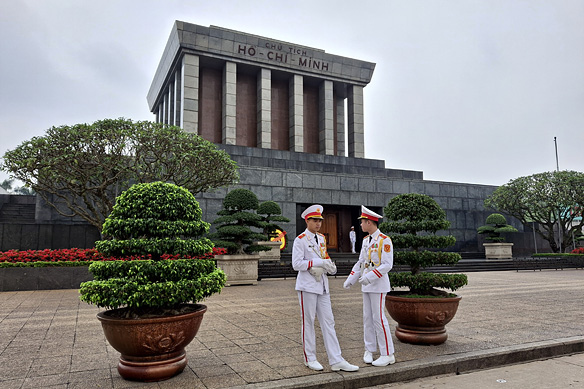
Hanoi’s most iconic landmark is the Ho Chi Minh Mausoleum where visitors silently file past the embalmed corpse of Vietnam’s beloved Uncle Ho. If it was not for him, the French may not have left or the country not united. He had wanted a simple cremation after his death. Instead, he got a gigantic marble mausoleum, like those accorded other communist stalwarts: Lenin and Mao. Continue reading