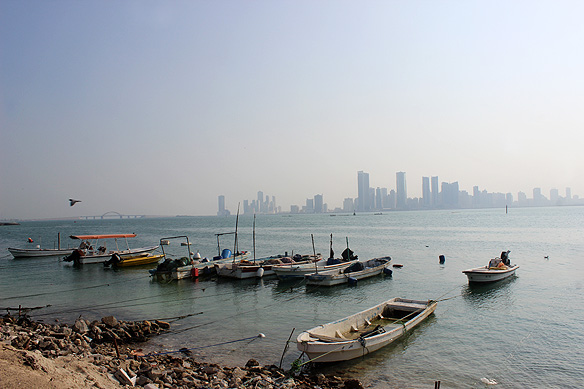
Fishing boats in historical Al-Muharraq overlooking modern Manama.
Bahrain, meaning ‘Two Seas’ in Arabic, is one of those delicious treats one encounters as a traveller. I do not mean that from a food perspective. Do not get me wrong. The food is fantastic here. What I mean is that it is a visual and historical treat. Layered, nuanced, and whole.
Middle East’s smallest country, the Kingdom of Bahrain is located a mere 25 kilometres off the north-east coast of Saudi Arabia. Ruled by the Al-Khalifa family, it is an archipelago of 33 islands with Bahrain Island the largest [51 kilometres long and 18 kilometres wide] and Manama as its capital. Though mainly barren desert, its freshwater underground springs and marine waters have given the country a remarkable gift: the finest Pinctada radiata oyster beds in the world, of which one in every 20 contains an iridescent natural pearl.
Since their discovery over four thousand years ago by the Dilmun civilization, these oyster beds have sustained empires who made Bahrain their home, and provided them with immense wealth. Pearl-diving, however, was no mean feat across these millennia. It was dangerous and physically demanding.
The divers, known as ghawwas, would plunge some 30 metres into the depths of the sea, armed with rudimentary nose clips and finger protectors, to collect the oysters. After gathering as many as they could with their breaths held tight, they would rush back to the surface, gasping for air. The oysters would be slit open, the pearls graded, and the wheeling and dealing begun with buyers from Europe and India. Once the prices were fixed, these little gems of nature left Bahrain’s shores to grace a crown, a robe, or a neck.
Everyone in the island was directly or indirectly involved in the business of pearls which peaked from 1810 to 1923 in Al-Muharraq, the second largest island in Bahrain. The result was a single product economy which made it to the UNESCO World Heritage list in 2012.
Any surprises then that Bahrain is often referred to by its moniker ‘Pearl of the Gulf?’
But what starts, ends. And though the oyster beds are still there, the pearling trade collapsed with the advent of the Japanese cultured pearl in the 1920s—a simpler, cheaper, and easier alternative—and the discovery of oil in Bahrain in 1932.
An Islamic nation based on Sharia Law, Bahrain’s maritime trade and exposure to multiple cultures for over four millennia has made it forward-thinking and tolerant. It is hard to distinguish between the Bahraini and 55 percent expatriate community at times. There is an easy comradery that cuts across race, class, and creed, peppered with some of the warmest, friendliest smiles around.
Here are 15 memorable things to do in Bahrain. Because, this little island kingdom is, well, different. ❤
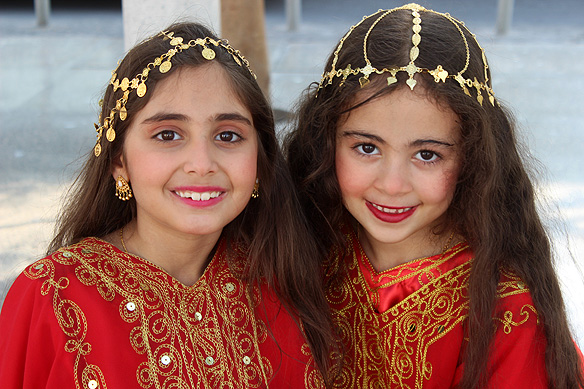
Children dressed up for Bahrain’s national day, 16th December, which celebrates the late Emir Isa bin Salman Al-Kalifa’s ascension to power in 1961.
 rama toshi arya's blog