italy 3: italy and the italian … young country in an ancient nation

That and this about Italy

Surrounded on three sides by the seas [Tyrrhenian, Adriatic and the Mediterranean aka the water between the lands] and shielded by the Alps in the north, Italy is a land of mountains with the Apennine range cutting through it lengthwise. Sicily and Sardinia, Italy’s two major islands, together with a number of smaller ones cluster around the mainland. Covering an area of 301,338 sq. kilometres, the country has a population of 57 million people, with 4 million living in Roma.

Italy completely encloses two independent countries—the Vatican and San Marino—the two smallest nations in the world. The latter, a mere 60 sq. kilometres in area and with a population of 21,000, was founded by Marino, a stone-cutter in the 4th Century and has been an independent republic since the 9th Century. The Vatican City, an independent papal State constituted in 1929 as an enclave in Rome, includes the Vatican [the papal residence consisting of a group of buildings] and St. Peter’s Basilica. It covers an area of 0.438 sq. kilometres and has a population of 1,000. Continue reading
italy 2: top attractions of roman, renaissance, baroque, modern rome

rome4
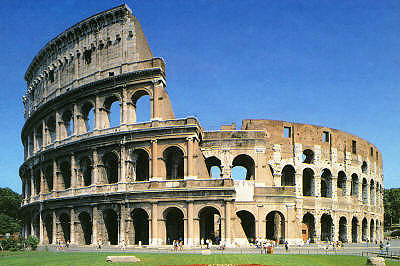
Eternal Rome, with its ancient Roman monuments (© Lozzi Roma)

Roman Rome

Though most of the buildings in Michelangelo’s piazza on Campidoglio [Capitoline hill] date from the Renaissance, the hill was once the epicentre of the Roman Empire, the place where the city’s first and holiest temples stood, including its most sacred, the Tempio di Giove [Temple of Jupiter]. By the Middle Ages, the Campidoglio had fallen into ruin. In 1547, Pope Paul III (1468-1549) decided to restore its grandeur for the triumphal entry into the city of Charles V (1500-1558), the Holy Roman Emperor. He called upon Michelangelo to create the Cordonata [the monumental staircase ramp], the edifices and facades on the three sides of the Campidoglio, the slightly convex pavement and its decoration, and the pedestal for the bronze equestrian statue of Marcus Aurelius, the only surviving example of the many bronze equestrian statues which once adorned Rome. As Michelangelo’s pre-eminent urban set piece, the piazza and its buildings sums up all the majesty of High Renaissance Rome. In spite of changing events and historic conditions, it has remained at the very centre of Roman life. Today, it is the headquarters of the mayor and municipality of modern Rome. Continue reading

italy 1: eternal roma and the vatican

rome1
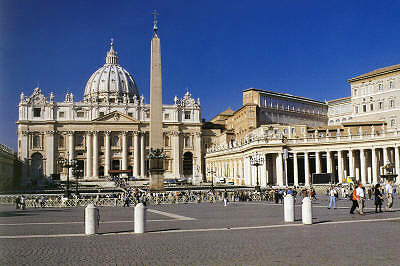
St. Peter’s Square (© Lozzi Roma)

Rome is like a tapestry of time. Ancient Roman ruins blending into medieval churches, Renaissance domes, Baroque fountains and fascist buildings, whilst the vivacity and vigour of modern Rome sparkles in the foreground. Eternal Roma. Time from all times stand here on display. Ancient Romans, Vandals, Popes and the Borgias, Michelangelo and Bernini, Napoleon, and Mussolini, all have left their physical and spiritual mark on this city by the banks of the river Tiber. Modern Rome has one foot in the past and one in the present—a wonderful stance that allows you to have an expresso in a square designed by Bernini, then walk back to your hotel room in a renovated Renaissance palace. Continue reading

greece 6: post-byzantine monasteries of meteora and thermopylae

Kalabaka—Meteora

meteora1
meteora2
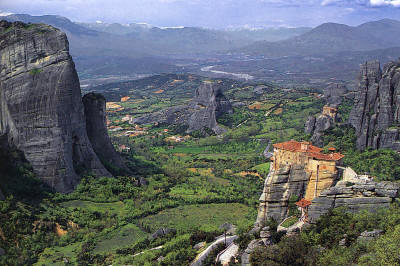
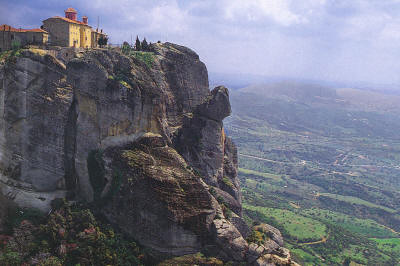
16th Century monasteries perched atop the towering peaks of Meteora

Kalabaka, known in Byzantine times as Stagi, is a small town and starting point for a visit to Meteora, a group of precipitous towering rocks in the centre of the plain of Thessaly. This unique geological phenomenon was created by a series of upheavals in the earth’s crust millions of years ago. The untrodden rocky peaks of the Meteora, totally isolated from the rest of the world, were a refuge for hermits from as early as the 11th Century. Continue reading

greece 5: roman patras and delphi, navel of the earth

patra1
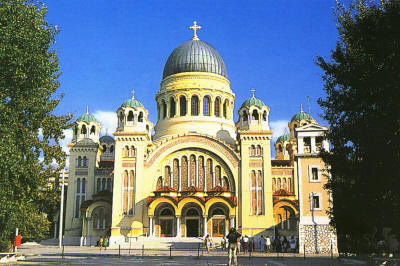
Church of St. Andrew in Patras

Patras

Today, in the early morning hours I left for Patras. My final destination was Delphi. Patras is one of the most important harbours for communication between Greece and Western Europe. Ships for Italy leave from here.

An agricultural settlement which took little part in the shared activities of the Greeks during the entire Greek historical epoch (from the end of the Mycenaean civilization to the end of the Classical period), Patras, however, flourished under the Romans and became a centre for commerce and industry during Roman rule. St. Andrew, patron saint of Patras, taught the gospel in this city and was martyred here in 68 AD. I visited the 20th Century church of St. Andrew, an imposing building decorated lavishly in gold on Byzantine lines in the inside. The blue cross in the Greek flag is St. Andrews cross. Possession of Patras alternated between the Venetians and Turks in the city’s later history. Continue reading

greece 4: olympia, home of zeus and the olympic games

olympia1
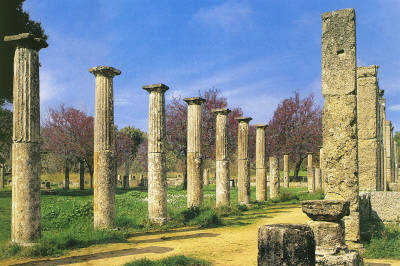
The Palaestra where the athletes trained for the contests in wrestling, boxing and jumping, 3rd Century BC

There was scarcely any city which failed to stage games in honour of the gods, but the attention of all Greece was drawn to the four great Pan-Hellenic festivals: the Olympic Games at Olympia and the Pythian Games at Delphi, both held every four years; and the Nemean Games in Argolis and the Isthmian Games at Corinth, each held every two years. These festivals drew athletes from all parts of Greece who competed as individuals, not as teams, on a passionately amateur basis. Wars were put aside for the Games. Greatest of all the Pan-Hellenic games were the Olympics held at Olympia. Continue reading

greece 3: epidaurus and nafplio, greece’s first capital

Epidaurus, Classical Greece’s centre for healing

In the hinterland of Epidaurus, on green hills enjoying mild climate and plentiful water from healing springs, the Epidaureans founded the sanctuary of Asclepius, the most impressive centre of healing in the ancient world.

The worship of gods of healing in Epidaurus goes back to the prehistoric period. In the Mycenaean period, the hero-doctor Malos, or Maleatas was worshipped on one of the peaks of Mt. Cynortium. After 1000 BC, Apollo displaced the prehistoric deity, and assumed his name, Apollo Maleatas, continuing to be worshipped in his sanctuary until the end of the ancient world. His cult evolved into that of Asclepius, culminating in the 6th Century BC with the building of Asclepius’ major sanctuary of healing. According to mythology, Asclepius was the son of Apollo and Coronis and he learned the art of medicine from his father and Cheiron, the wise Centaur.


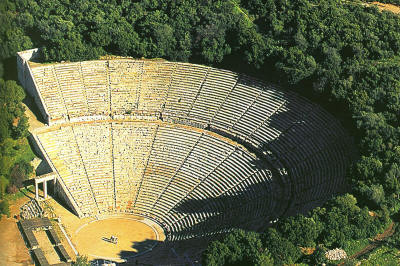
The Theatre of Epidaurus is the best preserved ancient theatre in Greece, 4th-3rd Century BC Continue reading

greece 2: ancient corinth and mycenae

Corinth Canal

The Corinth Canal, 6 kilometres long and 23 meters wide, was constructed in 1882-1893 by French and Greek engineers at the narrowest point of the Isthmus. I crossed the canal by bridge as I left Attica and entered the Peloponnese. The decision to build a canal on this spot was taken by many in antiquity: Periander, tyrant of Corinth and one of the seven sages of the ancient world, Julius Caesar, Nero, Hadrian, and Herodes Atticus. But it was only in the 19th Century that the idea received form. Nonetheless, the ancient Greeks had devised other means of bridging the gap between the two gulfs. In the late 7th or early 6th Century BC, they built a paved road called diolcus from the shores of the Gulf of Corinth to the shores of the Saronic, and ships were pulled on wheeled wagons from one side of the Isthmus to the other. Parts of the diolcus can still be seen today on the Gulf of Corinth.

Ancient Corinth

corinth1
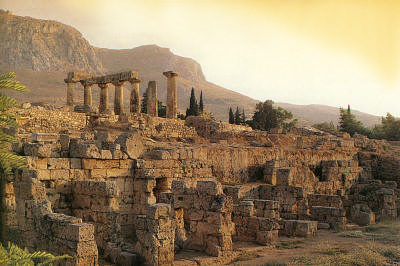
The ruins of ancient Corinth Continue reading

greece 1: pericles’ athens—an education to [classical] greece

athens1

I was in Athens. After months of reading numerous books on Classical Greece, I was finally in the city which had given birth to democracy, intellectual freedom, and the concept of individuality. My breath caught in my throat in bated excitement as I took the long drive from the airport to the hotel, amidst much heat, pollution, noise, crowds, and huge run-down buildings lining traffic-laden streets.

Next morning I commenced my exploration of the city’s glorious art and history. The heavy cloak of modern urban Athens slowly parted to reveal the Athens I’d come to see from across the many seas, the Athens of incomparable beauty.

Athens: An education to [Classical] Greece

To fully experience the classical beauty of Athens is to understand the essence of Greek civilization. Athens, the “school of Hellas”, and in Pericles’ words, “the city that was an education to Greece”, was the cultural and intellectual well-spring of Greek life in antiquity. During Greece’s Golden Age, the period commencing with the defeat of the Persians in 479 BC to the outbreak of the Peloponnesian war in 431 BC, it displayed a vigour that has no parallel in the history of humankind. And this golden age glowed brightest during the 30 years it had the leadership of the political genius of Pericles, the city’s first citizen, austere aristocrat, soldier, orator, and statesman. Continue reading