36 hours in almaty

What is the connection between apples and Almaty?

Gotcha!

The answer is: Almaty, the capital of Kazakhstan until 1997, is the birthplace of the apple. 🙂

Though Kazakhstan’s largest city has grown, both figuratively and literally, beyond its apples, its name still carries this legacy with elan. ‘Alma’ means apples and ‘ata’ means father or origin.

Surrounded by the Trans-Ili Alatau Mountains in south-east Kazakhstan, the city has had its fair share of history and avatars. From a prehistoric Saka settlement to a trading centre on the Silk Road, and in more recent years from being Verny, a Russian colonial outpost to Alma-Ata, capital of Kazakh SSR [Soviet Socialist Republic] within the Soviet Union.

In its last set of avatars, Almaty served as the capital of independent Kazakhstan from 1991 to 1997 and, thereafter, has stayed as the country’s vibrant commercial and cultural hub.

Of all of Kazakhstan’s cities, Almaty feels the most European with its wide leafy boulevards edged with open-air cafes, plenty of restful green urban spaces dotted with over 120 sparkling fountains, and a happening scene supported by numerous theatres, art galleries, and concert halls.

Though most travellers use Almaty mainly as a base to explore south-east Kazakhstan’s stunning national parks, the city does warrant a gentle exploration of its charms as well. 36 hours should do the trick in the sprawling metropolis that has earned the moniker ‘Southern Capital.’ Here are those 36 hours. ❤️ Continue reading

global travel shot: hanoi’s train street

Image

Think Vietnam, think Hanoi and the one place that might spring to mind [courtesy all the endless social media reels and selfies] is Train Street. Been to Hanoi and not been to Train Street? Shucks, the Hanoi visit does not count then. What is of more critical import nowadays though, warranting endless threads, is the do-or-die question: Is Train Street open?

For the uninitiated, Train Street is a 0.85-kilometre-long narrow road lined with open-air cafés in Hanoi’s Old Town in which railway tracks slice through a busy neighbourhood. At regular intervals trains whistle past, forcing households, café-owners, and their guests to stow furniture away and huddle behind doors. Once the train has gone, life carries on as usual—right next to the tracks, and yes, over the tracks.

Following a series of incidents caused purely out of tourists’ own negligence, access to Train Street has been closed with frowning security guards now resolutely seated behind bulky barriers.

But remember it is a ‘Street.’ Hence, there are still parts that can be accessed. For instance, in Google Maps, instead of ‘Train Street,’ if you type in ‘Train Street Coffee,’ voila, you will be in the company of travellers who had managed to crack the code. Sipping Vietnamese coffee, seated right next to the tracks. Please, however, do follow the rules. Which translate to: duck when the train arrives; it is not selfie time. 🙂

PS. Yes, I did see the train pass. Five minutes before I took the above picture!

– – –

[Note: This blog post is part of a series from my travels to Vietnam for three weeks in March 2025. To read more posts in my Vietnam series, click here.]

photo essay: hoi an, vietnam’s unesco-listed city of lanterns

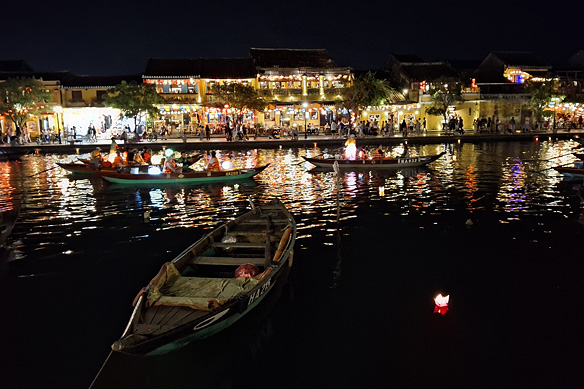
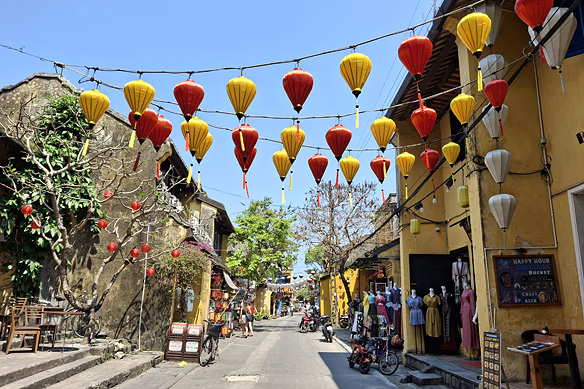
Imagine a whole town swathed in deep red and yellow silk lanterns. Across tree-lined streets and narrow alleys, on shopfronts and cutesy cafes. A centuries-old town with yellow tube houses that stretched between lanes, and a wide placid river that gently lapped against its banks.

If during the day Hoi An is a fairytale, at night it is as if those very fairies had waved a wand and created magic. Don’t be surprised if you catch yourself wondering if it was all for real. After all it is the 21st Century. How did this exquisite time capsule manage to survive. Especially one that was authentic, and not contrived.

Frozen somewhere in the 17th and 18th Centuries, UNESCO-listed Hoi An’s very name recounts its story. Hoi An means the ‘peaceful meeting place.’ Four hundred years ago, this idyllic riverside town became an international trading port in southeast Asia. Merchant vessels and traders from Japan, China, Europe, and India converged on its waterfronts and streets exchanging goods and ideas. Hoi An was their ‘peaceful meeting place.’

However, when neighbouring Da Nang started to grow as a port in the 19th Century, Hoi An’s fortunes fell and the town was forgotten. No one saw any merit in pumping money into building over its yellow trading tube homes and colourful assembly halls in the name of development. It was this very neglect which turned out to be Hoi An’s blessing in disguise and the reason for its revival, thanks to help from a completely unexpected quarter—Kazimierz Kwiatkowski, a Polish architect and conservationist.

If Hoi An is on every traveller’s bucket-list today, it is because Kwiatkowski spent years towards getting it listed as a UNESCO World Heritage Site. Hoi An never forgot the favour. A memorial in his honour stands in Kazik Park in the Old Town today.

Continue reading

caodaism — vietnam’s home-grown religion of kitsch, pluralism, and unity

This slideshow requires JavaScript.

[Note: Click on the play button or arrows to start the slide show.]

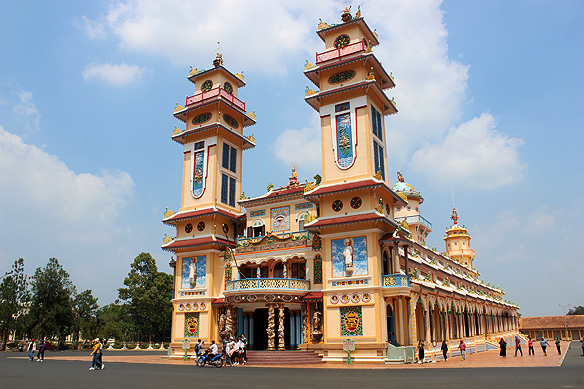
It is mid-day, somewhere in southern Vietnam, 80-odd kilometres from Ho Chi Minh City in Tay Ninh province. I am seated cross-legged inside a cavernous colourful ‘cathedral,’ on the fringes of a 99-year-old hypnotic performance of chants and rituals carried out by hundreds of solemn, serene-faced white-robed disciples.

Teal dragons, in contrast, wrap around soaring pink columns. Their candy red and white tongues stuck out mid-air. Above me, a ceiling recreates the heavens, punctuated with coiled snakes and flowers. Triangles with rays emanating from eyes adorn the windows and facades.

Rich in symbolism, every form and colour in the Cao Dai Holy See represents a belief or value mandated by divinity. Nothing is redundant here.

After all, there is enough inspiration. Vietnam’s very own monotheistic syncretic religion fuses together Buddhism, Confucianism, Taoism, Roman Catholicism, and ancestor worship, with a generous douse of seance [talking to spirits of the dead] into an eclectic mix guided by principles of harmony and simply doing good.

Overlooking this fantasyland are effigies of the first group of Cao Dai spirit mediums who ‘God’ identified himself to on Christmas eve in 1925. On the other end is the Bat Quai Dai altar. The most sacred part of the cathedral, it comprises a large sphere with a left ‘Divine’ eye painted on it, surrounded with religious paraphernalia. The eye represents the all-seeing supreme god Duc Cao Dai who is the universe which lives in all creation.

Not to be construed as an offshoot of any of the religions in its mix, Caodaism, born out of nationalism, was recognized as an independent religion on 7 October 1926 by Vietnam’s French colonial rulers. Officially known as The Great Faith for the Third Universal Redemption, the Holy See in Tay Ninh is its largest place of worship.

Continue reading

astana aka nur-sultan, the brand new capital for an ancient heritage

An eight-month pregnant young woman grabbed my phone from my hands, spoke to the cab driver at the other end in Kazakh, stood with me till he arrived, and left only after bundling me into the gleaming white vehicle.

I will never forget her and her serene warm face. I had been struggling to communicate my pickup location across language barriers with my cab driver on a massive multi-lane street in Astana. It was dark. I was clueless. And then she came along. Out of the blue.

That is Kazakhstan for you where people are so helpful, you do not even need to ask for help.

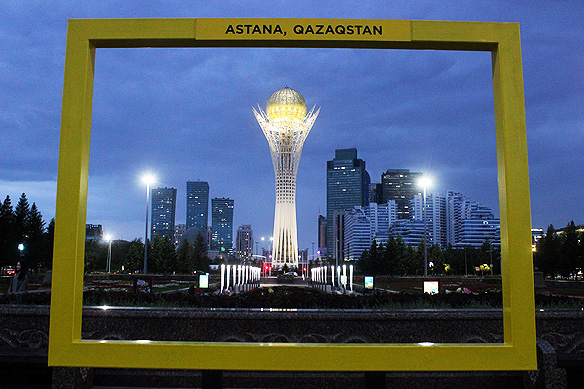
If you ever wondered what a modern city would look like, if created from scratch, where hearts such as hers are a common occurrence, then make your way to Astana, Kazakhstan’s capital since December 1997. Astana literally means ‘Capital City.’

And if like me, you had read that Kazakhstan’s capital was Nur-Sultan, and were a bit confused what was its correct current name. It is still Astana.

For around four years, from 2019 to 2022, Astana was renamed Nur-Sultan in honour of the country’s first President Nursultan Nazarbayev [1991 – 2019].

The city, located in the north-centre of the country in the middle of nowhere, has been around since 1830 when it went by the name Akmoly. It, however, really came into its own when the empty area adjoining it was transformed into a futuristic capital by Japanese architect Kisho Kurokawa in 1998. All those fantastically fabulous buildings one sees in the city-centre are government offices, including the supreme court.

Selected through a competition that was thrown open to the finest, most talented urban planners and architects in the world, his ‘new’ capital on the banks of Ishim River is meant to epitomize Kazakhstan’s vision for the future and its mythical past.

Continue reading

kazakhstan’s ‘golden man,’ stories told and untold

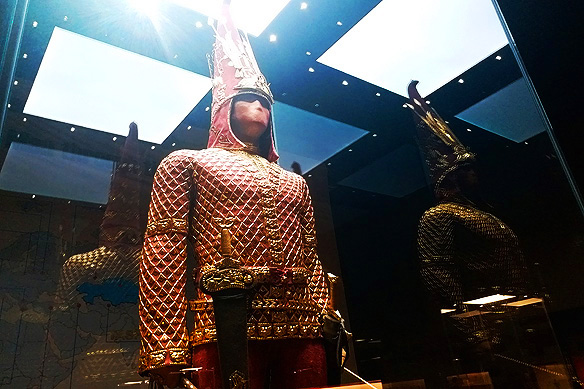
The Golden Man.

Ubiquitous with Kazakhstan, look closely and you will find him everywhere. Atop Almaty’s Independence Monument, in promotional cut-outs during events such as the recently held World Nomad Games, in state museums across the country, and both commemorative and currency coins.

He is the most celebrated son of Kazakh soil.

An 18-year-old Saka warrior prince [or princess] who lived in the 4th Century BC, his burial mound was found in April 1970. Purely by chance, as is usually the case. Inside the heap of rubble was a skeleton sheathed in over 4,000 pieces of pure gold from top to toe, holding weapons ready to go to war. The burial was the first in Central Asia, and with the largest gold hoard, to be discovered intact and not plundered. Ever.

Though the most famous, he is, however, not Kazakhstan’s only ‘Golden Man.’ Nine more have been unearthed after him, including four women, who like him were also draped in gold ornaments. Each with a unique story that is theirs alone.

Welcome to my photo essay on the Golden Man, where I share stories with you about him. Some told. Some untold. So, next time that you see him, he is no more a stranger, but almost a friend. 😊 Continue reading

top 15 memorable things to do in bahrain, pearl of the persian gulf

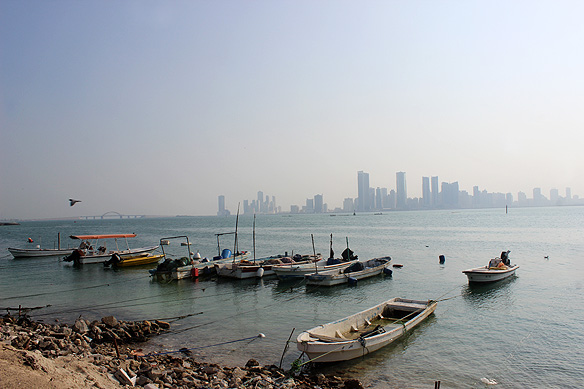
Fishing boats in historical Al-Muharraq overlooking modern Manama.

Fishing boats in historical Al-Muharraq overlooking modern Manama.

Bahrain, meaning ‘Two Seas’ in Arabic, is one of those delicious treats one encounters as a traveller. I do not mean that from a food perspective. Do not get me wrong. The food is fantastic here. What I mean is that it is a visual and historical treat. Layered, nuanced, and whole.

Middle East’s smallest country, the Kingdom of Bahrain is located a mere 25 kilometres off the north-east coast of Saudi Arabia. Ruled by the Al-Khalifa family, it is an archipelago of 33 islands with Bahrain Island the largest [51 kilometres long and 18 kilometres wide] and Manama as its capital. Though mainly barren desert, its freshwater underground springs and marine waters have given the country a remarkable gift: the finest Pinctada radiata oyster beds in the world, of which one in every 20 contains an iridescent natural pearl.

Since their discovery over four thousand years ago by the Dilmun civilization, these oyster beds have sustained empires who made Bahrain their home, and provided them with immense wealth. Pearl-diving, however, was no mean feat across these millennia. It was dangerous and physically demanding.

The divers, known as ghawwas, would plunge some 30 metres into the depths of the sea, armed with rudimentary nose clips and finger protectors, to collect the oysters. After gathering as many as they could with their breaths held tight, they would rush back to the surface, gasping for air. The oysters would be slit open, the pearls graded, and the wheeling and dealing begun with buyers from Europe and India. Once the prices were fixed, these little gems of nature left Bahrain’s shores to grace a crown, a robe, or a neck.

Everyone in the island was directly or indirectly involved in the business of pearls which peaked from 1810 to 1923 in Al-Muharraq, the second largest island in Bahrain. The result was a single product economy which made it to the UNESCO World Heritage list in 2012.

Any surprises then that Bahrain is often referred to by its moniker ‘Pearl of the Gulf?’

But what starts, ends. And though the oyster beds are still there, the pearling trade collapsed with the advent of the Japanese cultured pearl in the 1920s—a simpler, cheaper, and easier alternative—and the discovery of oil in Bahrain in 1932.

An Islamic nation based on Sharia Law, Bahrain’s maritime trade and exposure to multiple cultures for over four millennia has made it forward-thinking and tolerant. It is hard to distinguish between the Bahraini and 55 percent expatriate community at times. There is an easy comradery that cuts across race, class, and creed, peppered with some of the warmest, friendliest smiles around.

Here are 15 memorable things to do in Bahrain. Because, this little island kingdom is, well, different. ❤
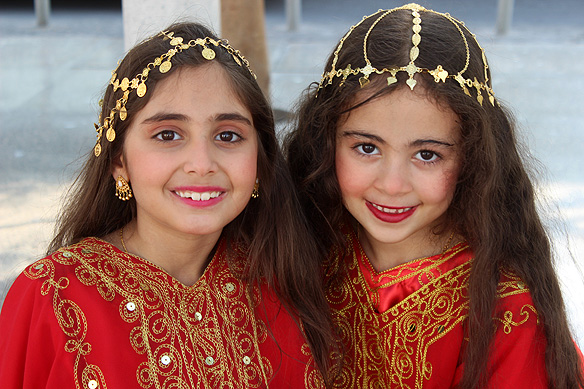
Children dressed up for Bahrain's national day, 16th December, which celebrates the late Emir Isa bin Salman Al-Kalifa's ascension to power in 1961.

Children dressed up for Bahrain’s national day, 16th December, which celebrates the late Emir Isa bin Salman Al-Kalifa’s ascension to power in 1961.

Continue reading

travel diaries: a tale of two capitals—nizwa and muscat

Nizwa, Oman’s 17th Century capital

I found myself blinking hard. And then blinking again. A little dazed. Bewildered is perhaps a better word. Was this for real? Was it indeed the 20th of December, 2024, or had I by some unexplained miracle time-travelled a good few centuries back?

Around me was a scene pulled right out of a medieval Arabian livestock souq. Sellers in pastel dishdashas were running around a ring. First with their goats, and then their cows, in tow. On either side of this parade were buyers in crisper, whiter dishdashas calling out if a particular animal caught their interest.

What followed next was a thorough examination of the selected livestock’s teeth, gums and hooves, and some hard-core bargaining. At times the seller won, at times the buyer, and the mute creature swapped masters. Often nothing materialised till another early Friday morning, when a display would again be put on show.

There were a handful of foreigners in the periphery, looking on, as amazed as me. Just like maybe a Marco Polo or Ibn Battuta did when witnessing a similar scene.

The business on hand was, however, completely unaffected by the cameras or gasps. There were more important things to focus on for these gentlemen. Would that goat be an asset? Would he be able to resell that cow for a profit? It’s a stock market in its most basic form wherein livestock are sold and resold every week.

In a couple of hours, the hullabaloo simmered down. The sellers and buyers dispersed. Showtime was over.

Did the end of the spectacle bring me back to the present? Not exactly. For next to the Friday traditional livestock souq were the 17th Century Nizwa Fort and Castle, the latter predating the fort by a few decades. Both built by the Ya’rubid dynasty, rulers of Oman from 1624 to 1742 who had made Nizwa, a historical city built over a stream and trade crossroads, their capital.

Nizwa Fort dates to the middle of the 17th Century. Built on the orders of Imam Sultan bin Saif Al Ya'rubi, the enormous earth-filled stone tower took 12 years to complete.

Nizwa Fort dates to the middle of the 17th Century. Built on the orders of Imam Sultan bin Saif Al Ya’rubi, the enormous earth-filled stone tower took 12 years to complete.

Continue reading

photo essay: mountains, desert, and coast of northern oman

If you look closely at Oman’s map you will notice a peculiar detail. There is the mainland, and separated from it is its governate Musandam on a peninsula jutting into the Strait of Hormuz. Look more closely. You will see an exclave [called Madha] between the two that is surrounded by the UAE. Look at it even more closely. Within Madha is Nahwa, an enclave that belongs to the UAE.

Now you may well ask, how did this happen?

Somewhere around the late-1930s, the four rival sheikhs controlling the surrounding area asked Madha’s village elders who did they want to pledge their allegiance to? Madha chose the Sultanate of Oman, but the bit inside it called Nahwa chose the Arab Emirates. Based on their choice, the rather unusual border between the UAE and Oman was drawn out in 1969.

That is Oman for you.

The eclectic set of borders further transposes into an eclectic set of mountains, desert, and coastline, juxtaposed right next to each other. It is as if the gods asked them too, whose realm did they choose, and they all in unison said “Oman.”

Described as a geologist’s paradise, the oldest continuously independent nation in the Arab World [since 1650] has held on to its authenticity well. Despite being a high-income country, there is no rivalry for high rises in the Sultanate of Oman, nor glitzy shows of oil wealth.

Come travel with me through my photo essay across northern Oman as I take you from Muscat to Fins Beach via the Bimmah Sinkhole and Wadi Tiwi, on to Ras Al-Hadd to see turtles and Sur to see dhows, camp under the stars in the Sharqiya Sands, stop by at a Bedouin market in Sinaw, have meals at traditional mud settlements, drive offroad to the top of Jebel Shams and then down Wadi Bani Awf, to be back in Muscat. And on the way, learn about this fascinating country and its warm, laid-back, friendly people. ❤


The journey begins. Continue reading

salalah: middle east’s anomaly

Tucked away on the Arabian Peninsula’s south-east coast is the Middle Eastern’s favourite getaway. Salalah.

Its very mention brings about a soft sweet smile to their otherwise calm controlled air, and a sparkle to dark eyes.

“Aah, Salalah!” followed with unbridled joy that I will be making the journey across a thousand kilometres from Muscat to this ‘haven.’

For two months in a year, July and August to be precise, Salalah in Southern Oman is engulfed in dense moist cloud and fog, with a light drizzle that amounts to less than a monthly average of an inch. This season is lovingly called ‘khareef,’ even though the term technically means autumn.

During these two monsoon months the barren shrivelled lunar landscape morphs into gushing waterfalls, turquoise-blue rivers, and lush green vegetation, replete with coconuts and bananas.

Whilst the rest of the Middle East swelters at 50 degrees, its populace flock to this anomaly in droves. Carnivals brighten the choppy sea-shores, and long queues together with packed car-parks peak to a frenzy.

Not your cup of tea?

Salalah is just as delightful in December when like the rest of Oman, it enjoys perfect weather. Continue reading