“Armenia, aah she is a prisoner of geography!” My guide Arpi exclaims as she narrates the country’s tumultuous history in a voice that any actor would envy. A professor in linguists, guiding is her second job.
We are on the way to Gyumri, Armenia’s second largest city in the country’s north-west, close to Turkey’s border. Built of local black and orange tuff [a volcanic porous rock], the city is known by various other names: cultural capital, city of arts and crafts, to name a few. But the most evocative is “city of orphans.” 22,000 orphans took refuge in Gyumri during the Armenian Genocide of 1915 – 1923, piecing together a new life in 170 orphanages across the city.
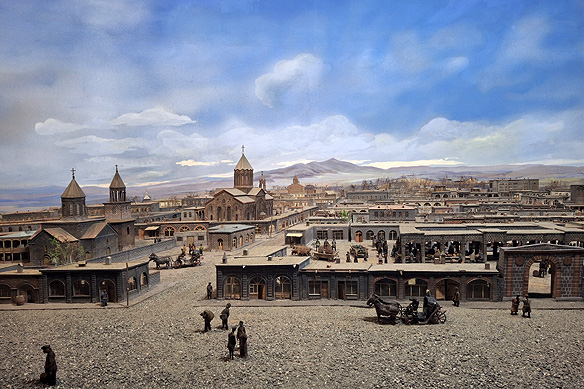
Founded as Kumayri in the 8th Century by the Urartians—the same kingdom which also established Erebuni, Yerevan’s ancestor—it has been renamed numerous times since 1837. Alexandropol on the orders of Russian Tsar Nicholas I after his wife, Leninakan in honour of Lenin, back to Kumayri on independence, and Gyumri in 1992.
A bustling industrial hub during the Soviet era [1922 – 1990], it came crashing down, literally, on 7 December, 1988 in a 6.8 magnitude earthquake. Everything turned to dust, except for Nicholas I’s Alexandropol in the Kumayri historic district. The area is a rare remnant of low-rise Armenian urban architecture in its original setting.
Tell your travel plans to an Armenian, and the first question that pops out is “Are you going to Gyumri?” Not many non-Armenians go up this far north, and if you are doing so, you will be instantly rewarded with an appreciative nod—transforming you from a flighty tourist to a traveller with gravitas.
Though its outskirts are all brand new, because of the earthquake’s devastation, the city holds its memories close to its bosom. The pain and hesitant optimism of its thousands of orphans; the filmmakers, authors, and actors who call Gyumri home; and the craftsmen who churned out masterpieces, and continue to do so, from seemingly insipid raw material.
All these and more whisper out of the black and orange tuff intrinsic to Gyumri. Here are five of Gyumri’s most magical treasures. Do not be surprised if you bookmark a few more of your own should you visit it. ❤ Continue reading
 rama toshi arya's blog