travel shorts: kazakhstan’s bronze age gallery with 5,000 petroglyphs

In search of the Arpauzen petroglyphs in southern Kazakhstan.

In search of the Arpauzen petroglyphs in southern Kazakhstan.

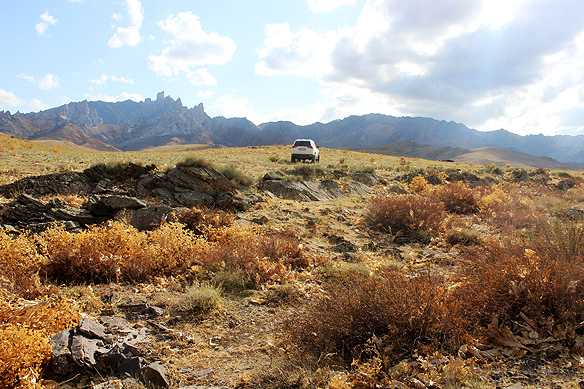
I wish I had some form of 360-degree vision and could see nature’s entire spread around me at the same go. On one side, the Prisyrdarya Karatau Mountains‘ dark craggy peaks encircled the isolated silent valley swathed in wild tulips and golden heather. On the other, colossal black chunks of rock glistening in the afternoon sun cascaded down the slopes. Pinch me, I whispered to myself. Is this really for real!

But this was all just half its magic …

“Come, look here. There are etchings of two double-humped Bactrian camels and a hunter with a bow and arrow.” My guide, Islam’s excited voice broke into my reverie, and the otherwise pin drop silence punctuated with the sound of our footsteps on crackling sun-dried tangled gorse, and neighing of wild horses grazing a mere stone’s throw away. Continue reading

the 5 untold treasures of abu dhabi and sharjah

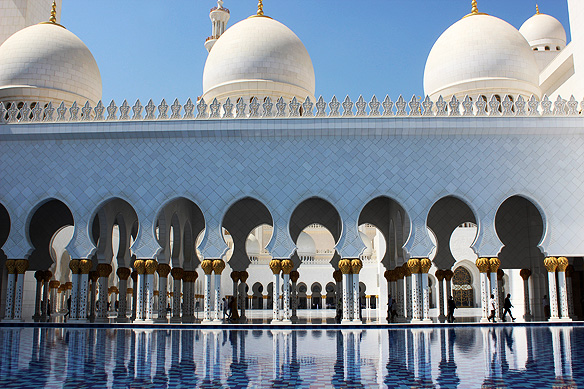
Think of the United Arab Emirates [UAE] and the one city that invariably pops up in our minds is Dubai—the city of steel, glass, and gold. But Dubai is not the only emirate. Notice the plural in the country’s name? There are six others, each with its own ruler, and of these, two are steadily vying with Dubai for a space in global tourism. For a reason: The incredible treasures they both hold which not many know about. They are Abu Dhabi and Sharjah.

Abu Dhabi is the richest emirate in the grouping and its city by the same name, Abu Dhabi, is the country’s capital. 96 percent of the UAE’s 100 billion barrels of proven oil reserves are within its borders, ranking it at number six worldwide. Abu Dhabi’s ruler is also the President of the UAE. Sharjah, on the other hand, is in a time-warp. It is older, more traditional, and regarded as the UAE’s cultural capital.

It was in 1958 when the UAE first discovered it had oil, and that too loads of it. Four years later, in 1962, Abu Dhabi, then a small fishing village on the edge of a desert, exported its first cargo of crude oil, and the country changed forever.

Supplying 4 percent of the world’s oil requirements with a production of 3.2 million barrels per day, the UAE has spiralled its way through progress at an astonishing speed. However, there is another side to the country that was formed on 2nd December, 1971. Its pre-oil era, swathed in a heritage that is beyond its oil. There is also a whole country that is beyond Dubai.

With ancient desert roots and a vision of unity through globalisation, here are some of UAE’s most spectacular treasures in its two lesser visited cities Abu Dhabi and Sharjah. For often the most beautiful sites are on the road less trodden. ❤ Continue reading

kullu manali and their 11 loadstones

Loadstone: Noun. A person or thing that is the focus of attention or attraction. In aplenty. In other words—Kullu and Manali.

– – –

Two of India’s most popular hill stations’ names are often taken in the same breath. Even though they are separated by some 40-odd kilometres.

Welcome to Kullu Manali. Two towns located on the verdant Kullu valley in India’s Himachal Pradesh with the ice-blue Beas river gurgling past them.

Free of a colonial overprint, or the culture and faith of an invading ruler, these two towns have in the past, as well as today, continue to epitomize Himachal history, traditions, and heritage. In all its unadulterated richness.

Gods are in abundance here, and so are centuries-old beliefs. The lines between mythology and mundane reality are blurred with characters from the epics Mahabharata and Ramayana popping up everywhere. Ancient sages, mythical heroes, demons, and the proverbial Noah [in Hinduism’s case Manu] who set forth from his ark to kick-start the lineage of mankind. They are all somehow associated with the Kullu valley which has earned itself the moniker ‘Valley of Gods.’

There’s also tall graceful fir trees, rivers fed by melting glaciers punctuated with hot water springs, and wooden homes which have housed many a generation of pahari [mountain] folks inside their weathered walls.

You will need at least a few days to get acquainted with Kullu and Manali’s sites. Hotels and taxis are easily available. Let me not go into them here. Rather let this post be a roadmap of what makes these two towns attract pilgrims and tourists in their droves, always. ❤ Continue reading

the road less travelled: delft island

Forty kilometres off the northern coast of Sri Lanka, is its farthest island—Delft.

It is an unusual name to come across for a tropical island in the Indian Ocean. After all, there is not much in common between the bleached island and the picture postcard region in Netherlands where white glazed pottery with blue decorations have been historically made. The 18th Century Dutch colonial rulers obviously felt differently; for them it was a perfect fit for their new home. Perhaps a gentle reminder of their roots in faraway lands.

Remote and sparsely populated, Delft is the largest island in the Palk Strait which separates Sri Lanka from the Indian subcontinent. Eight kilometres wide and 5.5 kilometres long, it is not just its name which is out of the ordinary. Delft Island used to be a coral reef in the distant past as revealed by the petrified coral chunks strewn on its emerald green beaches. Sans any streams, potable water is limited to catchment areas for surface water and a few pockets of ground water.

Despite these challenges, 1,300 Tamil Christian and Hindu families call the island their home today; their houses clustered around compounds in the north. Empty, windswept scrublands meanwhile stretch out in the south, right up to the rugged charred coastline. Continue reading

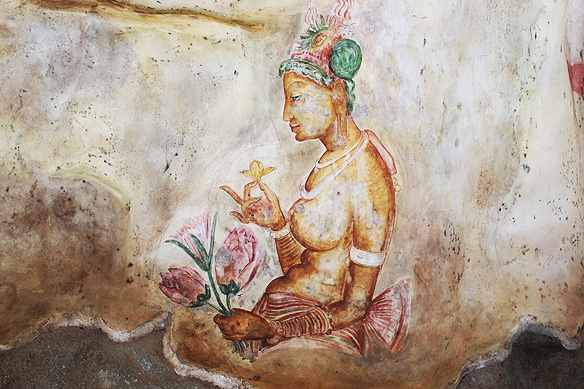
the sigiriya frescoes: king kassapa I and his 500 damsels

477 AD. Anuradhapura, Sri Lanka.

29-year-old Prince Kassapa I was filled with a deep burning desire to be king. So deep, it seemed to completely engulf him. To be the ruler of Anuradhapura, Sri Lanka’s ancient historical spiritual heart. How wondrous would that be!

And he would have been. Could have been. Except for one problem. His mother was the non-royal wife of Moriya King Dhatusena. The rightful heir to the coveted throne was his young half-brother Moggallana, offspring of his father’s chief consort.

Not to be deterred, Kassapa I, also known as Kashyapa I, decided to lead a palace coup with the help of Migara, the army commander who had a personal grudge of his own against the king. Young Moggallana, meanwhile, managed to escape, and took refuge in South India.

When Kassapa demanded to know the location of his father’s treasury, his imprisoned father responded saying Anuradhapura’s water tank was his one-and-only treasure. Miffed on hearing this, Kassapa had his father entombed alive.

For the rest of his life, Kassapa’s subjects and rivals, as well as the local Buddhist monks, would call him Pithru Ghathaka Kashyapa meaning Kashyapa the Patricide. It was a label he would not be able to shake off even after death.

In a bid to start afresh, away from public disgrace and the threat of a possible future retaliation by Moggallana, Kassapa moved his capital 75 kilometres south. Here, deep in Sri Lanka’s tropical plains stood a 180-metre-high monolith volcanic rock pillar with unhindered 360-degree views for miles on end. Continue reading

persian herat and its hidden wonders

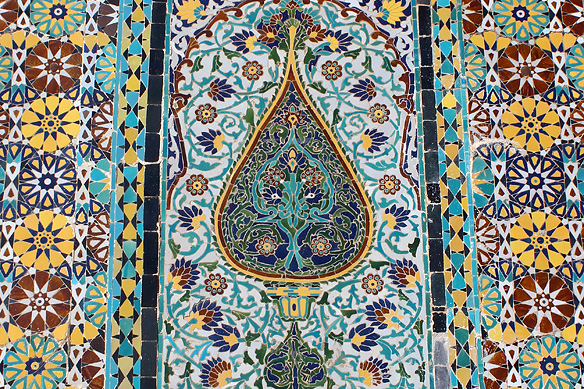
Right at the very end of the battered and bruised road, cutting across the country from east to west, is the Persian historical city of Herat. Not many travellers come this far. It is way too out, perched near Afghanistan’s western border with Iran. Yet, it has always been of great importance, as is revealed by its architectural and cultural treasures to those who take the trouble to reach it.

Herat’s been around for a long time; 6th Century BC records describe it as a Persian city which went by the name Aria. Yes, the same pronunciation as my surname. 🙂

Its strategic location on the Great Silk Road and the banks of the Hari River made it particularly appealing to conquerors and rulers. Alexander the Great defeated Herat’s Persian Achaemenids in 330 BC and put up a majestic citadel to celebrate his victory. He was followed by the Abbasid Caliphs in the 8th Century, Ghurids in 1175, the Mongol Genghis Khan who destroyed everything in 1221, the Kartids who then rebuilt it, and the Timurid Tamerlane who destroyed it once again in 1380.

When Tamerlane’s favourite son Shahrukh Mirza decided to move his capital from Samarkand to Herat, he was determined to make Herat the grandest city in the region. A vision shared by his wife Gawhar Shad and later descendent Husayn Bayqara.

The result was a city of much beauty and grace whose praise was extolled far and wide. Of its many buildings, 830 ‘cultural sites’ are still believed to survive today, warranting it a place in UNESCO’s tentative list in 2004.

It is a difficult combination. War and conservation. However, despite all the odds, both UNESCO and the Aga Khan Trust for Culture have consistently worked on Herat, ensuring its treasures, hidden from the world at large, manage to survive.

Come along with me on a virtual tour of Timurid Herat, the city on the Hari River, to see why it was called the ‘Pearl of the Khorasan’ for the longest time! Continue reading