kullu manali and their 11 loadstones

Loadstone: Noun. A person or thing that is the focus of attention or attraction. In aplenty. In other words—Kullu and Manali.

– – –

Two of India’s most popular hill stations’ names are often taken in the same breath. Even though they are separated by some 40-odd kilometres.

Welcome to Kullu Manali. Two towns located on the verdant Kullu valley in India’s Himachal Pradesh with the ice-blue Beas river gurgling past them.

Free of a colonial overprint, or the culture and faith of an invading ruler, these two towns have in the past, as well as today, continue to epitomize Himachal history, traditions, and heritage. In all its unadulterated richness.

Gods are in abundance here, and so are centuries-old beliefs. The lines between mythology and mundane reality are blurred with characters from the epics Mahabharata and Ramayana popping up everywhere. Ancient sages, mythical heroes, demons, and the proverbial Noah [in Hinduism’s case Manu] who set forth from his ark to kick-start the lineage of mankind. They are all somehow associated with the Kullu valley which has earned itself the moniker ‘Valley of Gods.’

There’s also tall graceful fir trees, rivers fed by melting glaciers punctuated with hot water springs, and wooden homes which have housed many a generation of pahari [mountain] folks inside their weathered walls.

You will need at least a few days to get acquainted with Kullu and Manali’s sites. Hotels and taxis are easily available. Let me not go into them here. Rather let this post be a roadmap of what makes these two towns attract pilgrims and tourists in their droves, always. ❤ Continue reading

travel shorts: hill country—nuwara eliya to ella by train

This slideshow requires JavaScript.

Most travellers are of the opinion that the only real way to see Sri Lanka is by train. And that of all the rail journeys through the sparkling tropical island, the most beautiful is the one from Nanu Oya [near Nuwara Eliya] to Demodara [near Ella] in the heart of ‘hill country.’ They are not wrong. 🙂

Built in the mid-19th Century by the British colonizers, the train’s primary purpose for the longest time was to transport crates of tea leaves and coffee from the mist-wrapped estates to Colombo Port. The segment from Nuwara Eliya, a colonial town, to Ella, a village steeped in Hindu mythology, is a tourism institution of sorts today. Continue reading

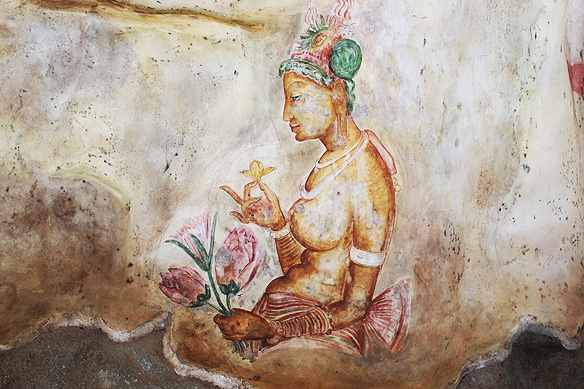
the sigiriya frescoes: king kassapa I and his 500 damsels

477 AD. Anuradhapura, Sri Lanka.

29-year-old Prince Kassapa I was filled with a deep burning desire to be king. So deep, it seemed to completely engulf him. To be the ruler of Anuradhapura, Sri Lanka’s ancient historical spiritual heart. How wondrous would that be!

And he would have been. Could have been. Except for one problem. His mother was the non-royal wife of Moriya King Dhatusena. The rightful heir to the coveted throne was his young half-brother Moggallana, offspring of his father’s chief consort.

Not to be deterred, Kassapa I, also known as Kashyapa I, decided to lead a palace coup with the help of Migara, the army commander who had a personal grudge of his own against the king. Young Moggallana, meanwhile, managed to escape, and took refuge in South India.

When Kassapa demanded to know the location of his father’s treasury, his imprisoned father responded saying Anuradhapura’s water tank was his one-and-only treasure. Miffed on hearing this, Kassapa had his father entombed alive.

For the rest of his life, Kassapa’s subjects and rivals, as well as the local Buddhist monks, would call him Pithru Ghathaka Kashyapa meaning Kashyapa the Patricide. It was a label he would not be able to shake off even after death.

In a bid to start afresh, away from public disgrace and the threat of a possible future retaliation by Moggallana, Kassapa moved his capital 75 kilometres south. Here, deep in Sri Lanka’s tropical plains stood a 180-metre-high monolith volcanic rock pillar with unhindered 360-degree views for miles on end. Continue reading

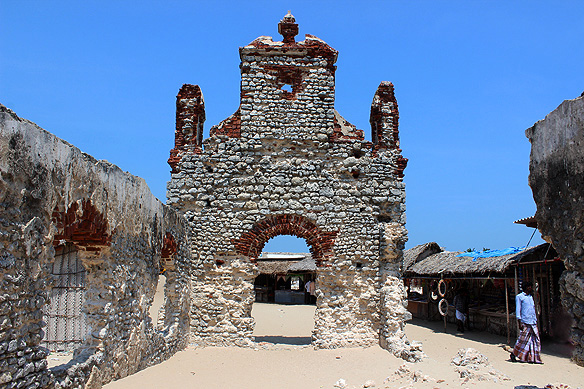
dhanushkodi: the indian border ghost town where mythology and cyclones meet

Dhanushkodi.

Meaning ‘End of Bow’.

It is 5:30 am and the alarm on my phone wakes me from my deep slumber with its cacophonic ring. I had slept late last night after taking part in an elaborate ritual at the 12th Century Madurai Temple which drew to a close only around midnight.

Known as the Palliarai pooja, the hour-long event saw the faithful escort Shiva from his shrine to that of his consort Meenakshi’s to spend a night of love-making. A ritual that has taken place every night uninterrupted for the past hundreds of years in the temple’s inner sanctums.

It was slowly dawning on me that in this part of the world common folks honoured their gods with much affection and awe. They were never separate or divided from them. Even their gods’ emotional and sexual desires were fondly celebrated. But more of all that in another post.

Today, I am on my way to Pamban Island connected by a road and railway track over the Bay of Bengal and Arabian Sea. On to India’s international border with Sri Lanka under a radiant blue sky, surrounded on three sides by equally radiant blue oceans. My destination is a tiny patch where land, sea and sky meet, and where one of Hindu mythology’s most significant events took place, at a distance of 192 kilometres south-east of Madurai. Continue reading

banganga: lord ram’s stopover in mumbai en-route to lanka

banganga1

“Excuse me, Banganga kahaan hai?” [Where is Banganga?]
This is the umpteenth time I have stopped to ask. There are no sign posts of any kind. Guided by countless shopkeepers, cab drivers and Marathi women with flowers in their hair, I finally find my way off the main road on to a small side lane with stone steps leading down into a valley.

Yes, I am confused. Around me urban Mumbai throbs with concrete high rises and bustling markets. The corner store keeper assures me, “Down the stairs on your right.”

“You sure?”

“Yes, sure.” And smiles.

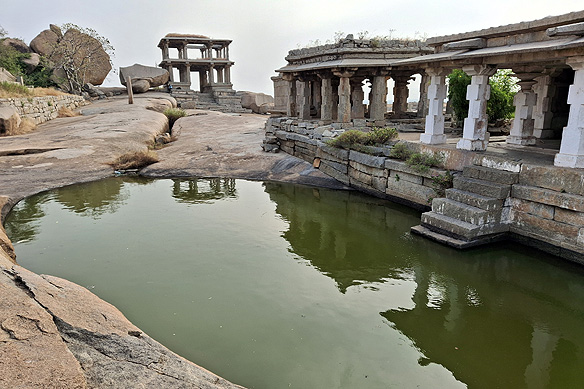
So down the stairs I go, and at the bottom look to my right. A huge water tank guarded by deepstambhs, pillars to hold diyas, and surrounded by temples and dharamshalas clinging to its walls greets me with old world whimsical charm. Continue reading

koteshwar temple, kutch: an 1820 ode to shiva

koteshwar_temple2

I am not one for religious rituals for the simple reason that I am quite ignorant of most of them, whether it be what one is supposed to say and do in a temple, church, mosque, synagogue or gurdwara. But that has in no way diluted my love for religious places. 🙂 Yes, god is everywhere—Next to me, as well as you. But within certain sacred walls, in the culmination of art and the faith of followers, He (or to be a feminist She—God doesn’t really care; we are the ones with all the issues) is a bit more tangible. Almost visible in his invisibility. Continue reading

art focus – samiksha (commentary) – shahed pasha


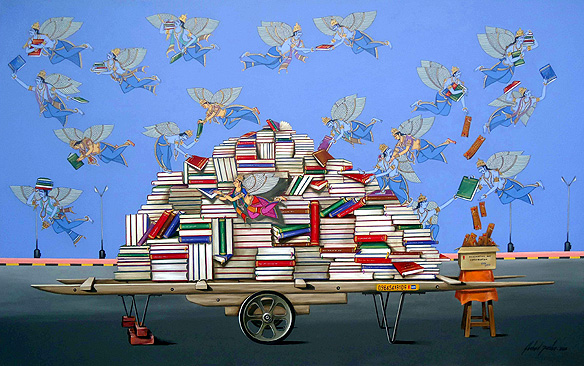
Fairies taking away the Books

The fantasy-tical world of Shahed Pasha.

It is a world where millennia old Hindu mythological stories are portrayed in modern contexts in miniature painting style, by a born and bred Muslim, across mammoth canvases. Continue reading