Unknown's avatar

About Rama Arya

I travel for the love of travelling. I blog for the love of blogging. About Me: ramaarya.com My Personal [Travel and Art] Blog: ramaarya.blog My Work: thecommunique.co.in

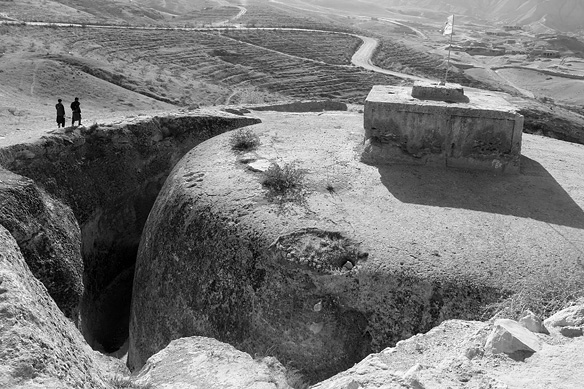
the complete travel guide to balkh: ancient bactria and silk road’s fabled city

Of all the cities that has survived the annals of time, Balkh, the capital of ancient Bactria [6th Century BC to 6th Century AD] in northern Afghanistan, is perhaps the most evocative.

Volumes have been written on its wars when it was the capital of Bactria, and thereafter, a part of post-Bactrian empires. Art and literature have had a constant muse in its colourful personalities, Alexander the Great and Roxanna, and their marriage which paved the course of history. One of the oldest religions in the world, Zoroastrianism, was founded by one of Balkh’s very own citizens, Zoroaster.

But its greatest claim to fame, and subsequently its greatest legacy, came from its simultaneous role as Silk Road’s fabled city. For 1,600 years, from 130 BC – 1453 AD, Balkh was not just a confluence of commodities, but also of religions, ideas, and knowledge. Continue reading
top 15 memorable things to do in kabul, afghanistan’s capital

Afghanistan’s capital, Kabul, is not your regular city. Hemmed in by the Hindu Kush Mountains and Kabul River, it is beautiful. And broken.

The city traces itself back some 3,500 years and was a strategic trading centre on the Silk Road linking India with the Hellenic world. Over the centuries, the Who’s Who of Central Asia’s rulers and empires have ruled over it.

One of its earliest turning points was in the 9th Century when it was conquered and Islamised by the Abbasid Caliphate. Prior to this, Kabul was politically and culturally a part of India with a Buddhist and Hindu populace and rulers. Another major turning point was in 1776, when it officially became the capital of ‘Afghanistan,’ a nation the country’s founding father Ahmed Shah Durrani had established a decade earlier. Continue reading

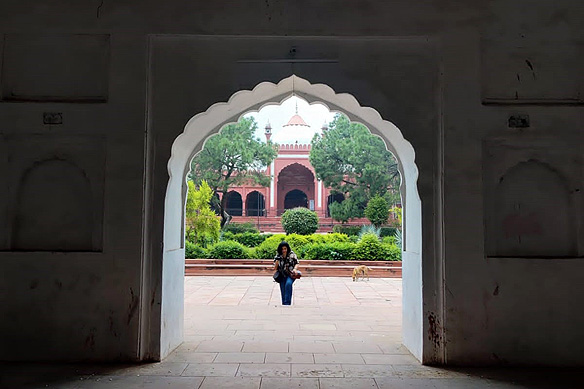
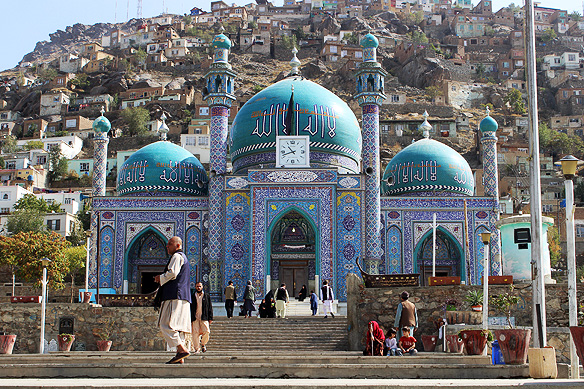
travel shorts: hazrat-e mazar, afghanistan’s most sacred site

Image

This slideshow requires JavaScript.

One of Islam’s most sacred sites lies in northern Afghanistan, a mere 55 kilometres from the Uzbekistan border. It is a blue-tiled mosque which glistens like a jewel, changing colour through the day, and home to countless pristine white pigeons.

Whilst the Shi’a sect of Islam believe that Ali, Prophet Muhammad’s cousin and son-in-law, is buried in Najaf, Iraq, the Sunni sect regard Hazrat-e Mazar in Mazar-e Sharif as Ali’s actual tomb.

Both, the city Mazar-e Sharif and its spiritual centrepiece Hazrat-e Mazar, date back to the 12th Century.

There is an interesting Afghan legend as to how the tomb came to be here. Continue reading

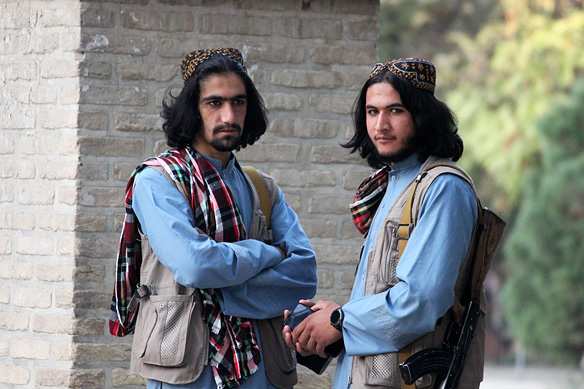
taliban afghanistan, a solo indian woman traveller, and help from unexpected quarters

An Australian tour company versus the Taliban. Who would you trust?

If I am not mistaken nearly everyone would choose the tour company. I did too.

After all, it is ‘white-owned’, from a ‘developed country,’ and the default conclusion is that ‘I would be safe with them’ in an otherwise unsafe country—in this case, Afghanistan under the Taliban.

Instead, as the only person of colour in a group of 10 led by two white Australian tour leaders, I was subjected to a barrage of India-bashing from the group. By the time one of the group, a Welshman living in Poland, crossed the lines on the seventh day of the tour, I’d had enough. I told them to stop. What happened next is what travel nightmares are made of. Continue reading

the story of qutub minar

Prologue

Perhaps it would be more apt to title this post: Stories about Qutub Minar. As in plural.

Apart from being Delhi’s most iconic monument, it is steeped in multiple stories and a whole lot of firsts, making it unlike any other in the city. To top it, it is not the handiwork of any one ruler or dynasty, but is a collaborative effort spanning 800 years with even an East India Company officer adding his own bit to it—a Bengal-styled chhatri perched on top of the tower, which was thankfully brought down twenty years later.

So, here are Qutub Minar’s most famous stories. The spunk behind its stones. 😊 Continue reading

a heritage buff’s guide to the eight cities of delhi

Delhi, a city of 7 cities, 8 cities or 14 cities? It depends on which lens one is looking at the city from. But it surely is not one city!

India’s political centre has been around for a long time. 1,300 years as per historical records, in which it served as the capital city for different rulers over various periods.

Many set up their own capital, in their own name, for posterity’s sake in and around Delhi. For instance, Mubarak Shah, the second Sayyid dynasty ruler during the Delhi Sultanate period founded Mubarakabad in the 15th Century [included in the 14 cities list]; it is now a neighbourhood called Kotla Mubarakpur.

All together, 14 such cities were built over the centuries in this patch of strategically placed land in northern India with the fertile Gangetic plain to its east, the impenetrable Deccan plateau to the south, and the arid desert state of Rajasthan to the west. An area nourished by the river Yamuna and the monsoons.

Much smaller than present-day Delhi, these cities were often built a short distance away from an old one or incorporated earlier ones into its boundary walls, and at times even existed concurrently. Each of them has added a distinctive layer to Delhi, making Modern India’s capital quintessentially different from any other. Where else can you time travel across a millennium in an hour.

For this post, I am taking the ‘8 cities in a city’ theory. Seven historical cities in Delhi that still exist, and New Delhi, listed in chronological order.

It is a longish post. After all, we talking about 1,300 years and eight cities. 🙂 Hope you enjoy reading it as much as I enjoyed writing it.

Happy time travel! Continue reading

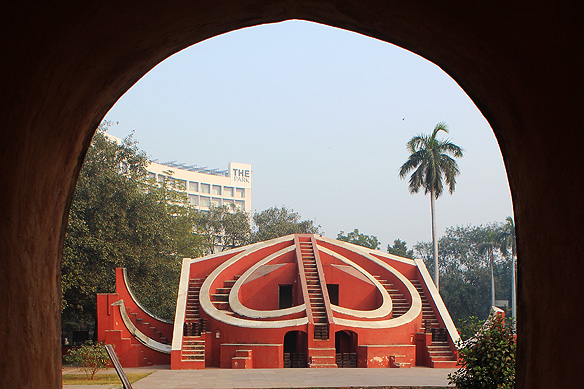
india travel shot: jantar mantar, a slice of jaipur in delhi

Image

Deep in the heart of New Delhi’s central business district, Connaught Place, is a remnant of the Princely State of Jaipur. Surprised?

Known earlier as Jaisinghpura Village, this patch of land formed part of Jaipur’s territories from the 16th Century right up to the year 1911. When Maharaja Sawai Jai Singh II built a monumental observatory to measure time in Delhi, on the invitation of the Mughal Emperor in 1724, he was technically building it on his own land.

He named his futuristic structures to measure the movement of the heavens Jantar Mantar, meaning instruments and formulae. So chaffed was he by his invention, he repeated it in his own capital, Jaipur, and three other cities in the following years.

Fast forward to 1911: Sir Edwin Lutyens decides this area is to be the site for the new Imperial capital, New Delhi. But it is already occupied. So, the British government buys it off from Jaipur, relocates all the villagers [to nearby Karol Bagh], and razes their homes to the ground. Except for the monuments and places of worship that stand on it.

Hence, surrounded by high-rises is a fenced area of green with a medieval observatory, along with Hindu [Hanuman Mandir and Bhairav Mandir], a couple of Jain temples, and a Sikh temple [Bangla Sahib Gurudwara], all dating back to Jai Singh’s reign.

These have become so much a part of Delhi’s heritage, the fact that they are actually remnants of the Princely State of Jaipur are all but forgotten. 🙂

– – –

Note: Yash Gupta, a conservation architect at Intach, leads a fabulous 2-part walk through Jaisinghpura based on his research of the area.

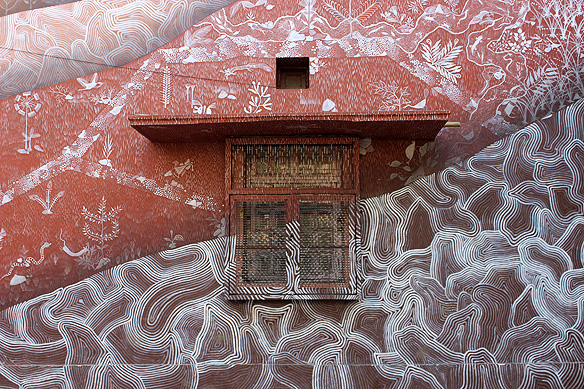
lodhi art district’s 16 most dazzling street art paintings

What happens when a sedate neighbourhood for government employees comes face-to-face with passionate street artists from across the world—Lodhi Art District happens. 😊

A leafy residential area dating back to Edwin Lutyens’ 1940s New Delhi, Lodhi Colony is characterised by wide streets and housing blocks encased in lofty colonial arches and vast facades. Unlike most of Delhi, it is relatively traffic-free—the perfect setting for an open-air art gallery, is what St+art India Foundation figured in 2015.

And so, over the years, street artists from across the world and India, were invited to transform its faded vanilla walls into riots of colour. At times the art was loaded with thought-provoking messaging, and at others about the simple truths of life. But always, magnificent in their aesthetic beauty.

There are some 60 street art works scattered over the neighbourhood, as of December 2022. You would need a whole day to see them all. Of these, 16 are drop-dead dazzling, and my absolute favourites!

I have included a link to a google map prepared by St+art at the end of this post to help you locate these paintings, along with a link to their official [free] audio guide available on HopOn India.

Here they are, the best of Lodhi Art District’s lot. Be prepared to be bowled over. ❤ Continue reading

delhi’s shahjahanabad unraveled: heritage, sacred places, markets, and food

No visit to Delhi would be deemed complete without a visit to Shahjahanabad, popularly referred to as ‘Old Delhi’ after the creation of Lutyens’ ‘New Delhi.’ But it is an overwhelming place. A sensory overload. After all, what do you expect from 400 years of continued habitation and history packed into 6.1 sq. kilometres.

This pocket of land has seen it all. The zenith of Mughal rule. India’s First War of Independence. The sure and steady takeover of Delhi by the British, culminating in India’s independence in 1947.

It has been razed to the ground and bathed in blood three times over the course of time. Yet, it has bounced back on its feet. Livelier. It has seen executions in the name of religion, and yet, coexistence continues to exist within its walls. Devoid of any ‘city planning,’ apart from the Fort area, Chandni Chowk, and Jama Masjid, it has grown organically over the centuries with bundles of overhead electric wires and unpaved paths put up, as and when needed, to meet infrastructure needs. Yet, there are heritage treasures in its midst which are some of the most stunning in the country.

This chaotic wonderland, which defies all rules, had its foundation stone laid on 19 April, 1639 by the Mughal Emperor Shah Jahan. For nine years, thereafter, construction took place under imperial orders, and in 1648 it was declared ready for use as the new Mughal capital. Continue reading

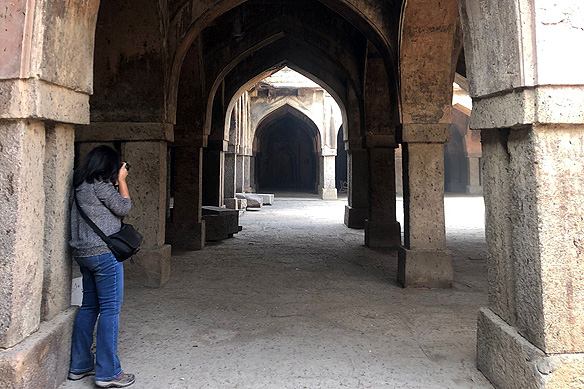
travel shorts: delhi’s 800-year-old spiritual retreat for eunuchs

This slideshow requires JavaScript.

Delhi is full of tombs and gravestones. There are tombs for sultans and emperors, and their consorts. For wealthy nobles and ordinary folks. But gravestones, sorry not for one, but 50 revered eunuchs or transgender women who lived eight hundred years ago? Aaah, that can only happen in Delhi. 😊

Hijron Ka Khanqah, which literally translates to ‘a Sufi spiritual retreat for eunuchs’ is a collection of whitewashed gravestones fronted by a wall mosque in Mehrauli Village, a neighbourhood in Delhi continuously inhabited for the past one thousand years. Amidst these gravestones stands a marble tomb marked with a kalamdan, a raised ridge, typical of graves belonging to males in medieval India. Continue reading