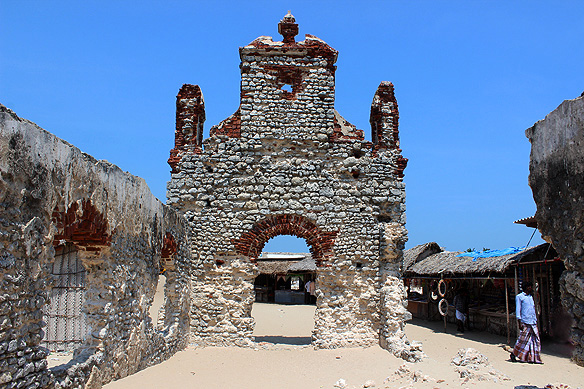
dhanushkodi: the indian border ghost town where mythology and cyclones meet

Dhanushkodi.

Meaning ‘End of Bow’.

It is 5:30 am and the alarm on my phone wakes me from my deep slumber with its cacophonic ring. I had slept late last night after taking part in an elaborate ritual at the 12th Century Madurai Temple which drew to a close only around midnight.

Known as the Palliarai pooja, the hour-long event saw the faithful escort Shiva from his shrine to that of his consort Meenakshi’s to spend a night of love-making. A ritual that has taken place every night uninterrupted for the past hundreds of years in the temple’s inner sanctums.

It was slowly dawning on me that in this part of the world common folks honoured their gods with much affection and awe. They were never separate or divided from them. Even their gods’ emotional and sexual desires were fondly celebrated. But more of all that in another post.

Today, I am on my way to Pamban Island connected by a road and railway track over the Bay of Bengal and Arabian Sea. On to India’s international border with Sri Lanka under a radiant blue sky, surrounded on three sides by equally radiant blue oceans. My destination is a tiny patch where land, sea and sky meet, and where one of Hindu mythology’s most significant events took place, at a distance of 192 kilometres south-east of Madurai. Continue reading
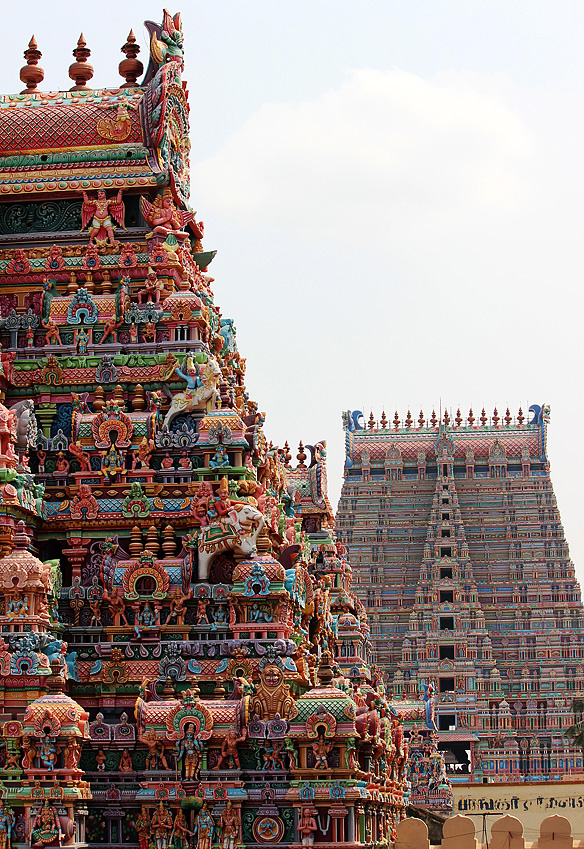
india travel shot: wonders of trichy’s vishnu temple—travel like today is all you’ve got

Image

My beloved mom on our long-distance WhatsApp call: “You have just come back from Mysore!”

Me: “The temple towns of Tamil Nadu are a world apart.”

My beloved mom: “Why don’t you go later, say in April?”

Me: “Nooooo. That will be too late!”

I often have conversations like the above with my mom. She is a homebody. I am usually looking for the next travel adventure.

This time it was no different. Wrong, it was different.

When I said it will be “too late” I had no idea that barely two weeks after my return from a 7-day exploration of the temple towns of Tamil Nadu, the world would be turned completely topsy-turvy by a virus called COVID-19. Especially my own city, Mumbai. Curfews. Lockdowns. Flights, trains, buses, cabs—all services cancelled. I have been living, like others in the Maximum City which never sleeps, in self-isolation since the 22nd of March. No one in my gated community is allowed to step out of one’s main doors. Today is the 9th day. Continue reading

once upon a day in mysore: a one day itinerary of south india’s royal city

What if I told you there is a small town in South India which will forever remain your favourite, long after you visit it. What if I told you that in this town, frangipani trees sway gently and history, heritage, art and literature sit in easy camaraderie. That people here are simpler and the sky is bluer. Would the traveller in you jump for it?

I am talking about Mysore, renamed Mysuru, its original name, in 2014.

Less than a million-population live under its green shade of aged fig trees and their sprawling branches. Its wide dusty roads weave their way through a life where nothing much has changed over time.

From 1399 to 1950 Mysore was the seat of the Wodeyar dynasty, rulers of the Kingdom of Mysore except for a brief interlude when Hyder Ali and his son Tipu Sultan snatched the reigns. The Wodeyar family still lives in the Mysore Palace and the dynasty’s legacy permeates the entire town. From its seven palaces, of which two have been turned into museums, to its tutelary goddess perched high up on a hill, to its terraced gardens over the sacred Cauvery river. Continue reading

srirangapatna, historical capital of tipu sultan: the why, what, where, when, how guide

Some 18.5 kilometres to the north-east of Mysore city, on an island called Srirangapatna, lies a dusty town lost in time. Its current worn state belies its glorious past which still reveals itself shyly from behind its weathered structures.

Key historical events have taken place on its softly undulating plains. Larger than life rulers who till date evoke strong emotions made the island the centre of their universe.

Welcome to my guide on Srirangapatna, capital of the 18th Century ruler Tipu Sultan aka the Tiger of Mysore. The Why, What, Where, When and How guide of a town well off the usual tourist circuit, but deeply ingrained in every Indian history book, mass media, world museums and private collections.

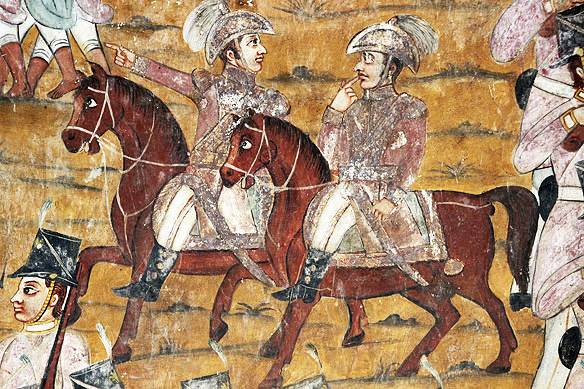
[Note: Top image: Detail, Fourth Anglo-Mysore War, 4 May 1799, British East India Company painting.] Continue reading

travel diaries: in search of shravanabelagola’s bahubali

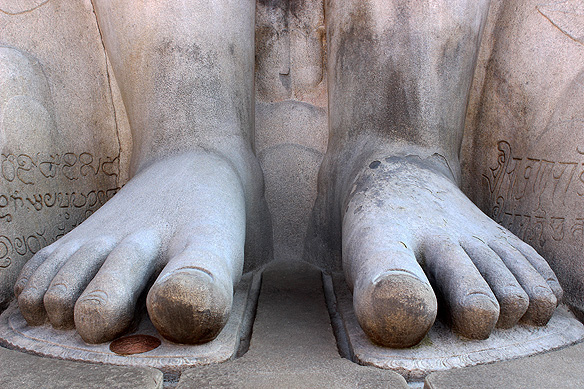
The entire 615 steps carved into the rock’s gleaming surface rose straight above me. No left or right turns. Just straight up, with a rudimentary metal rod for support along its length. Some of the steps were shallow, others steep. All equally worn out under the bare feet of countless pilgrims and travellers over a thousand years. The steps themselves were just as bare under the scorching sun, minus any shade whatsoever.

Only one spiritually legitimate way exists to reach the 58-feet-8-inch-high naked granite monolith of Bahubali Gommateshwara, the inimitable deity-hero in Jainism perched on top of the sacred Vindhyagiri Hill in Shravanabelagola. It is by climbing up these steps.

Though another flight of steps winds its way up on the western side of the 470-feet-high hill, this is the original path cut into the rock by Chavundaraya, a Ganga dynasty minister and commander way back in 981 AD. And by now you know me. It had to be the original path for me. 😀

It was 1 in the afternoon when I reached the minuscule town of Shravanabelagola after exploring the Hoysala temple at Somanathapur. My plan was to use one of the palanquins I had read about to reach the top. But do plans ever go as planned? Continue reading

poetry, myths and stone: the millennium-old sculpted hoysala temples of karnataka

[UPDATE: The ‘Sacred Ensembles of the Hoysalas’ made it to the UNESCO World Heritage Site list on 18 September, 2023. It is India’s 42nd UNESCO World Heritage Site.]

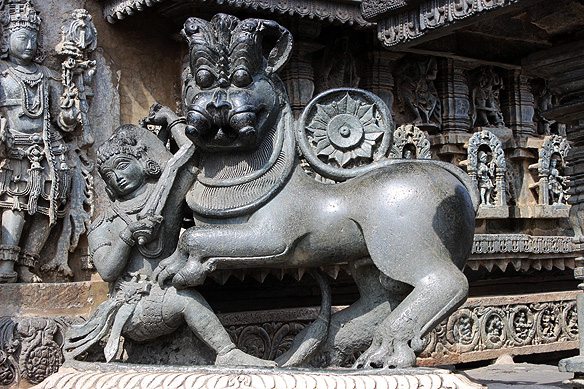
Cries of “Hoy, Sala” [Strike, Sala] rang out as Sala, a Jain youth, single-handed fought a tiger to save his guru. It was around 950 AD, in the Deccan plains of South India. He immortalised this cry in the name of the dynasty he founded—Hoysala—which ruled the region till 1355 AD. The incident became its emblem.

Sandwiched between the Chalukya dynasty in Badami and the ruling Cholas in Thanjavur, Sala and his descendants created a flourishing agrarian empire populated by a sophisticated society, and where the arts thrived. Their capital was Belur, then called Velapuri. Vishnuvardhana [1108 – 1152 AD], the 5th Hoysala king, later moved his capital to Halebidu, 17 kilometres away, where it stayed till the end.

Though Hoysala palaces and homes are long gone, their stone temples still stand. Even time and wars have not been able to diminish their exquisite beauty, a fascinating peek into a by-gone society’s values and aesthetics.

So, if you ever thought all temples in India look the same, think again. Every dynasty and empire in the Indian sub-continent created its own inimitable style through history. Hoysala temples are typified by being star-shaped, compact structures on a raised platform, ornate with a focus on dance and music, and carved out of soapstone. Continue reading

why tipu sultan’s dariya daulat bagh will take your breath away

Two-hundred-and-fifty years ago lived a man renowned for his opulence, and bravery. He was fearless. Nothing scared him. Or perturbed him. He also had a deep abhorrence for the British East India Company and its colonial inroads into India.

His name was Tipu Sultan, ruler of the Kingdom of Mysore. And his capital was Srirangapatna [spelt Seringapatam by the British], an island plonk in the middle of the mystical Cauvery River in present-day Karnataka.

It was to this tiny little, steeped in history, sleepy town that I found myself one day during my Mysore travels. Where.time.stood.still. And there were stories galore. Continue reading

global travel shot: the durbar hall in mysore palace

Image

I could never get tired of exploring India. This past week, I stumbled upon a new found love. A love for India’s southern states. I was in Mysore.

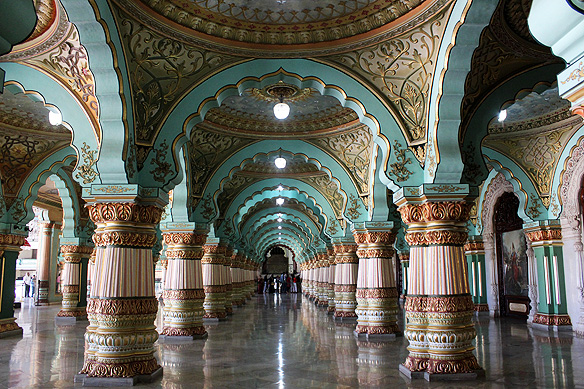
The Durbar Hall, also known as Sajje or Dasara Hall, in Mysore Palace is the most photographed room, for a better word, in the city. I had visited the palace earlier, many moons ago, as part of a college educational two-week trip. I remember, distinctively, I had found it kitsch and over the top, and was quick to dismiss it.

I guess I have changed. It is still kitsch, but this time I found beauty in its perfect symmetry. The grandeur, imposing. The stories in its walls – riveting. Continue reading

volunteering diaries: a pan-indian carrom board match in mother teresa’s hospice

As India gears up for Daan Utsav, the national Joy of Giving Week festival held from 2 to 8 October, this year has a special significance for me. In my role as a volunteer with the festival’s Mumbai chapter, I organize various events of giving for the week. A handful of them are usually held at the housing complex I live in. And guess what, this year one of the events is centred around donating groceries and spending a morning at the Mother Teresa and Missionaries of Charity’s Home for the Destitute here in Mumbai!

If you wondering what’s so special about this, well, it is a reason for me to revisit some rather magical personal memories.

Some time ago I had spent an afternoon, just like the upcoming one on 5 October, volunteering at Mother Teresa’s hospice for the sick, destitute and dying in Kolkata. It was one of the most beautiful days of my life. A day I would like share with you today in my blog. 🙂 Continue reading

36 hours in dharamshala, home of the dalai lama

A visit to Dharamshala is on every Indian traveller, and every traveller to India’s, bucket list. With Tibetan monasteries snuggled in cedar-clad hills, crooked narrow streets, and the mighty frozen Himalayas for a backdrop, the city offers unparalleled charm. Why, even its name is a winner. Dharam Shala means “spiritual dwelling.” 🙂

For two thousand years though, Dharamshala was a mere hamlet, ruled along with the rest of the Kangra valley by the Katoch rulers based in Kangra Fort. A tiny colonial hill-station during the British Raj, it catapulted to international fame when it was presented in May 1960 to the 14th Dalai Lama by the then Prime Minister of India, Jawaharlal Nehru, to serve as the former’s new headquarters. There has been no looking back for the settlement up in the Dhauladhar range since then.

Dharamshala’s sights can be broadly divided into three parts: All that is Tibetan, what little that is left of the British Raj, and Dharamshala’s past and present Indian heritage.

But hey, didn’t the Dalai Lama live in McLeod Ganj? Continue reading