travel diaries: a tale of two capitals—nizwa and muscat

Nizwa, Oman’s 17th Century capital

I found myself blinking hard. And then blinking again. A little dazed. Bewildered is perhaps a better word. Was this for real? Was it indeed the 20th of December, 2024, or had I by some unexplained miracle time-travelled a good few centuries back?

Around me was a scene pulled right out of a medieval Arabian livestock souq. Sellers in pastel dishdashas were running around a ring. First with their goats, and then their cows, in tow. On either side of this parade were buyers in crisper, whiter dishdashas calling out if a particular animal caught their interest.

What followed next was a thorough examination of the selected livestock’s teeth, gums and hooves, and some hard-core bargaining. At times the seller won, at times the buyer, and the mute creature swapped masters. Often nothing materialised till another early Friday morning, when a display would again be put on show.

There were a handful of foreigners in the periphery, looking on, as amazed as me. Just like maybe a Marco Polo or Ibn Battuta did when witnessing a similar scene.

The business on hand was, however, completely unaffected by the cameras or gasps. There were more important things to focus on for these gentlemen. Would that goat be an asset? Would he be able to resell that cow for a profit? It’s a stock market in its most basic form wherein livestock are sold and resold every week.

In a couple of hours, the hullabaloo simmered down. The sellers and buyers dispersed. Showtime was over.

Did the end of the spectacle bring me back to the present? Not exactly. For next to the Friday traditional livestock souq were the 17th Century Nizwa Fort and Castle, the latter predating the fort by a few decades. Both built by the Ya’rubid dynasty, rulers of Oman from 1624 to 1742 who had made Nizwa, a historical city built over a stream and trade crossroads, their capital.

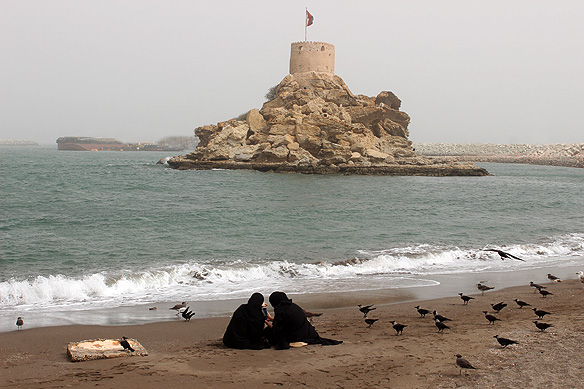
Nizwa Fort dates to the middle of the 17th Century. Built on the orders of Imam Sultan bin Saif Al Ya'rubi, the enormous earth-filled stone tower took 12 years to complete.

Nizwa Fort dates to the middle of the 17th Century. Built on the orders of Imam Sultan bin Saif Al Ya’rubi, the enormous earth-filled stone tower took 12 years to complete.
Continue reading

photo essay: mountains, desert, and coast of northern oman

If you look closely at Oman’s map you will notice a peculiar detail. There is the mainland, and separated from it is its governate Musandam on a peninsula jutting into the Strait of Hormuz. Look more closely. You will see an exclave [called Madha] between the two that is surrounded by the UAE. Look at it even more closely. Within Madha is Nahwa, an enclave that belongs to the UAE.

Now you may well ask, how did this happen?

Somewhere around the late-1930s, the four rival sheikhs controlling the surrounding area asked Madha’s village elders who did they want to pledge their allegiance to? Madha chose the Sultanate of Oman, but the bit inside it called Nahwa chose the Arab Emirates. Based on their choice, the rather unusual border between the UAE and Oman was drawn out in 1969.

That is Oman for you.

The eclectic set of borders further transposes into an eclectic set of mountains, desert, and coastline, juxtaposed right next to each other. It is as if the gods asked them too, whose realm did they choose, and they all in unison said “Oman.”

Described as a geologist’s paradise, the oldest continuously independent nation in the Arab World [since 1650] has held on to its authenticity well. Despite being a high-income country, there is no rivalry for high rises in the Sultanate of Oman, nor glitzy shows of oil wealth.

Come travel with me through my photo essay across northern Oman as I take you from Muscat to Fins Beach via the Bimmah Sinkhole and Wadi Tiwi, on to Ras Al-Hadd to see turtles and Sur to see dhows, camp under the stars in the Sharqiya Sands, stop by at a Bedouin market in Sinaw, have meals at traditional mud settlements, drive offroad to the top of Jebel Shams and then down Wadi Bani Awf, to be back in Muscat. And on the way, learn about this fascinating country and its warm, laid-back, friendly people. ❤


The journey begins. Continue reading

salalah: middle east’s anomaly

Tucked away on the Arabian Peninsula’s south-east coast is the Middle Eastern’s favourite getaway. Salalah.

Its very mention brings about a soft sweet smile to their otherwise calm controlled air, and a sparkle to dark eyes.

“Aah, Salalah!” followed with unbridled joy that I will be making the journey across a thousand kilometres from Muscat to this ‘haven.’

For two months in a year, July and August to be precise, Salalah in Southern Oman is engulfed in dense moist cloud and fog, with a light drizzle that amounts to less than a monthly average of an inch. This season is lovingly called ‘khareef,’ even though the term technically means autumn.

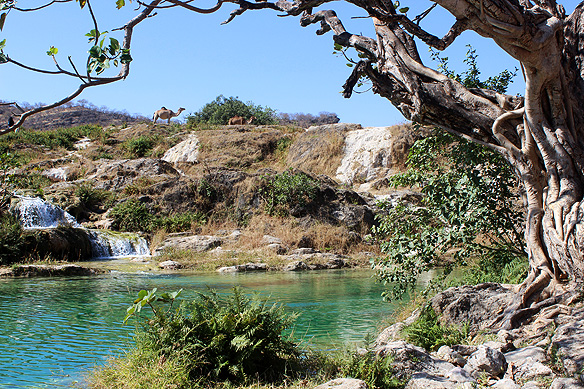
During these two monsoon months the barren shrivelled lunar landscape morphs into gushing waterfalls, turquoise-blue rivers, and lush green vegetation, replete with coconuts and bananas.

Whilst the rest of the Middle East swelters at 50 degrees, its populace flock to this anomaly in droves. Carnivals brighten the choppy sea-shores, and long queues together with packed car-parks peak to a frenzy.

Not your cup of tea?

Salalah is just as delightful in December when like the rest of Oman, it enjoys perfect weather. Continue reading