a self-guided walk through shimla, the british raj’s summer capital

1864. The British Crown was now directly in control of the Indian subcontinent. Five years had passed since they had squashed the Indian Mutiny. It had been a tough fight lasting nearly two years and two months, but they’d won in the end.

Summers in their new capital, Calcutta, were, however, brutal. Oh, how they longed for the grey overcast days back home, bathed in gentle drizzle.

Since the 1820s, the earlier British East India Company officers stationed in India had been escaping from the sun-baked plains to a hamlet in the middle hills of the Himalayas during such summers. The hamlet, comprising some 50 houses, was called Shayamala after a local Hindu goddess.

India’s new rulers decided to make this association more permanent. They renamed the hamlet ‘Shimla,’ and set up the British Raj’s ‘Summer Capital’ on its seven hills.

Every year, just before the sweltering heat clamped down on the Gangetic plains, the entire administrative machinery would move here, replete with traders, restaurateurs, and socialites. Once the heat cooled down, and snow started to peck its slopes, they would all move back again south-eastwards.

A mini-Britain was created in Shimla’s hills. Timber-strapped Tudor houses, soaring neo-Gothic churches, grand town halls, and a theatre for concerts and plays. On the Ridge, which offered rather splendid views, a bandstand was thrown in where military bands could play music and the gentry could indulge in leisurely strolls. Not too shabby now, perhaps they whispered to each other in relief.

Though it is now 77 years since the British have left, their summer capital’s remnants still dot Shimla, and more so on its main commercial pedestrian artery—Mall Road.

Here is a self-guided walk on what to watch out for should you ever be in the vicinity, with suggestions for eating and staying dating back to the colonial days. Take your time and savour its charms. After all, Shimla was always for the long haul. ❤

PS. Take the lift up to Mall Road, and on exiting the lift turn left towards Christ Church.

Continue reading

a travel guide to colonial delhi

If you have been to Delhi, India’s capital city, your memories of it would most likely comprise of evocative Sultanate and Mughal monuments. Monuments which are remnants of the multiple cities that flourished here over the past one thousand years.

But no one can deny the city’s most alluring charm, perhaps just a tad bit more than its monuments, is its dense green canopy. A veritable garden city, its broad leafy avenues transform into tunnels of foliage in the monsoons. Large roundabouts embellished with manicured lawns, regal palms, and flowering bushes punctuate the roads at short intervals; roads lined by whitewashed bungalows set amidst their own personal gardens. Expansive reserves called the ‘Ridge’ run wild with jungles. And then there are the countless parks laid out neatly around the city’s monuments and jogging tracts through dark forests.

What if I told you none of this greenery is indigenous to Delhi. That the green cover is the Britishers’ most visible legacy to the city which they made their capital from 12 December, 1911 to 15 August, 1947. Even the Ridge, which Delhiites take much pride in, is draped in the Vilayati Kikar, a Mexican species, planted by the British. Its deep roots kill off any competition, especially Delhi’s native trees. Continue reading

global art shot: kampani kalam, when east met west

Image

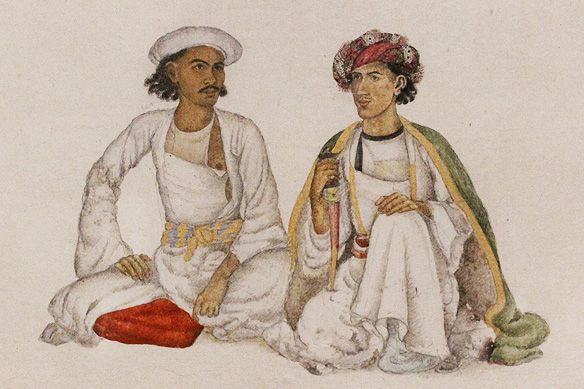
Two friends seated in discussion. Way back in the year 1810-12 in Delhi. Two very real, very ordinary people. Just like you and me. And if it weren’t for an art form that went by the name Kampani Kalam in the local Indian lingua franca, or Company Paintings in English, these two gentlemen would have been forgotten in the pages of time.

But they survived. The two, not meeting my eye, but seemingly fully aware of being the focus of my attention last Sunday, were part of a special exhibition at Delhi’s National Museum. Some two hundred other paintings hung around me, but this hung in the spectrum of time. Their true-to-life faces, their elaborate local costumes, even the hair on their arms and chest.

Through them, I could travel back 210 years. In a flash. Continue reading

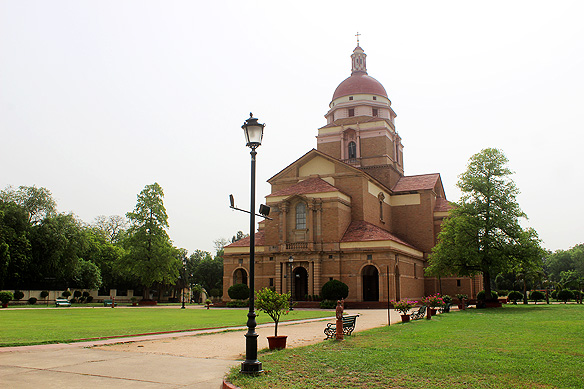
new delhi’s most beautiful church: cathedral church of the redemption

On a quiet tree-lined lane aptly called Church Lane, a stone’s throw from Rashtrapati Bhawan the president’s estate, is New Delhi’s most beautiful church.

Most people in the city, and to the city, are clueless about its existence. Much like I was, and would have been, if it wasn’t for a chance conversation on one of the heritage walks I have been taking since I came to Delhi.

Delhi’s Sultanate and Mughal-era chapters, with their magnificent monuments and dramatic stories, tend to be all-consuming. Yet, the years the British Crown used the city as the capital of their ‘Jewel in the Crown’, from 1931 to 1947, churned out edifices just as spectacular. [Prior to Delhi, Calcutta had been their capital.]

Take for instance Herbert Baker’s North and South Block Secretariat Buildings, Edwin Lutyens’ Viceroy’s House now the Rashtrapati Bhawan, their joint endeavour the Parliament House, and Henry Alexander Medd’s splendid stone church for the Englishman in Delhi—the Cathedral Church of the Redemption. Continue reading

photo essay: delhi’s red fort, stories told and untold

Behind a pile of impregnable traffic barriers and guarded by the stern-lipped, but polite, Central Reserve Police Force [CRPF] is Delhi’s most prestigious fort, Qila-e-Mubarak, meaning ‘Auspicious Fort’. Or the Red Fort, as the British called it.

Mughal Emperor Shah Jahan, who designed and built it in 1648 [the same gentleman who built Taj Mahal], would not have been too pleased about the barricades, both human and metal. He was not even happy when his son Aurangzeb built a wall around Lahore Gate, the public entrance.

With a direct line of view from Chandni Chowk to the Diwan-e-Aam [Hall of Public Audience], Shah Jahan argued that the enclosure was like putting a veil in front of a woman’s beautiful face. Continue reading

8 hours in eclectic ajmer, rajasthan’s centre for sufism

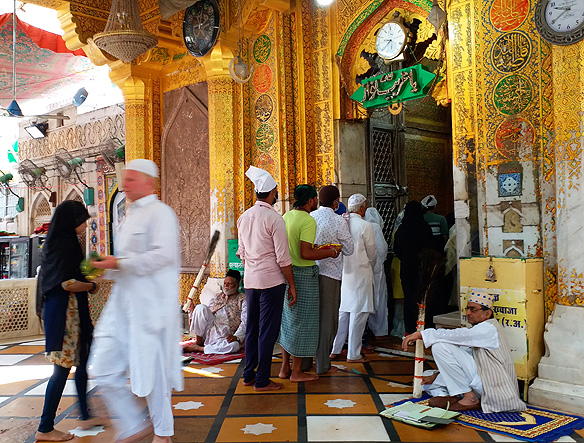
Rose essence from Hinduism’s holy city of Pushkar fills the air of Sufi Islam’s sacred dargah in Ajmer. The courtyard reverberates with qawwalis in praise of the 13th Century saint from Iran, as the faithful shuffle past his grave in deep reverence, heads bowed, eyes lowered, a prayer or two on their lips.

It is 9ish in the morning and I am at the Khwaja Moinuddin Chishti Dargah deep in the heart of Ajmer’s Muslim quarter. As far back as I can remember, I had wanted to visit the tomb-shrine. Now actually standing here, it feels unreal. Surreal.

– – –

Just 15 kilometres from Pushkar, separated by Nag Pahar an ancient hill in the Aravalli range, is Ajmer—Pushkar’s antithesis. Continue reading

beyond the obvious: lucknow beyond its heritage precinct

Lucknow had still not fully woken up as I took a rickshaw from my hotel in the chaos surrounding the railway station to classical Chattar Manzil built by Frenchman Claude Martin, hidden behind the wide leafy avenues of Qaiser Bagh. “We start at 7:30 am,” the guide at Uttar Pradesh Tourism had informed me over the phone.

I was the only person on the walk which revealed a Lucknow far removed from its iconic Nawabi heritage precinct—a side of Lucknow brimming with lesser recounted stories and unsullied beauty. From this one walk, further stemmed, a series of explorations to equally lesser known parts of the city, spanning a few centuries and a few geographies.

The sum of all these detours was an affirmation that there are two parts to every place’s lure. One, those that get touted, and have travellers and tourists alike clambering to check them off their list. These are the ones which make it to backdrops of selfies, travel guides, and blogs galore. And then there is the other part. The ones which often remain forgotten in the pages of history or are so embedded in local life they remain hidden from the casual outside eye.

This post is about those hidden gems and travel experiences in Lucknow. The Lucknow beyond its obvious attractions. Read on and you’ll know why they made it to this list. 😊 Continue reading

24 hours in incredible allahabad

Amitabh Bachchan’s hometown. If one is Indian, it is the first thing that in most probability comes to mind when one hears of Allahabad. This is by virtue of the superstar’s constant vocal affirmation, flaunted with much pride, of its role in his life. It is where he was born and spent his childhood and youth, before becoming the country’s biggest and brightest star, still shining at 75.

To those spiritually inclined, Allahabad is evocative of all that is sacred in Hinduism. The meeting point of Ganga, Yamuna, and the mythical Saraswati, the city is built on the site of the ancient Aryan town of Prayag—the place for offerings. And perhaps, thus, by pure logic, it is also the site, since time immemorial, of the largest Hindu gathering held every 12 years on the banks of Sangam, or the confluence, in the form of the Maha Kumbh.

Rarely on most travellers’ circuit, Allahabad often gets side-lined in favour of its more popular neighbours on either side—Lucknow and Varanasi. But, like everything else in India, it too oozes of history, heritage, and stories galore, as I was quick to discover. Continue reading

st. mary’s church in camp, the oldest anglican church in the deccan

For some obscure misguided reason, I was under the assumption Camp [the Cantonment] area in Pune would be just one road. To add to it, my rather simplistic imagination envisioned Pune’s famed historical churches, built to serve the then Poona’s British Raj gentry, to be standing sentinel on both sides of it in a homogenous line. I could not be more wrong.

After being driven through a maze of wide, empty streets on a Sunday morning, I found myself dropped outside a poker faced, art deco facade by a cab driver with the announcement, “Old church.” Before I could ask or argue he had sped away, and there was I in the slowly rising heat, wondering, my brows raised towards the heavens, where the hell was I?

Almost, as if in answer, a woman with a beaming smile stepped out and wanted to know what I was looking for. Her name was Sheeba Reuben Deshmukh, a counsellor and committee member of the Oldham Methodist Church, the church I had been dropped at.

I explained to her I was a blogger from Mumbai and exploring Pune that weekend.

“Have you been to St. Mary’s?” Continue reading

3 reasons why the bdl tops as mumbai’s most lovely museum

bdlmuseum_titlepic

Do you like museums? I do. Not all of them though. Just those that stand out, whether it be in scale or the splendour of its exhibits, recount a tale which draws one within its folds, or is so darned quaint it looks like it stepped straight out from another world, another time.

I spent this past Sunday at one that fit the last bill.

One does not often relate Mumbai to museums. And when one does, it is invariably the grand Chhatrapati Shivaji Maharaj Vastu Sangrahalaya which comes to mind. The name itself is a mouthful as is its repertoire of treasures. But there is another that is just as inimitable, albeit in an altogether different way—reminiscent of a large Victorian doll house brimming with charm and pretty things. It is the Dr. Bhau Daji Lad Museum in Byculla.

Three things set the second one apart and place it firmly as Mumbai’s most lovely repository: Its restored stunning Victorian edifice, a bevy of vibrant clay models which transform the place into a magical fantasy, and its exquisite collection of decorative arts which showcase India’s rich heritage. Quite a heady mix!

Read on to know more. 🙂 Continue reading