travel shorts: pattadakal, a marriage of sorts

Anyone who is acquainted with the idea of India, will also be familiar with the great north-south divide. It encompasses ethnicity, language, culture and in a deeply religious nation, temple architecture. Yet, in a narrow strip atop the Deccan plateau, one gets to witness a marriage of sorts in the latter that is completely unique to the subcontinent.

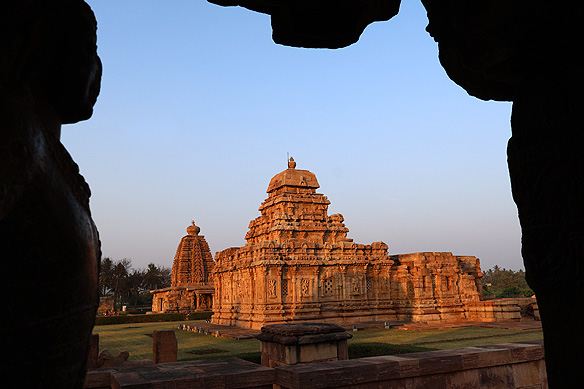
Pattadakal, a UNESCO-listed 7th-8th Century World Heritage Site displays this north-south eclectic mix at its finest. The enclosed part of the site is made up of eight temples—three of which are models, one a ‘project work,’ and four designed as full-fledged functional places of worship.

The Virupaksha Temple in the last group, with its sophisticated amalgamation of north and south elements, has been in continuous use since its consecration in 740 CE. It was commissioned by Lokamahadevi, a powerful Chalukya Queen, to commemorate her husband’s victory over the Pallava kings of the South.

If you have been wondering about my terminology, it is because Pattadakal, along with Aihole, were akin to a ‘laboratory’ where architects and artisans under royal decree experimented with temple architecture.

How about a corridor through which the local populace could circumambulate the holy sanctum which was otherwise out of bounds? A Nandi to mark the temple site? Perhaps a kalash finale atop the roof symbolising the meeting of heaven and earth? This investigational process, carried out over a couple of centuries culminated in Pattadakal’s most sophisticated edifices. Where the north and south architectural styles, till then side by side in platonic comradery, also merged in a hybrid blend for a while.

Scroll on to see some more images of this site. ❤ Continue reading
travel diaries: four caves, a lake, a seeker and badami

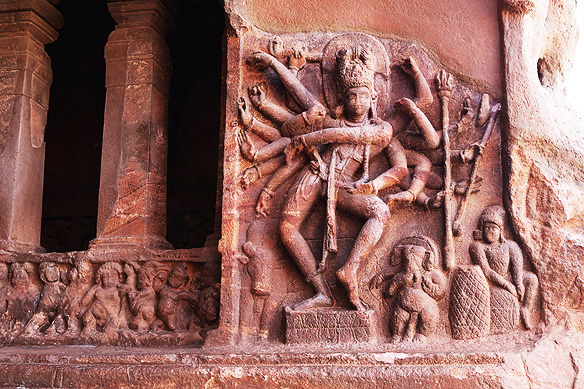
One of Badami Cave Temples' most impressive sculptures: Shiva as the 18-armed Nataraja doing the Tandava Nritya—the cosmic dance of creation, preservation, and destruction.

One of Badami Cave Temples’ most impressive sculptures: Shiva as the 18-armed Nataraja doing the Tandava Nritya—the cosmic dance of creation, preservation, and destruction.

One is never far from the gods in India. They are everywhere. Carved out of living rock. Carved into living rock. As far back as even 578 CE.

It is just after lunchtime, and I am at the foot of a gigantic red sandstone escarpment. Hundreds of school-children are racing down the steep uneven steps hewn into the cliff’s face. Their teachers shout behind them to slow down. Not that their wards pay any attention to the ominous warnings. Dressed in shiny tracksuits, they run in and out of the cavernous halls, doubled over in unstoppable giggles.

Slicing their way through this human avalanche are staid family groups. Their elderly matriarchs stomping ahead, undeterred by limps or wobbly canes.

Aaj bahut bheed hai [It is very crowded today],” I observe to the security guard at the gate. “Roz aisa hai. Season hai na aaj kal [It is like this every day. It is the season nowadays],” he smiles back happily.

In a few months these cliffs will be deserted again, first under the scorching summer sun and then because of the monsoons which would make the stone steps a veritable death trap.

Yet such ominous weathers rarely affected pilgrims in the distant past. 1,400 years ago.

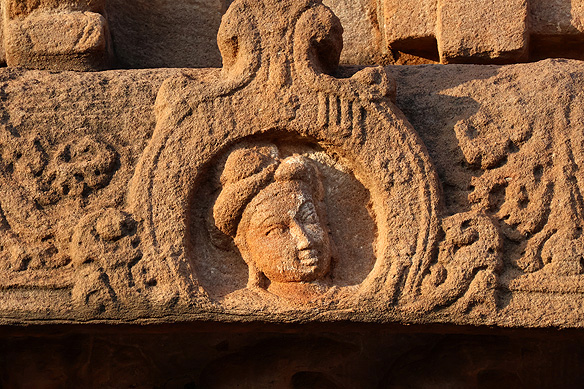
Portrait of a man in Ancient India. Ancient Hindu temples, by virtue of their depiction of both the sacred and secular, offer a fascinating insight into the then prevailing norms and societies.

Portrait of a man in Ancient India. Ancient Hindu temples, by virtue of their depiction of both the sacred and secular, offer a fascinating insight into the then prevailing norms and societies.

Continue reading