jaffna: the unexplored north of sri lanka

Twenty-six years of civil war is a long time. A whole generation grows up exposed to the horrors of war, stripped of their right to education, health-care, and utilities. It is hard for one living in a ‘secure’ country to even fathom such dreadfulness day in and day out, year in and year out.

Sri Lanka’s LTTE-Sinhalese civil war started on 23 July, 1983 and ended on 19 May, 2009, during which an estimated 40,000 civilians died according to a UN Experts Report. Those who could leave, left the country. Root causes of the civil war were a series of anti-Tamil riots following independence in 1948 and the 1956 Government Act which recognized Sinhalese as the only official language.

Fuelled further by the government’s citizenship and education policies, it led to the creation of the LTTE or Tamil Tigers, as they were known, and their demand for a separate Tamil state ‘Tamil Eelam.’

Suicide bombers were a trademark of the Tamil insurgency. Even India, Sri Lanka’s neighbour, could not be immune to it. India’s ex-Prime Minister Rajiv Gandhi was assassinated in 1991 by a 22-year-old female LTTE suicide bomber.

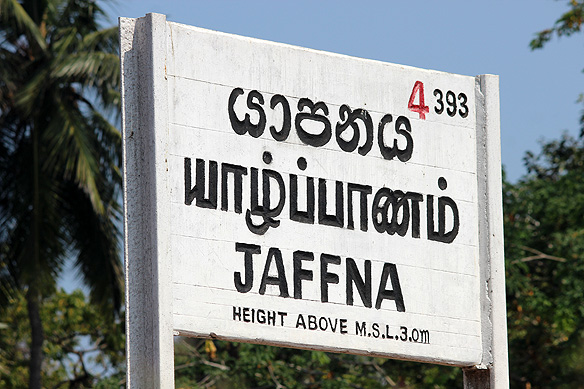
Jaffna [Yalpanam in Tamil] on the northern tip of Sri Lanka, was the epicentre of this civil war which spread across the island’s northern and eastern coastlines. Mutilated factories, bombed homes, and walls pock-marked with gunshots are still scattered throughout the city and its surrounds. An echo of its turbulent past.

Three things, by some miracle, have survived from the nearly three decades of fighting: One, the region’s places of worship—magnificent colourful Hindu temples, poignant grand churches, and sacred Buddhist sites—two, its bygone colonial ruins, and three, a bunch of remote sleepy isles on the Palk Strait in the Indian Ocean. Continue reading
11 memorable experiences only to be had in turkmenistan

Tourist number: 1933.

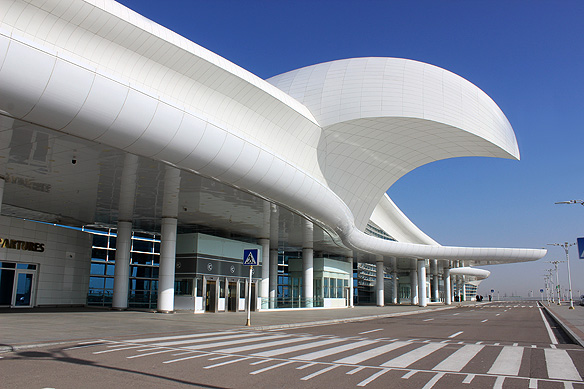
It is the early hours in the morning of 1 October, and I am at the gleaming falcon-shaped marble-encased airport in Ashgabat, capital of Turkmenistan. I ask the official at the visa counter what does this line on my entry stamp mean. He explains that 1,932 tourist visas had been issued in 2023 before mine. I am 1,933rd. This does not include the 3-to-7-day transit visas, by-the-way.

With a silly grin plastered on my face, I tell him he has no idea how much it means to have that sticker on my passport. Many months of planning and three back-to-back flights, from Goa to Muscat to Dubai to Ashgabat, and I am finally, finally here.

I guess my enthusiasm is contagious. The otherwise poker-faced official gives a little smile and wishes me a happy stay. I respond with a beaming grin.

Outside, shifting lights on the airport’s facade recreate a falcon’s flapping wings. Continue reading

time-travel and dinosaur plateaus in remote north-east turkmenistan

Lebap Province in north-east Turkmenistan is as remote as it gets in this least visited country. Filled with moonscapes, a dinosaur plateau scalloped with around a couple of hundred, 150-million-year-old footprints of Megalosaurians during the Jurassic Period, deep canyons, and grottoes dedicated to saints and wishes, it is untouched by tourism. No-one speaks English here either.

To put things in context, Turkmenistan does not allow tourists to travel independently through the country. Neither can one simply travel to any random part of the country that tickles one’s fancy. There are designated places one is allowed to explore, and when out of Ashgabat, one must be accompanied with a licensed local guide.

Not many people visit Turkmenistan. The average number is less than 10,000 annually excluding the 3-to-7-day transit visas. Even fewer make it to its remote north-east. One of those rare ones was me. 😀

Here is my photo diary on this part of the world. I hope it inspires you to take the road less travelled, in this case time-travel to Lebap Province!

Continue reading

at turkmenistan’s darvaza: the gates of hell

Wouldn’t you agree that some sites are synonymous with the country in which they are? Especially the iconic, larger-than-life epic ones. For instance, think of India, and the Taj Mahal leaps to mind. Likewise, think of South Africa, and it is Table Mountain. The list goes on.

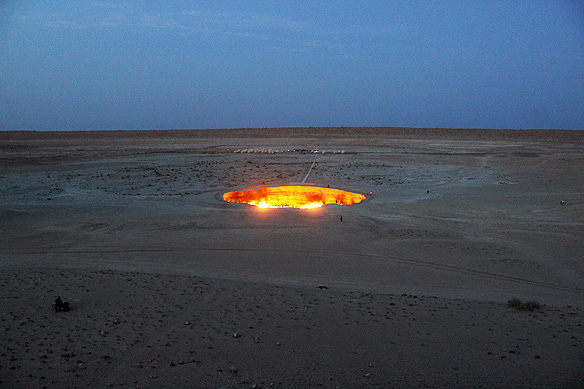
For Turkmenistan, it is Darvaza, the ‘Door to Hell’ or ‘Gates of Hell,’ a burning inferno in a massive pit, deep in the Karakum Desert.

And yes, it is an appropriate synonym. No, not the Hell part. That is the touristy moniker.

Darvaza encapsulates the country’s recent history, geography, and economy all rolled into a bizarre visual spectacle, befitting a country that is different from any other. In Turkmenistan’s official documentation, the site is called ‘Shining of Karakum.’ 😊

Two-hundred-and-sixty kilometres north of its capital Ashgabat, the 70-metre-wide, 30-metre-deep methane gas crater has been burning non-stop since 1971. Its raging flames whip into the air, becoming more menacing, yet beautiful, as the desert is engulfed in total darkness at night.

Neither a natural wonder nor of any particular historical significance, Darvaza is the result of, simply put, an oil exploration gone astray. Continue reading

global travel shot: yangykala canyon in western turkmenistan

Image

In October this year, I did two fabulous and least visited countries back-to-back: Turkmenistan and Afghanistan. Thirty days of spectacular human, cultural, and geographical terrain. For the traveller in me, it was 30 days of paradise!

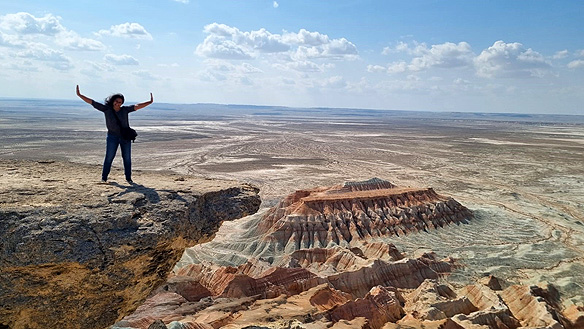
The picture above is at Crocodile’s Mouth in Yangykala Canyon, Western Turkmenistan. Some millions of years ago the canyon was the prehistoric Tethys Sea’s ocean floor. Then continents collided and oceans receded, revealing miles and miles of this surreal desolate landscape in all its glory. And yes, I am standing on the edge of a crumbling limestone overhang. At times, I can be pretty brave too. 🙂

P.S. This image was taken by Dondon, a world traveller I met when visiting Turkmenistan.