travel diaries: in search of champa, vietnam’s ancient hindu kingdom

It is still dark. The sun, groggy-eyed as it squints through the heavens punctuated by a sole star.

I am on my way from Hoi An to My Son Sanctuaryβ€”the temple ruins of an ancient Hindu kingdom which called this part of Vietnam home for 1,600 years. You may ask, but why so early? Because some places are best seen at sunrise. When it is just them, you, and the centuries of silence in-between. This silence then starts talking, regaling stories. Some voraciously. Some hinted at with a smile. Don’t you agree? 😊

An hour later, walking through the site’s lush green meadows, I pass scores of my country-folks. Perplexed, I am about to stop one of them and ask the reason, when a large placard explains their presence. They are archaeologists from the Archaeological Survey of India carrying out restoration work in association with the Vietnamese government. It makes sense. Who else could understand the remnants of a millennia-old Hindu kingdom better, even if it wore a different mantle on a foreign ground.
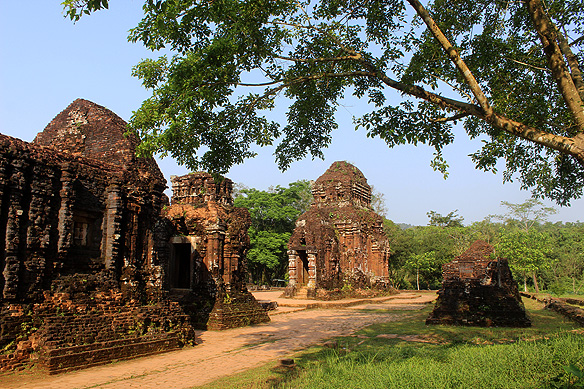

My Son Sanctuary, a UNESCO-listed World Heritage Site, is one of the most important ancient religious sites in south-east Asia. Continue reading
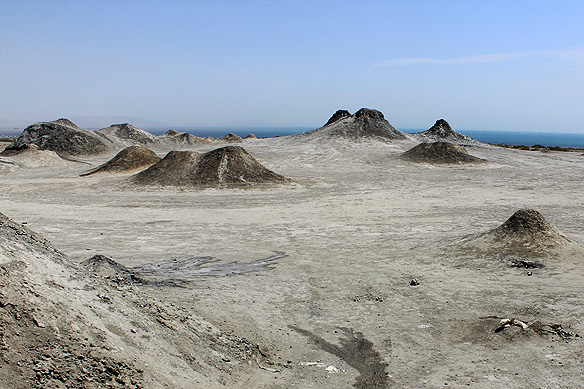
mud, petroglyphs, oil, and fire: quintessentially azerbaijan

Sandwiched in the Caucasus, between the Caspian and Black Seas, Azerbaijan is a bit of a latecomer to global tourism. But catching up fast.

Unusual on multiple counts, four features and their unique mix set the country even further apart from the ordinary: Mud, petroglyphs, oil, and fire. Where else can one find such a cocktail! To add to its appeal, they come candy-wrapped in picturesque settings at a short distance from the capital Baku in the surrounding Absheron Peninsula.

Of the 700 mud volcanoes found around our planet, 40 percent lie in Azerbaijan. They bubble away on barren stretches courtesy of methane gas trapped under the earth’s crust. When the pressurized gas encounters groundwater, and together they find an opening in a fault line, they ooze out in the form of mud, cool to the touch.

Ranging from 1 to 700 metres high, and a few centimetres to a few kilometres wide, they function similarly to regular volcanoes. When they erupt, they can spew flames and mud from the bowels of the earth. Kinezadagh [397 metres high] and Turaghay [400 metres high] are the largest mud volcanoes in the country.

Azerbaijan is also among the oldest inhabited regions in the world, going back to the Stone Age. The Gobustan Rock Art Cultural Landscape Reserve, a UNESCO-listed World Heritage Site, contains an exceptionally large collection of petroglyphs. Etched into rock with sharp stone tools, and with the advent of the Bronze and Iron Ages, with metal, the earliest of the lot is 40,000 years old.

Subjects range from dancing figures, shamans, boats with oarsmen, and battle and hunting scenes; the latter replete with bison, gazelles, horses, and goats. Some of these were ‘drawn’ even before the region’s ancient men and women shifted to farming and husbandry as a source of food. Continue reading

part 3: the spiti trilogy: lahaul, the mystical side of life and himachal

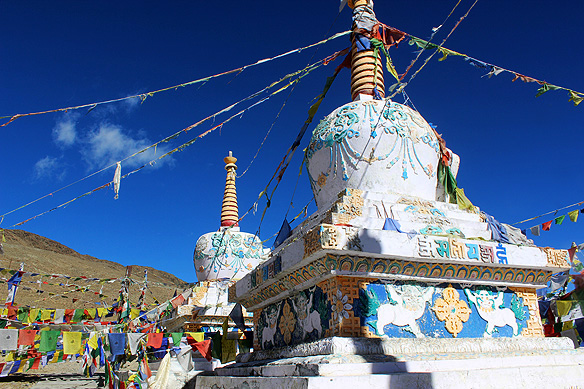
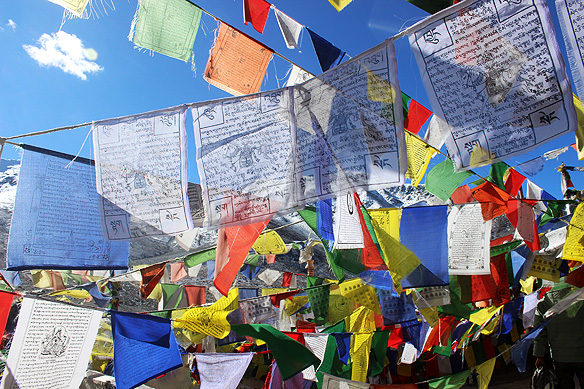
Prayer flags at Kunzum Pass. Because the gods live in the mountains.

Prayer flags at Kunzum Pass. Because the gods live in the mountains.

Welcome to part 3 of my photo diary trilogy on Kinnaur, Spiti, and Lahaul, high up in the Himalayas in India’s Himachal Pradesh.

If Kinnaur is all about the lush flourishing side of living, and Spiti the very oppositeβ€”about its barrenness, then Lahaul is the natural outcome of going through both sides of life. It is of tuning in with one’s inner self. I guess you could simply also describe it as meeting one’s Maker.

Here in Lahaul, Buddhist chants echo from monasteries perched atop peaks. Lakes contain deities and so do mountain passes. There is the sacred everywhere, and it is celebrated with much joy.

I would like to share my journey through Lahaul valley with you here. Maybe its magic captures your heart and soul too. πŸ™‚

Continue reading

part 2: the spiti trilogy: spiti, the barren side of life and himachal

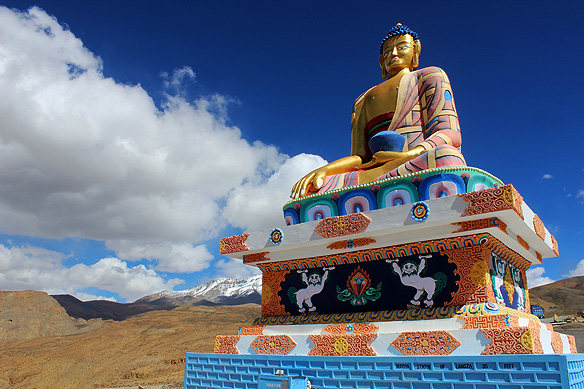
Buddha statue in Langza Village. Because the gods live in the mountains.

Buddha statue in Langza Village. Because the gods live in the mountains.

Welcome to part 2 of my photo diary trilogy on Kinnaur, Spiti, and Lahaul.

This week’s post is about Spiti, a cold desert biosphere in the rain shadow area of the Himalayas bordering Tibet. India’s monsoons do not reach here. Even if they do manage to squeeze their way past the soaring peaks, all they are able to muster is a drizzle. The summers are always dry. The winters are covered in thick snow and ice.

None of which is conducive to agriculture except if carried out on the banks of the Spiti river. The land is otherwise brown and barren, its moonscapes strewn with sand and boulders. Nestled in this arid bleakness are countless ancient monasteries, bedecked and bejewelled with Tibetan Tantric Buddhist iconography. These pockets of sanctity serve as places of refuge, giving strength and meaning beyond a difficult life.

Come along with me to Spiti.

Continue reading

part 1: the spiti trilogy: kinnaur, the verdant side of life and himachal

Sangla valleyβ€”Sangla means 'Pass of Light' in Tibetan language. Because the gods live in the mountains.

Sangla valleyβ€”Sangla means ‘Pass of Light’ in Tibetan language. Because the gods live in the mountains.

I have always seen myself as an ocean person. I love the rhythm of crashing waves, the smell of salt in the sea air, the white foam breaking into froth around my feet, and tugging me along as it leaves.

And then I went to the Lahaul and Spiti valleys and everything changed inside of me. I became a mountain soul. Those who have been there will understand what I mean.

The Lahaul and Spiti district in India’s northern state of Himachal Pradesh is one of the most beautiful places I have travelled to. Remote and untouched, its offroad route is accessed through neighbouring Kinnaur district if coming in from the Shimla side. When exiting, it continues to Manali to form a loop. Kinnaur and Lahaul are both verdant and green. Sandwiched between them, Spiti, in stark contrast, is a high mountain barren desert perched on the soaring Himalayan range, wild and windswept.

Starting with today, I will be posting a photo diary trilogy of Kinnaur, Spiti, and Lahaul over the coming three weeks. Care to join me and let your soul fall in love with the mountains too? ❀

Note: Lahaul and Spiti used to be two separate districts and were merged into one in 1960. For the purpose of this trilogy, they are treated separately because of their geographic distinctiveness.

Continue reading

the complete travel guide to the treasures of sri lanka’s cultural triangle

Welcome to my travel guide on Sri Lanka’s Cultural Triangle told a bit differentlyβ€”through short photo-essay chapters on the country’s ancient and medieval history.

Of the six UNESCO-listed cultural world heritage sites in Sri Lanka, five lie within the Cultural Triangle in the heart of the country. It is a region rooted in 2,500 years of history and heritage, both sacred and secular, from timeless Theravada Buddhist sites to splendid Sinhalese royal capitals. All surrounded in lush tropical jungles.

Before I write any further, I would like to briefly explain two terms used in this guide which are part of the warp and woof of the country. Theravada Buddhism and ‘Sinhalese.’ Theravada Buddhism is the oldest school of Buddhism and a direct offshoot of Buddha’s teachings. There are five countries in the world which have Theravada Buddhism as their official religion, and Sri Lanka is one of them. Sinhalese refers to the Indo-Aryan ethnic race native to Sri Lanka.

Whilst this guide covers the five UNESCO-listed sites, it also includes some gems scattered in-between. I hope you find it useful and it helps put the country’s Cultural Triangle as a seamless whole with all the dots connected. ❀

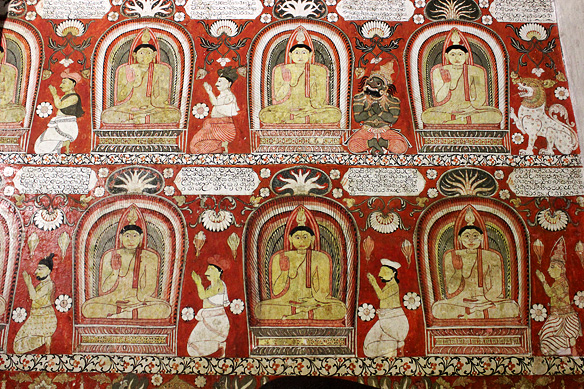
[Title photo: 18th Century Mural at Lankatilaka Vihara, Kandy.]

Table of Contents:

Continue reading

travel guide: turkmenistan’s 3 legendary unesco-listed treasures

For a history buff, Turkmenistan is what wish-lists are made of. Its historical sites comprise three of the greatest world cities of the past which served as the capitals of some of the region’s most powerful empires in the ancient and medieval world, namely, the Great Seljuks, Khwarezmshahs, and Parthians.

All three of these cities are UNESCO World Heritage Sites today: Merv in the south-east, Konye Urgench in the north, and Old Nisa near the capital Ashgabat.

Welcome to my travel guide on these legendary metropolises’ fantastic histories and breathtaking monuments. Places very few visit, in one of our world’s Least Visited Countries. ❀

MERV: ‘QUEEN OF THE WORLD’ AND CAPITAL OF THE GREAT SELJUKS

Coronation of Seljuk Sultan Ahmad Sanjar [r. 1118 – 1157]; Jami' al-Tawarikh by Rashid al-Din, Tabriz, Persia, 1307 AD.

Coronation of Seljuk Sultan Ahmad Sanjar [r. 1118 – 1157]; Jami’ al-Tawarikh by Rashid al-Din, Tabriz, Persia, 1307 AD.

Often described as ‘the wandering city,’ Merv is Turkmenistan’s grandest UNESCO World Heritage Site, both in scale and age: 1,236 hectares [including the buffer zone] and 4,500 years. Listed in 1999, it is also the oldest and best-preserved oasis city along the Silk Road in Central Asia. Continue reading

travel shorts: kyrk giz grotto, if ribbons and mud could stick

This slideshow requires JavaScript.

Take a long piece of cloth or ribbon, add a blob of mud to it, and hurl it high onto the ceiling of the grotto. If it sticks, your wishes will come true. If the ribbon falls flat on the ground, well you can either give up, or try again. πŸ™‚

It is a ritual which people from across Turkmenistan carry out at the 50-metre-high grotto in Lebap Province, in remote north-east Turkmenistan. Starting a new job, getting married, or want a babyβ€”it would not be amiss to make a pilgrimage here first. Continue reading

travel shorts: hazrat-e mazar, afghanistan’s most sacred site

Image

This slideshow requires JavaScript.

One of Islam’s most sacred sites lies in northern Afghanistan, a mere 55 kilometres from the Uzbekistan border. It is a blue-tiled mosque which glistens like a jewel, changing colour through the day, and home to countless pristine white pigeons.

Whilst the Shi’a sect of Islam believe that Ali, Prophet Muhammad’s cousin and son-in-law, is buried in Najaf, Iraq, the Sunni sect regard Hazrat-e Mazar in Mazar-e Sharif as Ali’s actual tomb.

Both, the city Mazar-e Sharif and its spiritual centrepiece Hazrat-e Mazar, date back to the 12th Century.

There is an interesting Afghan legend as to how the tomb came to be here. Continue reading

a self-guided walk through biblical mount of olives

Caution: This post is for travellers. Not tourists.

Whew. Now that I have got that out of the way, let me write on. Comforted by the thought you and I are on the same page.

Some of us like to wander. To immerse ourselves at a particular site just because, inexplicably, it touches a chord within us. To gaze at the details. Behind and under the obvious. To look at all versions of history and legends with an open mind.

The reason I bring it up particularly for my post on the Mount of Olives is because one cannot not visit the Mount of Olives while in Jerusalem. For that would be blasphemy. But you’d like to do it at your own pace.

Why? Because you are in the Holy Land. And Jesus Christ spent his last night before his crucifixion as well as ascended to heaven from here. Christian communities from around the globe have built a string of lovely churches down a near perpendicular street between these two key sites. Because you do not have to be believers of the Old or New Testament to believe in a higher sacred self. Or Roman Catholic or Eastern Orthodox. But also, because the view from the top and the walk to the bottom is what memories, which make you all starry-eyed once back home, are made of. πŸ™‚ Continue reading