global travel shot: the pagan temple that became a christian country’s favourite

Image

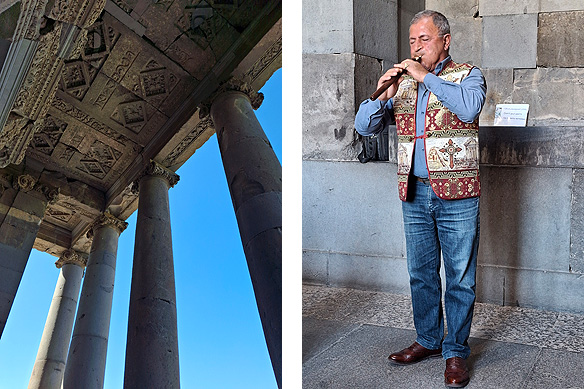
When I walked into Garni Temple’s Cella one October morning there was a 2,000-year-old UNESCO-listed duduk performance taking place inside the stone confines to the unbridled joy of a rapt audience. Once the show was over, I somehow managed to get the temple all to myself for a few long moments.

Garni Temple is the only one of its kind in all of Armenia and [now defunct] Soviet Union. The fact that it still stands—a rare pagan Greco-Roman remnant in the world’s first Christian country despite wars, religious upmanship, atheism, and even an earthquake—is a miracle.

Two thousand years old, scholars differ on its exact purpose and age. Is it a temple to the Zoroastrian sun god Mihr built in 77 AD by the Romanized Armenian King Tiridates I or a Roman tomb of the 2nd Century? Either way, its soaring 24 basalt Ionic columns reaching out to a ceiling draped in reliefs of grapes and vine leaves, perched above nine 12-inch-high steps is an evocative magnificent otherworldly sight.

Seated on the stone floor by the empty altar, it was just me and the echoes of those who had passed through the sanctuary two millennia ago. And that remote yesterday from the distant annals of time, briefly became my today.

Welcome to my Armenia series, dear Reader. ❤

travel shorts: kazakhstan’s bronze age gallery with 5,000 petroglyphs

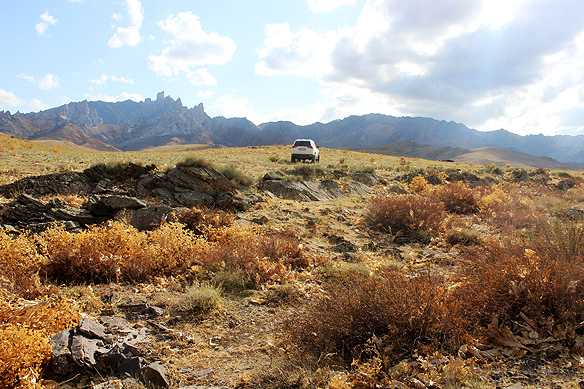
In search of the Arpauzen petroglyphs in southern Kazakhstan.

In search of the Arpauzen petroglyphs in southern Kazakhstan.

I wish I had some form of 360-degree vision and could see nature’s entire spread around me at the same go. On one side, the Prisyrdarya Karatau Mountains‘ dark craggy peaks encircled the isolated silent valley swathed in wild tulips and golden heather. On the other, colossal black chunks of rock glistening in the afternoon sun cascaded down the slopes. Pinch me, I whispered to myself. Is this really for real!

But this was all just half its magic …

“Come, look here. There are etchings of two double-humped Bactrian camels and a hunter with a bow and arrow.” My guide, Islam’s excited voice broke into my reverie, and the otherwise pin drop silence punctuated with the sound of our footsteps on crackling sun-dried tangled gorse, and neighing of wild horses grazing a mere stone’s throw away. Continue reading

persian herat and its hidden wonders

Right at the very end of the battered and bruised road, cutting across the country from east to west, is the Persian historical city of Herat. Not many travellers come this far. It is way too out, perched near Afghanistan’s western border with Iran. Yet, it has always been of great importance, as is revealed by its architectural and cultural treasures to those who take the trouble to reach it.

Herat’s been around for a long time; 6th Century BC records describe it as a Persian city which went by the name Aria. Yes, the same pronunciation as my surname. 🙂

Its strategic location on the Great Silk Road and the banks of the Hari River made it particularly appealing to conquerors and rulers. Alexander the Great defeated Herat’s Persian Achaemenids in 330 BC and put up a majestic citadel to celebrate his victory. He was followed by the Abbasid Caliphs in the 8th Century, Ghurids in 1175, the Mongol Genghis Khan who destroyed everything in 1221, the Kartids who then rebuilt it, and the Timurid Tamerlane who destroyed it once again in 1380.

When Tamerlane’s favourite son Shahrukh Mirza decided to move his capital from Samarkand to Herat, he was determined to make Herat the grandest city in the region. A vision shared by his wife Gawhar Shad and later descendent Husayn Bayqara.

The result was a city of much beauty and grace whose praise was extolled far and wide. Of its many buildings, 830 ‘cultural sites’ are still believed to survive today, warranting it a place in UNESCO’s tentative list in 2004.

It is a difficult combination. War and conservation. However, despite all the odds, both UNESCO and the Aga Khan Trust for Culture have consistently worked on Herat, ensuring its treasures, hidden from the world at large, manage to survive.

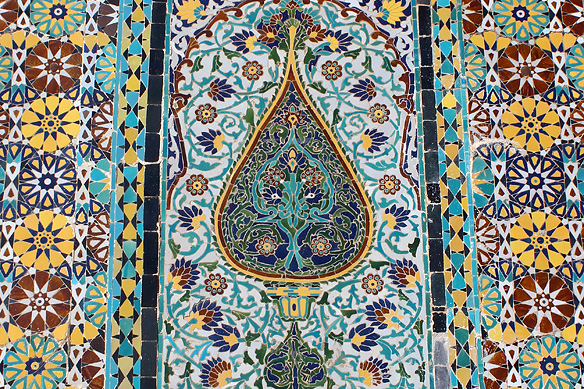
Come along with me on a virtual tour of Timurid Herat, the city on the Hari River, to see why it was called the ‘Pearl of the Khorasan’ for the longest time! Continue reading

the complete travel guide to balkh: ancient bactria and silk road’s fabled city

Of all the cities that has survived the annals of time, Balkh, the capital of ancient Bactria [6th Century BC to 6th Century AD] in northern Afghanistan, is perhaps the most evocative.

Volumes have been written on its wars when it was the capital of Bactria, and thereafter, a part of post-Bactrian empires. Art and literature have had a constant muse in its colourful personalities, Alexander the Great and Roxanna, and their marriage which paved the course of history. One of the oldest religions in the world, Zoroastrianism, was founded by one of Balkh’s very own citizens, Zoroaster.

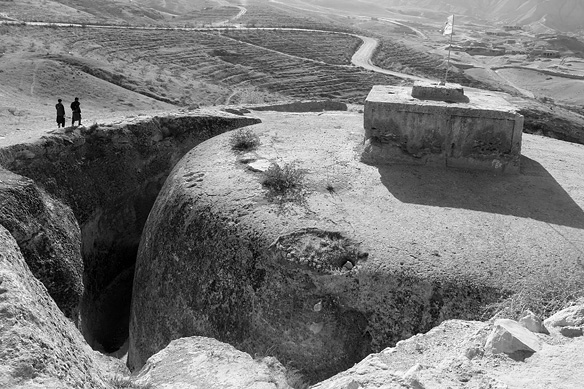
But its greatest claim to fame, and subsequently its greatest legacy, came from its simultaneous role as Silk Road’s fabled city. For 1,600 years, from 130 BC – 1453 AD, Balkh was not just a confluence of commodities, but also of religions, ideas, and knowledge. Continue reading