travel guide: hue, capital of vietnam’s last royal dynasty

Welcome to my travel guide on royal Hue.

Often reduced to an overnight visit enroute to colourful Hoi An or sidelined completely for Vietnam’s buzzing metropolises and beach cities, Hue is where Vietnamese history and culture bask in full authentic glory.

For 143 years, from 1802 to 1945, the city on the banks of the Perfume river in the middle of the country served as the capital of the Nguyen dynasty, Vietnam’s last royal ruling family. Prior to this, Hue had been the capital of their predecessors—the Nguyen Lords, a feudal noble clan, since 1558.

The Nguyen empire marked a period of dramatic flux in the country’s history. Starting off as an isolationist Confucianism-driven kingdom of unified Viet Nam, it morphed into a military might to reckon with, on to an eclectic marriage of European and Vietnamese cultural elements, before being ousted in 1945.

Thirteen Nguyen emperors ruled from Hue’s Imperial Citadel during these years—a fortress-cum-administration centre-cum-royal residence. It is where military decisions to conquer neighbouring lands, followed by agreements to relinquish the same lands to French colonial rulers were drawn and sealed.

In and around the city, seven of Hue’s 13 emperors designed and built their grand tombs to be remembered by. These reflected not just their personalities, philosophies, and aspirations as rulers, but also the prevailing geopolitical scenarios.

Whilst the UNESCO-listed Imperial Citadel and royal tombs took care of the Nguyen emperors’ lives and afterlives, patronage of spiritual places continued unabated. An age-old royal practice, it ensured the gods were kept happy and added a touch of divinity to dynastic rule.

Yes, Hue has all this and even more!

Dear Reader, I hope you find this travel guide useful as I take you along Hue’s imperial history, connecting its rich and varied monuments to the city’s incredible story. ❤

Table of Contents:

Continue reading

travel diaries: in search of champa, vietnam’s ancient hindu kingdom

It is still dark. The sun, groggy-eyed as it squints through the heavens punctuated by a sole star.

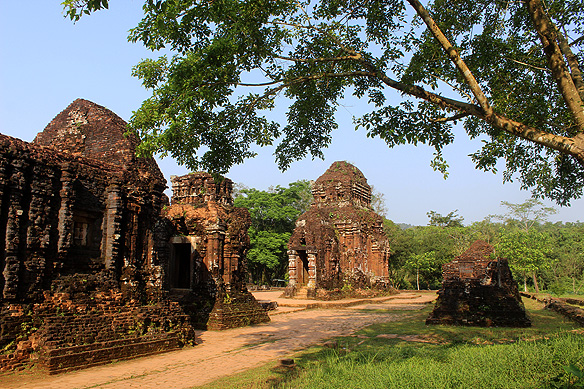
I am on my way from Hoi An to My Son Sanctuary—the temple ruins of an ancient Hindu kingdom which called this part of Vietnam home for 1,600 years. You may ask, but why so early? Because some places are best seen at sunrise. When it is just them, you, and the centuries of silence in-between. This silence then starts talking, regaling stories. Some voraciously. Some hinted at with a smile. Don’t you agree? 😊

An hour later, walking through the site’s lush green meadows, I pass scores of my country-folks. Perplexed, I am about to stop one of them and ask the reason, when a large placard explains their presence. They are archaeologists from the Archaeological Survey of India carrying out restoration work in association with the Vietnamese government. It makes sense. Who else could understand the remnants of a millennia-old Hindu kingdom better, even if it wore a different mantle on a foreign ground.


My Son Sanctuary, a UNESCO-listed World Heritage Site, is one of the most important ancient religious sites in south-east Asia. Continue reading

travel shorts: dragons of the unesco-listed ha long bay and trang an landscape

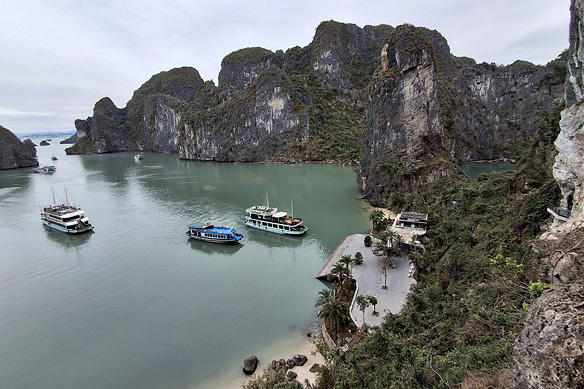
Once upon a time, thousands of years ago, Vietnam’s hamlets on its east coast were in grave danger. A fleet of foreign invaders were approaching. Defeat seemed imminent. They called upon Jade Emperor, the supreme deity in Taoism, in desperation.

In answer to their prayers, he sent the Mother Dragon to help them. She and her children plunged into the waters spewing fire, jade, and emeralds to ward off the enemies. These jewels instantly solidified into 1,133 sea mountains spread over 65,650 hectares creating an impregnable barrier on the sea. With the invaders now battered and trapped in the rocky outcrops, the Vietnamese were able to drive them away.

This mythical place came to be known as Ha Long Bay. Meaning ‘Bay of the Descending Dragon.’ It was listed as a UNESCO World Heritage Site in 1994. No, not because of the dragons, but for its unique geological formations and marine landscape.

What happened to the dragons? They decided to stay on in the mortal world and continue to guard the Vietnamese.


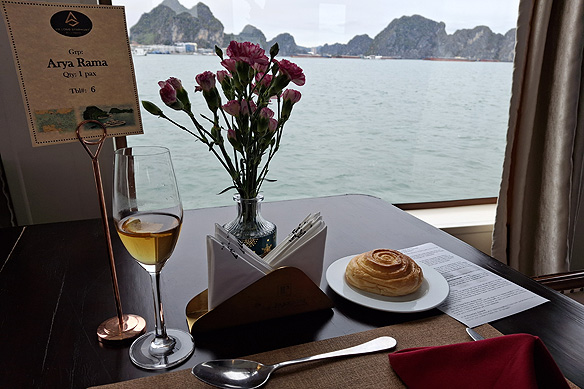
Welcome to Ha Long Bay. My table with a view. 🙂 Continue reading

travel guide: the six untold treasures of kazakhstan’s silk road heritage

Tucked away in the remote wind-swept folds of southern Kazakhstan are the ruins of a string of medieval Silk Road cities. A thousand years ago, these crumbling remains with their grand Sufi shrines were flourishing centres of trade, attracting merchants from far and wide; their glories held in awe across the golden steppes.

Welcome to Kazakhstan’s Silk Road heritage and its evocative treasures: The lost cities of Otrar and Sauran, and the cities of Turkestan, Taraz, and Shymkent which resolutely stood their ground.

The Silk Road, parts of which are UNESCO World Heritage Sites, was a trade route that operated from 114 BC to 1450 AD. Named after the primary product traded, the route comprised of a network of trails which cut across Central Asia, connecting the Far East with the Mediterranean. During its 1,600 years of existence, Chinese silk, along with spices, porcelain, and tea from the East were exchanged for horses, honey, and wine from the West.

It was a harsh terrain. Relentless. Fortified cities sprung up throughout the 6400-kilometre-long stretch to counter the bandits and uncertainty. Inside them, the traded goods changed hands, many times over, before reaching their destinations.

These cities were not just centres of trade, but also hubs of cultural exchange. A melting pot of ideas, philosophies, language, and faith. It is through the gatherings within their walls that Buddhism travelled from India to make a permanent home for itself in the Far East and Islamic science and knowledge fed into the western Renaissance.

Come along with me as I take you on a visual tour of this less visited, medieval side of Kazakhstan. On a journey back into time. 🙂

1. Mausoleum of Khoja Ahmed Yasawi, the jewel in Medieval Kazakhstan’s crown

Mausoleum of the 12th Century Sufi saint Khoja Ahmed Yasawi is Tamerlane's labour of love and the prototype for Timurid architecture.

Mausoleum of the 12th Century Sufi saint Khoja Ahmed Yasawi is Tamerlane’s labour of love and the prototype for Timurid architecture.

Continue reading

36 hours in almaty

What is the connection between apples and Almaty?

Gotcha!

The answer is: Almaty, the capital of Kazakhstan until 1997, is the birthplace of the apple. 🙂

Though Kazakhstan’s largest city has grown, both figuratively and literally, beyond its apples, its name still carries this legacy with elan. ‘Alma’ means apples and ‘ata’ means father or origin.

Surrounded by the Trans-Ili Alatau Mountains in south-east Kazakhstan, the city has had its fair share of history and avatars. From a prehistoric Saka settlement to a trading centre on the Silk Road, and in more recent years from being Verny, a Russian colonial outpost to Alma-Ata, capital of Kazakh SSR [Soviet Socialist Republic] within the Soviet Union.

In its last set of avatars, Almaty served as the capital of independent Kazakhstan from 1991 to 1997 and, thereafter, has stayed as the country’s vibrant commercial and cultural hub.

Of all of Kazakhstan’s cities, Almaty feels the most European with its wide leafy boulevards edged with open-air cafes, plenty of restful green urban spaces dotted with over 120 sparkling fountains, and a happening scene supported by numerous theatres, art galleries, and concert halls.

Though most travellers use Almaty mainly as a base to explore south-east Kazakhstan’s stunning national parks, the city does warrant a gentle exploration of its charms as well. 36 hours should do the trick in the sprawling metropolis that has earned the moniker ‘Southern Capital.’ Here are those 36 hours. ❤️ Continue reading

global travel shot: hanoi’s train street

Image

Think Vietnam, think Hanoi and the one place that might spring to mind [courtesy all the endless social media reels and selfies] is Train Street. Been to Hanoi and not been to Train Street? Shucks, the Hanoi visit does not count then. What is of more critical import nowadays though, warranting endless threads, is the do-or-die question: Is Train Street open?

For the uninitiated, Train Street is a 0.85-kilometre-long narrow road lined with open-air cafés in Hanoi’s Old Town in which railway tracks slice through a busy neighbourhood. At regular intervals trains whistle past, forcing households, café-owners, and their guests to stow furniture away and huddle behind doors. Once the train has gone, life carries on as usual—right next to the tracks, and yes, over the tracks.

Following a series of incidents caused purely out of tourists’ own negligence, access to Train Street has been closed with frowning security guards now resolutely seated behind bulky barriers.

But remember it is a ‘Street.’ Hence, there are still parts that can be accessed. For instance, in Google Maps, instead of ‘Train Street,’ if you type in ‘Train Street Coffee,’ voila, you will be in the company of travellers who had managed to crack the code. Sipping Vietnamese coffee, seated right next to the tracks. Please, however, do follow the rules. Which translate to: duck when the train arrives; it is not selfie time. 🙂

PS. Yes, I did see the train pass. Five minutes before I took the above picture!

– – –

[Note: This blog post is part of a series from my travels to Vietnam for three weeks in March 2025. To read more posts in my Vietnam series, click here.]

photo essay: hoi an, vietnam’s unesco-listed city of lanterns

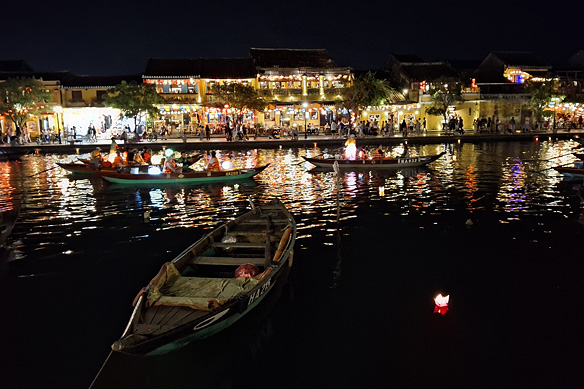
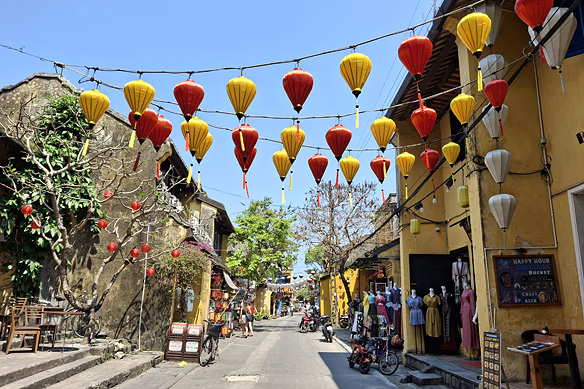
Imagine a whole town swathed in deep red and yellow silk lanterns. Across tree-lined streets and narrow alleys, on shopfronts and cutesy cafes. A centuries-old town with yellow tube houses that stretched between lanes, and a wide placid river that gently lapped against its banks.

If during the day Hoi An is a fairytale, at night it is as if those very fairies had waved a wand and created magic. Don’t be surprised if you catch yourself wondering if it was all for real. After all it is the 21st Century. How did this exquisite time capsule manage to survive. Especially one that was authentic, and not contrived.

Frozen somewhere in the 17th and 18th Centuries, UNESCO-listed Hoi An’s very name recounts its story. Hoi An means the ‘peaceful meeting place.’ Four hundred years ago, this idyllic riverside town became an international trading port in southeast Asia. Merchant vessels and traders from Japan, China, Europe, and India converged on its waterfronts and streets exchanging goods and ideas. Hoi An was their ‘peaceful meeting place.’

However, when neighbouring Da Nang started to grow as a port in the 19th Century, Hoi An’s fortunes fell and the town was forgotten. No one saw any merit in pumping money into building over its yellow trading tube homes and colourful assembly halls in the name of development. It was this very neglect which turned out to be Hoi An’s blessing in disguise and the reason for its revival, thanks to help from a completely unexpected quarter—Kazimierz Kwiatkowski, a Polish architect and conservationist.

If Hoi An is on every traveller’s bucket-list today, it is because Kwiatkowski spent years towards getting it listed as a UNESCO World Heritage Site. Hoi An never forgot the favour. A memorial in his honour stands in Kazik Park in the Old Town today.

Continue reading

caodaism — vietnam’s home-grown religion of kitsch, pluralism, and unity

This slideshow requires JavaScript.

[Note: Click on the play button or arrows to start the slide show.]

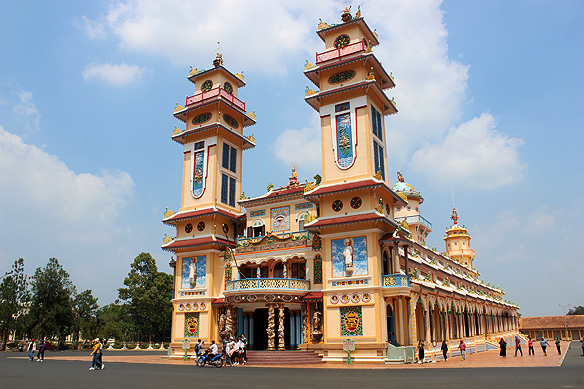
It is mid-day, somewhere in southern Vietnam, 80-odd kilometres from Ho Chi Minh City in Tay Ninh province. I am seated cross-legged inside a cavernous colourful ‘cathedral,’ on the fringes of a 99-year-old hypnotic performance of chants and rituals carried out by hundreds of solemn, serene-faced white-robed disciples.

Teal dragons, in contrast, wrap around soaring pink columns. Their candy red and white tongues stuck out mid-air. Above me, a ceiling recreates the heavens, punctuated with coiled snakes and flowers. Triangles with rays emanating from eyes adorn the windows and facades.

Rich in symbolism, every form and colour in the Cao Dai Holy See represents a belief or value mandated by divinity. Nothing is redundant here.

After all, there is enough inspiration. Vietnam’s very own monotheistic syncretic religion fuses together Buddhism, Confucianism, Taoism, Roman Catholicism, and ancestor worship, with a generous douse of seance [talking to spirits of the dead] into an eclectic mix guided by principles of harmony and simply doing good.

Overlooking this fantasyland are effigies of the first group of Cao Dai spirit mediums who ‘God’ identified himself to on Christmas eve in 1925. On the other end is the Bat Quai Dai altar. The most sacred part of the cathedral, it comprises a large sphere with a left ‘Divine’ eye painted on it, surrounded with religious paraphernalia. The eye represents the all-seeing supreme god Duc Cao Dai who is the universe which lives in all creation.

Not to be construed as an offshoot of any of the religions in its mix, Caodaism, born out of nationalism, was recognized as an independent religion on 7 October 1926 by Vietnam’s French colonial rulers. Officially known as The Great Faith for the Third Universal Redemption, the Holy See in Tay Ninh is its largest place of worship.

Continue reading

astana aka nur-sultan, the brand new capital for an ancient heritage

An eight-month pregnant young woman grabbed my phone from my hands, spoke to the cab driver at the other end in Kazakh, stood with me till he arrived, and left only after bundling me into the gleaming white vehicle.

I will never forget her and her serene warm face. I had been struggling to communicate my pickup location across language barriers with my cab driver on a massive multi-lane street in Astana. It was dark. I was clueless. And then she came along. Out of the blue.

That is Kazakhstan for you where people are so helpful, you do not even need to ask for help.

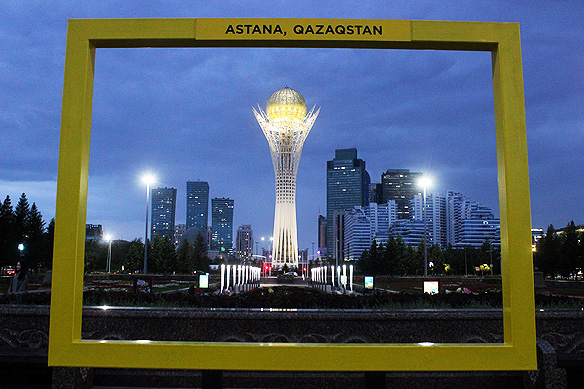
If you ever wondered what a modern city would look like, if created from scratch, where hearts such as hers are a common occurrence, then make your way to Astana, Kazakhstan’s capital since December 1997. Astana literally means ‘Capital City.’

And if like me, you had read that Kazakhstan’s capital was Nur-Sultan, and were a bit confused what was its correct current name. It is still Astana.

For around four years, from 2019 to 2022, Astana was renamed Nur-Sultan in honour of the country’s first President Nursultan Nazarbayev [1991 – 2019].

The city, located in the north-centre of the country in the middle of nowhere, has been around since 1830 when it went by the name Akmoly. It, however, really came into its own when the empty area adjoining it was transformed into a futuristic capital by Japanese architect Kisho Kurokawa in 1998. All those fantastically fabulous buildings one sees in the city-centre are government offices, including the supreme court.

Selected through a competition that was thrown open to the finest, most talented urban planners and architects in the world, his ‘new’ capital on the banks of Ishim River is meant to epitomize Kazakhstan’s vision for the future and its mythical past.

Continue reading

kazakhstan’s ‘golden man,’ stories told and untold

The Golden Man.

Ubiquitous with Kazakhstan, look closely and you will find him everywhere. Atop Almaty’s Independence Monument, in promotional cut-outs during events such as the recently held World Nomad Games, in state museums across the country, and both commemorative and currency coins.

He is the most celebrated son of Kazakh soil.

An 18-year-old Saka warrior prince [or princess] who lived in the 4th Century BC, his burial mound was found in April 1970. Purely by chance, as is usually the case. Inside the heap of rubble was a skeleton sheathed in over 4,000 pieces of pure gold from top to toe, holding weapons ready to go to war. The burial was the first in Central Asia, and with the largest gold hoard, to be discovered intact and not plundered. Ever.

Though the most famous, he is, however, not Kazakhstan’s only ‘Golden Man.’ Nine more have been unearthed after him, including four women, who like him were also draped in gold ornaments. Each with a unique story that is theirs alone.

Welcome to my photo essay on the Golden Man, where I share stories with you about him. Some told. Some untold. So, next time that you see him, he is no more a stranger, but almost a friend. 😊 Continue reading